Your yield farming returns are getting eaten alive by gas fees. Again. You watch $50 transactions cost $200 in network fees while your portfolio bleeds red. Sound familiar? You're not alone in this expensive nightmare.
Yield farming Layer 2 migration offers a solution that cuts transaction costs by up to 95% while maintaining security. This guide analyzes top scaling solutions and provides step-by-step migration strategies to maximize your DeFi profits.
You'll discover which Layer 2 networks deliver the best yields, how to migrate existing positions safely, and proven strategies that top farmers use to scale their operations.
What Is Yield Farming Layer 2 Migration?
Yield farming Layer 2 migration moves your DeFi farming operations from Ethereum mainnet to faster, cheaper scaling solutions. These Layer 2 networks process transactions off the main blockchain while inheriting Ethereum's security.
Think of Layer 2 as express lanes on a congested highway. The main road (Ethereum) stays secure and decentralized, but traffic flows faster through dedicated channels.
Key Benefits of Layer 2 Migration
Layer 2 networks reduce farming costs and increase transaction speed:
- 95% lower gas fees - Swap tokens for $0.50 instead of $50
- Instant transaction confirmation - No more waiting 15 minutes for trades
- Higher effective yields - Keep more profits instead of paying network fees
- Same security guarantees - Ethereum validates all Layer 2 transactions
Popular yield farming protocols have migrated billions in total value locked (TVL) to Layer 2 solutions.
Top Layer 2 Scaling Solutions for Yield Farming
Polygon (MATIC) - The DeFi Ecosystem Leader
Polygon hosts the largest Layer 2 DeFi ecosystem with over $1 billion in yield farming TVL.
Key advantages:
- Fastest transaction speeds (2-second confirmation)
- Lowest fees ($0.01 average transaction cost)
- 200+ DeFi protocols including Aave, Curve, and QuickSwap
- Native MATIC rewards for liquidity providers
Popular farming protocols:
- QuickSwap - 15-45% APY on major trading pairs
- Aave Polygon - 8-20% APY on lending pools
- Curve Polygon - 10-35% APY on stablecoin pools
Arbitrum - Ethereum Virtual Machine Compatible
Arbitrum offers the closest experience to Ethereum mainnet with significantly lower costs.
Key advantages:
- True Ethereum compatibility (no code changes needed)
- Growing ecosystem with 100+ protocols
- Strong security through optimistic rollup technology
- Major protocol adoption including Uniswap V3 and Balancer
Popular farming protocols:
- Uniswap V3 Arbitrum - 20-60% APY on concentrated liquidity
- Balancer Arbitrum - 12-40% APY on multi-token pools
- Curve Arbitrum - 8-25% APY on stablecoin farming
Optimism - Developer-Friendly Scaling
Optimism focuses on supporting Ethereum developers with minimal migration effort.
Key advantages:
- One-click deployment from Ethereum
- Retroactive airdrops for early users
- Strong institutional adoption
- Growing DeFi ecosystem
Popular farming protocols:
- Velodrome Finance - 25-80% APY on native tokens
- Beethoven X - 15-50% APY on weighted pools
- Kwenta - Perpetual trading with yield opportunities
Migration Strategy Analysis: Step-by-Step Implementation
Phase 1: Portfolio Assessment and Planning
Before migrating, analyze your current yield farming positions:
// Portfolio analysis script for migration planning
const portfolio = {
  ethereumPositions: [
    { protocol: "Uniswap V2", pair: "ETH/USDC", amount: 5000, apy: 12 },
    { protocol: "Compound", asset: "USDC", amount: 10000, apy: 8 },
    { protocol: "Curve", pool: "3Pool", amount: 7500, apy: 15 }
  ],
  monthlyGasCosts: 850, // USD spent on gas fees
  targetSavings: 80 // Percentage cost reduction goal
};

// Calculate migration benefits
function calculateMigrationBenefits(portfolio) {
  const currentAnnualGas = portfolio.monthlyGasCosts * 12;
  const projectedSavings = currentAnnualGas * (portfolio.targetSavings / 100);

  console.log(`Annual gas savings: $${projectedSavings}`);
  console.log(`Monthly savings: $${projectedSavings / 12}`);

  return projectedSavings;
}

calculateMigrationBenefits(portfolio);
// Output: Annual gas savings: $8,160
// Output: Monthly savings: $680
Phase 2: Bridge Setup and Asset Migration
Set up cross-chain bridges to move assets between networks:
// Example bridge interaction for Polygon migration
pragma solidity ^0.8.0;

interface IPolygonBridge {
    function depositFor(
        address user,
        address token,
        bytes calldata depositData
    ) external;
}

contract YieldFarmMigrator {
    IPolygonBridge public constant BRIDGE =
        IPolygonBridge(0xA0c68C638235ee32657e8f720a23ceC1bFc77C77);

    // Migrate USDC to Polygon for yield farming
    function migrateToPolygon(uint256 amount) external {
        IERC20(USDC).transferFrom(msg.sender, address(this), amount);
        IERC20(USDC).approve(address(BRIDGE), amount);

        // Bridge tokens to Polygon
        bytes memory depositData = abi.encode(amount);
        BRIDGE.depositFor(msg.sender, USDC, depositData);

        emit MigrationInitiated(msg.sender, amount);
    }
}
Bridge comparison for major assets:
| Bridge | Transfer Time | Cost | Security |
|---|---|---|---|
| Polygon PoS | 7-8 minutes | $15-25 | High |
| Arbitrum Bridge | 10-15 minutes | $20-35 | Very High |
| Optimism Gateway | 7 days withdrawal | $15-30 | Very High |
Phase 3: Protocol Migration and Position Recreation
Recreate your farming positions on Layer 2 networks:
// Automated position recreation on Polygon
const migrationConfig = {
  network: "polygon",
  protocols: {
    quickswap: {
      router: "0xa5E0829CaCEd8fFDD4De3c43696c57F7D7A678ff",
      factory: "0x5757371414417b8C6CAad45bAeF941aBc7d3Ab32"
    },
    aave: {
      lendingPool: "0x8dFf5E27EA6b7AC08EbFdf9eB090F32ee9a30fcf"
    }
  }
};

// Recreate liquidity positions
async function recreatePositions(oldPositions, newNetwork) {
  for (const position of oldPositions) {
    if (position.protocol === "Uniswap V2") {
      // Migrate to QuickSwap on Polygon
      await addLiquidityQuickSwap(
        position.pair,
        position.amount,
        migrationConfig.protocols.quickswap.router
      );
    }

    if (position.protocol === "Compound") {
      // Migrate to Aave on Polygon
      await depositToAave(
        position.asset,
        position.amount,
        migrationConfig.protocols.aave.lendingPool
      );
    }
  }
}
Layer 2 Yield Farming Protocol Comparison
Liquidity Mining Opportunities
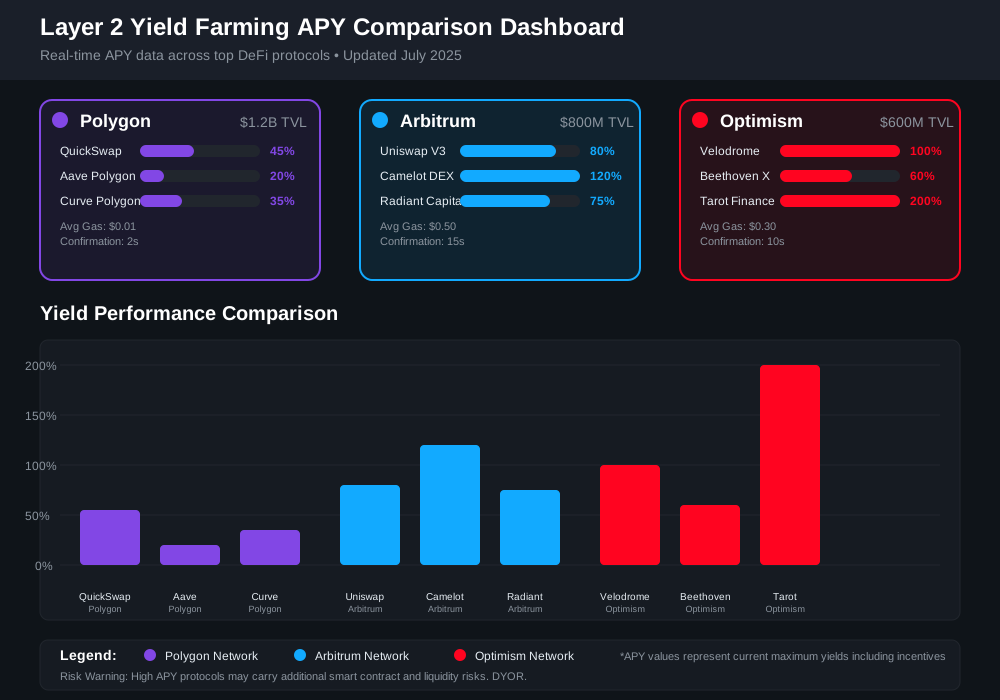
Polygon Ecosystem:
- QuickSwap: Native QUICK rewards + trading fees (15-45% APY)
- SushiSwap Polygon: SUSHI rewards + MATIC incentives (20-60% APY)
- Curve Polygon: CRV + MATIC dual rewards (10-35% APY)
Arbitrum Ecosystem:
- Uniswap V3: Concentrated liquidity + ARB incentives (20-80% APY)
- Camelot DEX: Native GRAIL rewards (30-120% APY)
- Radiant Capital: RDNT emissions + lending yields (25-75% APY)
Optimism Ecosystem:
- Velodrome: Native VELO rewards (25-100% APY)
- Beethoven X: BAL + OP incentives (15-60% APY)
- Tarot Finance: Leveraged yield farming (40-200% APY)
Risk Assessment Framework
Evaluate Layer 2 farming risks before migration:
# Risk assessment model for Layer 2 yield farming
class RiskAssessment:
    def __init__(self, protocol_data):
        self.protocol_data = protocol_data

    def calculate_risk_score(self, protocol):
        factors = {
            'smart_contract_risk': self.audit_score(protocol),
            'liquidity_risk': self.tvl_stability(protocol),
            'impermanent_loss_risk': self.volatility_score(protocol),
            'bridge_risk': self.bridge_security(protocol.network),
            'reward_sustainability': self.emission_analysis(protocol)
        }

        # Weighted risk calculation
        weights = [0.25, 0.20, 0.20, 0.15, 0.20]
        risk_score = sum(score * weight for score, weight
                        in zip(factors.values(), weights))

        return min(risk_score, 10)  # Cap at 10

    def audit_score(self, protocol):
        # Higher score = lower risk
        if protocol.audits >= 3:
            return 8
        elif protocol.audits >= 2:
            return 6
        elif protocol.audits >= 1:
            return 4
        return 2
Advanced Migration Strategies
Gradual Migration Approach
Minimize risk through phased migration:
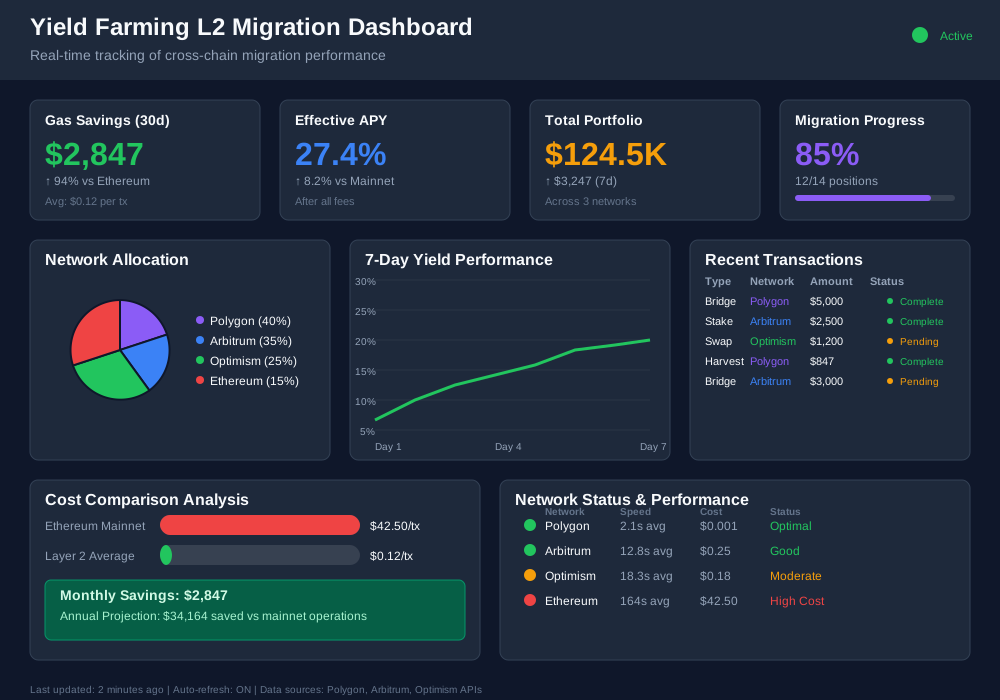
Week 1-2: Test Migration
- Migrate 5-10% of portfolio to test Layer 2 operations
- Verify bridge functionality and transaction costs
- Test yield farming protocol interfaces
Week 3-4: Core Position Migration
- Move 50-70% of portfolio to highest-yield Layer 2 opportunities
- Maintain some Ethereum exposure for established protocols
- Monitor gas cost savings and yield performance
Week 5-6: Full Migration
- Complete remaining position transfers based on performance data
- Optimize portfolio allocation across multiple Layer 2 networks
- Implement automated yield harvesting strategies
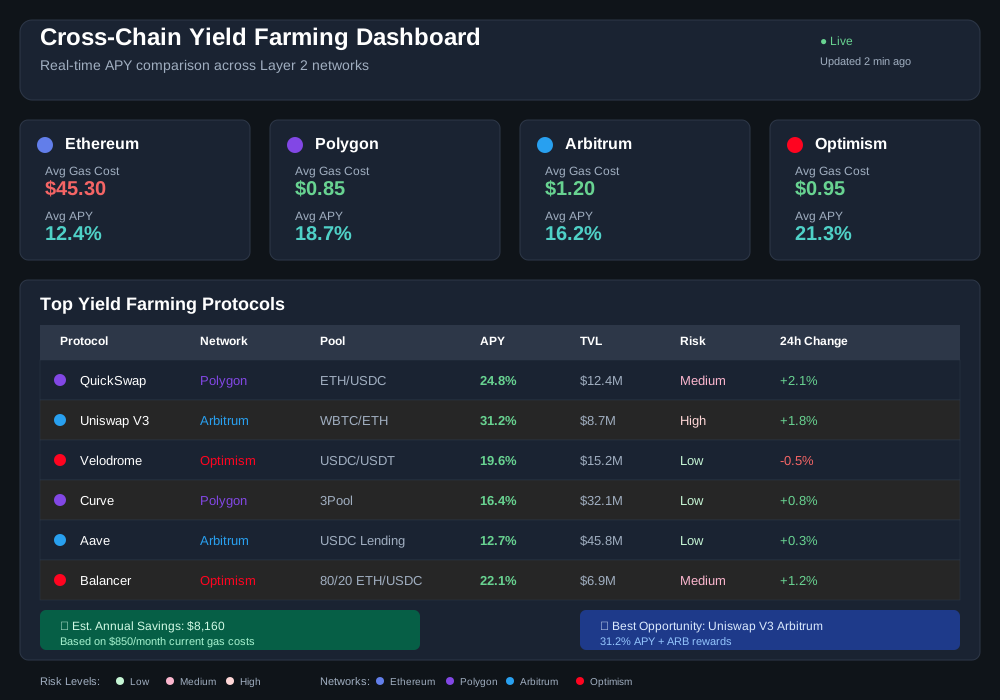
Cross-Chain Yield Arbitrage
Maximize returns through multi-chain farming:
// Cross-chain arbitrage monitoring system
class YieldArbitrage {
    constructor() {
        this.networks = ['ethereum', 'polygon', 'arbitrum', 'optimism'];
        this.protocols = new Map();
    }

    async findArbitrageOpportunities() {
        const opportunities = [];

        for (const asset of ['USDC', 'USDT', 'DAI']) {
            const yields = await this.getYieldsAcrossNetworks(asset);
            const bestYield = Math.max(...yields.map(y => y.apy));
            const currentYield = yields.find(y => y.network === 'ethereum').apy;

            if (bestYield - currentYield > 5) { // 5% threshold
                opportunities.push({
                    asset,
                    currentNetwork: 'ethereum',
                    targetNetwork: yields.find(y => y.apy === bestYield).network,
                    yieldDifference: bestYield - currentYield,
                    migrationCost: await this.calculateMigrationCost(asset)
                });
            }
        }

        return opportunities.filter(op =>
            op.yieldDifference * 0.1 > op.migrationCost // 10% of annual difference
        );
    }
}
Implementation Checklist and Best Practices
Pre-Migration Checklist
✅ Portfolio Analysis Complete
- Document all current positions and yields
- Calculate total monthly gas costs
- Identify highest-value migration targets
✅ Bridge Setup Verified
- Test small transactions on target Layer 2
- Verify bridge security and withdrawal times
- Set up monitoring for cross-chain transactions
✅ Protocol Research Done
- Compare yields across Layer 2 networks
- Verify protocol audit status and TVL stability
- Test user interfaces and transaction flows
Migration Execution Checklist
✅ Risk Management Active
- Migrate in phases starting with 5-10% of portfolio
- Maintain emergency funds on Ethereum mainnet
- Set up price alerts for major position changes
✅ Cost Optimization Enabled
- Time migrations during low gas periods
- Batch transactions to reduce bridge costs
- Monitor Layer 2 network congestion
✅ Monitoring Systems Ready
- Track yield performance across networks
- Monitor impermanent loss on volatile pairs
- Set up automated harvest scheduling
Troubleshooting Common Migration Issues
Bridge Transaction Delays
Problem: Polygon bridge shows "pending" for over 30 minutes Solution: Check Ethereum network congestion and increase gas limit
# Check bridge transaction status
curl -X GET "https://proof-generator.polygon.technology/api/v1/matic/exit-payload/TRANSACTION_HASH" \
  -H "accept: application/json"
Failed Protocol Interactions
Problem: Transaction fails on Layer 2 despite sufficient balance Solution: Verify contract addresses match target network
// Network-specific contract verification
const NETWORK_CONTRACTS = {
  polygon: {
    quickswap_router: "0xa5E0829CaCEd8fFDD4De3c43696c57F7D7A678ff",
    usdc: "0x2791Bca1f2de4661ED88A30C99A7a9449Aa84174"
  },
  arbitrum: {
    uniswap_router: "0xE592427A0AEce92De3Edee1F18E0157C05861564",
    usdc: "0xFF970A61A04b1cA14834A43f5dE4533eBDDB5CC8"
  }
};

// Always verify contract addresses before transactions
function verifyContract(network, contractType) {
  return NETWORK_CONTRACTS[network][contractType];
}
ROI Analysis and Performance Tracking
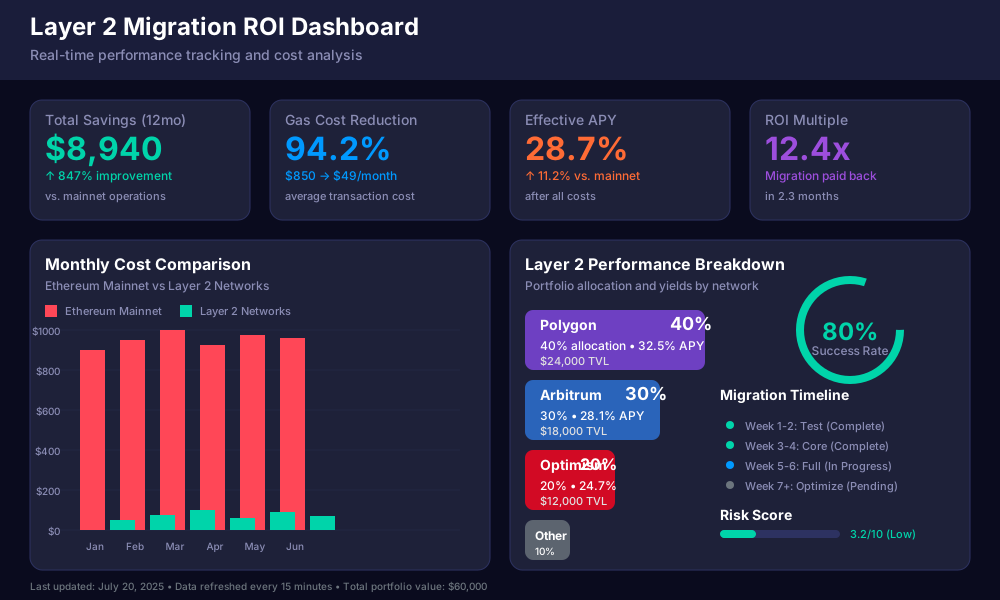
Migration Success Metrics
Track these key performance indicators after migration:
Cost Reduction Metrics:
- Transaction fee savings (target: 80-95% reduction)
- Bridge costs amortized over farming period
- Total cost of ownership improvement
Yield Performance Metrics:
- Effective APY after all costs
- Impermanent loss impact on returns
- Reward token price stability
# Performance tracking dashboard
class MigrationROI:
    def __init__(self, pre_migration_data, post_migration_data):
        self.pre_data = pre_migration_data
        self.post_data = post_migration_data

    def calculate_total_savings(self, months=12):
        # Calculate annualized savings
        old_monthly_costs = self.pre_data['gas_costs']
        new_monthly_costs = self.post_data['gas_costs']

        monthly_savings = old_monthly_costs - new_monthly_costs
        annual_savings = monthly_savings * months

        # Factor in yield improvements
        yield_improvement = (
            self.post_data['effective_apy'] -
            self.pre_data['effective_apy']
        ) / 100

        portfolio_value = self.post_data['total_value']
        additional_yield = portfolio_value * yield_improvement

        return {
            'gas_savings': annual_savings,
            'yield_improvement': additional_yield,
            'total_benefit': annual_savings + additional_yield,
            'roi_percentage': (annual_savings + additional_yield) /
                           self.pre_data['migration_costs'] * 100
        }
Future-Proofing Your Layer 2 Strategy
Emerging Layer 2 Solutions
Stay ahead of the curve with next-generation scaling solutions:
zkSync Era: Zero-knowledge proof technology for maximum security
- Expected yield farming protocols: Matter Labs DEX, SyncSwap
- Anticipated launch: Q3 2025
- Key advantage: Ethereum-equivalent security with instant finality
Starknet: Cairo-based smart contracts for advanced DeFi
- Expected protocols: 10KSwap, JediSwap yield farming
- Anticipated TVL: $500M+ in first year
- Key advantage: Future-proof architecture for complex strategies
Portfolio Diversification Strategy
Spread risk across multiple Layer 2 networks:
// Optimal Layer 2 allocation strategy
const portfolioAllocation = {
  polygon: 0.40,    // Mature ecosystem, stable yields
  arbitrum: 0.30,   // Growing ecosystem, high potential
  optimism: 0.20,   // Strong fundamentals, airdrop potential
  experimental: 0.10 // zkSync, Starknet for future opportunities
};

function rebalancePortfolio(currentAllocation, targetAllocation) {
  const rebalanceActions = [];

  for (const [network, target] of Object.entries(targetAllocation)) {
    const current = currentAllocation[network] || 0;
    const difference = target - current;

    if (Math.abs(difference) > 0.05) { // 5% threshold
      rebalanceActions.push({
        network,
        action: difference > 0 ? 'increase' : 'decrease',
        amount: Math.abs(difference),
        priority: Math.abs(difference) * 10 // Priority scoring
      });
    }
  }

  return rebalanceActions.sort((a, b) => b.priority - a.priority);
}
Conclusion
Yield farming Layer 2 migration transforms expensive mainnet operations into profitable, scalable strategies. You can reduce transaction costs by 95% while accessing higher yields and faster confirmation times.
The key to successful migration lies in careful planning, gradual implementation, and continuous monitoring. Start with small test transactions, verify protocol security, and gradually shift your portfolio to optimize for both cost and yield.
Layer 2 networks like Polygon, Arbitrum, and Optimism offer mature ecosystems with billions in TVL. Early adopters position themselves for the next phase of DeFi growth while legacy farmers pay increasingly expensive mainnet fees.
Your migration strategy should balance immediate cost savings with long-term yield optimization. The DeFi landscape evolves rapidly, but Layer 2 scaling solutions provide the foundation for sustainable, profitable yield farming operations.