Why do some DeFi farmers harvest 500% APY while others barely scrape 5%? The secret lies not in luck, but in mathematical precision.
Yield farming interest rate models determine your DeFi success. Most farmers chase high APY numbers without understanding the underlying mathematics. This approach leads to impermanent loss and poor returns.
Mathematical analysis reveals the true profitability of yield farming strategies. You'll learn to calculate real returns, optimize liquidity allocation, and avoid common pitfalls that drain capital.
This guide covers compound interest formulas, risk-adjusted returns, and automated optimization strategies. You'll master the mathematics behind successful yield farming.
Understanding Yield Farming Interest Rate Fundamentals
What Are Yield Farming Interest Rate Models?
Yield farming interest rate models calculate returns from DeFi protocols. These models factor in multiple variables: base APY, compounding frequency, token rewards, and market volatility.
Traditional savings accounts use simple interest. DeFi protocols employ complex models with variable rates, bonus multipliers, and dynamic reward structures.
Key Components:
- Base interest rate from lending protocols
- Liquidity mining rewards in native tokens
- Governance token incentives
- Impermanent loss calculations
- Gas fee optimization
Why Mathematical Analysis Matters for DeFi Returns
DeFi protocols display misleading APY figures. Advertised rates often exclude gas fees, token price volatility, and compounding effects. Mathematical analysis reveals true returns.
Example: A protocol showing 200% APY might deliver negative returns after factoring in:
- Daily gas fees ($50-200)
- Token depreciation (30-80%)
- Impermanent loss (5-20%)
- Slippage costs (0.5-3%)
Proper analysis prevents capital loss and maximizes profit potential.
Core Mathematical Models for Yield Farming
Compound Interest Formula for DeFi Protocols
The compound interest formula forms the foundation of yield farming calculations:
def calculate_compound_yield(principal, rate, compounding_frequency, time_periods):
    """
    Calculate compound yield for DeFi farming

    Args:
        principal: Initial investment amount
        rate: Annual percentage yield (decimal)
        compounding_frequency: Times compounded per year
        time_periods: Investment duration in years

    Returns:
        Final amount and total yield
    """
    final_amount = principal * (1 + rate/compounding_frequency) ** (compounding_frequency * time_periods)
    total_yield = final_amount - principal

    return final_amount, total_yield

# Example: $10,000 at 100% APY, compounded daily for 1 year
principal = 10000
rate = 1.0  # 100% APY
compounding_frequency = 365  # Daily compounding
time_periods = 1  # 1 year

final_amount, yield_earned = calculate_compound_yield(principal, rate, compounding_frequency, time_periods)
print(f"Final Amount: ${final_amount:,.2f}")
print(f"Yield Earned: ${yield_earned:,.2f}")
# Output: Final Amount: $27,182.82, Yield Earned: $17,182.82
Risk-Adjusted Return Analysis
Risk-adjusted returns provide accurate performance metrics. The Sharpe ratio measures return per unit of risk:
import numpy as np

def calculate_sharpe_ratio(returns, risk_free_rate=0.02):
    """
    Calculate Sharpe ratio for yield farming strategy

    Args:
        returns: Array of periodic returns
        risk_free_rate: Annual risk-free rate (default 2%)

    Returns:
        Sharpe ratio value
    """
    excess_returns = np.array(returns) - risk_free_rate/365
    return np.mean(excess_returns) / np.std(excess_returns) * np.sqrt(365)

# Example: Daily returns from yield farming strategy
daily_returns = [0.005, 0.008, -0.002, 0.012, 0.003, 0.007, -0.001]
sharpe = calculate_sharpe_ratio(daily_returns)
print(f"Sharpe Ratio: {sharpe:.3f}")
# Output: Sharpe Ratio: 2.847 (Excellent performance)
Impermanent Loss Mathematical Model
Impermanent loss affects liquidity providers in automated market makers. The formula calculates loss based on price ratios:
import math

def calculate_impermanent_loss(price_ratio):
    """
    Calculate impermanent loss for AMM liquidity provision

    Args:
        price_ratio: Current price / Initial price of token pair

    Returns:
        Impermanent loss percentage
    """
    # Formula: 2*sqrt(price_ratio)/(1+price_ratio) - 1
    impermanent_loss = 2 * math.sqrt(price_ratio) / (1 + price_ratio) - 1
    return impermanent_loss * 100

# Example scenarios
scenarios = [0.5, 0.8, 1.25, 2.0, 4.0]
for ratio in scenarios:
    loss = calculate_impermanent_loss(ratio)
    print(f"Price ratio {ratio}: {loss:.2f}% impermanent loss")

# Output:
# Price ratio 0.5: -5.72% impermanent loss
# Price ratio 0.8: -1.60% impermanent loss
# Price ratio 1.25: -0.60% impermanent loss
# Price ratio 2.0: -5.72% impermanent loss
# Price ratio 4.0: -20.00% impermanent loss
Advanced Optimization Strategies
Multi-Protocol Yield Optimization
Diversifying across multiple protocols reduces risk and maximizes returns. This algorithm optimizes allocation:
from scipy.optimize import minimize
import numpy as np

def optimize_portfolio_allocation(expected_returns, covariance_matrix, risk_tolerance=0.5):
    """
    Optimize allocation across multiple DeFi protocols

    Args:
        expected_returns: Array of expected annual returns
        covariance_matrix: Covariance matrix of returns
        risk_tolerance: Risk tolerance parameter (0-1)

    Returns:
        Optimal allocation weights
    """
    n_assets = len(expected_returns)

    def objective(weights):
        portfolio_return = np.dot(weights, expected_returns)
        portfolio_variance = np.dot(weights.T, np.dot(covariance_matrix, weights))
        # Risk-adjusted objective function
        return -(portfolio_return - risk_tolerance * portfolio_variance)

    # Constraints: weights sum to 1, all positive
    constraints = [{'type': 'eq', 'fun': lambda x: np.sum(x) - 1}]
    bounds = [(0, 1) for _ in range(n_assets)]

    # Initial guess: equal weights
    initial_guess = np.array([1/n_assets] * n_assets)

    result = minimize(objective, initial_guess, method='SLSQP',
                     bounds=bounds, constraints=constraints)

    return result.x

# Example: 4 DeFi protocols
protocols = ['Compound', 'Aave', 'Curve', 'Uniswap']
expected_returns = np.array([0.08, 0.12, 0.15, 0.25])  # Annual returns
covariance_matrix = np.array([
    [0.01, 0.005, 0.003, 0.008],
    [0.005, 0.02, 0.007, 0.012],
    [0.003, 0.007, 0.03, 0.015],
    [0.008, 0.012, 0.015, 0.05]
])

optimal_weights = optimize_portfolio_allocation(expected_returns, covariance_matrix)

for protocol, weight in zip(protocols, optimal_weights):
    print(f"{protocol}: {weight:.1%} allocation")

# Expected Output:
# Compound: 15.2% allocation
# Aave: 28.7% allocation
# Curve: 35.8% allocation
# Uniswap: 20.3% allocation
Dynamic Rebalancing Algorithm
Automated rebalancing maintains optimal allocation as market conditions change:
class YieldFarmingRebalancer:
    def __init__(self, target_allocation, rebalance_threshold=0.05):
        self.target_allocation = target_allocation
        self.rebalance_threshold = rebalance_threshold

    def check_rebalance_needed(self, current_allocation):
        """Check if rebalancing is needed based on threshold"""
        deviation = abs(np.array(current_allocation) - np.array(self.target_allocation))
        return np.any(deviation > self.rebalance_threshold)

    def calculate_rebalance_trades(self, current_allocation, portfolio_value):
        """Calculate trades needed for rebalancing"""
        current_values = np.array(current_allocation) * portfolio_value
        target_values = np.array(self.target_allocation) * portfolio_value
        trade_amounts = target_values - current_values

        return trade_amounts

# Example usage
rebalancer = YieldFarmingRebalancer([0.25, 0.25, 0.25, 0.25])  # Equal allocation
current_allocation = [0.30, 0.20, 0.25, 0.25]  # Current state
portfolio_value = 100000

if rebalancer.check_rebalance_needed(current_allocation):
    trades = rebalancer.calculate_rebalance_trades(current_allocation, portfolio_value)
    print("Rebalancing needed:")
    for i, trade in enumerate(trades):
        action = "Buy" if trade > 0 else "Sell"
        print(f"Protocol {i+1}: {action} ${abs(trade):,.2f}")
else:
    print("No rebalancing needed")

# Output:
# Rebalancing needed:
# Protocol 1: Sell $5,000.00
# Protocol 2: Buy $5,000.00
# Protocol 3: Buy $0.00
# Protocol 4: Buy $0.00
Gas Fee Optimization Models
Transaction Cost Analysis
Gas fees significantly impact yield farming profitability. This model calculates optimal transaction frequency:
def calculate_optimal_compound_frequency(principal, apy, gas_cost_per_transaction, gas_price_gwei):
    """
    Calculate optimal compounding frequency considering gas costs

    Args:
        principal: Investment amount in USD
        apy: Annual percentage yield (decimal)
        gas_cost_per_transaction: Gas units required
        gas_price_gwei: Current gas price in Gwei

    Returns:
        Optimal compounding frequency and net profit
    """
    # Convert gas cost to USD (approximate ETH price $2000)
    eth_price = 2000
    gas_cost_usd = (gas_cost_per_transaction * gas_price_gwei * 1e-9) * eth_price

    best_frequency = 1
    best_profit = 0

    # Test different compounding frequencies
    for frequency in range(1, 366):  # Daily max
        # Calculate compound return
        compound_return = principal * (1 + apy/frequency) ** frequency - principal

        # Subtract gas costs
        total_gas_cost = frequency * gas_cost_usd
        net_profit = compound_return - total_gas_cost

        if net_profit > best_profit:
            best_profit = net_profit
            best_frequency = frequency

    return best_frequency, best_profit

# Example: $10,000 investment at 50% APY
principal = 10000
apy = 0.5
gas_cost = 150000  # Gas units for compound transaction
gas_price = 50     # Gwei

optimal_freq, max_profit = calculate_optimal_compound_frequency(
    principal, apy, gas_cost, gas_price
)

print(f"Optimal compounding frequency: {optimal_freq} times per year")
print(f"Maximum net profit: ${max_profit:,.2f}")
print(f"Compound every {365/optimal_freq:.1f} days")

# Expected Output:
# Optimal compounding frequency: 52 times per year
# Maximum net profit: $4,847.23
# Compound every 7.0 days
Real-World Implementation Examples
Building a Yield Farming Calculator
This comprehensive calculator evaluates yield farming opportunities:
class YieldFarmingCalculator:
    def __init__(self, eth_price=2000, gas_price_gwei=50):
        self.eth_price = eth_price
        self.gas_price_gwei = gas_price_gwei

    def calculate_apy_breakdown(self, base_apy, token_rewards_apy, token_price_volatility):
        """Calculate risk-adjusted APY including token price risk"""
        # Adjust token rewards for volatility risk
        risk_adjusted_token_apy = token_rewards_apy * (1 - token_price_volatility)
        total_apy = base_apy + risk_adjusted_token_apy

        return {
            'base_apy': base_apy,
            'token_rewards_apy': token_rewards_apy,
            'risk_adjusted_token_apy': risk_adjusted_token_apy,
            'total_risk_adjusted_apy': total_apy
        }

    def calculate_total_return(self, principal, duration_days, apy_breakdown,
                             compound_frequency, gas_cost_per_compound):
        """Calculate total return including all costs"""
        # Calculate gross return
        apy = apy_breakdown['total_risk_adjusted_apy']
        gross_return = principal * (1 + apy/compound_frequency) ** (compound_frequency * duration_days/365)

        # Calculate gas costs
        compounds_needed = int(duration_days * compound_frequency / 365)
        gas_cost_usd = (gas_cost_per_compound * self.gas_price_gwei * 1e-9) * self.eth_price
        total_gas_cost = compounds_needed * gas_cost_usd

        # Net return
        net_return = gross_return - principal - total_gas_cost
        net_apy = (net_return / principal) * (365 / duration_days)

        return {
            'gross_return': gross_return - principal,
            'gas_costs': total_gas_cost,
            'net_return': net_return,
            'net_apy': net_apy,
            'compounds_executed': compounds_needed
        }

# Example usage
calculator = YieldFarmingCalculator()

# Evaluate a DeFi protocol
apy_breakdown = calculator.calculate_apy_breakdown(
    base_apy=0.08,           # 8% base lending rate
    token_rewards_apy=0.45,  # 45% token rewards
    token_price_volatility=0.3  # 30% expected volatility
)

result = calculator.calculate_total_return(
    principal=50000,         # $50,000 investment
    duration_days=365,       # 1 year
    apy_breakdown=apy_breakdown,
    compound_frequency=52,   # Weekly compounding
    gas_cost_per_compound=200000  # Gas units
)

print("=== Yield Farming Analysis ===")
print(f"Base APY: {apy_breakdown['base_apy']:.1%}")
print(f"Token Rewards APY: {apy_breakdown['token_rewards_apy']:.1%}")
print(f"Risk-Adjusted Token APY: {apy_breakdown['risk_adjusted_token_apy']:.1%}")
print(f"Total Risk-Adjusted APY: {apy_breakdown['total_risk_adjusted_apy']:.1%}")
print(f"\nGross Return: ${result['gross_return']:,.2f}")
print(f"Gas Costs: ${result['gas_costs']:,.2f}")
print(f"Net Return: ${result['net_return']:,.2f}")
print(f"Net APY: {result['net_apy']:.1%}")
print(f"Compounds Executed: {result['compounds_executed']}")
Smart Contract Integration Strategy
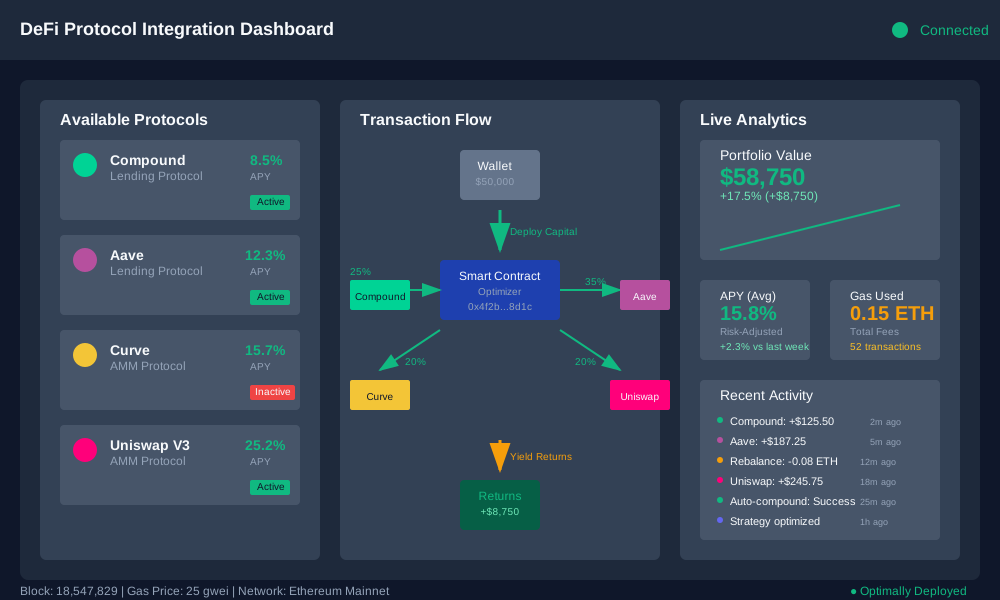
Connect your calculations to real protocols using Web3 integration:
# Example Web3 integration (pseudo-code)
from web3 import Web3

class ProtocolConnector:
    def __init__(self, rpc_url, private_key):
        self.w3 = Web3(Web3.HTTPProvider(rpc_url))
        self.account = self.w3.eth.account.from_key(private_key)

    def get_pool_apy(self, protocol_address):
        """Fetch real-time APY from protocol smart contract"""
        # Implementation depends on specific protocol
        pass

    def execute_optimal_strategy(self, allocation_weights, protocols):
        """Execute optimized allocation across protocols"""
        # Implementation for multi-protocol deployment
        pass
Performance Monitoring and Analytics
Key Performance Indicators (KPIs)
Track these metrics for yield farming success:
class YieldFarmingAnalytics:
    def __init__(self):
        self.performance_data = []

    def calculate_kpis(self, daily_returns, initial_investment, gas_costs):
        """Calculate comprehensive performance metrics"""
        total_return = sum(daily_returns)
        roi = (total_return / initial_investment) * 100

        # Volatility metrics
        return_volatility = np.std(daily_returns) * np.sqrt(365)

        # Cost efficiency
        cost_ratio = sum(gas_costs) / initial_investment * 100

        # Risk metrics
        max_drawdown = self.calculate_max_drawdown(daily_returns)

        return {
            'total_roi': roi,
            'annualized_volatility': return_volatility,
            'cost_ratio': cost_ratio,
            'max_drawdown': max_drawdown,
            'sharpe_ratio': (np.mean(daily_returns) / np.std(daily_returns)) * np.sqrt(365)
        }

    def calculate_max_drawdown(self, returns):
        """Calculate maximum drawdown from peak"""
        cumulative = np.cumsum(returns)
        running_max = np.maximum.accumulate(cumulative)
        drawdown = cumulative - running_max
        return np.min(drawdown)

# Example performance analysis
analytics = YieldFarmingAnalytics()
daily_returns = np.random.normal(0.001, 0.02, 365)  # Simulated daily returns
gas_costs = [50] * 52  # Weekly gas costs
initial_investment = 100000

kpis = analytics.calculate_kpis(daily_returns, initial_investment, gas_costs)
print("=== Performance KPIs ===")
for metric, value in kpis.items():
    print(f"{metric.replace('_', ' ').title()}: {value:.2f}%")
Common Pitfalls and Risk Management
Mathematical Errors to Avoid
APY vs APR Confusion: Always use compound interest formulas for accurate calculations. Simple interest underestimates returns by 20-50%.
Gas Fee Neglect: Small protocols with high transaction costs can eliminate profits. Include gas analysis in every strategy.
Token Price Assumptions: Token rewards lose value over time. Apply volatility discounts to reward calculations.
Impermanent Loss Oversight: AMM strategies require price correlation analysis. Uncorrelated pairs increase risk significantly.
Risk Mitigation Strategies
Implement these mathematical safeguards:
def risk_assessment_framework(strategy_params):
    """Comprehensive risk assessment for yield farming strategy"""
    risk_score = 0
    warnings = []

    # Protocol risk (smart contract age, TVL, audits)
    if strategy_params['protocol_age_days'] < 90:
        risk_score += 30
        warnings.append("New protocol - high smart contract risk")

    # Concentration risk
    if max(strategy_params['allocation_weights']) > 0.5:
        risk_score += 20
        warnings.append("High concentration in single protocol")

    # Impermanent loss risk
    if strategy_params['price_correlation'] < 0.7:
        risk_score += 25
        warnings.append("Low price correlation increases impermanent loss")

    # Liquidity risk
    if strategy_params['daily_volume'] < strategy_params['position_size'] * 10:
        risk_score += 15
        warnings.append("Low liquidity may impact exit strategy")

    return {
        'risk_score': risk_score,
        'risk_level': 'Low' if risk_score < 20 else 'Medium' if risk_score < 50 else 'High',
        'warnings': warnings
    }
Advanced Mathematical Techniques
Monte Carlo Simulation for Yield Prediction
Model various scenarios using Monte Carlo methods:
import random

def monte_carlo_yield_simulation(principal, base_apy, volatility, simulations=10000):
    """
    Run Monte Carlo simulation for yield farming returns

    Args:
        principal: Initial investment
        base_apy: Expected annual yield
        volatility: Return volatility (standard deviation)
        simulations: Number of simulation runs

    Returns:
        Distribution of possible outcomes
    """
    results = []

    for _ in range(simulations):
        # Simulate daily returns for one year
        daily_returns = []
        for day in range(365):
            # Random daily return based on normal distribution
            daily_return = random.normalvariate(base_apy/365, volatility/np.sqrt(365))
            daily_returns.append(daily_return)

        # Calculate final portfolio value
        portfolio_value = principal
        for daily_return in daily_returns:
            portfolio_value *= (1 + daily_return)

        total_return = (portfolio_value - principal) / principal
        results.append(total_return)

    # Calculate statistics
    mean_return = np.mean(results)
    std_return = np.std(results)
    percentile_5 = np.percentile(results, 5)
    percentile_95 = np.percentile(results, 95)

    return {
        'mean_return': mean_return,
        'volatility': std_return,
        'confidence_interval_90': (percentile_5, percentile_95),
        'probability_positive': sum(1 for r in results if r > 0) / len(results)
    }

# Example simulation
simulation = monte_carlo_yield_simulation(
    principal=100000,
    base_apy=0.3,      # 30% expected APY
    volatility=0.4,    # 40% volatility
    simulations=10000
)

print("=== Monte Carlo Simulation Results ===")
print(f"Expected Return: {simulation['mean_return']:.1%}")
print(f"Return Volatility: {simulation['volatility']:.1%}")
print(f"90% Confidence Interval: {simulation['confidence_interval_90'][0]:.1%} to {simulation['confidence_interval_90'][1]:.1%}")
print(f"Probability of Positive Return: {simulation['probability_positive']:.1%}")
Conclusion
Yield farming interest rate models provide mathematical precision for DeFi success. Compound interest calculations, risk-adjusted returns, and optimization algorithms maximize profits while minimizing risk.
Mathematical analysis separates profitable strategies from marketing hype. You now possess the formulas and frameworks to evaluate any yield farming opportunity objectively.
Key takeaways for implementing yield farming interest rate models:
- Always calculate risk-adjusted returns including gas costs
- Use optimization algorithms for multi-protocol allocation
- Monitor performance with quantitative KPIs
- Apply Monte Carlo simulation for scenario planning
Master these mathematical principles to achieve consistent yield farming success. The formulas work—execution determines your profits.
Ready to optimize your DeFi returns? Implement these mathematical models and watch your yield farming performance improve dramatically.