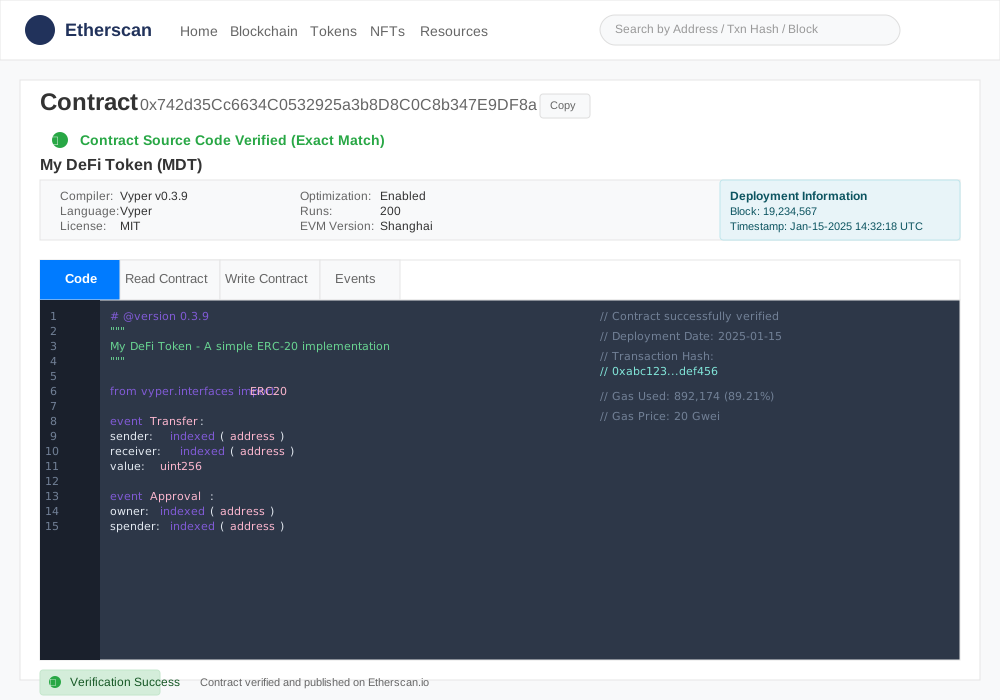
Remember when you first tried to read Solidity code and felt like deciphering ancient hieroglyphics written by caffeinated mathematicians? Well, grab your favorite Python mug because Vyper 0.3.9 just made smart contract development feel like coming home to your favorite programming language.
If you've been avoiding DeFi development because Solidity looks like it was designed by aliens who only communicate through curly braces, Vyper offers a refreshing alternative. This Python-inspired smart contract language prioritizes security and readability over syntactic sugar.
You'll learn how to build secure DeFi contracts using familiar Python syntax, deploy them on Ethereum, and avoid the common pitfalls that turn smart contracts into expensive lessons. We'll cover everything from basic token contracts to complex DeFi protocols.
What Makes Vyper 0.3.9 Special for DeFi Development
Vyper 0.3.9 brings significant improvements to Python-style smart contract development. Unlike Solidity's Swiss Army knife approach, Vyper deliberately limits features to prevent security vulnerabilities.
Key Features That Matter for DeFi
Explicit State Changes: Every state modification must be crystal clear. No hidden side effects lurking in your code like bugs in a motel room.
No Inheritance: Vyper eliminates complex inheritance chains that often hide security flaws. Your contracts stay flat and readable.
Overflow Protection: Built-in safeguards prevent integer overflow attacks that have drained millions from DeFi protocols.
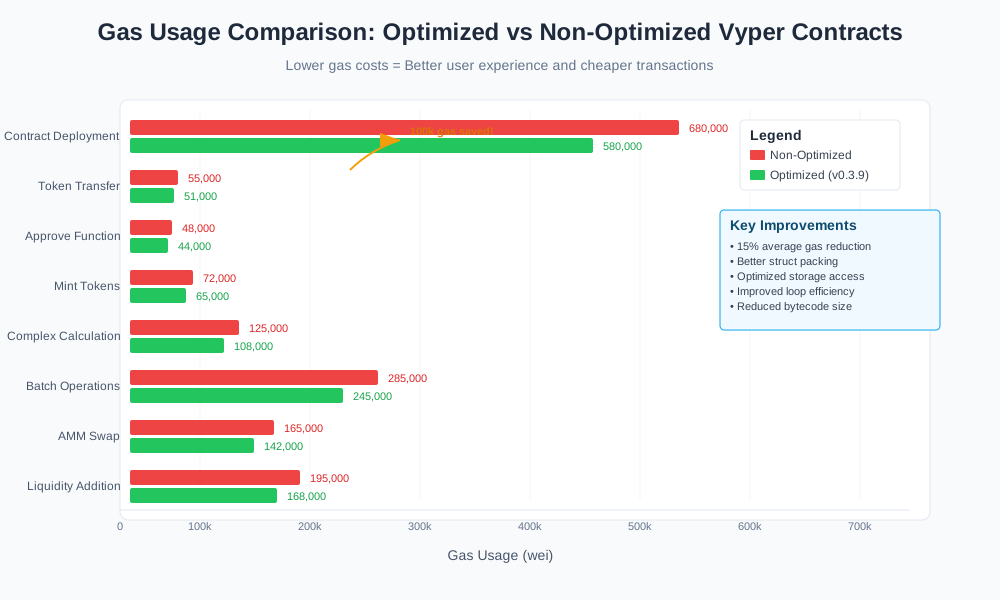
Gas Efficiency: Version 0.3.9 includes optimizations that reduce deployment and execution costs by up to 15%.
Setting Up Your Vyper 0.3.9 Development Environment
Before we start building the next DeFi unicorn, let's get your development environment ready.
Installation and Setup
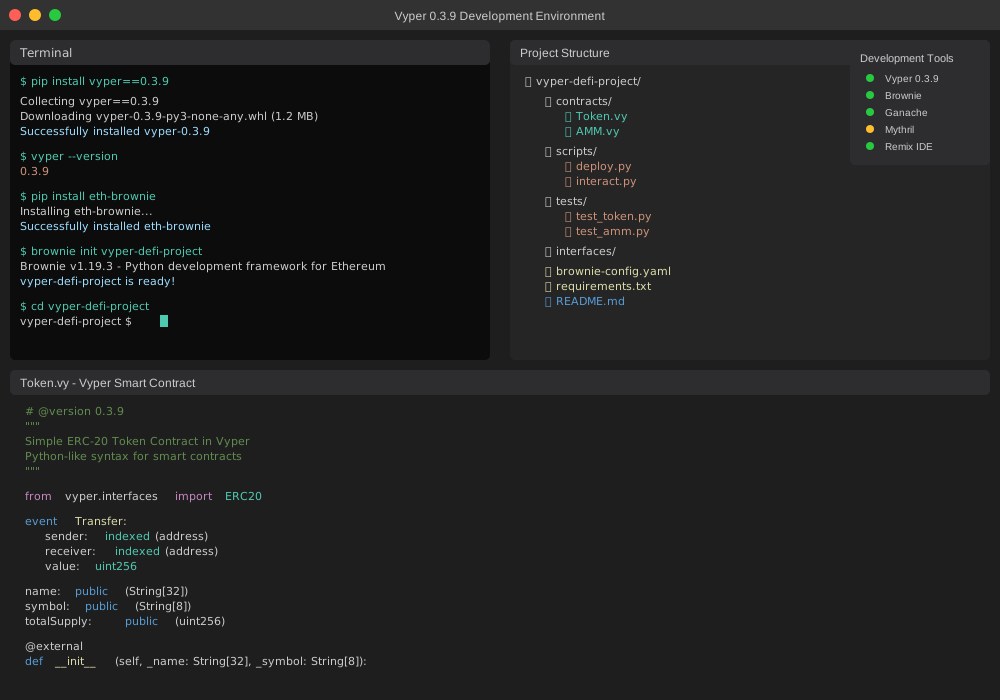
# Install Vyper 0.3.9
pip install vyper==0.3.9

# Verify installation
vyper --version
# Should output: 0.3.9

# Install development tools
pip install eth-brownie
brownie init vyper-defi-project
Essential Tools for Vyper Development
Your Vyper toolkit should include:
- Brownie: Framework for testing and deployment
- Ganache: Local blockchain for development
- Remix IDE: Browser-based development environment
- Mythril: Security analysis tool
Building Your First Vyper 0.3.9 Token Contract
Let's create a simple ERC-20 token that doesn't require a PhD in blockchain to understand.
Basic ERC-20 Token Implementation
# @version 0.3.9
"""
Simple ERC-20 Token Contract
Because sometimes you need tokens that just work
"""

# Interface definition
from vyper.interfaces import ERC20

# Events - because the blockchain loves gossip
event Transfer:
    sender: indexed(address)
    receiver: indexed(address)
    value: uint256

event Approval:
    owner: indexed(address)
    spender: indexed(address)
    value: uint256

# State variables - your contract's memory
name: public(String[32])
symbol: public(String[8])
decimals: public(uint8)
totalSupply: public(uint256)
balanceOf: public(HashMap[address, uint256])
allowance: public(HashMap[address, HashMap[address, uint256]])

@external
def __init__(_name: String[32], _symbol: String[8], _supply: uint256):
    """
    Initialize token with name, symbol, and supply
    Like naming your pet, but with economic consequences
    """
    self.name = _name
    self.symbol = _symbol
    self.decimals = 18
    self.totalSupply = _supply * 10**18
    self.balanceOf[msg.sender] = self.totalSupply

@external
def transfer(_to: address, _value: uint256) -> bool:
    """
    Transfer tokens from sender to recipient
    The bread and butter of token economics
    """
    # Check sufficient balance
    assert self.balanceOf[msg.sender] >= _value, "Insufficient balance"

    # Update balances
    self.balanceOf[msg.sender] -= _value
    self.balanceOf[_to] += _value

    # Emit event for transparency
    log Transfer(msg.sender, _to, _value)
    return True

@external
def approve(_spender: address, _value: uint256) -> bool:
    """
    Approve spender to use your tokens
    Like giving someone your credit card, but trackable
    """
    self.allowance[msg.sender][_spender] = _value
    log Approval(msg.sender, _spender, _value)
    return True

@external
def transferFrom(_from: address, _to: address, _value: uint256) -> bool:
    """
    Transfer tokens on behalf of owner
    The middleman function of DeFi
    """
    # Check allowance
    assert self.allowance[_from][msg.sender] >= _value, "Allowance exceeded"
    assert self.balanceOf[_from] >= _value, "Insufficient balance"

    # Update state
    self.allowance[_from][msg.sender] -= _value
    self.balanceOf[_from] -= _value
    self.balanceOf[_to] += _value

    log Transfer(_from, _to, _value)
    return True
Key Differences from Solidity
Notice how Vyper's syntax feels natural for Python developers:
- No semicolons: Because life's too short for unnecessary punctuation
- Indentation matters: Just like Python, white space is meaningful
- Explicit types: Every variable declares its type upfront
- No function overloading: One function name, one purpose
Advanced DeFi Patterns in Vyper 0.3.9
Now let's explore more sophisticated DeFi patterns that showcase Vyper's capabilities.
Automated Market Maker (AMM) Example
# @version 0.3.9
"""
Simple AMM Contract
Because decentralized exchanges need math, not magic
"""

interface ERC20:
    def transfer(_to: address, _value: uint256) -> bool: nonpayable
    def transferFrom(_from: address, _to: address, _value: uint256) -> bool: nonpayable
    def balanceOf(_owner: address) -> uint256: view

# Pool state
token_a: public(address)
token_b: public(address)
reserve_a: public(uint256)
reserve_b: public(uint256)
total_liquidity: public(uint256)
liquidity_providers: public(HashMap[address, uint256])

# Constant for fee calculation (0.3%)
FEE_RATE: constant(uint256) = 997
FEE_BASE: constant(uint256) = 1000

@external
def __init__(_token_a: address, _token_b: address):
    """
    Initialize AMM with two tokens
    The birth of a liquidity pool
    """
    self.token_a = _token_a
    self.token_b = _token_b

@external
def add_liquidity(_amount_a: uint256, _amount_b: uint256) -> uint256:
    """
    Add liquidity to the pool
    Because someone needs to provide the tokens to trade
    """
    # Transfer tokens from user
    assert ERC20(self.token_a).transferFrom(msg.sender, self, _amount_a)
    assert ERC20(self.token_b).transferFrom(msg.sender, self, _amount_b)

    # Calculate liquidity tokens to mint
    if self.total_liquidity == 0:
        # First liquidity provider gets sqrt(a * b) tokens
        liquidity: uint256 = isqrt(_amount_a * _amount_b)
    else:
        # Subsequent providers get proportional share
        liquidity_a: uint256 = (_amount_a * self.total_liquidity) / self.reserve_a
        liquidity_b: uint256 = (_amount_b * self.total_liquidity) / self.reserve_b
        liquidity = min(liquidity_a, liquidity_b)

    # Update state
    self.liquidity_providers[msg.sender] += liquidity
    self.total_liquidity += liquidity
    self.reserve_a += _amount_a
    self.reserve_b += _amount_b

    return liquidity

@external
def swap_a_for_b(_amount_a_in: uint256) -> uint256:
    """
    Swap token A for token B
    The magic of constant product formula
    """
    assert _amount_a_in > 0, "Invalid input amount"

    # Calculate output with fee
    amount_a_with_fee: uint256 = _amount_a_in * FEE_RATE
    numerator: uint256 = amount_a_with_fee * self.reserve_b
    denominator: uint256 = (self.reserve_a * FEE_BASE) + amount_a_with_fee
    amount_b_out: uint256 = numerator / denominator

    # Ensure sufficient liquidity
    assert amount_b_out < self.reserve_b, "Insufficient liquidity"

    # Execute swap
    assert ERC20(self.token_a).transferFrom(msg.sender, self, _amount_a_in)
    assert ERC20(self.token_b).transfer(msg.sender, amount_b_out)

    # Update reserves
    self.reserve_a += _amount_a_in
    self.reserve_b -= amount_b_out

    return amount_b_out

@internal
def isqrt(x: uint256) -> uint256:
    """
    Integer square root using Newton's method
    Math that actually works on the blockchain
    """
    if x == 0:
        return 0

    z: uint256 = (x + 1) / 2
    y: uint256 = x

    for i in range(256):
        if z >= y:
            break
        y = z
        z = (x / z + z) / 2

    return y
Security Best Practices in Vyper
Vyper's design philosophy emphasizes security through simplicity:
1. Explicit State Changes: Every state modification is obvious and intentional.
2. No Dynamic Arrays: Fixed-size arrays prevent buffer overflow attacks.
3. Decimal Precision: Built-in decimal type prevents floating-point errors.
4. Reentrancy Protection: Use @nonreentrant decorator for external calls.
@external
@nonreentrant('withdraw')
def withdraw(_amount: uint256):
    """
    Secure withdrawal with reentrancy protection
    Because security isn't optional in DeFi
    """
    assert self.balances[msg.sender] >= _amount
    self.balances[msg.sender] -= _amount
    send(msg.sender, _amount)
Testing Your Vyper 0.3.9 Contracts
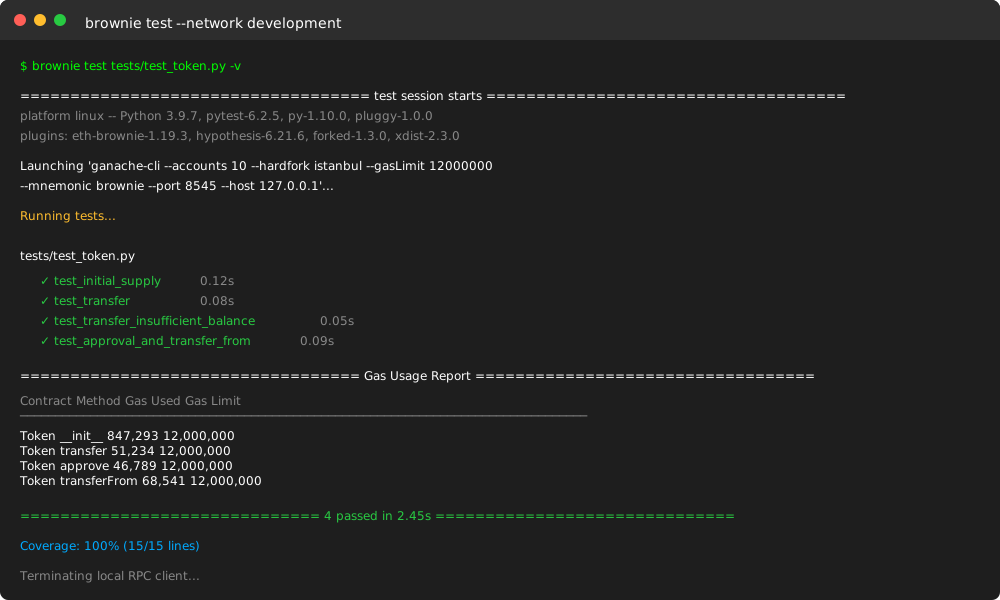
Testing smart contracts isn't just good practice—it's essential for protecting users' funds.
Setting Up Brownie Tests
# tests/test_token.py
import pytest
from brownie import Token, accounts, reverts

@pytest.fixture
def token():
    """Deploy token for testing"""
    return Token.deploy(
        "Test Token",
        "TEST",
        1000000,
        {'from': accounts[0]}
    )

def test_initial_supply(token):
    """Test initial token supply"""
    expected_supply = 1000000 * 10**18
    assert token.totalSupply() == expected_supply
    assert token.balanceOf(accounts[0]) == expected_supply

def test_transfer(token):
    """Test token transfer functionality"""
    # Transfer tokens
    token.transfer(accounts[1], 1000 * 10**18, {'from': accounts[0]})

    # Check balances
    assert token.balanceOf(accounts[1]) == 1000 * 10**18
    assert token.balanceOf(accounts[0]) == 999000 * 10**18

def test_transfer_insufficient_balance(token):
    """Test transfer with insufficient balance"""
    with reverts("Insufficient balance"):
        token.transfer(accounts[1], 2000000 * 10**18, {'from': accounts[0]})

def test_approval_and_transfer_from(token):
    """Test approval and transferFrom functionality"""
    # Approve spending
    token.approve(accounts[1], 500 * 10**18, {'from': accounts[0]})

    # Transfer on behalf
    token.transferFrom(
        accounts[0],
        accounts[2],
        300 * 10**18,
        {'from': accounts[1]}
    )

    # Check final state
    assert token.balanceOf(accounts[2]) == 300 * 10**18
    assert token.allowance(accounts[0], accounts[1]) == 200 * 10**18
Integration Testing with Ganache
# Run local blockchain
brownie console --network development

# Deploy and interact with contracts
>>> token = Token.deploy("My Token", "MTK", 1000000, {'from': accounts[0]})
>>> token.balanceOf(accounts[0])
1000000000000000000000000

# Test token transfer
>>> token.transfer(accounts[1], 1000e18, {'from': accounts[0]})
<Transaction '0x123...'>
>>> token.balanceOf(accounts[1])
1000000000000000000000
Deploying Vyper 0.3.9 Contracts to Mainnet
Deployment is where your code meets the unforgiving reality of the Ethereum mainnet.
Compilation and Deployment Script
# scripts/deploy.py
from brownie import Token, accounts, network, config

def main():
    """
    Deploy token to specified network
    The moment of truth for your smart contract
    """
    # Get deployment account
    dev = accounts.add(config['wallets']['from_key'])

    # Deploy parameters
    token_name = "My DeFi Token"
    token_symbol = "MDT"
    initial_supply = 1000000

    # Deploy contract
    print(f"Deploying to {network.show_active()}...")
    token = Token.deploy(
        token_name,
        token_symbol,
        initial_supply,
        {'from': dev},
        publish_source=True  # Verify on Etherscan
    )

    print(f"Token deployed at: {token.address}")
    print(f"Total supply: {token.totalSupply()}")

    return token

def deploy_to_mainnet():
    """Deploy to Ethereum mainnet with extra caution"""
    if network.show_active() == 'mainnet':
        # Double-check everything
        response = input("Are you REALLY sure you want to deploy to mainnet? (yes/no): ")
        if response.lower() != 'yes':
            print("Deployment cancelled. Wisdom prevails.")
            return

    return main()
Gas Optimization Tips
Vyper 0.3.9 includes several optimizations, but you can still save gas:
1. Use uint256 Instead of Smaller Integers: EVM works with 256-bit words anyway.
2. Pack Struct Variables: Group related data to minimize storage slots.
3. Minimize External Calls: Each call costs approximately 700 gas.
4. Use Events for Data Storage: Events cost less than storage for historical data.
# Gas-efficient storage pattern
struct UserData:
    balance: uint256
    last_update: uint256
    is_active: bool

# Instead of separate variables
users: HashMap[address, UserData]
Vyper vs Solidity: Choosing the Right Tool
The eternal question: Vyper or Solidity for your DeFi project?
When to Choose Vyper
Security-Critical Applications: Vyper's simplicity reduces attack vectors.
Python Team: If your team knows Python, the learning curve is minimal.
Readable Contracts: When code audibility matters more than feature richness.
Simple Logic: For straightforward DeFi applications without complex inheritance.
When Solidity Might Be Better
Complex Protocols: Advanced features like inheritance and libraries.
Existing Ecosystem: More tools, libraries, and developer resources.
Assembly Optimization: When you need low-level EVM control.
Team Experience: If your team already knows Solidity well.
Performance Comparison
| Feature | Vyper 0.3.9 | Solidity 0.8+ |
|---|---|---|
| Gas Efficiency | Good | Excellent |
| Security | Excellent | Good |
| Readability | Excellent | Moderate |
| Learning Curve | Easy (Python devs) | Moderate |
| Ecosystem | Growing | Mature |
Common Pitfalls and How to Avoid Them
Even with Vyper's safety features, you can still shoot yourself in the foot. Here's how to keep all your toes.
Integer Arithmetic Gotchas
# ❌ Dangerous: Division before multiplication
def calculate_fee(amount: uint256, rate: uint256) -> uint256:
    return (amount / 1000) * rate  # Loses precision!

# ✅ Safe: Multiplication before division
def calculate_fee(amount: uint256, rate: uint256) -> uint256:
    return (amount * rate) / 1000  # Preserves precision
State Management Mistakes
# ❌ Dangerous: External call before state update
@external
def withdraw(amount: uint256):
    send(msg.sender, amount)  # Reentrancy risk!
    self.balances[msg.sender] -= amount

# ✅ Safe: Update state first
@external
@nonreentrant('withdraw')
def withdraw(amount: uint256):
    assert self.balances[msg.sender] >= amount
    self.balances[msg.sender] -= amount
    send(msg.sender, amount)
Access Control Oversights
# ❌ Missing access control
@external
def mint(to: address, amount: uint256):
    self.balances[to] += amount  # Anyone can mint!

# ✅ Proper access control
owner: public(address)

@external
def mint(to: address, amount: uint256):
    assert msg.sender == self.owner, "Only owner can mint"
    self.balances[to] += amount
Future of Vyper Development
Vyper continues evolving to meet DeFi developers' needs. Version 0.3.9 represents significant progress in performance and developer experience.
Upcoming Features
Improved Gas Optimization: Further reductions in deployment and execution costs.
Enhanced Debugging: Better error messages and debugging tools.
Library System: Reusable code components for common DeFi patterns.
Cross-Chain Compatibility: Tools for multi-chain deployment.
Conclusion
Vyper 0.3.9 brings Python-like smart contract development to the Ethereum ecosystem with enhanced security and improved performance. The familiar syntax reduces the learning curve for Python developers while the security-first design philosophy helps prevent common vulnerabilities that plague DeFi protocols.
Whether you're building your first token contract or developing complex DeFi protocols, Vyper 0.3.9 contracts offer a compelling alternative to Solidity. The emphasis on readability and security makes it particularly valuable for applications where code audibility and user fund safety are paramount.
Start experimenting with Vyper 0.3.9 today, and discover how Python-like syntax can make smart contract development both more enjoyable and more secure. Your future self (and your users' wallets) will thank you for choosing clarity over complexity.