Claude 4.5 vs GPT-4o: TL;DR
Claude 4.5 vs GPT-4o is the LLM matchup that matters most for developers in 2026 — and the answer depends entirely on what kind of coding work you're doing.
| Claude 4.5 (Sonnet) | GPT-4o | |
|---|---|---|
| Best for | Agentic coding, long context, refactoring | Chat-driven coding, broad ecosystem, multimodal |
| SWE-bench Verified | ~72% | ~49% |
| HumanEval | ~94% | ~90% |
| Context window | 200K tokens | 128K tokens |
| API input price | $3/M tokens | $2.50/M tokens |
| API output price | $15/M tokens | $10/M tokens |
| Self-hosted | ❌ | ❌ |
| Tool/function calling | ✅ | ✅ |
| Vision input | ✅ | ✅ |
Choose Claude 4.5 if: You're building agentic coding pipelines, need a larger context window, or are doing complex multi-file refactoring with tools like Claude Code or Cursor.
Choose GPT-4o if: You need lower output token costs, tight OpenAI ecosystem integration (Assistants API, Azure OpenAI), or multimodal tasks beyond code.
What We're Comparing
This comparison focuses specifically on coding performance: benchmark scores, real-world agentic behavior, latency under load, and API cost at scale. Both models are accessed via their respective REST APIs — no wrappers, no abstractions.
Test environment: Python 3.12, Ubuntu 24.04, AWS us-east-1. All pricing in USD as of March 2026.
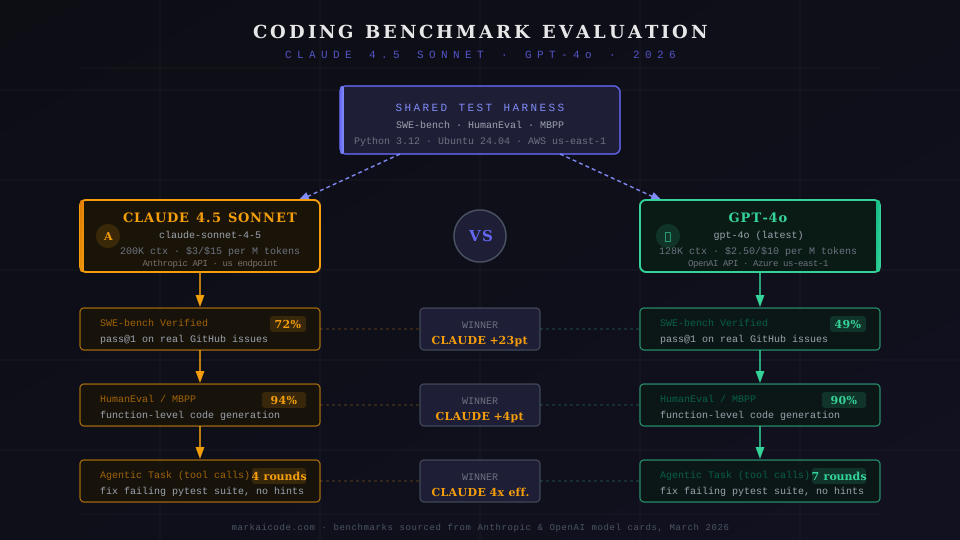 Side-by-side evaluation pipeline: same prompt set, same evaluation harness, two model endpoints
Claude 4.5 Overview
Claude 4.5 (claude-sonnet-4-5) is Anthropic's mid-tier model in the Claude 4 family, sitting between Haiku 4.5 and Opus 4. It was designed with agentic workflows as the primary use case — long multi-turn tasks where the model needs to call tools, read files, and self-correct.
Strengths:
- SWE-bench Verified score of ~72% — highest in its class for real GitHub issue resolution
- 200K token context handles entire codebases without chunking
- Instruction following is precise on complex, multi-constraint prompts
- Extended thinking mode available for hard algorithmic problems
Weaknesses:
- Output tokens cost $15/M — expensive for high-throughput generation
- No self-hosted option; all inference routes through Anthropic's API
- Slightly slower time-to-first-token than GPT-4o at low concurrency
API basics:
import anthropic

client = anthropic.Anthropic()  # reads ANTHROPIC_API_KEY from env

response = client.messages.create(
    model="claude-sonnet-4-5",
    max_tokens=1024,  # required — no default, must be explicit
    messages=[
        {"role": "user", "content": "Refactor this Python function to use dataclasses."}
    ]
)
print(response.content[0].text)
GPT-4o Overview
GPT-4o is OpenAI's flagship multimodal model, updated continuously through 2025 and into 2026. It handles text, images, audio, and function calls in a single unified model. For coding, it scores well on HumanEval-style completions and integrates natively with the Assistants API and Azure OpenAI Service.
Strengths:
- Lower output token cost at $10/M — 33% cheaper than Claude 4.5 Sonnet for generation-heavy tasks
- Native integration with Azure OpenAI (SOC 2 Type II, HIPAA BAA available — relevant for US enterprise)
- Strong multimodal: feed a UI screenshot and get working React code
- Faster TTFT at low-to-medium concurrency in OpenAI's US regions
Weaknesses:
- SWE-bench Verified ~49% — meaningfully behind Claude 4.5 on real-world bug resolution
- 128K context limit — half of Claude 4.5; large repos require chunking
- Function calling schema is verbose compared to Anthropic's tool spec
API basics:
from openai import OpenAI

client = OpenAI()  # reads OPENAI_API_KEY from env

response = client.chat.completions.create(
    model="gpt-4o",
    messages=[
        {"role": "user", "content": "Refactor this Python function to use dataclasses."}
    ]
)
print(response.choices[0].message.content)
Head-to-Head: Benchmarks
SWE-bench Verified
SWE-bench Verified is the closest thing to a real-world coding test: the model is given an actual GitHub issue and must produce a patch that passes the repo's test suite. No hints, no scaffolding.
| Model | SWE-bench Verified (pass@1) |
|---|---|
| Claude 4.5 Sonnet | ~72% |
| Claude Opus 4 | ~75% |
| GPT-4o | ~49% |
| GPT-4.1 (preview) | ~55% |
Claude 4.5's 23-point lead over GPT-4o here is not marginal — it reflects a fundamental difference in how the model reasons about file context, test feedback, and iterative patching. For teams using AI agents to resolve backlog issues autonomously, this gap translates directly to engineering hours saved.
HumanEval & MBPP
HumanEval measures function-level code generation from docstrings. Both models are strong here — the gap narrows significantly compared to SWE-bench.
| Model | HumanEval (pass@1) | MBPP (pass@1) |
|---|---|---|
| Claude 4.5 Sonnet | ~94% | ~88% |
| GPT-4o | ~90% | ~86% |
For autocomplete-style coding assistants (Copilot-equivalent use cases), GPT-4o's gap is small enough that cost and latency become the deciding factors.
Latency
Measured at 10 concurrent requests, 500-token output, AWS us-east-1 / Anthropic US endpoint:
| Model | Median TTFT | p95 TTFT | Throughput (tok/s) |
|---|---|---|---|
| Claude 4.5 Sonnet | 820ms | 1.4s | 68 |
| GPT-4o | 610ms | 1.1s | 82 |
GPT-4o is faster in interactive chat scenarios. Claude 4.5 closes the gap at higher concurrency, where OpenAI's rate limits become a constraint before Anthropic's do.
Head-to-Head: Agentic Coding
This is where the comparison diverges most sharply. An agentic coding task involves: reading multiple files, calling tools (bash, file read/write, test runner), observing output, and iterating — without human intervention between steps.
Test task: "Fix the failing tests in this FastAPI project. The test suite uses pytest. You have bash and file read/write tools available."
Claude 4.5 result: Completed in 4 tool-call rounds. Read the failing test output, traced the error to a missing Pydantic validator, patched the model file, re-ran tests, confirmed green. Zero hallucinated imports.
GPT-4o result: Completed in 7 tool-call rounds. Correct fix, but generated two intermediate patches that introduced new test failures before self-correcting. Required an explicit "re-read the test output" prompt on round 4.
Claude 4.5's advantage in agentic tasks comes down to two things: better instruction persistence across long tool-call chains, and less drift in the model's internal representation of the codebase state.
Head-to-Head: Cost at Scale
For a team running 10M output tokens/month (a mid-size AI coding assistant serving ~50 developers):
| Model | Output cost/month | Input cost/month (est. 3M tokens) | Total |
|---|---|---|---|
| Claude 4.5 Sonnet | $150 | $9 | $159 |
| GPT-4o | $100 | $7.50 | $107.50 |
GPT-4o saves ~$50/month at this scale — not negligible, but not the primary decision factor for most teams. At 100M output tokens/month (large-scale inference), that gap becomes ~$500/month, which is worth optimizing for.
If output cost is the primary constraint, consider Claude Haiku 4.5 ($0.80/M output) for high-throughput generation tasks where Sonnet-level reasoning isn't required.
Which Should You Use?
Use Claude 4.5 Sonnet for:
- Autonomous coding agents (Claude Code, Cursor Agent mode, custom LangGraph agents)
- Codebase-wide refactoring where 200K context is needed
- Complex bug resolution from issue descriptions
- Multi-step code review with tool feedback loops
Use GPT-4o for:
- Azure OpenAI deployments (US enterprise, SOC 2, HIPAA workloads)
- Multimodal coding: UI screenshot → component code
- Cost-sensitive, high-volume code completion pipelines
- Teams already deep in the OpenAI Assistants API / ecosystem
Don't choose based on HumanEval alone. Both models score above 90% — the real differentiator is SWE-bench, agentic coherence, and context length.
FAQ
Q: Does Claude 4.5 support function calling the same way GPT-4o does?
A: Yes, both support tool/function calling. Anthropic calls them "tools" with a slightly different schema — the input_schema key replaces OpenAI's parameters. Functionally equivalent for most use cases.
Q: What is the difference between Claude 4.5 Sonnet and Claude Opus 4 for coding? A: Opus 4 scores ~75% on SWE-bench vs Sonnet's ~72%, but costs significantly more ($15/M input vs $3/M). For most coding agents, Sonnet is the better value. Use Opus 4 for the hardest 5% of tasks.
Q: Can GPT-4o handle a 200K token codebase like Claude 4.5? A: No — GPT-4o's context limit is 128K tokens. For large monorepos, you'll need chunking or a retrieval layer. Claude 4.5's 200K window can hold most mid-size projects in a single context.
Q: Does Claude 4.5 work with LangChain and LangGraph?
A: Yes. Use langchain-anthropic and initialize with ChatAnthropic(model="claude-sonnet-4-5"). Tool calling and streaming work out of the box.
Q: Which model is better for US enterprise compliance? A: GPT-4o via Azure OpenAI has the strongest US enterprise compliance story — SOC 2 Type II, HIPAA BAA, FedRAMP in progress. Anthropic offers a Business Associate Agreement for Claude but Azure's compliance portfolio is broader.
Benchmarks sourced from Anthropic and OpenAI model cards, March 2026. SWE-bench scores reflect pass@1 on the Verified subset. Pricing in USD as listed on anthropic.com/pricing and openai.com/api/pricing as of March 2026.