TRL 0.12 is the biggest post-training release from Hugging Face in 2024 — PPOv2 is gone, ScriptArguments are unified, and Online DPO finally works with any reward model. If you're upgrading from 0.11 or earlier, this article covers every breaking change and new feature so you don't hit runtime surprises at 3 AM on an H100.
You'll learn:
- Every breaking change introduced in TRL 0.12 and the one-line fix for each
- How to use pairwise judges (
PairRMJudge) inOnlineDPOTrainer - How Weighted Preference Optimization (WPO) improves DPO alignment
- How to use
trl envto debug environment issues fast
Time: 20 min | Difficulty: Intermediate
What Changed in TRL 0.12
TRL 0.12 was released on November 4, 2024. The core theme is consolidation: reduce API surface, promote better abstractions, and finally clean up the PPO namespace.
Before upgrading, run the new environment diagnostic tool introduced in this version:
trl env
It prints your Python version, PyTorch version, CUDA device, and all library versions at once. Expected output on a well-configured H100 instance (AWS p4d.24xlarge, us-east-1):
Copy-paste the following information when reporting an issue:

- Platform: Linux-5.15.0-1048-aws-x86_64-with-glibc2.31
- Python version: 3.11.9
- PyTorch version: 2.4.0
- CUDA device(s): NVIDIA H100 80GB HBM3
- Transformers version: 4.47.0.dev0
- Accelerate version: 0.19.0
- TRL version: 0.12.0+14ef1ab
- PEFT version: 0.13.2
This is the fastest way to rule out version mismatches before you start debugging a training run.
Architecture Diagram: TRL 0.12 Trainer Relationships
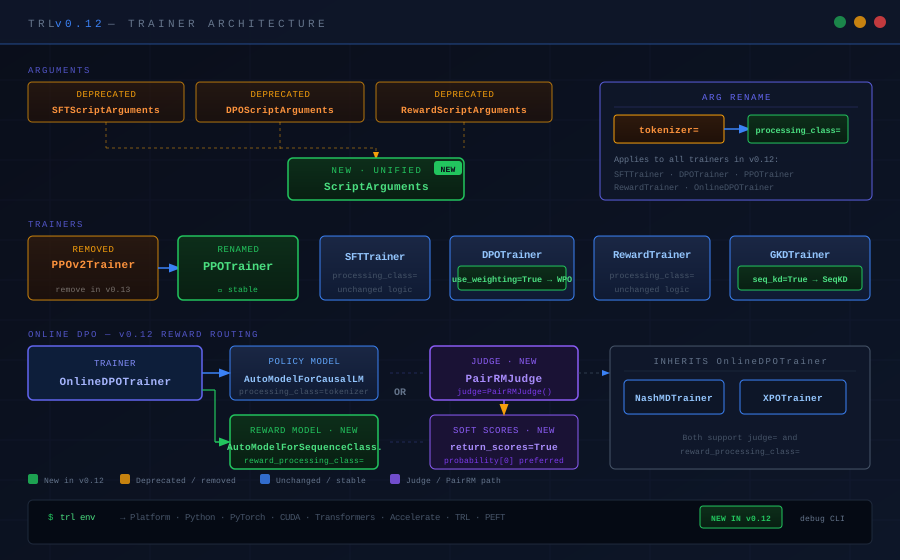 TRL 0.12 unifies ScriptArguments and decouples reward models from the trained model's tokenizer in Online DPO.
Breaking Change 1: PPOv2 Renamed to PPO
The biggest footgun in this release. PPOv2Trainer is now PPOTrainer. The original PPOTrainer (the pre-v0.9 implementation) has been removed entirely. PPOv2 still works in 0.12 but throws a deprecation warning — it will be removed in 0.13.
# TRL 0.11 — works but warns in 0.12
from trl import PPOv2Trainer
trainer = PPOv2Trainer(config, model, tokenizer=tokenizer)

# TRL 0.12 — correct
from trl import PPOTrainer
trainer = PPOTrainer(config, model, processing_class=tokenizer)
The rename also means your old imports will fail silently if you had from trl import PPOTrainer pointing at the legacy implementation. Verify which one your code was using before upgrading.
Breaking Change 2: tokenizer Renamed to processing_class
Every trainer in TRL 0.12 now accepts processing_class instead of tokenizer. The old argument name still works for SFTTrainer and DPOTrainer in 0.12 but is deprecated.
The reason: TRL now supports vision-language models where the input is processed by a Processor object, not just a tokenizer. Using tokenizer as the argument name was misleading for multimodal workflows.
# TRL 0.11
trainer = DPOTrainer(
    model,
    args=training_args,
    train_dataset=dataset,
    tokenizer=tokenizer,  # deprecated in 0.12
)

# TRL 0.12
trainer = DPOTrainer(
    model,
    args=training_args,
    train_dataset=dataset,
    processing_class=tokenizer,  # correct
)
This applies to SFTTrainer, DPOTrainer, RewardTrainer, OnlineDPOTrainer, and PPOTrainer.
Breaking Change 3: Unified ScriptArguments
TRL previously had four separate argument classes: ScriptArguments, SFTScriptArguments, DPOScriptArguments, and RewardScriptArguments. They had nearly identical fields and diverged only on minor dataset parameters.
In 0.12, these are merged into a single ScriptArguments. The specialized classes still exist but are deprecated.
# TRL 0.11
from trl import DPOScriptArguments
script_args = DPOScriptArguments(dataset_name="trl-lib/ultrafeedback_binarized")

# TRL 0.12
from trl import ScriptArguments
script_args = ScriptArguments(dataset_name="trl-lib/ultrafeedback_binarized")
If you have custom scripts that import SFTScriptArguments or RewardScriptArguments, swap them now. They will error out in 0.13.
New Feature 1: General Reward Model Support for Online DPO
This is the most practically valuable change in TRL 0.12. Previously, OnlineDPOTrainer required the reward model to share the same tokenizer and chat template as the model being trained. That constraint ruled out using a general-purpose reward model like Skywork-Reward-Gemma-2-27B with a Qwen-based policy.
In 0.12, you pass separate reward_processing_class and reward_model arguments. TRL handles the tokenization routing internally.
from datasets import load_dataset
from transformers import (
    AutoModelForCausalLM,
    AutoModelForSequenceClassification,
    AutoTokenizer,
)
from trl import OnlineDPOConfig, OnlineDPOTrainer

model_name = "Qwen/Qwen2.5-0.5B-Instruct"
reward_model_name = "Ray2333/GRM-Llama3.2-3B-rewardmodel-ft"

model = AutoModelForCausalLM.from_pretrained(model_name)
tokenizer = AutoTokenizer.from_pretrained(model_name, padding_side="left")

reward_model = AutoModelForSequenceClassification.from_pretrained(
    reward_model_name, num_labels=1
)
reward_tokenizer = AutoTokenizer.from_pretrained(
    reward_model_name, truncation=True, truncation_side="left"
)

dataset = load_dataset("trl-lib/ultrafeedback-prompt", split="train")

training_args = OnlineDPOConfig(output_dir="qwen2.5-online-dpo", logging_steps=10)

trainer = OnlineDPOTrainer(
    model=model,
    reward_model=reward_model,
    args=training_args,
    train_dataset=dataset,
    processing_class=tokenizer,
    reward_processing_class=reward_tokenizer,  # separate tokenizer for reward model
)
trainer.train()
Expected behavior: The reward model scores completions in its own tokenization space. The policy model never sees the reward tokenizer. This separation means you can mix architectures freely — a Llama-based reward model scoring Qwen-based completions.
New Feature 2: Pairwise Judges in Online DPO
If you'd rather avoid loading a reward model altogether, TRL 0.12 lets you pass a PairwiseJudge directly to OnlineDPOTrainer. The judge replaces the reward model for preference labeling.
This also applies to NashMDTrainer and XPOTrainer, which inherit from OnlineDPOTrainer.
from datasets import load_dataset
from trl import OnlineDPOConfig, OnlineDPOTrainer, PairRMJudge
from transformers import AutoModelForCausalLM, AutoTokenizer

model = AutoModelForCausalLM.from_pretrained("Qwen/Qwen2-0.5B-Instruct")
tokenizer = AutoTokenizer.from_pretrained("Qwen/Qwen2-0.5B-Instruct")

judge = PairRMJudge()  # llm-blender/PairRM under the hood

train_dataset = load_dataset("trl-lib/ultrafeedback-prompt", split="train")

training_args = OnlineDPOConfig(
    output_dir="qwen2-online-dpo-judge",
    logging_steps=10,
)
trainer = OnlineDPOTrainer(
    model=model,
    judge=judge,          # pass judge instead of reward_model
    args=training_args,
    processing_class=tokenizer,
    train_dataset=train_dataset,
)
trainer.train()
When to use judge vs reward model: Judges are faster to set up and don't require a separate GPU allocation. Reward models give finer-grained scalar signals and are better for production runs where you need stable, calibrated scores.
New Feature 3: Soft Scores from PairRMJudge
The PairRMJudge now supports return_scores=True, which returns continuous probability scores instead of a hard rank. This is useful when you need to weight preferences by confidence.
from trl import PairRMJudge

judge = PairRMJudge()

prompts = ["Translate 'hello' to French", "What's the capital of Japan?"]
completions = [["Bonjour", "Salut"], ["Kyoto", "Tokyo"]]

# Hard ranking (TRL 0.11 behavior)
ranks = judge.judge(prompts, completions)
print(ranks)  # [0, 1]

# Soft scores (new in TRL 0.12)
scores = judge.judge(prompts, completions, return_scores=True)
print(scores)  # [0.749, 0.0005] — probability that completion[0] is preferred
The optional temperature parameter scales the logits before computing the softmax, letting you calibrate how sharp the preference signal is.
New Feature 4: Weighted Preference Optimization (WPO)
WPO adapts off-policy DPO data to look more like on-policy data. It reweights each preference pair by the probability of the winning and losing completions under the current policy. Pairs that the current policy finds likely get higher weight; pairs it considers improbable get downweighted.
This addresses a core limitation of standard DPO: your preference dataset was collected from a different model, so the gradient signal can be noisy or mis-calibrated for your current policy.
To enable WPO in DPOTrainer:
from trl import DPOConfig, DPOTrainer
from datasets import load_dataset
from transformers import AutoModelForCausalLM, AutoTokenizer

model = AutoModelForCausalLM.from_pretrained("Qwen/Qwen2.5-1.5B-Instruct")
tokenizer = AutoTokenizer.from_pretrained("Qwen/Qwen2.5-1.5B-Instruct")
dataset = load_dataset("trl-lib/ultrafeedback_binarized", split="train")

training_args = DPOConfig(
    output_dir="qwen2.5-wpo",
    use_weighting=True,   # enables WPO
    beta=0.1,
)

trainer = DPOTrainer(
    model=model,
    args=training_args,
    train_dataset=dataset,
    processing_class=tokenizer,
)
trainer.train()
When to use: Enable use_weighting=True any time your preference dataset is more than one model version old. If you're training Qwen2.5 on preferences collected from Qwen2, WPO helps. If your dataset was collected from the exact same checkpoint you're training, WPO has no effect.
New Feature 5: Sequence-Level KD in GKDTrainer
The GKDTrainer now supports Sequence-Level Knowledge Distillation (SeqKD) via seq_kd=True in GKDConfig. SeqKD fine-tunes the student on high-probability sequences sampled from the teacher, rather than token-level KL divergence. It serves as a strong baseline before applying the full GKD objective.
from trl import GKDConfig, GKDTrainer

training_args = GKDConfig(
    output_dir="qwen-student-seqkd",
    seq_kd=True,  # new in TRL 0.12
    teacher_model_name_or_path="Qwen/Qwen2.5-7B-Instruct",
)
SeqKD is equivalent to supervised fine-tuning on teacher-generated outputs. Use it to pre-warm the student before running full GKD.
Full Migration Checklist: TRL 0.11 → 0.12
| What changed | TRL 0.11 | TRL 0.12 |
|---|---|---|
| PPO trainer class | PPOv2Trainer | PPOTrainer |
| Trainer tokenizer arg | tokenizer= | processing_class= |
| Script argument classes | SFTScriptArguments, DPOScriptArguments, RewardScriptArguments | ScriptArguments |
| Online DPO reward model | Must share tokenizer | Independent model + tokenizer |
| Pairwise judge in Online DPO | Not supported | judge=PairRMJudge() |
| WPO in DPO | Not supported | use_weighting=True |
| PairRM soft scores | Not supported | return_scores=True |
| SeqKD in GKD | Not supported | seq_kd=True |
| Env diagnostics | Manual | trl env |
Verification
After upgrading, confirm your environment is configured correctly:
pip install "trl==0.12.2"
trl env
Then run a minimal training smoke test:
from datasets import load_dataset
from trl import SFTConfig, SFTTrainer

dataset = load_dataset("trl-lib/Capybara", split="train[:100]")

trainer = SFTTrainer(
    model="Qwen/Qwen2.5-0.5B",
    args=SFTConfig(output_dir="/tmp/trl-smoke", max_steps=5),
    train_dataset=dataset,
)
trainer.train()
Expected output: Training completes in under 30 seconds on an A10G. If you see a TypeError: __init__() got an unexpected keyword argument 'tokenizer', you have an old training script that still passes tokenizer= — replace with processing_class=.
What You Learned
PPOv2Traineris nowPPOTrainer. Migrate before 0.13 removes the alias.processing_classreplacestokenizeracross all trainers to support multimodal processors.- Online DPO now accepts any reward model via separate
reward_modelandreward_processing_classarguments. - WPO (
use_weighting=True) corrects the off-policy bias in standard DPO when your preference dataset is stale. trl envis the first thing to run when debugging a training setup.
TRL 0.12 ships on Python ≥ 3.10, PyTorch ≥ 2.4, and CUDA 12. It was tested on NVIDIA H100 and A100 on AWS us-east-1. Pricing on p4d.24xlarge (8×A100 80GB) runs around $32.77/hr on-demand.
Tested on TRL v0.12.2, Python 3.12, CUDA 12.4, PyTorch 2.4.0, Ubuntu 22.04.
FAQ
Q: Does PPOv2Trainer still work in TRL 0.12?
A: Yes, but it throws a deprecation warning. It will be removed in 0.13. Rename all usages to PPOTrainer now.
Q: What happens if I still pass tokenizer= to DPOTrainer in 0.12?
A: It still works in 0.12 with a deprecation warning. In 0.13, it will raise a TypeError. Update to processing_class= immediately.
Q: Does WPO require a different dataset format than standard DPO?
A: No. WPO uses the same preference dataset format as DPOTrainer. You only need to set use_weighting=True in DPOConfig.
Q: Can I use PairRMJudge on CPU for small-scale experiments?
A: Yes. PairRMJudge runs the llm-blender/PairRM model, which is small enough to run on CPU for testing. For production Online DPO, use a GPU to avoid bottlenecking generation throughput.
Q: Does trl env require any special permissions or API keys?
A: No. It only reads local system and library version information. Run it as a standard user with trl env.