Remember when getting paid for saving the planet sounded like science fiction? Well, grab your recycling bin and dust off your MetaMask because Toucan Protocol just made eco-friendly yield farming as real as your grandmother's composting habit.
What is Toucan Protocol Yield?
Toucan Protocol Yield represents a groundbreaking approach to carbon credit monetization through decentralized finance. This innovative platform transforms verified carbon credits into tradeable digital assets, creating sustainable revenue streams for environmental projects.
The protocol operates through two primary token mechanisms: Nature Carbon Tonnes (NCT) and Base Carbon Tonnes (BCT). These tokens represent real-world carbon credits that users can stake, provide liquidity for, or trade across various DeFi platforms.
Key benefits include:
- Automated yield generation from carbon credit appreciation
- Liquidity provision rewards in carbon-backed pools
- Staking mechanisms that support environmental projects
- Integration with major DeFi protocols like Uniswap and SushiSwap
How Toucan Protocol Tokenizes Carbon Credits
Carbon Credit Bridging Process
The tokenization begins when verified carbon credits enter the Toucan ecosystem through their bridging mechanism:
// Example: Bridging carbon credits to blockchain
contract CarbonCreditBridge {
    struct CarbonCredit {
        uint256 id;
        string registry;
        uint256 vintage;
        string methodology;
        address owner;
    }

    mapping(uint256 => CarbonCredit) public carbonCredits;

    function bridgeCredit(
        uint256 creditId,
        string memory registry,
        uint256 vintage,
        string memory methodology
    ) external {
        // Verify credit authenticity with registry
        require(verifyWithRegistry(creditId, registry), "Invalid credit");

        // Mint corresponding TCO2 token
        TCO2Token(tco2Address).mint(msg.sender, 1 ether);

        // Store credit metadata
        carbonCredits[creditId] = CarbonCredit(
            creditId,
            registry,
            vintage,
            methodology,
            msg.sender
        );
    }
}
This process creates TCO2 tokens (Toucan Carbon Offsets) that represent individual carbon credits on-chain.
Pooling Mechanism for NCT and BCT
Carbon credits are then pooled into standardized baskets:
// NCT Pool Configuration
const NCTPoolParams = {
  minimumVintage: 2008,
  regions: ["Global"],
  standards: ["VCS", "Gold Standard", "CAR"],
  methodologies: ["All approved methodologies"]
};

// BCT Pool Configuration
const BCTPoolParams = {
  minimumVintage: 2008,
  regions: ["Global"],
  standards: ["VCS"],
  methodologies: ["Specific approved list"]
};
Building Yield Strategies with Carbon Tokens
Liquidity Mining Setup
Create sustainable yield through liquidity provision:
// Connect to Toucan Protocol contracts
const Web3 = require('web3');
const web3 = new Web3('YOUR_RPC_URL');

// Contract addresses on Polygon
const NCT_ADDRESS = '0xD838290e877E0188a4A44700463419ED96c16107';
const BCT_ADDRESS = '0x2F800Db0fdb5223b3C3f354886d907A671414A7F';
const UNISWAP_V3_ROUTER = '0xE592427A0AEce92De3Edee1F18E0157C05861564';

async function addLiquidityToNCTPool() {
    // Approve tokens for Uniswap interaction
    const nctContract = new web3.eth.Contract(ERC20_ABI, NCT_ADDRESS);
    const usdcContract = new web3.eth.Contract(ERC20_ABI, USDC_ADDRESS);

    // Approve NCT tokens
    await nctContract.methods.approve(
        UNISWAP_V3_ROUTER,
        web3.utils.toWei('100', 'ether')
    ).send({from: userAddress});

    // Approve USDC tokens
    await usdcContract.methods.approve(
        UNISWAP_V3_ROUTER,
        '100000000' // 100 USDC (6 decimals)
    ).send({from: userAddress});

    // Add liquidity to NCT/USDC pool
    const routerContract = new web3.eth.Contract(UNISWAP_V3_ABI, UNISWAP_V3_ROUTER);

    const params = {
        token0: NCT_ADDRESS,
        token1: USDC_ADDRESS,
        fee: 3000, // 0.3% fee tier
        tickLower: -276320,
        tickUpper: -276200,
        amount0Desired: web3.utils.toWei('100', 'ether'),
        amount1Desired: '100000000',
        amount0Min: 0,
        amount1Min: 0,
        recipient: userAddress,
        deadline: Math.floor(Date.now() / 1000) + 3600
    };

    return await routerContract.methods.mint(params).send({
        from: userAddress,
        gas: 500000
    });
}
Yield Farming Integration
Integrate with established DeFi protocols for enhanced returns:
// Yield farming contract for carbon tokens
contract CarbonYieldFarm {
    IERC20 public nctToken;
    IERC20 public rewardToken;

    mapping(address => uint256) public stakedBalances;
    mapping(address => uint256) public rewardDebt;

    uint256 public rewardPerBlock = 1e18; // 1 token per block
    uint256 public lastRewardBlock;
    uint256 public accRewardPerShare;

    function stake(uint256 amount) external {
        updateRewards();

        // Transfer NCT tokens to contract
        nctToken.transferFrom(msg.sender, address(this), amount);

        // Calculate pending rewards
        if (stakedBalances[msg.sender] > 0) {
            uint256 pending = (stakedBalances[msg.sender] * accRewardPerShare / 1e12) - rewardDebt[msg.sender];
            rewardToken.transfer(msg.sender, pending);
        }

        // Update user balance
        stakedBalances[msg.sender] += amount;
        rewardDebt[msg.sender] = stakedBalances[msg.sender] * accRewardPerShare / 1e12;
    }

    function updateRewards() internal {
        if (block.number <= lastRewardBlock) return;

        uint256 totalStaked = nctToken.balanceOf(address(this));
        if (totalStaked == 0) {
            lastRewardBlock = block.number;
            return;
        }

        uint256 blocksPassed = block.number - lastRewardBlock;
        uint256 rewards = blocksPassed * rewardPerBlock;
        accRewardPerShare += (rewards * 1e12) / totalStaked;
        lastRewardBlock = block.number;
    }
}
Advanced Carbon Credit DeFi Strategies
Cross-Platform Arbitrage
Capitalize on price differences across platforms:
// Monitor NCT prices across DEXs
class CarbonArbitrageBot {
    constructor() {
        this.uniswapPrice = 0;
        this.sushiswapPrice = 0;
        this.quickswapPrice = 0;
        this.minProfitThreshold = 0.02; // 2% minimum profit
    }

    async fetchPrices() {
        // Get Uniswap V3 price
        this.uniswapPrice = await this.getUniswapPrice(NCT_ADDRESS, USDC_ADDRESS);

        // Get SushiSwap price
        this.sushiswapPrice = await this.getSushiPrice(NCT_ADDRESS, USDC_ADDRESS);

        // Get QuickSwap price
        this.quickswapPrice = await this.getQuickswapPrice(NCT_ADDRESS, USDC_ADDRESS);
    }

    async executeArbitrage() {
        await this.fetchPrices();

        const prices = [
            {exchange: 'Uniswap', price: this.uniswapPrice},
            {exchange: 'SushiSwap', price: this.sushiswapPrice},
            {exchange: 'QuickSwap', price: this.quickswapPrice}
        ];

        const sortedPrices = prices.sort((a, b) => a.price - b.price);
        const buyExchange = sortedPrices[0];
        const sellExchange = sortedPrices[2];

        const profit = (sellExchange.price - buyExchange.price) / buyExchange.price;

        if (profit > this.minProfitThreshold) {
            console.log(`Arbitrage opportunity: Buy on ${buyExchange.exchange} at $${buyExchange.price}, sell on ${sellExchange.exchange} at $${sellExchange.price}`);

            // Execute trades
            await this.buyNCT(buyExchange.exchange, 1000); // Buy 1000 NCT
            await this.sellNCT(sellExchange.exchange, 1000); // Sell 1000 NCT
        }
    }
}
Automated Rebalancing Strategy
Maintain optimal portfolio allocation:
// Portfolio management for carbon credits
class CarbonPortfolioManager {
    constructor() {
        this.targetAllocation = {
            NCT: 0.4,  // 40% NCT
            BCT: 0.3,  // 30% BCT
            USDC: 0.3  // 30% stable
        };
        this.rebalanceThreshold = 0.05; // 5% deviation triggers rebalance
    }

    async getCurrentAllocation() {
        const nctBalance = await this.getTokenBalance(NCT_ADDRESS);
        const bctBalance = await this.getTokenBalance(BCT_ADDRESS);
        const usdcBalance = await this.getTokenBalance(USDC_ADDRESS);

        const totalValue = nctBalance.usdValue + bctBalance.usdValue + usdcBalance.usdValue;

        return {
            NCT: nctBalance.usdValue / totalValue,
            BCT: bctBalance.usdValue / totalValue,
            USDC: usdcBalance.usdValue / totalValue
        };
    }

    async rebalancePortfolio() {
        const currentAllocation = await this.getCurrentAllocation();

        // Check if rebalancing is needed
        for (const [token, currentPercent] of Object.entries(currentAllocation)) {
            const targetPercent = this.targetAllocation[token];
            const deviation = Math.abs(currentPercent - targetPercent);

            if (deviation > this.rebalanceThreshold) {
                console.log(`Rebalancing needed for ${token}: Current ${currentPercent}, Target ${targetPercent}`);
                await this.executeRebalance(currentAllocation);
                break;
            }
        }
    }
}
Risk Management and Best Practices
Smart Contract Security
Implement proper security measures:
// Security features for carbon yield contracts
contract SecureCarbonYield {
    using SafeMath for uint256;

    // Reentrancy protection
    modifier nonReentrant() {
        require(!locked, "ReentrancyGuard: reentrant call");
        locked = true;
        _;
        locked = false;
    }

    // Emergency pause functionality
    modifier whenNotPaused() {
        require(!paused, "Contract is paused");
        _;
    }

    // Maximum stake per user (whale protection)
    uint256 public maxStakePerUser = 10000 ether;

    function emergencyWithdraw() external nonReentrant {
        uint256 amount = stakedBalances[msg.sender];
        require(amount > 0, "No stake to withdraw");

        stakedBalances[msg.sender] = 0;
        rewardDebt[msg.sender] = 0;

        nctToken.transfer(msg.sender, amount);
        emit EmergencyWithdraw(msg.sender, amount);
    }
}
Price Impact Analysis
Monitor and minimize slippage:
// Calculate price impact before large trades
async function calculatePriceImpact(tokenAddress, amount) {
    const pair = await uniswapFactory.getPair(tokenAddress, USDC_ADDRESS);
    const reserves = await pair.getReserves();

    const tokenReserve = tokenAddress < USDC_ADDRESS ? reserves[0] : reserves[1];
    const usdcReserve = tokenAddress < USDC_ADDRESS ? reserves[1] : reserves[0];

    // Calculate price impact using constant product formula
    const priceImpact = amount / (tokenReserve + amount);

    console.log(`Price impact for ${amount} tokens: ${priceImpact * 100}%`);
    return priceImpact;
}

// Split large orders to minimize impact
async function executeLargeOrder(tokenAddress, totalAmount) {
    const maxSingleTradeImpact = 0.02; // 2% max impact per trade
    const chunks = [];
    let remainingAmount = totalAmount;

    while (remainingAmount > 0) {
        // Find optimal chunk size
        let chunkSize = remainingAmount * 0.1; // Start with 10% of remaining
        let impact = await calculatePriceImpact(tokenAddress, chunkSize);

        while (impact > maxSingleTradeImpact && chunkSize > remainingAmount * 0.01) {
            chunkSize *= 0.8; // Reduce chunk size
            impact = await calculatePriceImpact(tokenAddress, chunkSize);
        }

        chunks.push(chunkSize);
        remainingAmount -= chunkSize;
    }

    // Execute trades with delays
    for (const chunk of chunks) {
        await executeSwap(tokenAddress, chunk);
        await new Promise(resolve => setTimeout(resolve, 60000)); // 1 minute delay
    }
}
Integration with Major DeFi Protocols
Aave Integration
Use carbon tokens as collateral:
// Deposit NCT tokens to Aave for lending
async function depositToAave() {
    const aavePool = new web3.eth.Contract(AAVE_POOL_ABI, AAVE_POOL_ADDRESS);

    // Approve NCT tokens for Aave
    await nctContract.methods.approve(
        AAVE_POOL_ADDRESS,
        web3.utils.toWei('1000', 'ether')
    ).send({from: userAddress});

    // Deposit NCT tokens
    await aavePool.methods.supply(
        NCT_ADDRESS,
        web3.utils.toWei('1000', 'ether'),
        userAddress,
        0 // referral code
    ).send({from: userAddress});

    console.log('NCT tokens deposited to Aave successfully');
}

// Borrow against carbon collateral
async function borrowAgainstCarbon() {
    const aavePool = new web3.eth.Contract(AAVE_POOL_ABI, AAVE_POOL_ADDRESS);

    // Borrow USDC against NCT collateral
    await aavePool.methods.borrow(
        USDC_ADDRESS,
        '50000000', // 50 USDC
        2, // Variable rate mode
        0, // referral code
        userAddress
    ).send({from: userAddress});

    console.log('USDC borrowed against carbon collateral');
}
Compound Integration
Generate additional yield through money markets:
// Supply carbon tokens to Compound
async function supplyToCompound() {
    // Note: This assumes NCT has been listed on Compound
    const cNCTContract = new web3.eth.Contract(CERC20_ABI, CNCT_ADDRESS);

    // Approve NCT for cNCT contract
    await nctContract.methods.approve(
        CNCT_ADDRESS,
        web3.utils.toWei('500', 'ether')
    ).send({from: userAddress});

    // Mint cNCT tokens
    await cNCTContract.methods.mint(
        web3.utils.toWei('500', 'ether')
    ).send({from: userAddress});

    console.log('NCT tokens supplied to Compound');
}
Performance Monitoring and Analytics
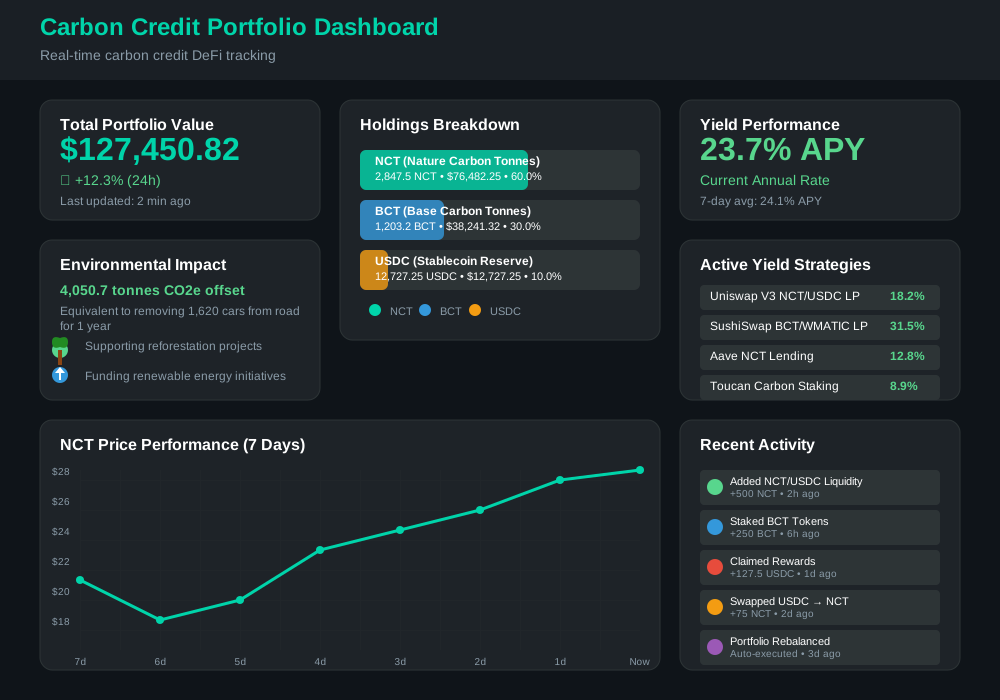
Yield Tracking Dashboard
Monitor your carbon credit investments:
// Carbon portfolio analytics
class CarbonPortfolioAnalytics {
    constructor() {
        this.positions = [];
        this.historicalData = [];
    }

    async trackYieldPerformance() {
        const currentPositions = await this.getCurrentPositions();

        const performance = {
            totalValue: 0,
            totalYield: 0,
            apy: 0,
            carbonCreditsOwned: 0
        };

        for (const position of currentPositions) {
            const currentValue = await this.getPositionValue(position);
            const initialValue = position.initialValue;
            const timeHeld = (Date.now() - position.startTime) / (1000 * 60 * 60 * 24); // days

            const positionYield = currentValue - initialValue;
            const positionAPY = (positionYield / initialValue) * (365 / timeHeld) * 100;

            performance.totalValue += currentValue;
            performance.totalYield += positionYield;
            performance.carbonCreditsOwned += position.carbonAmount;
        }

        performance.apy = performance.totalYield / (performance.totalValue - performance.totalYield) * 365 / this.getAverageHoldingPeriod() * 100;

        return performance;
    }

    generateReport() {
        const report = `
# Carbon Credit DeFi Portfolio Report

## Current Holdings
- Total Portfolio Value: $${this.totalValue.toFixed(2)}
- Total Carbon Credits: ${this.carbonCreditsOwned.toFixed(2)} tonnes CO2
- Average APY: ${this.apy.toFixed(2)}%

## Environmental Impact
- Carbon Offset: ${this.carbonCreditsOwned.toFixed(2)} tonnes CO2e
- Equivalent to: ${(this.carbonCreditsOwned * 0.4).toFixed(1)} cars off road for 1 year

## Top Performing Strategies
${this.getTopStrategies()}
        `;

        return report;
    }
}
Future Developments and Roadmap
Upcoming Features
Toucan Protocol continues evolving with several exciting developments:
Enhanced Pool Mechanisms: New specialized carbon pools for specific project types (forestry, renewable energy, direct air capture) will provide more targeted investment opportunities.
Cross-Chain Expansion: Integration with Ethereum mainnet, Arbitrum, and other Layer 2 solutions will increase accessibility and reduce transaction costs.
Institutional Tools: Advanced portfolio management features, ESG reporting, and compliance tools designed for institutional investors entering the carbon credit space.
Integration Possibilities
Carbon Credit Derivatives: Development of futures, options, and other derivative products based on NCT and BCT tokens.
DAO Governance: Community-driven decision making for pool parameters, fee structures, and protocol upgrades.
Insurance Protocols: Integration with decentralized insurance to protect against carbon credit defaults or verification failures.
Conclusion
Toucan Protocol Yield transforms traditional carbon markets through innovative DeFi integration. By tokenizing carbon credits as NCT and BCT tokens, the protocol creates sustainable yield opportunities while supporting global climate initiatives.
The platform's integration with major DeFi protocols like Uniswap, Aave, and SushiSwap provides multiple avenues for yield generation. From simple liquidity provision to complex arbitrage strategies, carbon credit tokenization offers both financial returns and environmental impact.
Smart contract security, proper risk management, and continuous monitoring remain essential for successful carbon credit DeFi participation. As the regenerative finance sector grows, Toucan Protocol positions itself at the forefront of sustainable blockchain innovation.
Start your carbon credit DeFi journey today by exploring NCT and BCT token opportunities on Polygon. Connect your wallet, add liquidity to carbon pools, and begin earning yield while supporting global decarbonization efforts.
This article provides educational information about Toucan Protocol and carbon credit tokenization. Always conduct thorough research and consider consulting with financial advisors before making investment decisions. Past performance does not guarantee future results.