Picture this: You're a DeFi developer sitting in a pristine Swiss café in Zug, sipping overpriced coffee while your yield farming smart contract churns out 300% APY. Everything seems perfect until FINMA knocks on your digital door. Welcome to Switzerland's Crypto Valley, where precision meets pandemonium in the most regulated yet crypto-friendly way imaginable.
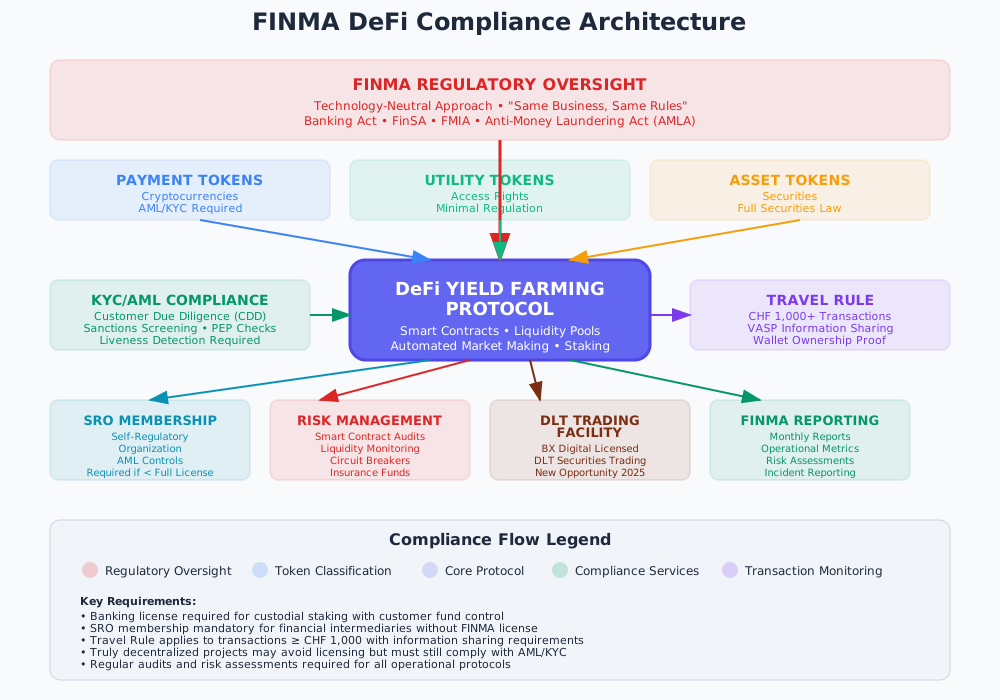
Switzerland has become the unlikely hero of DeFi regulation—not by creating mountains of red tape, but by applying Swiss precision to an inherently chaotic ecosystem. FINMA, according to its annual report, applies the existing financial market legislation, including any licensing requirements, in a technology-neutral way, including to DeFi projects.
This guide reveals exactly how to navigate Switzerland's DeFi regulations, comply with FINMA requirements, and build yield farming protocols that won't land you in regulatory hot water.
The Swiss Approach: "Same Business, Same Rules" Philosophy
Understanding FINMA's DeFi Framework
Switzerland has no specific prohibitions or restrictions in place with respect to fintech businesses or cryptocurrency-related activities, but general Swiss laws and regulations for the financial sector apply. This technology-neutral approach means your DeFi protocol gets judged by what it does, not how it does it.
FINMA categorizes all tokens into three distinct buckets:
Payment Tokens (Cryptocurrencies): Pure digital cash equivalents
Utility Tokens: Access keys to applications or services
Asset Tokens: Digital representations of traditional securities
Your yield farming protocol's regulatory requirements depend entirely on which category your tokens fall into. Get this wrong, and you'll face licensing requirements that make traditional banking look simple.
The Crypto Valley Advantage
One association that has been established in Zug is the "Crypto Valley Association," On its website it describes itself as "an independent, government-supported association established to take full advantage of Switzerland's strengths to build the world's leading blockchain and cryptographic technologies ecosystem."
Crypto Valley isn't just marketing fluff—it's a regulatory sandbox with real benefits:
- Direct communication channels with FINMA
- Industry roundtables for regulatory clarity
- Government support for blockchain innovation
- The Commercial Register Office in the Canton of Zug started accepting bitcoin and ether as payment for administrative costs
Yield Farming Compliance: The Technical Requirements
Smart Contract Audit Requirements
Every yield farming protocol operating in Switzerland must undergo rigorous security audits. Here's the minimum compliance framework:
// FINMA-Compliant Yield Farming Contract Structure
pragma solidity ^0.8.19;

import "@openzeppelin/contracts/security/ReentrancyGuard.sol";
import "@openzeppelin/contracts/access/AccessControl.sol";

contract FinmaCompliantYieldFarm is ReentrancyGuard, AccessControl {
    bytes32 public constant COMPLIANCE_OFFICER_ROLE = keccak256("COMPLIANCE_OFFICER");

    // FINMA requires clear separation of customer funds
    mapping(address => uint256) private customerDeposits;
    mapping(address => bool) private kycApproved;

    event ComplianceCheck(address indexed user, bool approved);
    event FundsSegregated(address indexed customer, uint256 amount);

    modifier onlyKycApproved() {
        require(kycApproved[msg.sender], "KYC verification required");
        _;
    }

    // Mandatory customer due diligence
    function performKyc(address customer) external onlyRole(COMPLIANCE_OFFICER_ROLE) {
        kycApproved[customer] = true;
        emit ComplianceCheck(customer, true);
    }

    // Segregated customer fund handling
    function depositFunds() external payable onlyKycApproved nonReentrant {
        customerDeposits[msg.sender] += msg.value;
        emit FundsSegregated(msg.sender, msg.value);
    }
}
AML/KYC Implementation
FINMA requires regulated companies to verify a presented applicant is indeed a real person and conduct comprehensive customer due diligence. Your yield farming platform needs these compliance features:
// KYC Verification Service Integration
class FinmaKycService {
    constructor(apiKey) {
        this.apiKey = apiKey;
        this.complianceEndpoint = 'https://api.swiss-kyc.ch/v1/verify';
    }

    async verifyCustomer(customerData) {
        const verification = {
            // Liveness detection requirement
            biometricCheck: await this.performLivenessDetection(customerData.photo),

            // Identity document verification
            documentVerification: await this.verifyIdentityDocument(customerData.document),

            // Sanctions screening
            sanctionsCheck: await this.screenAgainstSanctions(customerData.personalInfo),

            // PEP (Politically Exposed Person) screening
            pepScreening: await this.checkPepStatus(customerData.personalInfo),

            // Address verification
            addressVerification: await this.verifyResidentialAddress(customerData.address)
        };

        return this.submitToFinma(verification);
    }

    async performLivenessDetection(photo) {
        // FINMA requires proof of real person
        return await this.biometricApi.verifyLiveness(photo);
    }

    async screenAgainstSanctions(personalInfo) {
        // Check against global watchlists
        const sanctionsList = await this.getSanctionsList();
        return !sanctionsList.includes(personalInfo.name);
    }
}
The Travel Rule: CHF 1,000 Threshold
The crypto Travel Rule entered into force on January 1st, 2020. It requires VASPs to implement the travel rule for transactions above $1000 (1,000 CHF) and prove ownership of non-custodial wallets.
This creates specific compliance requirements for yield farming platforms:
// Travel Rule Compliance Implementation
class TravelRuleCompliance {
    constructor() {
        this.threshold = 1000; // CHF
        this.finmaEndpoint = 'https://api.finma.ch/travel-rule/report';
    }

    async processTransaction(transaction) {
        if (transaction.amount >= this.threshold) {
            // Mandatory information collection
            const travelRuleData = {
                originatorInfo: {
                    name: transaction.sender.name,
                    address: transaction.sender.address,
                    accountIdentifier: transaction.sender.wallet,
                    nationalId: transaction.sender.nationalId
                },
                beneficiaryInfo: {
                    name: transaction.recipient.name,
                    address: transaction.recipient.address,
                    accountIdentifier: transaction.recipient.wallet,
                    nationalId: transaction.recipient.nationalId
                },
                transactionData: {
                    amount: transaction.amount,
                    currency: transaction.currency,
                    purpose: 'yield_farming_deposit',
                    timestamp: new Date().toISOString()
                }
            };

            // Submit to counterparty VASP
            await this.transmitTravelRuleData(travelRuleData);

            // Report to FINMA if required
            if (this.requiresFinmaReporting(transaction)) {
                await this.reportToFinma(travelRuleData);
            }
        }

        return this.executeTransaction(transaction);
    }

    async verifyWalletOwnership(walletAddress, customerData) {
        // FINMA requires proof of wallet ownership
        const challenge = this.generateChallenge();
        const signature = await this.requestSignature(walletAddress, challenge);

        return this.verifySignature(signature, challenge, walletAddress);
    }
}
Staking vs Banking: The Fine Line
FINMA, the Swiss financial regulator, is considering a change to its current practice, which means that crypto service providers offering staking services shall hold a banking licence, arguing that digital and traditional banking risk factors are converging.
The distinction matters enormously for yield farming protocols:
Safe Harbor: Non-Custodial Staking
// Non-custodial staking (generally no banking license required)
contract NonCustodialStaking {
    mapping(address => uint256) public stakedBalances;

    function stake() external payable {
        // User retains control of private keys
        // Protocol merely coordinates staking rewards
        stakedBalances[msg.sender] += msg.value;
        // Emit staking event to validators
    }
}
Banking Territory: Custodial Services
// Custodial staking (may require banking license)
contract CustodialStaking {
    mapping(address => uint256) private customerFunds;
    address private operatorWallet;

    function acceptDeposit() external payable {
        // Operator controls customer funds = banking activity
        customerFunds[msg.sender] += msg.value;
        // Transfer to operator-controlled wallet
        payable(operatorWallet).transfer(msg.value);
    }
}
DLT Trading Facility: The New Opportunity
FINMA authorised the first DLT trading facility, BX Digital, on 18 March 2025. This creates new opportunities for compliant yield farming protocols:
// DLT Trading Facility Integration
class DltTradingIntegration {
    constructor(facilityLicense) {
        this.license = facilityLicense;
        this.bxDigitalApi = 'https://api.bxdigital.ch/v1/';
    }

    async createYieldFarmingProduct() {
        const product = {
            type: 'DLT_SECURITY',
            underlyingAsset: 'yield_farming_pool',
            regulatoryClassification: 'asset_token',
            finmaApproval: true,
            tradingFacility: 'BX_DIGITAL',

            // Mandatory disclosures
            riskDisclosures: {
                smartContractRisk: true,
                impermanentLoss: true,
                liquidityRisk: true,
                regulatoryRisk: true
            },

            // Investor protection measures
            investorProtection: {
                qualifiedInvestorOnly: false,
                minimumInvestment: 1000, // CHF
                maximumExposure: 0.05, // 5% of portfolio
                coolingOffPeriod: 86400 // 24 hours
            }
        };

        return await this.submitToFinma(product);
    }
}
Practical Implementation Steps
Step 1: Regulatory Classification
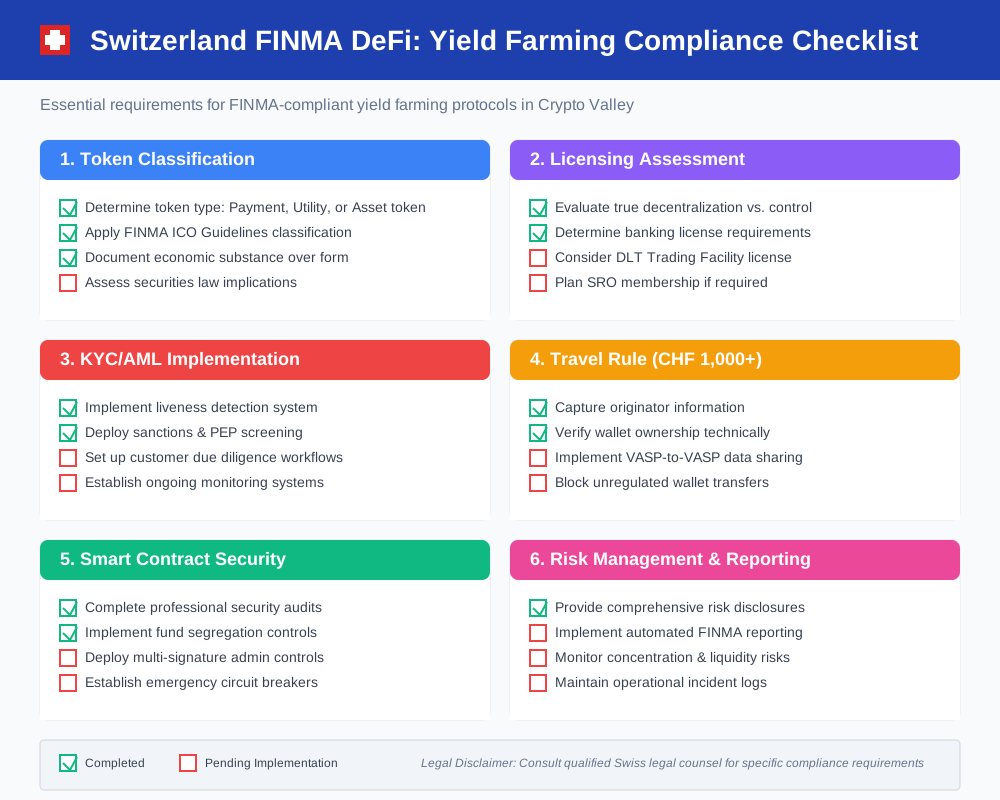
Before writing a single line of code, determine your token classification using FINMA's three-category system.
Step 2: Licensing Assessment
As a rule of thumb, truly decentralised projects would typically not trigger licensing requirements in Switzerland, whereas for projects where an individual or legal entity in Switzerland either provides financial services in relation to such DeFi project or actually controls the underlying assets or even the DeFi project itself (eg, by way of governance tokens), licensing requirements under Swiss financial market laws may be triggered.
Step 3: SRO Membership
Join a Self-Regulatory Organization for AML compliance if you don't qualify for full FINMA licensing.
Step 4: Technical Implementation
Deploy smart contracts with built-in compliance features, KYC integration, and audit trails.
Step 5: Ongoing Monitoring
Implement continuous compliance monitoring and regular reporting to relevant authorities.
Risk Management Framework
// Comprehensive Risk Management System
class FinmaRiskManagement {
    constructor() {
        this.riskThresholds = {
            maxPoolConcentration: 0.20, // 20% max in single pool
            maxUserExposure: 0.10, // 10% of total protocol TVL
            liquidityReserve: 0.15, // 15% emergency reserve
            geographicDiversification: true
        };
    }

    async assessProtocolRisk() {
        const risks = {
            smartContractRisk: await this.auditSmartContracts(),
            liquidityRisk: await this.assessLiquidityDepth(),
            concentrationRisk: await this.analyzePoolConcentration(),
            operationalRisk: await this.evaluateOperationalControls(),
            regulatoryRisk: await this.monitorRegulatoryChanges()
        };

        return this.generateRiskReport(risks);
    }

    async implementSafeguards() {
        // Circuit breakers for extreme market conditions
        await this.deployCircuitBreakers();

        // Insurance fund for protocol failures
        await this.establishInsuranceFund();

        // Multi-signature controls for admin functions
        await this.setupMultiSigControls();

        // Regular security audits
        await this.scheduleSecurityAudits();
    }
}
FINMA Reporting Requirements
Your yield farming protocol needs automated reporting capabilities:
// Automated FINMA Reporting System
class FinmaReporting {
    constructor(license) {
        this.reportingApi = 'https://api.finma.ch/reporting/v1/';
        this.license = license;
    }

    async generateMonthlyReport() {
        const report = {
            licensee: this.license,
            reportingPeriod: this.getCurrentMonth(),

            // Operational metrics
            totalValueLocked: await this.getTotalValueLocked(),
            activeUsers: await this.getActiveUserCount(),
            transactionVolume: await this.getTransactionVolume(),

            // Risk metrics
            liquidityRatio: await this.calculateLiquidityRatio(),
            concentrationRisk: await this.measureConcentrationRisk(),
            defaultRate: await this.calculateDefaultRate(),

            // Compliance metrics
            kycCompletionRate: await this.getKycCompletionRate(),
            sanctionsScreeningResults: await this.getSanctionsScreeningResults(),
            travelRuleCompliance: await this.getTravelRuleCompliance(),

            // Incident reporting
            securityIncidents: await this.getSecurityIncidents(),
            operationalFailures: await this.getOperationalFailures(),
            customerComplaints: await this.getCustomerComplaints()
        };

        return await this.submitToFinma(report);
    }
}
Common Compliance Pitfalls to Avoid
Pitfall 1: Assuming True Decentralization
Many projects claim decentralization to avoid regulation but maintain operational control through governance tokens or admin keys.
Pitfall 2: Ignoring Token Classification
Mislabeling utility tokens that function as securities leads to enforcement action.
Pitfall 3: Inadequate KYC Procedures
Implementing basic identity verification without proper sanctions screening and PEP checks.
Pitfall 4: Missing Travel Rule Implementation
Failing to implement proper information sharing for transactions above CHF 1,000.
Pitfall 5: Insufficient Risk Disclosures
Not properly communicating smart contract risks, impermanent loss, and liquidation scenarios to users.
The Bottom Line: Compliance as Competitive Advantage
Switzerland's regulatory approach transforms compliance from a burden into a competitive advantage. While other jurisdictions struggle with unclear rules, Switzerland offers:
- Regulatory Clarity: Know exactly what's required upfront
- Market Access: Direct access to European institutional investors
- Innovation Space: Regulatory sandboxes for testing new concepts
- International Recognition: Swiss compliance recognized globally
Switzerland provides a formal process for listing cryptocurrencies and legally operating, for which a license from the Swiss Financial Market Supervisory Authority is required.
Your yield farming protocol doesn't just need to comply with FINMA regulations—it needs to embrace them as a foundation for sustainable growth. Swiss precision meets DeFi innovation in Crypto Valley, creating opportunities for protocols that get compliance right from day one.
The future belongs to compliant DeFi protocols that combine innovation with institutional-grade risk management. In Switzerland, that future is already here—you just need to know how to navigate it.
Ready to build your FINMA-compliant yield farming protocol? Start with proper token classification, implement robust KYC procedures, and embrace the regulatory clarity that makes Switzerland the global leader in cryptocurrency regulation.