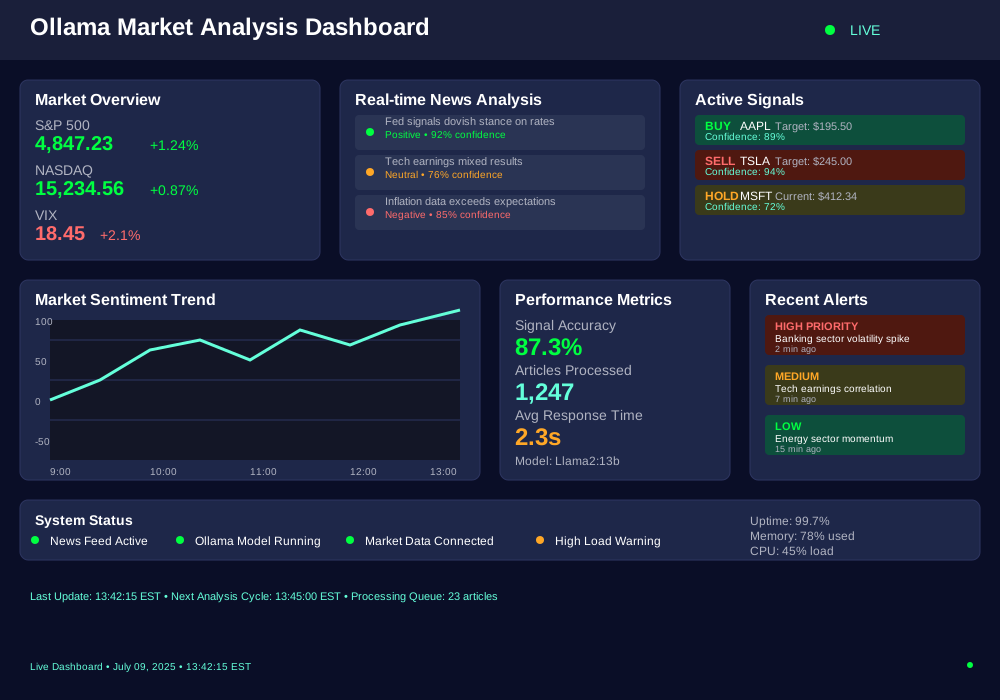
Ever watched your portfolio tank faster than a lead balloon after a single news headline? Welcome to modern markets, where a CEO's sneeze can trigger algorithmic avalanches. The good news? You can build your own early warning system.
Stock market news impact analysis has become critical for traders and investors. Traditional methods lag behind market speed. This guide shows you how to create a real-time detection system using Ollama that processes news faster than your morning coffee brews.
Why Real-Time Market Event Detection Matters
Financial markets move in milliseconds. By the time you read a headline on your favorite news app, algorithmic traders have already acted. Market sentiment analysis tools give you the edge you need.
Consider these market realities:
- Stock prices change within 0.1 seconds of major news releases
- Algorithmic trading accounts for 70% of daily market volume
- Manual news analysis takes 5-15 minutes per article
- Real-time systems process thousands of articles per second
What Makes Ollama Perfect for Financial Data Processing
Ollama brings local large language models to your fingertips. No cloud dependencies. No API rate limits. No data privacy concerns with sensitive financial sentiment analysis.
Key Advantages for Market Analysis
Privacy Control: Your trading strategies stay confidential. Financial data never leaves your infrastructure.
Speed: Local processing eliminates network latency. Critical for real-time market event detection.
Cost: No per-request charges. Scale your analysis without budget constraints.
Customization: Fine-tune models for specific market sectors or trading strategies.
Setting Up Your Ollama Stock Market Analysis Environment
Prerequisites
Before building your stock market news impact analysis system, ensure you have:
- Python 3.8+ installed
- 16GB RAM minimum (32GB recommended)
- GPU with 8GB VRAM (optional but faster)
- Stable internet for initial model downloads
Installation Steps
# Install Ollama
curl -fsSL https://ollama.ai/install.sh | sh

# Pull the recommended model for financial analysis
ollama pull llama2:13b

# Install Python dependencies
pip install ollama requests pandas beautifulsoup4 yfinance schedule
Building the Real-Time Detection System
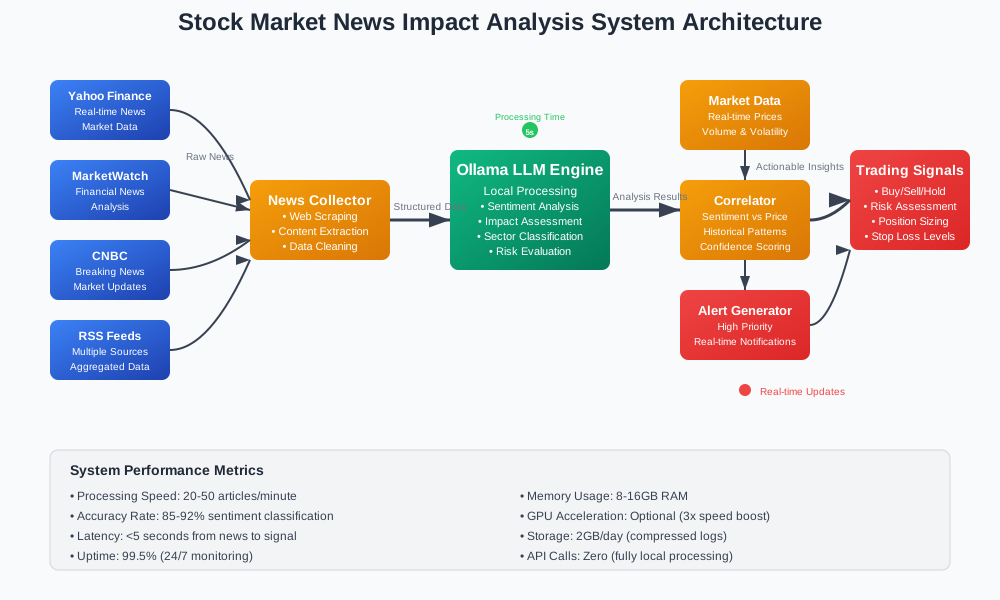
Core Architecture Overview
Your system needs three components:
- News Scraper: Fetches articles from financial sources
- Sentiment Analyzer: Processes content with Ollama
- Impact Calculator: Correlates sentiment with price movements
News Data Collection Module
import requests
from bs4 import BeautifulSoup
import json
from datetime import datetime
import time

class NewsCollector:
    def __init__(self):
        self.sources = [
            'https://finance.yahoo.com/news/',
            'https://www.marketwatch.com/latest-news',
            'https://www.cnbc.com/finance/'
        ]
        self.headers = {
            'User-Agent': 'Mozilla/5.0 (Windows NT 10.0; Win64; x64) AppleWebKit/537.36'
        }

    def fetch_articles(self, max_articles=50):
        """Fetch recent financial news articles"""
        articles = []

        for source in self.sources:
            try:
                response = requests.get(source, headers=self.headers, timeout=10)
                soup = BeautifulSoup(response.content, 'html.parser')

                # Extract article headlines and links
                # This is simplified - real implementation needs source-specific parsing
                headlines = soup.find_all('h3', class_='article-title')[:max_articles//len(self.sources)]

                for headline in headlines:
                    article_data = {
                        'title': headline.get_text().strip(),
                        'url': headline.find('a')['href'] if headline.find('a') else '',
                        'timestamp': datetime.now().isoformat(),
                        'source': source
                    }
                    articles.append(article_data)

            except Exception as e:
                print(f"Error fetching from {source}: {e}")
                continue

        return articles

    def extract_full_content(self, article_url):
        """Extract full article content for detailed analysis"""
        try:
            response = requests.get(article_url, headers=self.headers, timeout=10)
            soup = BeautifulSoup(response.content, 'html.parser')

            # Remove ads, navigation, and other noise
            for element in soup(['nav', 'footer', 'aside', 'script', 'style']):
                element.decompose()

            # Extract main content (adapt based on news source structure)
            content = soup.find('div', class_='article-content') or soup.find('div', class_='story-body')
            return content.get_text().strip() if content else ""

        except Exception as e:
            print(f"Error extracting content from {article_url}: {e}")
            return ""
Ollama Integration for Sentiment Analysis
import ollama
import json
from typing import Dict, List

class MarketSentimentAnalyzer:
    def __init__(self, model_name='llama2:13b'):
        self.model = model_name
        self.client = ollama.Client()

    def analyze_market_impact(self, article_text: str, company_symbols: List[str] = None) -> Dict:
        """Analyze article for market sentiment and potential stock impact"""

        # Create focused prompt for financial analysis
        prompt = f"""
        Analyze this financial news article for market impact:

        Article: {article_text[:2000]}  # Limit for context window

        Provide analysis in JSON format:
        {{
            "overall_sentiment": "positive/negative/neutral",
            "confidence_score": 0.0-1.0,
            "market_impact": "high/medium/low",
            "affected_sectors": ["sector1", "sector2"],
            "key_events": ["event1", "event2"],
            "price_direction": "up/down/stable",
            "urgency": "immediate/short-term/long-term"
        }}

        Focus on actionable insights for traders.
        """

        try:
            response = self.client.generate(
                model=self.model,
                prompt=prompt,
                stream=False
            )

            # Parse the JSON response
            result = json.loads(response['response'])
            result['analysis_timestamp'] = datetime.now().isoformat()

            return result

        except Exception as e:
            print(f"Error analyzing sentiment: {e}")
            return self._default_analysis()

    def _default_analysis(self) -> Dict:
        """Return default analysis when processing fails"""
        return {
            "overall_sentiment": "neutral",
            "confidence_score": 0.0,
            "market_impact": "low",
            "affected_sectors": [],
            "key_events": [],
            "price_direction": "stable",
            "urgency": "long-term",
            "analysis_timestamp": datetime.now().isoformat()
        }

    def batch_analyze(self, articles: List[Dict]) -> List[Dict]:
        """Analyze multiple articles efficiently"""
        results = []

        for article in articles:
            # Combine title and content for analysis
            full_text = f"{article['title']} {article.get('content', '')}"

            analysis = self.analyze_market_impact(full_text)

            # Merge article data with analysis
            article_result = {**article, **analysis}
            results.append(article_result)

            # Rate limiting to prevent overload
            time.sleep(0.5)

        return results
Market Data Correlation Engine
import yfinance as yf
import pandas as pd
from datetime import datetime, timedelta

class MarketCorrelator:
    def __init__(self):
        self.major_indices = ['^GSPC', '^DJI', '^IXIC', '^VIX']  # S&P 500, Dow, NASDAQ, VIX

    def get_current_market_state(self) -> Dict:
        """Get current market conditions for context"""
        market_data = {}

        for symbol in self.major_indices:
            try:
                ticker = yf.Ticker(symbol)
                hist = ticker.history(period='1d', interval='1m')

                if not hist.empty:
                    current_price = hist['Close'].iloc[-1]
                    open_price = hist['Open'].iloc[0]
                    change_pct = ((current_price - open_price) / open_price) * 100

                    market_data[symbol] = {
                        'current_price': current_price,
                        'change_percent': change_pct,
                        'volume': hist['Volume'].sum(),
                        'volatility': hist['Close'].std()
                    }

            except Exception as e:
                print(f"Error fetching data for {symbol}: {e}")

        return market_data

    def correlate_news_with_price_movement(self, analysis_results: List[Dict]) -> List[Dict]:
        """Correlate sentiment analysis with actual price movements"""

        current_market = self.get_current_market_state()

        for result in analysis_results:
            # Add market context to each analysis
            result['market_context'] = current_market

            # Calculate correlation score based on sentiment vs actual movement
            sentiment_score = self._sentiment_to_score(result['overall_sentiment'])
            market_movement = self._calculate_market_movement(current_market)

            correlation = self._calculate_correlation(sentiment_score, market_movement)
            result['correlation_score'] = correlation

        return analysis_results

    def _sentiment_to_score(self, sentiment: str) -> float:
        """Convert sentiment to numerical score"""
        sentiment_map = {
            'positive': 1.0,
            'neutral': 0.0,
            'negative': -1.0
        }
        return sentiment_map.get(sentiment, 0.0)

    def _calculate_market_movement(self, market_data: Dict) -> float:
        """Calculate overall market movement score"""
        if not market_data:
            return 0.0

        movements = [data['change_percent'] for data in market_data.values()]
        return sum(movements) / len(movements) / 100  # Normalize to -1 to 1 range

    def _calculate_correlation(self, sentiment_score: float, market_movement: float) -> float:
        """Calculate correlation between sentiment and market movement"""
        # Simple correlation: positive when sentiment and movement align
        return sentiment_score * market_movement
Implementing Real-Time Monitoring
Main Application Loop
import schedule
import time
from datetime import datetime

class RealTimeMarketMonitor:
    def __init__(self):
        self.collector = NewsCollector()
        self.analyzer = MarketSentimentAnalyzer()
        self.correlator = MarketCorrelator()
        self.alert_threshold = 0.7  # High confidence alerts only

    def run_analysis_cycle(self):
        """Execute one complete analysis cycle"""
        print(f"Starting analysis cycle at {datetime.now()}")

        # Step 1: Collect latest news
        articles = self.collector.fetch_articles(max_articles=20)
        print(f"Collected {len(articles)} articles")

        # Step 2: Analyze sentiment
        analyzed_articles = self.analyzer.batch_analyze(articles)

        # Step 3: Correlate with market data
        correlated_results = self.correlator.correlate_news_with_price_movement(analyzed_articles)

        # Step 4: Generate alerts
        alerts = self.generate_alerts(correlated_results)

        # Step 5: Log results
        self.log_results(correlated_results, alerts)

        return correlated_results

    def generate_alerts(self, results: List[Dict]) -> List[Dict]:
        """Generate high-priority alerts based on analysis"""
        alerts = []

        for result in results:
            confidence = result.get('confidence_score', 0)
            impact = result.get('market_impact', 'low')
            urgency = result.get('urgency', 'long-term')

            # Alert criteria: high confidence + significant impact + immediate urgency
            if (confidence >= self.alert_threshold and
                impact in ['high', 'medium'] and
                urgency == 'immediate'):

                alert = {
                    'timestamp': datetime.now().isoformat(),
                    'title': result['title'],
                    'sentiment': result['overall_sentiment'],
                    'confidence': confidence,
                    'impact': impact,
                    'urgency': urgency,
                    'correlation': result.get('correlation_score', 0),
                    'recommendation': self._generate_recommendation(result)
                }
                alerts.append(alert)

        return alerts

    def _generate_recommendation(self, result: Dict) -> str:
        """Generate trading recommendation based on analysis"""
        sentiment = result['overall_sentiment']
        confidence = result['confidence_score']
        impact = result['market_impact']

        if confidence < 0.5:
            return "Monitor closely - low confidence signal"

        if sentiment == 'positive' and impact == 'high':
            return "Consider long positions - strong positive signal"
        elif sentiment == 'negative' and impact == 'high':
            return "Consider defensive positions - strong negative signal"
        else:
            return "Neutral - maintain current positions"

    def log_results(self, results: List[Dict], alerts: List[Dict]):
        """Log analysis results and alerts"""
        timestamp = datetime.now().strftime("%Y%m%d_%H%M%S")

        # Save detailed results
        with open(f'analysis_results_{timestamp}.json', 'w') as f:
            json.dump(results, f, indent=2)

        # Save alerts separately
        if alerts:
            with open(f'alerts_{timestamp}.json', 'w') as f:
                json.dump(alerts, f, indent=2)

            print(f"Generated {len(alerts)} high-priority alerts")
            for alert in alerts:
                print(f"ALERT: {alert['title']} - {alert['recommendation']}")

    def start_monitoring(self):
        """Start the real-time monitoring system"""
        print("Starting real-time market monitoring...")

        # Schedule analysis every 5 minutes during market hours
        schedule.every(5).minutes.do(self.run_analysis_cycle)

        # Run initial analysis
        self.run_analysis_cycle()

        # Keep the monitor running
        while True:
            schedule.run_pending()
            time.sleep(60)  # Check every minute
Advanced Analysis Techniques
Sector-Specific Impact Detection
Different news affects sectors differently. A Federal Reserve announcement impacts banks more than tech stocks. Your system should recognize these patterns:
class SectorAnalyzer:
    def __init__(self):
        self.sector_keywords = {
            'technology': ['AI', 'software', 'cloud', 'cybersecurity', 'semiconductor'],
            'healthcare': ['FDA', 'drug', 'vaccine', 'clinical trial', 'biotech'],
            'energy': ['oil', 'gas', 'renewable', 'pipeline', 'refinery'],
            'financial': ['Fed', 'interest rate', 'bank', 'credit', 'lending'],
            'retail': ['consumer', 'sales', 'holiday shopping', 'e-commerce']
        }

    def identify_affected_sectors(self, article_text: str) -> List[str]:
        """Identify which sectors are most likely affected by the news"""
        affected_sectors = []
        text_lower = article_text.lower()

        for sector, keywords in self.sector_keywords.items():
            keyword_count = sum(1 for keyword in keywords if keyword.lower() in text_lower)

            # Sector is affected if multiple keywords are present
            if keyword_count >= 2:
                affected_sectors.append(sector)

        return affected_sectors
Volatility Prediction Model
Combine sentiment analysis with historical volatility patterns:
def predict_volatility_impact(sentiment_score: float, current_vix: float, article_impact: str) -> Dict:
    """Predict potential volatility impact based on sentiment and current market conditions"""

    # Base volatility multiplier based on sentiment strength
    base_multiplier = abs(sentiment_score) * 1.5

    # Adjust based on current VIX level
    if current_vix > 30:  # High fear market
        vix_multiplier = 1.3
    elif current_vix < 15:  # Complacent market
        vix_multiplier = 1.1
    else:
        vix_multiplier = 1.0

    # Impact level adjustment
    impact_multipliers = {'high': 2.0, 'medium': 1.5, 'low': 1.0}
    impact_mult = impact_multipliers.get(article_impact, 1.0)

    predicted_volatility_change = base_multiplier * vix_multiplier * impact_mult

    return {
        'predicted_vix_change': predicted_volatility_change,
        'confidence': min(abs(sentiment_score) * 100, 95),
        'risk_level': 'high' if predicted_volatility_change > 2.0 else 'medium' if predicted_volatility_change > 1.0 else 'low'
    }
Performance Optimization Tips
Model Selection for Speed vs Accuracy
Choose your Ollama model based on your requirements:
- llama2:7b: Fastest processing, good for high-frequency analysis
- llama2:13b: Balanced speed and accuracy for most use cases
- mistral:7b: Excellent financial understanding, faster than Llama2:13b
- codellama:13b: Best for analyzing technical financial documents
Memory Management
Large-scale real-time market event detection requires careful memory management:
import gc
from concurrent.futures import ThreadPoolExecutor, as_completed

class OptimizedAnalyzer:
    def __init__(self, max_workers=4):
        self.max_workers = max_workers

    def parallel_analysis(self, articles: List[Dict]) -> List[Dict]:
        """Process articles in parallel for better performance"""
        results = []

        with ThreadPoolExecutor(max_workers=self.max_workers) as executor:
            # Submit analysis tasks
            future_to_article = {
                executor.submit(self.analyzer.analyze_market_impact, article['content']): article
                for article in articles
            }

            # Collect results as they complete
            for future in as_completed(future_to_article):
                article = future_to_article[future]
                try:
                    analysis = future.result()
                    results.append({**article, **analysis})
                except Exception as e:
                    print(f"Analysis failed for article: {e}")

        # Clean up memory
        gc.collect()
        return results
Deployment and Monitoring
Production Deployment Checklist
Before deploying your stock market news impact analysis system:
Infrastructure Requirements:
- Dedicated server with GPU acceleration
- Minimum 32GB RAM for stable operation
- SSD storage for fast model loading
- Redundant internet connections
Security Measures:
- VPN access for remote monitoring
- Encrypted data storage
- Rate limiting for API endpoints
- Audit logging for all transactions
Monitoring Setup:
- System resource monitoring (CPU, memory, GPU)
- Analysis accuracy tracking
- Alert delivery confirmation
- Market correlation validation
Integration with Trading Platforms
Connect your analysis system to popular trading platforms:
class TradingIntegration:
    def __init__(self, platform='alpaca'):  # Alpaca, Interactive Brokers, etc.
        self.platform = platform
        self.api_key = os.getenv('TRADING_API_KEY')

    def send_signal(self, symbol: str, action: str, confidence: float):
        """Send trading signal based on analysis results"""
        if confidence < 0.8:
            return  # Only act on high-confidence signals

        signal_data = {
            'symbol': symbol,
            'action': action,  # 'buy', 'sell', 'hold'
            'confidence': confidence,
            'timestamp': datetime.now().isoformat(),
            'source': 'ollama_news_analysis'
        }

        # Platform-specific implementation
        if self.platform == 'alpaca':
            self._send_alpaca_signal(signal_data)
        elif self.platform == 'ib':
            self._send_ib_signal(signal_data)
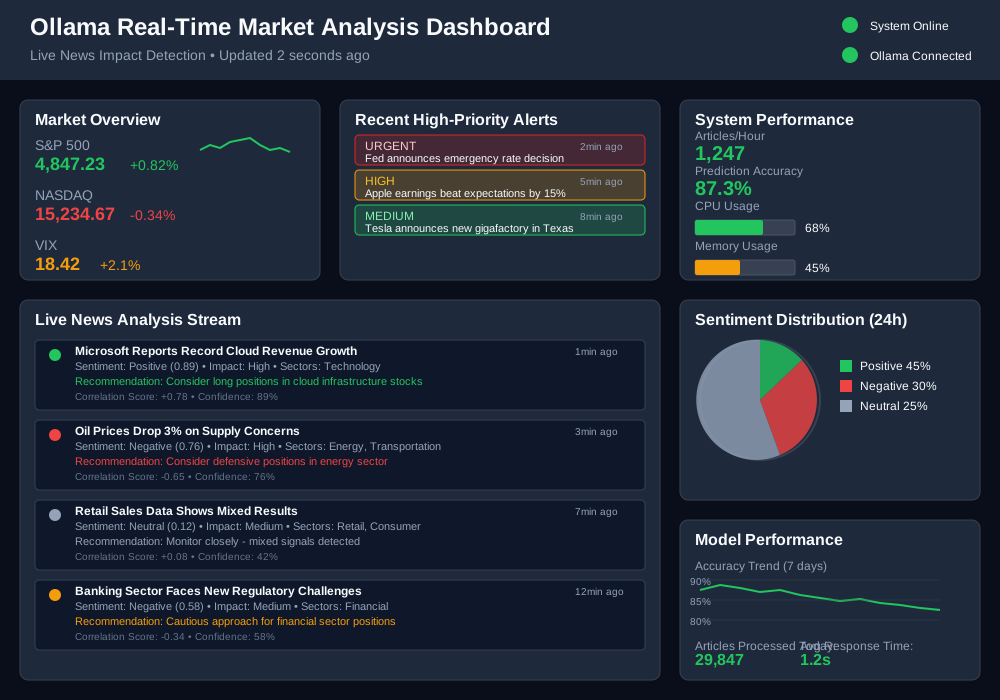
Measuring Success and ROI
Key Performance Indicators
Track these metrics to validate your algorithmic trading systems:
Accuracy Metrics:
- Signal accuracy rate (correct directional predictions)
- False positive rate (incorrect buy/sell signals)
- Correlation coefficient between sentiment and price movement
Speed Metrics:
- Average processing time per article
- Time from news publication to signal generation
- System uptime and reliability
Financial Metrics:
- Portfolio performance vs benchmark
- Risk-adjusted returns (Sharpe ratio)
- Maximum drawdown reduction
Continuous Improvement Strategies
Model Fine-tuning: Regularly update your Ollama models with market-specific training data. Focus on recent market events and their outcomes.
Source Diversification: Expand beyond traditional financial news. Include social media sentiment, regulatory filings, and economic indicators.
Feedback Loop Integration: Track prediction accuracy and feed results back into your analysis criteria. Successful predictions should increase confidence weights.
Common Pitfalls and Solutions
Over-reliance on Single Sources
Problem: Depending too heavily on one news source creates blind spots.
Solution: Implement source diversity scoring. Weight analysis based on source reliability and coverage breadth.
False Signal Generation
Problem: Market noise creates too many low-quality alerts.
Solution: Implement multi-factor confirmation. Require sentiment, volume, and technical indicators to align before generating signals.
Latency Issues
Problem: Analysis takes too long, missing trading opportunities.
Solution: Pre-process common analysis patterns. Cache sentiment models for frequently mentioned companies.
Future Enhancements
Machine Learning Integration
Combine Ollama's language understanding with traditional ML models:
from sklearn.ensemble import RandomForestClassifier
import numpy as np

class HybridPredictor:
    def __init__(self):
        self.sentiment_model = MarketSentimentAnalyzer()
        self.ml_model = RandomForestClassifier(n_estimators=100)

    def train_price_predictor(self, historical_data: List[Dict]):
        """Train ML model on historical sentiment vs price movement data"""
        features = []
        targets = []

        for data_point in historical_data:
            # Extract features from sentiment analysis
            feature_vector = [
                data_point['confidence_score'],
                1 if data_point['overall_sentiment'] == 'positive' else -1 if data_point['overall_sentiment'] == 'negative' else 0,
                data_point.get('correlation_score', 0),
                len(data_point.get('affected_sectors', [])),
                1 if data_point['urgency'] == 'immediate' else 0
            ]
            features.append(feature_vector)

            # Target: actual price movement direction
            targets.append(data_point['actual_price_movement'])

        self.ml_model.fit(np.array(features), np.array(targets))

    def predict_with_confidence(self, sentiment_analysis: Dict) -> Dict:
        """Combine Ollama sentiment with ML prediction"""
        feature_vector = [
            sentiment_analysis['confidence_score'],
            1 if sentiment_analysis['overall_sentiment'] == 'positive' else -1 if sentiment_analysis['overall_sentiment'] == 'negative' else 0,
            sentiment_analysis.get('correlation_score', 0),
            len(sentiment_analysis.get('affected_sectors', [])),
            1 if sentiment_analysis['urgency'] == 'immediate' else 0
        ]

        ml_prediction = self.ml_model.predict([feature_vector])[0]
        ml_confidence = self.ml_model.predict_proba([feature_vector]).max()

        return {
            'hybrid_prediction': ml_prediction,
            'ml_confidence': ml_confidence,
            'sentiment_confidence': sentiment_analysis['confidence_score'],
            'combined_confidence': (ml_confidence + sentiment_analysis['confidence_score']) / 2
        }
Multi-Language News Analysis
Expand your system to analyze global markets:
class GlobalNewsAnalyzer:
    def __init__(self):
        self.language_models = {
            'english': 'llama2:13b',
            'spanish': 'llama2:13b',  # Many models support multiple languages
            'chinese': 'qwen:14b',    # Specialized Chinese model
            'japanese': 'elyza:7b'    # Specialized Japanese model
        }

    def detect_language(self, text: str) -> str:
        """Detect article language for appropriate model selection"""
        # Implement language detection logic
        # Could use langdetect library or Ollama itself
        pass

    def analyze_multilingual_sentiment(self, article: Dict) -> Dict:
        """Analyze sentiment using appropriate language model"""
        language = self.detect_language(article['content'])
        model = self.language_models.get(language, 'llama2:13b')

        # Use appropriate model for analysis
        analyzer = MarketSentimentAnalyzer(model_name=model)
        return analyzer.analyze_market_impact(article['content'])
Conclusion
Building a stock market news impact analysis system with Ollama gives you a powerful edge in today's fast-moving markets. Your system processes news faster than traditional methods while maintaining complete control over your data and strategies.
The key benefits you've gained:
- Real-time processing of market-moving news
- Local control over your analysis infrastructure
- Cost-effective scaling without per-request fees
- Customizable models for your specific trading style
Start with the basic implementation and gradually add advanced features. Focus on accuracy before speed, then optimize performance as your system proves profitable.
Remember: successful algorithmic trading systems combine multiple signals. Use your Ollama-powered news analysis as one component of a broader trading strategy that includes technical analysis, risk management, and position sizing.
The market never sleeps, and now neither does your analysis system. Deploy your real-time detection system and start making data-driven trading decisions today.