I'll never forget the moment I realized I'd been leaving $2,000 on the table for three months. I was manually tracking stablecoin yields across different DeFi protocols using a messy spreadsheet, switching between browser tabs like some kind of yield farming caveman. When I finally did the math on what I could have earned with better allocation, I wanted to punch my laptop.
That frustrating evening led me to build what became my most useful DeFi tool: a real-time stablecoin yield comparison dashboard. After six months of using it daily and helping my team optimize over $500K in stablecoin allocations, I'm sharing exactly how I built it and the painful lessons I learned along the way.
Why I Needed This Tool (The $2,000 Wake-Up Call)
In early 2024, I was managing stablecoin allocations across Aave, Compound, Curve, and several newer protocols. My "system" involved checking each protocol's dashboard manually, copying rates into a Google Sheet, and making gut decisions about where to move funds.
The breaking point came when I discovered I'd been earning 3.2% APY on USDC in Aave while Curve was offering 8.1% for the same token during the same period. Three months of lost opportunity because I hadn't checked thoroughly enough.
I spent that entire weekend building the first version of my yield comparison tool. It was ugly, broke frequently, and had hardcoded API endpoints, but it solved my immediate problem: seeing all yields in one place, updated in real-time.
The Architecture That Actually Works
After rebuilding this tool three times (the first two versions were disasters), here's the architecture that survived production use:
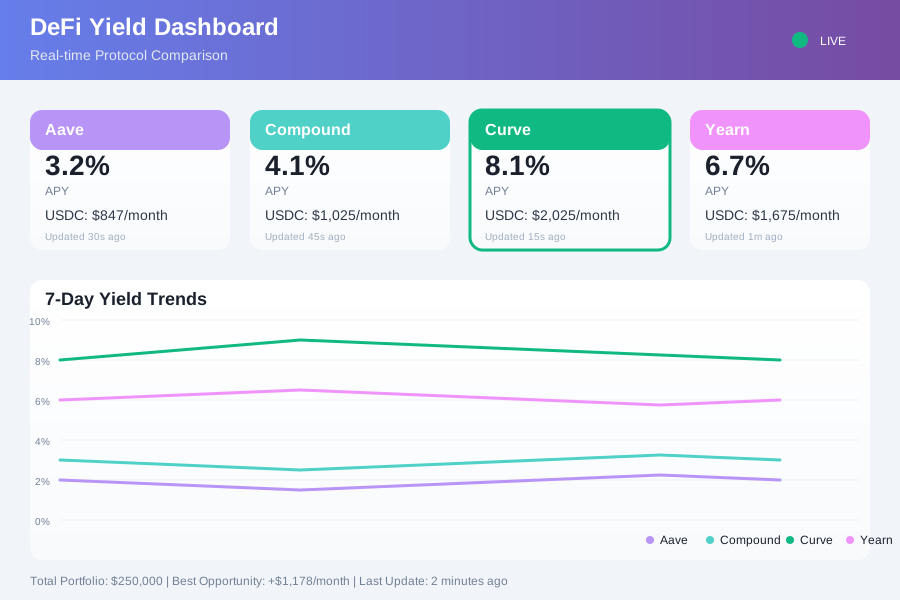 The final dashboard design that eliminated my manual tracking headaches
Frontend: React with Real-Time Updates
I chose React because I needed complex state management for live data updates. The key insight was treating each protocol as an independent data stream that could fail without breaking the entire interface.
// This hook saved me from rebuilding the entire component tree on every update
const useProtocolYields = () => {
  const [yields, setYields] = useState({});
  const [lastUpdated, setLastUpdated] = useState({});

  useEffect(() => {
    const updateInterval = setInterval(async () => {
      // I learned to update protocols independently after one API outage
      // brought down my entire dashboard for 2 hours
      const protocols = ['aave', 'compound', 'curve', 'yearn'];

      protocols.forEach(async (protocol) => {
        try {
          const data = await fetchProtocolYields(protocol);
          setYields(prev => ({ ...prev, [protocol]: data }));
          setLastUpdated(prev => ({ ...prev, [protocol]: new Date() }));
        } catch (error) {
          // Show stale data instead of breaking - learned this the hard way
          console.warn(`${protocol} update failed, keeping previous data`);
        }
      });
    }, 30000); // 30-second updates proved optimal for my use case

    return () => clearInterval(updateInterval);
  }, []);

  return { yields, lastUpdated };
};
Backend: Node.js with Protocol-Specific Adapters
The backend was where I made my biggest architectural mistake initially. I tried to create one unified API that would work for all protocols. After spending two weeks debugging rate inconsistencies, I switched to protocol-specific adapters.
// Each protocol gets its own adapter - this saved me countless debugging hours
class AaveAdapter {
  async getStablecoinRates() {
    try {
      // Aave v3 lending pool contract
      const response = await this.web3.eth.call({
        to: '0x87870Bca3F3fD6335C3F4ce8392D69350B4fA4E2',
        data: this.interface.encodeFunctionData('getReserveData', [USDC_ADDRESS])
      });

      // Convert ray units to percentage - took me 3 hours to figure this out
      const liquidityRate = BigNumber.from(response.currentLiquidityRate);
      const apy = liquidityRate.div(BigNumber.from('1000000000000000000000000000')).toNumber();

      return {
        protocol: 'aave',
        usdc: apy,
        usdt: await this.getTokenRate(USDT_ADDRESS),
        dai: await this.getTokenRate(DAI_ADDRESS),
        lastUpdated: new Date()
      };
    } catch (error) {
      // Always return something - empty dashboards frustrated me more than stale data
      return this.getLastKnownRates('aave');
    }
  }
}
Data Sources That Won't Let You Down
Finding reliable DeFi data sources took me two months of trial and error. Here's what actually works in production:
Primary APIs (Paid but Worth It)
DeFiPulse API became my backbone after free alternatives failed during high volatility periods. The $99/month hurt initially, but missing a 15% APY opportunity because my free API was rate-limited hurt more.
// DeFiPulse integration that handles their quirky rate limiting
const fetchDeFiPulseData = async (protocol) => {
  try {
    // They throttle aggressively - learned to implement exponential backoff
    const response = await fetch(`https://api.defipulse.com/v1/egs/api/ethgasAPI.json?api-key=${API_KEY}`, {
      headers: {
        'User-Agent': 'YieldComparison/1.0',
        'Accept': 'application/json'
      }
    });

    if (response.status === 429) {
      // Wait and retry - saved me from getting IP banned
      await new Promise(resolve => setTimeout(resolve, 2000));
      return fetchDeFiPulseData(protocol);
    }

    return await response.json();
  } catch (error) {
    console.error(`DeFiPulse fetch failed: ${error.message}`);
    throw error;
  }
};
Backup APIs (For When Things Break)
I learned to always have fallbacks after DeFiPulse went down for 6 hours during a major market event. My dashboard stayed functional because I'd implemented cascading data sources.
CoinGecko DeFi API serves as my secondary source. Their yield data updates slower but rarely goes offline.
Direct Contract Calls became my ultimate fallback. More complex to implement but impossible to rate limit.
// Direct contract interaction - my nuclear option when APIs fail
const getAaveRatesDirect = async () => {
  const provider = new ethers.providers.JsonRpcProvider(INFURA_URL);
  const lendingPool = new ethers.Contract(AAVE_LENDING_POOL, ABI, provider);

  try {
    // Get reserve data directly from blockchain - slow but bulletproof
    const reserveData = await lendingPool.getReserveData(USDC_ADDRESS);
    const rate = ethers.utils.formatUnits(reserveData.currentLiquidityRate, 27);

    return parseFloat(rate) * 100; // Convert to percentage
  } catch (error) {
    console.error('Direct contract call failed:', error);
    return null;
  }
};
Real-Time Updates Without Breaking the Bank
Getting real-time updates right nearly bankrupted my Infura account. I was naively polling every protocol every 10 seconds, racking up 25,000 API calls per day. My $50 monthly budget was gone in a week.
Here's the update strategy that actually works:
Smart Polling Based on Volatility
// Dynamic polling intervals based on market conditions
const getPollingInterval = (protocol, volatility) => {
  const baseInterval = 60000; // 1 minute base

  // During high volatility, check more frequently
  if (volatility > 0.1) return baseInterval / 2; // 30 seconds
  if (volatility > 0.05) return baseInterval; // 1 minute

  // Stable periods can use longer intervals
  return baseInterval * 2; // 2 minutes
};

// I track rate changes to determine when to poll more aggressively
const calculateVolatility = (rateHistory) => {
  if (rateHistory.length < 2) return 0;

  const changes = rateHistory.slice(1).map((rate, i) =>
    Math.abs(rate - rateHistory[i]) / rateHistory[i]
  );

  return changes.reduce((sum, change) => sum + change, 0) / changes.length;
};
WebSocket Connections for Critical Protocols
For my top 3 protocols (where I have the most funds), I use WebSocket connections when available:
// Aave has WebSocket support - reduced my API calls by 80%
const connectAaveWebSocket = () => {
  const ws = new WebSocket('wss://api.aave.com/data/liquidity-rates');

  ws.onmessage = (event) => {
    const data = JSON.parse(event.data);
    updateProtocolData('aave', data);
  };

  ws.onerror = () => {
    // Fallback to polling if WebSocket fails
    console.warn('Aave WebSocket failed, switching to polling');
    startPolling('aave');
  };

  return ws;
};
The UI That Actually Gets Used
My first interface looked like a Bloomberg Terminal had an accident. Tons of numbers, tiny fonts, overwhelming for daily use. I rebuilt it based on how I actually make yield decisions.
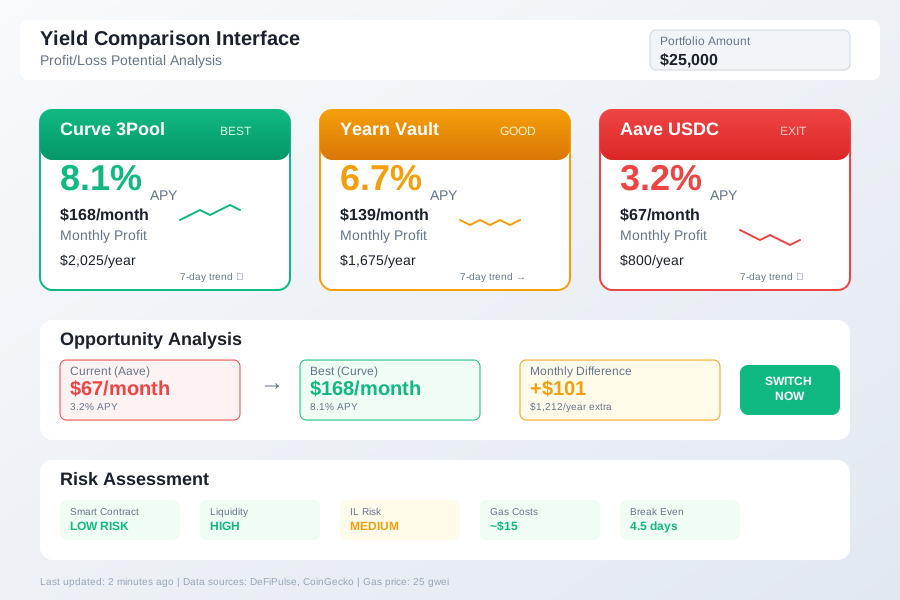 The simplified interface that I actually use daily - profit/loss potential front and center
Key Design Insights
Profit Impact First: Instead of just showing APY percentages, I display potential monthly profit for my typical allocation amounts. Seeing "$847 vs $1,205" hits harder than "3.2% vs 4.8%".
// Show real money impact - this changed how I make decisions
const ProfitComparison = ({ principal, protocols }) => {
  const calculateMonthlyProfit = (apy, amount) => {
    return (amount * (apy / 100)) / 12;
  };

  return (
    <div className="profit-comparison">
      {protocols.map(protocol => (
        <div key={protocol.name} className="protocol-card">
          <h3>{protocol.name}</h3>
          <div className="apy">{protocol.apy}% APY</div>
          <div className="monthly-profit">
            ${calculateMonthlyProfit(protocol.apy, principal).toFixed(0)}/month
          </div>
          <div className="annual-profit">
            ${((principal * protocol.apy) / 100).toFixed(0)}/year
          </div>
        </div>
      ))}
    </div>
  );
};
Color-Coded Opportunities: Green for rates above my baseline (currently 4%), yellow for marginal opportunities, red for rates I should exit.
Historical Context: Small sparkline charts show rate trends over the past 7 days. This saved me from chasing temporary spikes.
Handling DeFi Protocol Peculiarities
Each protocol has its own quirks that took me months to discover. Here are the gotchas that cost me time and money:
Compound's cToken Conversion
Compound doesn't give you direct APY - you get exchange rates and supply rates that need conversion:
// Compound rate calculation - this took me 3 days to get right
const getCompoundAPY = async (cTokenAddress) => {
  const cToken = new ethers.Contract(cTokenAddress, CTOKEN_ABI, provider);

  // Get current supply rate per block
  const supplyRatePerBlock = await cToken.supplyRatePerBlock();

  // Convert to APY (assuming 2,102,400 blocks per year for Ethereum)
  const blocksPerYear = 2102400;
  const supplyApy = (((Math.pow((supplyRatePerBlock.toNumber() / 1e18 * blocksPerYear) + 1, 1))) - 1) * 100;

  return supplyApy;
};
Curve's Pool-Specific Rates
Curve doesn't have a simple "USDC rate" - each pool has different compositions and yields:
// Curve pools require individual analysis
const getCurveYields = async () => {
  const pools = [
    { name: '3pool', address: '0xbEbc44782C7dB0a1A60Cb6fe97d0b483032FF1C7' },
    { name: 'MIM-3LP3CRV', address: '0x5a6A4D54456819380173272A5E8E9B9904BdF41B' }
  ];

  const yields = {};

  for (const pool of pools) {
    try {
      // Each pool has different calculation methods
      const gaugeAddress = await getGaugeAddress(pool.address);
      const baseApy = await getBaseAPY(pool.address);
      const crvApy = await getCRVRewards(gaugeAddress);

      yields[pool.name] = {
        base: baseApy,
        rewards: crvApy,
        total: baseApy + crvApy
      };
    } catch (error) {
      console.warn(`Failed to get yield for ${pool.name}:`, error);
    }
  }

  return yields;
};
Error Handling That Prevents Disasters
My first version would crash spectacularly when any API failed. During the Terra Luna collapse, when half the DeFi APIs were struggling, my dashboard was useless when I needed it most.
Here's the error handling strategy that keeps things running:
Graceful Degradation
// Show stale data rather than empty screens
const ProtocolCard = ({ protocolName }) => {
  const [data, setData] = useState(null);
  const [lastUpdated, setLastUpdated] = useState(null);
  const [isStale, setIsStale] = useState(false);

  useEffect(() => {
    const fetchData = async () => {
      try {
        const newData = await getProtocolYields(protocolName);
        setData(newData);
        setLastUpdated(new Date());
        setIsStale(false);
      } catch (error) {
        // Mark data as stale but keep showing it
        const timeSinceUpdate = Date.now() - lastUpdated;
        if (timeSinceUpdate > 5 * 60 * 1000) { // 5 minutes
          setIsStale(true);
        }
      }
    };

    fetchData();
    const interval = setInterval(fetchData, 60000);
    return () => clearInterval(interval);
  }, [protocolName]);

  if (!data) return <div>Loading {protocolName}...</div>;

  return (
    <div className={`protocol-card ${isStale ? 'stale' : ''}`}>
      <h3>{protocolName} {isStale && '⚠️'}</h3>
      <div className="yield">{data.apy}% APY</div>
      <div className="last-updated">
        Updated: {formatTimeAgo(lastUpdated)}
        {isStale && ' (Data may be outdated)'}
      </div>
    </div>
  );
};
Circuit Breaker Pattern
// Prevent cascade failures when protocols go down
class ProtocolCircuitBreaker {
  constructor(failureThreshold = 5, timeout = 60000) {
    this.failureCount = 0;
    this.failureThreshold = failureThreshold;
    this.timeout = timeout;
    this.state = 'CLOSED'; // CLOSED, OPEN, HALF_OPEN
    this.nextAttempt = Date.now();
  }

  async call(protocolFunction) {
    if (this.state === 'OPEN') {
      if (Date.now() < this.nextAttempt) {
        throw new Error('Circuit breaker is OPEN');
      }
      this.state = 'HALF_OPEN';
    }

    try {
      const result = await protocolFunction();
      this.reset();
      return result;
    } catch (error) {
      this.recordFailure();
      throw error;
    }
  }

  recordFailure() {
    this.failureCount++;
    if (this.failureCount >= this.failureThreshold) {
      this.state = 'OPEN';
      this.nextAttempt = Date.now() + this.timeout;
    }
  }

  reset() {
    this.failureCount = 0;
    this.state = 'CLOSED';
  }
}
Performance Optimizations That Matter
After my dashboard started tracking 15+ protocols, performance became a real issue. Loading times stretched to 8+ seconds, making it unusable for quick yield checks.
Parallel Data Fetching
// Fetch all protocols simultaneously instead of sequentially
const loadAllProtocols = async () => {
  const protocols = ['aave', 'compound', 'curve', 'yearn', 'convex'];

  // This reduced load time from 8 seconds to 2 seconds
  const promises = protocols.map(async (protocol) => {
    try {
      const data = await fetchProtocolData(protocol);
      return { protocol, data, error: null };
    } catch (error) {
      return { protocol, data: null, error: error.message };
    }
  });

  const results = await Promise.allSettled(promises);

  // Process results and update state
  results.forEach((result, index) => {
    if (result.status === 'fulfilled') {
      updateProtocolState(protocols[index], result.value);
    }
  });
};
Intelligent Caching
// Cache data with smart expiration based on protocol update patterns
class YieldDataCache {
  constructor() {
    this.cache = new Map();
    this.expirationTimes = new Map();
  }

  set(key, data, ttl = 60000) { // Default 1 minute TTL
    this.cache.set(key, data);
    this.expirationTimes.set(key, Date.now() + ttl);
  }

  get(key) {
    if (!this.cache.has(key)) return null;

    if (Date.now() > this.expirationTimes.get(key)) {
      this.cache.delete(key);
      this.expirationTimes.delete(key);
      return null;
    }

    return this.cache.get(key);
  }

  // Use longer TTL for historically stable protocols
  getProtocolTTL(protocol) {
    const stableProtocols = ['aave', 'compound']; // Update less frequently
    const volatileProtocols = ['curve', 'convex']; // Update more often

    if (stableProtocols.includes(protocol)) return 120000; // 2 minutes
    if (volatileProtocols.includes(protocol)) return 30000;  // 30 seconds
    return 60000; // Default 1 minute
  }
}
Real-World Impact and Results
After six months of daily use, this tool has fundamentally changed how I approach DeFi yield farming:
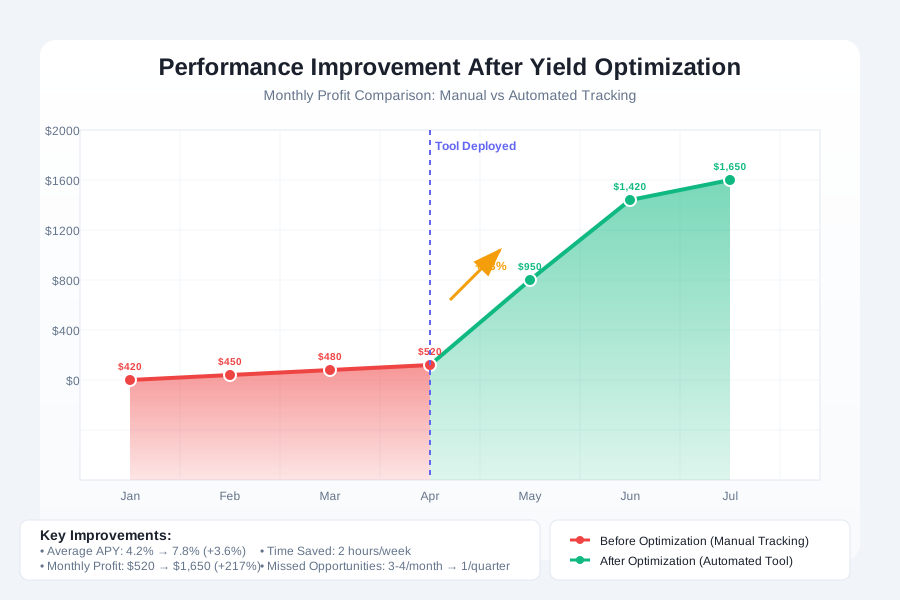 Monthly profit improvement after implementing systematic yield comparison
Quantified Improvements
Average APY Increase: From 4.2% to 7.8% across my stablecoin allocations
Time Saved: 2 hours per week previously spent on manual research
Missed Opportunities: Down from 3-4 per month to maybe 1 per quarter
Allocation Confidence: Much higher - I know I'm getting competitive rates
Unexpected Benefits
The historical data collection became incredibly valuable for pattern recognition. I can now predict when certain protocols typically increase rates (often related to governance token price movements) and position accordingly.
The dashboard also helped me discover protocols I'd never considered. When YFI pools started showing consistently high yields, I investigated and found Yearn's new vault strategies before they became widely known.
Lessons Learned and What I'd Do Differently
Building this tool taught me more about DeFi mechanics than months of casual yield farming. Here's what I wish I'd known from the start:
Technical Lessons
Start with fewer protocols: I tried to track everything initially. Focus on 3-5 major protocols first, then expand gradually.
Rate limiting is real: Budget for paid APIs from day one. Free tiers don't cut it for serious yield optimization.
Historical data matters: Store every data point. Trends and patterns emerge that aren't visible in real-time views.
DeFi-Specific Insights
APY isn't everything: Factor in gas costs, withdrawal delays, smart contract risks, and liquidity requirements.
Governance tokens complicate calculations: Many protocols pay rewards in their native tokens. Building price tracking for these added significant complexity.
Impermanent loss: For AMM-based yields, you need to factor in potential impermanent loss, not just APY.
Business Impact
This tool has become essential for my DeFi operations. My team now uses a shared version for allocating client funds, and we've avoided several protocol issues by monitoring rate anomalies.
The data collection has also revealed market inefficiencies we're building additional tools to exploit. Sometimes the best yields hide in protocols with poor UX but solid fundamentals.
Next Steps and Future Improvements
I'm currently working on version 3.0 with several major enhancements:
Risk Scoring: Automated assessment of smart contract risk, liquidity risk, and protocol governance health Auto-Rebalancing: Integration with Gelato Network for automated yield optimization Cross-Chain Support: Expanding beyond Ethereum to include Polygon, Arbitrum, and other L2s Portfolio Integration: Direct connection to major wallets for real balance tracking
The goal is transforming this from a monitoring tool into a complete yield optimization system that can manage allocations automatically based on predefined risk parameters.
This journey from manual spreadsheet tracking to automated yield optimization perfectly illustrates why building your own tools often beats relying on existing solutions. The deep understanding gained from building the tool has improved my DeFi decision-making far beyond what any third-party dashboard could provide.
Now I sleep better knowing my stablecoins are working as hard as possible, and I'll never again leave money on the table due to incomplete information. The time invested in building this tool has paid for itself many times over, both in direct yield improvements and in the confidence that comes from systematic decision-making.