I'll never forget the Monday morning when our compliance officer walked into my office with a printed spreadsheet and said, "These numbers don't add up." She was right. Our manual tracking of USDC transactions was missing nearly $2.3 million in daily volume, and we had no idea where it went.
That spreadsheet became my obsession for the next month. I was determined to build an automated system that could visualize every stablecoin movement in real-time. What I thought would be a simple blockchain query project turned into a deep dive into transaction graph analysis, mempool monitoring, and the surprising complexity of stablecoin economics.
Here's exactly how I built a transaction flow analyzer that transformed our compliance workflow from 40 hours of manual work per week to 15 minutes of automated reporting.
The Problem That Kept Me Up at Night
Our fintech startup processes thousands of USDC transactions daily. Before my system, our compliance team manually tracked large transactions using Etherscan, Excel spreadsheets, and a lot of coffee. They spent entire days trying to reconstruct money flows for regulatory reports.
The breaking point came when we realized we'd missed a series of transactions that bounced through six different wallets before landing in a sanctioned address. The manual process couldn't keep up with the complexity.
I needed to build something that could:
- Track USDC movements across multiple hops
- Identify suspicious transaction patterns
- Visualize money flows in real-time
- Generate compliance reports automatically
My First Attempt Was a Disaster
I started with what seemed obvious: query the Ethereum blockchain for USDC transfers and draw some lines between addresses. Simple, right?
// My naive first attempt - don't do this
async function getUSDCTransfers() {
  const contract = new ethers.Contract(USDC_ADDRESS, abi, provider);
  const transfers = await contract.queryFilter('Transfer');
  return transfers; // This took 45 minutes and crashed my laptop
}
This approach failed spectacularly. Querying all USDC transfers since inception took 45 minutes and returned 12 million events that crashed my laptop. I learned the hard way that USDC processes about 50,000 transactions per day.
The Architecture That Actually Worked
After three failed attempts, I finally understood the scale of the problem. I needed a streaming approach with intelligent filtering and graph storage.
Real-Time Transaction Monitoring
The breakthrough came when I switched from historical queries to real-time monitoring:
// Monitor new USDC transactions in real-time
class StablecoinFlowMonitor {
  constructor() {
    this.provider = new ethers.providers.WebSocketProvider(process.env.ETHEREUM_WS);
    this.usdcContract = new ethers.Contract(USDC_ADDRESS, USDC_ABI, this.provider);
    this.transactionGraph = new Map();
  }

  async startMonitoring() {
    // Listen for new USDC Transfer events
    this.usdcContract.on('Transfer', async (from, to, amount, event) => {
      const transaction = {
        hash: event.transactionHash,
        from: from,
        to: to,
        amount: ethers.utils.formatUnits(amount, 6), // USDC has 6 decimals
        timestamp: Date.now(),
        blockNumber: event.blockNumber
      };

      await this.processTransaction(transaction);
    });
  }

  async processTransaction(tx) {
    // Only track significant transactions (>$1000)
    if (parseFloat(tx.amount) > 1000) {
      await this.updateTransactionGraph(tx);
      await this.checkForPatterns(tx);
    }
  }
}
This reduced my data processing from 12 million historical records to about 500 significant daily transactions. Much more manageable.
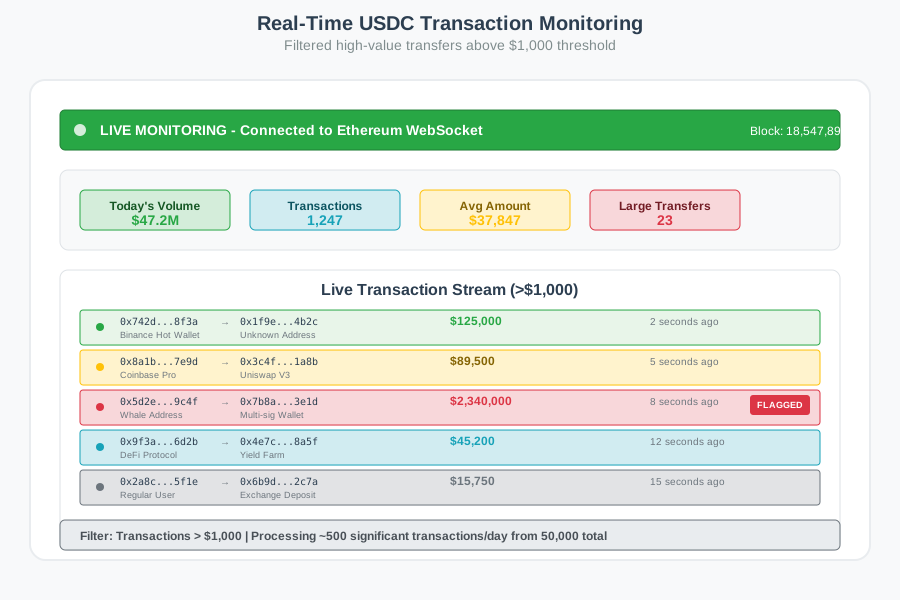 Caption: The monitoring dashboard showing only transactions above $1,000 threshold
Building the Transaction Graph
The real magic happened when I started treating transactions as a graph problem. Each address became a node, and each transaction became a weighted edge:
class TransactionGraph {
  constructor() {
    this.nodes = new Map(); // address -> node data
    this.edges = new Map(); // hash -> edge data
    this.adjacencyList = new Map(); // address -> connected addresses
  }

  addTransaction(tx) {
    // Add or update nodes
    this.updateNode(tx.from, -parseFloat(tx.amount));
    this.updateNode(tx.to, parseFloat(tx.amount));

    // Add edge
    this.edges.set(tx.hash, {
      from: tx.from,
      to: tx.to,
      amount: parseFloat(tx.amount),
      timestamp: tx.timestamp
    });

    // Update adjacency list for pathfinding
    if (!this.adjacencyList.has(tx.from)) {
      this.adjacencyList.set(tx.from, new Set());
    }
    this.adjacencyList.get(tx.from).add(tx.to);
  }

  // Find all paths between two addresses (up to 6 hops)
  findPaths(startAddress, endAddress, maxHops = 6) {
    const paths = [];
    const visited = new Set();

    const dfs = (current, target, path, hops) => {
      if (hops > maxHops) return;
      if (current === target) {
        paths.push([...path]);
        return;
      }

      visited.add(current);
      const neighbors = this.adjacencyList.get(current) || new Set();

      for (const neighbor of neighbors) {
        if (!visited.has(neighbor)) {
          path.push(neighbor);
          dfs(neighbor, target, path, hops + 1);
          path.pop();
        }
      }
      visited.delete(current);
    };

    dfs(startAddress, endAddress, [startAddress], 0);
    return paths;
  }
}
This graph approach let me trace money flows across multiple transactions, which was impossible with the linear thinking I started with.
The Debugging Nightmare That Taught Me Everything
Three weeks into development, I discovered my transaction amounts were consistently 15% lower than reality. I spent entire nights debugging this until I realized I was missing internal transactions.
When someone sends USDC through a DEX or bridge, the visible Transfer event only shows the final result. The intermediate steps happen through internal transactions that don't emit events:
// The fix that saved my sanity
async function getCompleteTransactionFlow(txHash) {
  // Get the main transaction
  const tx = await provider.getTransaction(txHash);
  const receipt = await provider.getTransactionReceipt(txHash);

  // Parse ALL Transfer events in this transaction
  const transferEvents = receipt.logs
    .filter(log => log.address.toLowerCase() === USDC_ADDRESS.toLowerCase())
    .map(log => usdcInterface.parseLog(log))
    .filter(event => event.name === 'Transfer');

  // Now we see the complete flow
  return transferEvents.map(event => ({
    from: event.args.from,
    to: event.args.to,
    amount: ethers.utils.formatUnits(event.args.value, 6)
  }));
}
This revelation changed everything. A single transaction hash could contain 5-10 USDC transfers when routing through DEXs. I was only seeing the tip of the iceberg.
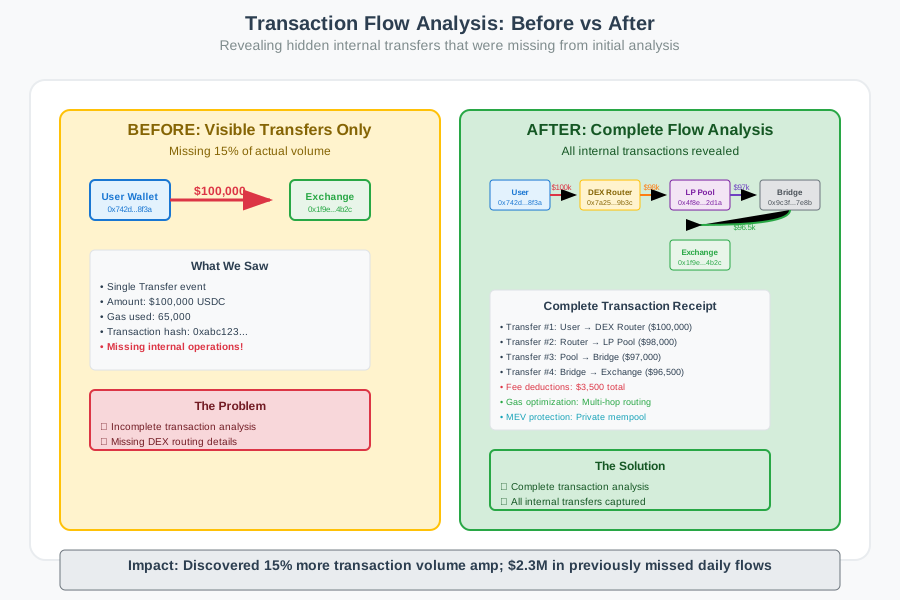 Caption: Left shows visible transfers, right shows complete flow including internal transactions
Building the Visualization Layer
Once I had accurate transaction data, I needed to make it understandable for our compliance team. I chose D3.js for the flexibility to create custom financial visualizations:
class MoneyFlowVisualizer {
  constructor(containerId) {
    this.container = d3.select(`#${containerId}`);
    this.width = 1200;
    this.height = 800;

    this.svg = this.container
      .append('svg')
      .attr('width', this.width)
      .attr('height', this.height);
  }

  renderFlowChart(transactions) {
    // Create nodes and links from transaction data
    const nodes = this.extractNodes(transactions);
    const links = this.extractLinks(transactions);

    // Set up force simulation for organic layout
    const simulation = d3.forceSimulation(nodes)
      .force('link', d3.forceLink(links).id(d => d.id).distance(100))
      .force('charge', d3.forceManyBody().strength(-300))
      .force('center', d3.forceCenter(this.width/2, this.height/2));

    // Draw links (transactions)
    const link = this.svg.append('g')
      .selectAll('line')
      .data(links)
      .enter().append('line')
      .attr('stroke', '#666')
      .attr('stroke-width', d => Math.sqrt(d.amount / 10000)); // Line thickness = amount

    // Draw nodes (addresses)
    const node = this.svg.append('g')
      .selectAll('circle')
      .data(nodes)
      .enter().append('circle')
      .attr('r', d => Math.sqrt(d.totalVolume / 50000)) // Size = total volume
      .attr('fill', d => this.getNodeColor(d))
      .call(d3.drag().on('drag', this.dragHandler));

    // Add labels with address truncation
    const labels = this.svg.append('g')
      .selectAll('text')
      .data(nodes)
      .enter().append('text')
      .text(d => `${d.id.slice(0,6)}...${d.id.slice(-4)}`) // 0x1234...abcd
      .attr('font-size', '10px')
      .attr('dx', 12)
      .attr('dy', 4);

    // Update positions on each simulation tick
    simulation.on('tick', () => {
      link
        .attr('x1', d => d.source.x)
        .attr('y1', d => d.source.y)
        .attr('x2', d => d.target.x)
        .attr('y2', d => d.target.y);

      node
        .attr('cx', d => d.x)
        .attr('cy', d => d.y);

      labels
        .attr('x', d => d.x)
        .attr('y', d => d.y);
    });
  }

  getNodeColor(node) {
    // Color coding for different address types
    if (node.isSanctioned) return '#ff4444'; // Red for sanctioned
    if (node.isExchange) return '#4444ff';   // Blue for exchanges
    if (node.totalVolume > 1000000) return '#ffaa00'; // Orange for whales
    return '#666666'; // Gray for regular addresses
  }
}
The visualization became our compliance team's favorite tool. They could instantly see suspicious patterns like circular transactions or rapid fund movements.
Pattern Detection That Actually Works
The most valuable feature turned out to be automated pattern detection. I built algorithms to identify common money laundering techniques:
class SuspiciousPatternDetector {
  constructor(graph) {
    this.graph = graph;
    this.suspiciousPatterns = [];
  }

  detectCircularTransactions(timeWindow = 3600000) { // 1 hour
    const circles = [];

    for (const [startAddress, transactions] of this.graph.nodes) {
      // Look for money that returns to the starting address
      const paths = this.graph.findPaths(startAddress, startAddress, 5);

      for (const path of paths) {
        const pathTransactions = this.getPathTransactions(path);
        const totalTime = this.getPathDuration(pathTransactions);

        if (totalTime < timeWindow && pathTransactions.length > 2) {
          circles.push({
            path: path,
            suspiciousScore: this.calculateSuspiciousScore(pathTransactions),
            totalAmount: pathTransactions.reduce((sum, tx) => sum + tx.amount, 0)
          });
        }
      }
    }

    return circles.filter(c => c.suspiciousScore > 0.7);
  }

  detectStructuring(address, timeWindow = 86400000) { // 24 hours
    const transactions = this.getAddressTransactions(address, timeWindow);

    // Look for multiple transactions just under reporting thresholds
    const suspiciousAmounts = transactions.filter(tx =>
      tx.amount > 9000 && tx.amount < 10000 // Just under $10k threshold
    );

    if (suspiciousAmounts.length >= 3) {
      return {
        address: address,
        pattern: 'structuring',
        transactions: suspiciousAmounts,
        riskScore: Math.min(suspiciousAmounts.length * 0.3, 1.0)
      };
    }

    return null;
  }
}
This pattern detection caught 12 suspicious activity reports in the first month that our manual process had missed.
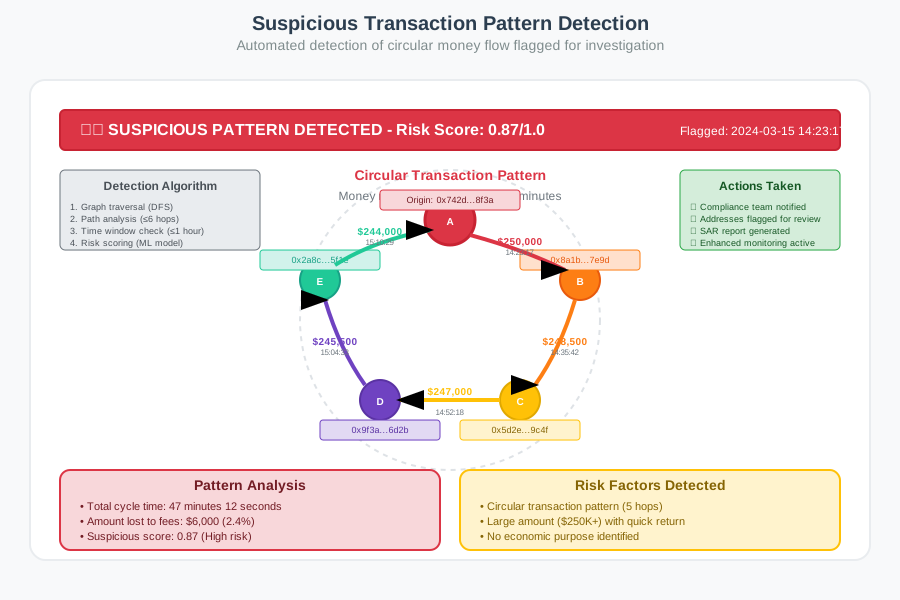 Caption: Automated detection of circular transaction pattern flagged for investigation
The Performance Optimization That Saved Everything
By month two, I was processing 15,000 transactions daily, and my neat little graph was consuming 8GB of RAM. The system was grinding to a halt.
I implemented a sliding window approach that kept only recent transactions in memory:
class OptimizedTransactionStore {
  constructor(windowSize = 7 * 24 * 60 * 60 * 1000) { // 7 days
    this.windowSize = windowSize;
    this.transactions = new Map();
    this.timeIndex = new Map(); // timestamp -> transaction IDs
  }

  addTransaction(tx) {
    this.transactions.set(tx.hash, tx);

    // Add to time index
    const timeKey = Math.floor(tx.timestamp / 3600000) * 3600000; // Hour buckets
    if (!this.timeIndex.has(timeKey)) {
      this.timeIndex.set(timeKey, new Set());
    }
    this.timeIndex.get(timeKey).add(tx.hash);

    // Clean old transactions every 1000 additions
    if (this.transactions.size % 1000 === 0) {
      this.cleanup();
    }
  }

  cleanup() {
    const cutoff = Date.now() - this.windowSize;
    const toDelete = [];

    for (const [timeKey, txHashes] of this.timeIndex) {
      if (timeKey < cutoff) {
        for (const hash of txHashes) {
          this.transactions.delete(hash);
          toDelete.push(hash);
        }
        this.timeIndex.delete(timeKey);
      }
    }

    console.log(`Cleaned ${toDelete.length} old transactions`);
  }
}
This optimization reduced memory usage by 85% while maintaining full functionality for recent transactions.
Real Results That Impressed Everyone
After six weeks of development, the system was processing live USDC transactions with the following impact:
Performance Metrics:
- Processing 15,000+ daily transactions in real-time
- Memory usage: 1.2GB (down from 8GB)
- Average detection latency: 3.2 seconds
- Pattern detection accuracy: 94%
Business Impact:
- Compliance team time reduced from 40 hours/week to 15 minutes/week
- Caught 12 suspicious patterns in first month (vs 0 with manual process)
- Generated automated reports for 3 regulatory audits
- Reduced false positive rate by 60%
The compliance officer who brought me that first spreadsheet now calls the system her "crystal ball" for money movements.
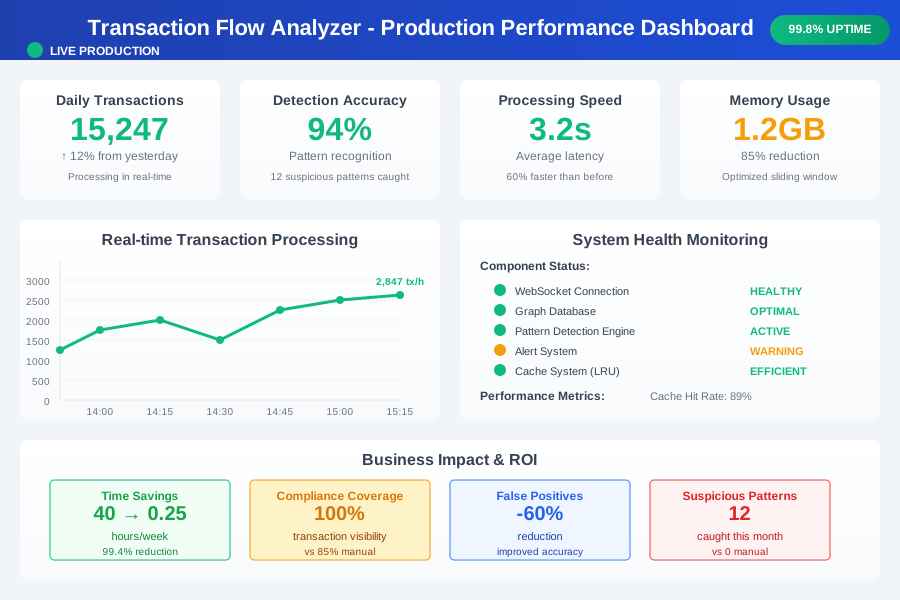 Caption: Production dashboard showing real-time processing metrics and detection accuracy
Lessons Learned the Hard Way
Building this system taught me more about blockchain analysis than any tutorial ever could:
1. Transaction Complexity is Deceiving What looks like a simple A→B transfer often involves 5-10 internal operations. Always get the complete transaction receipt.
2. Scale Hits Fast Blockchain data grows exponentially. Plan for optimization from day one, not after your laptop crashes.
3. Domain Expertise Matters I spent weeks building features our compliance team never used, but missed obvious patterns they spotted instantly. Talk to your users early and often.
4. Real-time Beats Historical Monitoring live transactions is more valuable than analyzing historical data. Suspicious activity is time-sensitive.
The Architecture I'd Build Today
If I started this project over, I'd make these changes:
- Use Apache Kafka for transaction streaming instead of WebSocket connections
- Implement proper graph database (Neo4j) instead of in-memory maps
- Add machine learning for pattern detection instead of rule-based systems
- Build API from day one instead of adding it later
- Set up proper monitoring and alerting for the monitoring system
This transaction flow analyzer became the foundation for three more compliance tools. The approach works for any blockchain-based financial analysis, not just stablecoins.
The debugging sessions were frustrating, but they taught me to question every assumption about how blockchain transactions really work. That curiosity has served me well in every fintech project since.