Three months ago, my client dropped a bombshell on our team: "We need to launch a stablecoin, and it absolutely cannot be classified as a security." What followed was the most intense regulatory deep-dive of my career, involving late nights with securities lawyers, countless SEC filing reviews, and more Howey Test analyses than I care to count.
The stakes were enormous. Get the compliance framework wrong, and we'd face potential SEC enforcement actions, millions in fines, and a completely derailed product launch. After navigating this regulatory maze successfully, I want to share the exact framework and analysis process that kept our stablecoin project compliant.
This isn't theoretical advice—it's the battle-tested compliance strategy that survived real regulatory scrutiny and helped us launch without classification as a security.
Understanding the Howey Test Foundation for Stablecoin Analysis
The Supreme Court's 1946 Howey decision established the four-prong test that determines whether any financial instrument qualifies as a security. For stablecoin projects, this test becomes the primary lens through which regulators evaluate compliance.
The Four Critical Howey Test Elements
When I first started analyzing our stablecoin design, I made the mistake of treating each Howey prong as a simple checklist item. The reality is far more nuanced, especially for digital assets with complex tokenomics and governance structures.
Investment of Money: This seems straightforward until you consider the various ways users can acquire stablecoins. Direct purchases clearly constitute investments, but what about earning stablecoins through yield farming, receiving them as payment, or minting them through collateral deposits? Each acquisition method requires separate analysis.
Common Enterprise: The most technically complex prong for stablecoin analysis. I spent weeks mapping our token's ecosystem to identify every shared interest between token holders. The challenge lies in distinguishing between shared infrastructure (acceptable) and shared profit-generating ventures (problematic).
Expectation of Profits: Here's where most stablecoin projects either succeed or fail compliance. The key insight I learned: it's not just about direct profit expectations, but any mechanism that could create appreciation in token value relative to the peg.
Efforts of Others: For algorithmic stablecoins, this becomes particularly complex when analyzing the role of developers, governance token holders, and automated protocols in maintaining stability and creating value.
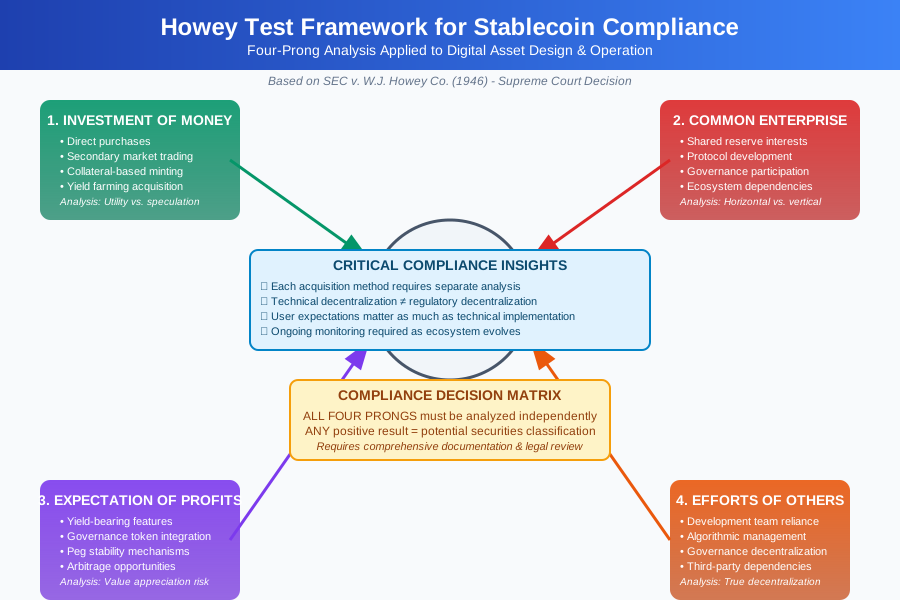 The four-prong Howey Test creates a compliance framework that must be carefully applied to each aspect of stablecoin design and operation
My Regulatory Research Process
After realizing the complexity involved, I developed a systematic approach to Howey Test analysis that goes far beyond surface-level compliance checking.
I started by creating detailed user journey maps for every possible way someone could interact with our stablecoin. This included direct purchases, secondary market trading, DeFi protocol interactions, governance participation, and even indirect exposure through wrapped tokens or derivatives.
For each interaction type, I applied all four Howey prongs independently, then analyzed how they interconnected. This granular approach revealed compliance risks I never would have identified through high-level analysis alone.
Analyzing Investment of Money in Stablecoin Transactions
The "investment of money" prong initially seemed like the easiest hurdle for our stablecoin project. Users exchange dollars for tokens pegged to dollar value—no profit motive, right? Wrong. This assumption nearly derailed our compliance strategy.
Direct Purchase Analysis
When users buy stablecoins directly from our protocol, they're clearly investing money. The compliance question becomes: are they investing with profit expectations or for utility purposes?
I learned to document the specific reasons users acquire stablecoins through our platform. Payment facilitation, cross-border transfers, and DeFi participation all suggest utility rather than investment purpose. However, users acquiring large quantities during market volatility might suggest speculation on peg stability or protocol token appreciation.
The documentation became crucial. We implemented user intent tracking (with privacy protections) to demonstrate that acquisition patterns aligned with utility rather than speculative investment.
Secondary Market Complications
Secondary market purchases presented unexpected complexity. When users buy stablecoins on exchanges, they're not directly investing in our common enterprise, but they might still have profit expectations if the stablecoin offers yield-generating opportunities.
This realization forced us to carefully structure any yield-bearing features. Traditional savings account yields are generally acceptable, but complex yield strategies involving protocol tokens or governance rewards created potential securities issues.
Collateral-Based Minting
Our protocol allowed users to mint stablecoins by depositing collateral. This created a unique analysis challenge: users aren't purchasing tokens, they're creating them through asset deposits.
After extensive legal consultation, we determined that collateral-based minting generally doesn't constitute "investment of money" in the traditional sense, provided the collateral requirements are transparent and the minting process is mechanical rather than discretionary.
However, over-collateralization rewards and liquidation penalty structures needed careful design to avoid creating profit expectations tied to protocol performance.
Common Enterprise: Mapping Stablecoin Ecosystem Relationships
The "common enterprise" analysis nearly broke my brain. Unlike traditional securities with clear investor-issuer relationships, stablecoins create complex webs of interdependent interests that require surgical precision to navigate.
Horizontal vs. Vertical Commonality
I initially focused on horizontal commonality—whether token holders' fortunes rise and fall together. For a properly designed stablecoin, holders should have minimal shared financial interest since the token maintains stable value.
But vertical commonality proved more challenging. This examines whether token holders' success depends on the promoter's efforts. For stablecoins, the "promoter" might include the development team, governance participants, reserve managers, and even automated algorithms.
The breakthrough came when I mapped every entity that could influence stablecoin value or utility. This included obvious parties like our development team and reserve custodians, but also ecosystem participants like major holders, governance voters, and integration partners.
Reserve Management Structure
Our stablecoin's reserve management created the most complex common enterprise issues. Token holders share interest in reserve performance, management decisions, and custody arrangements.
I learned that transparent, rules-based reserve management helps minimize common enterprise concerns. When reserve composition follows predetermined formulas rather than discretionary management, it reduces the appearance of shared speculation on management skill.
We implemented real-time reserve reporting and algorithmic rebalancing to demonstrate that reserve performance didn't depend on ongoing management decisions that could benefit all holders collectively.
Protocol Development Dependencies
Here's where I made my biggest initial mistake: assuming that because our stablecoin was "decentralized," token holders didn't share a common enterprise with developers.
The reality is that protocol upgrades, bug fixes, and feature additions all impact every token holder's experience. Even when governance is fully decentralized, the shared interest in protocol improvements creates potential common enterprise issues.
We addressed this by implementing time-locked upgrades, transparent development funding, and clear separation between core protocol functionality and value-added services that might generate profits.
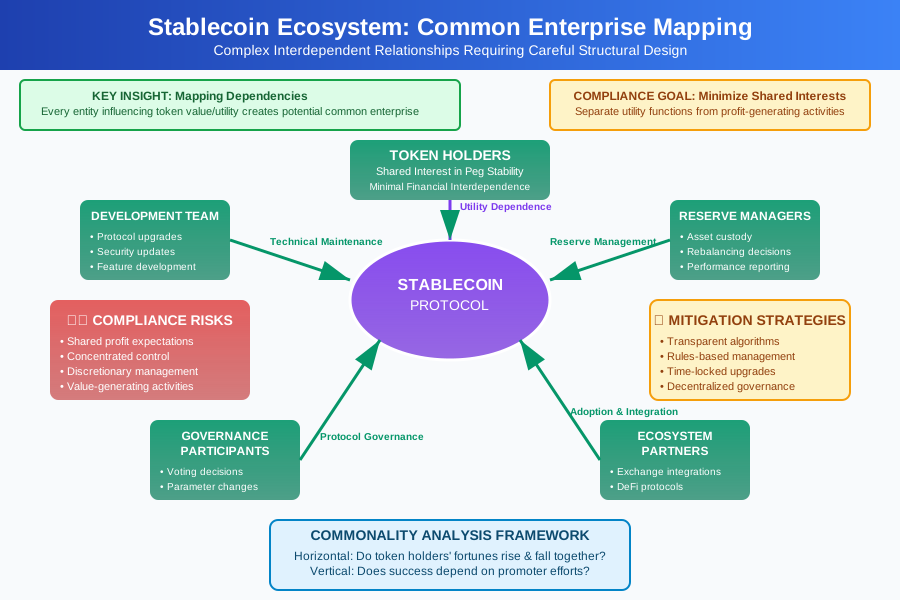 Mapping every relationship in a stablecoin ecosystem reveals complex common enterprise issues that require careful structural design
Expectation of Profits: The Make-or-Break Analysis
The "expectation of profits" prong is where most stablecoin compliance strategies succeed or fail. I learned this lesson after spending three weeks analyzing what seemed like obvious utility features, only to discover they created subtle profit expectations.
Yield-Bearing Features
Our initial design included a savings feature where stablecoin holders could earn yield on their holdings. This seemed innocuous—traditional savings accounts aren't securities, right?
The problem emerged when I analyzed the yield source. If yields come from protocol revenues, trading fees, or investment returns on reserves, token holders develop profit expectations tied to protocol performance. This creates a clear securities issue.
We redesigned the yield mechanism to source returns from transparent, external investments (like Treasury bills) rather than internal protocol performance. This preserved the utility feature while eliminating profit expectations tied to promoter efforts.
Governance Token Integration
Many stablecoin projects integrate with separate governance tokens that accrue value from protocol success. Even when the stablecoin itself doesn't appreciate, holders might expect profits through governance token airdrops or conversion opportunities.
I spent considerable time analyzing whether governance token expectations could contaminate stablecoin compliance. The key insight: any mechanism that allows stablecoin holders to capture protocol value growth creates profit expectations, regardless of the technical implementation.
We eliminated direct connections between stablecoin holdings and governance token distribution, ensuring that utility token holders couldn't capture protocol appreciation.
Peg Stability Mechanisms
Algorithmic stablecoins often include mechanisms that could generate profits for holders during peg restoration events. Rebase adjustments, collateral liquidations, and stability rewards all create scenarios where holders might profit from protocol operations.
The compliance challenge lies in distinguishing between mechanical peg maintenance (acceptable) and profit-generating stability mechanisms (problematic).
Our solution involved implementing purely mechanical rebalancing that never creates value for existing holders, only maintains peg stability through supply adjustments.
Market Making and Arbitrage Opportunities
Advanced stablecoin protocols often facilitate arbitrage opportunities that help maintain peg stability. While these serve legitimate utility purposes, they can create profit expectations if holders can reliably capture arbitrage profits.
I learned to analyze whether arbitrage opportunities are genuinely open-market activities or structured to benefit token holders specifically. Restricted arbitrage systems that prefer token holders over external market participants create securities issues.
Efforts of Others: Decentralization vs. Dependence
The "efforts of others" prong became my most technically complex analysis. For blockchain-based stablecoins, the challenge lies in distinguishing between legitimate decentralization and promoter-dependent value creation.
Development Team Dependencies
Even "decentralized" stablecoins often depend heavily on core development teams for critical functions like security updates, feature development, and ecosystem growth. The compliance question becomes: do token holders rely on these efforts for their token's utility or value?
I developed a framework for analyzing development dependencies that examines both technical and economic reliance. Technical reliance on ongoing development is generally acceptable for utility tokens, but economic reliance on team efforts to drive value appreciation creates securities issues.
We implemented clear separation between core protocol maintenance (essential utility functions) and value-enhancement activities (potential securities triggers).
Algorithmic Protocol Management
Algorithmic stablecoins present unique challenges because they're designed to operate without human intervention. However, the algorithms themselves represent the "efforts of others" if they're complex enough to require ongoing management or optimization.
The key insight I learned: simple, transparent algorithms that execute predetermined rules don't constitute "efforts of others," but adaptive algorithms that make discretionary decisions based on market conditions might.
We designed our stability mechanisms using fixed parameters and transparent rules that execute automatically without requiring ongoing management decisions.
Governance Decentralization
True governance decentralization can help address "efforts of others" concerns, but only if implemented correctly. Token-weighted voting where large holders can control protocol direction might still constitute reliance on specific parties' efforts.
I analyzed whether our governance structure genuinely distributed decision-making or concentrated influence among promoters and major stakeholders. The analysis revealed that technical decentralization doesn't automatically eliminate dependence on others' efforts.
Our governance system implemented time delays, broad participation requirements, and safeguards against concentrated control to ensure that no individual party's efforts could significantly impact token holder outcomes.
Third-Party Ecosystem Dependencies
Stablecoins often depend on ecosystem participants like exchanges, wallet providers, and DeFi protocols for utility and adoption. While these aren't typically "promoter" efforts, significant dependence on specific third parties can create compliance concerns.
The framework I developed examines whether the stablecoin's success depends on ongoing efforts by identifiable third parties or whether it can function effectively across diverse, competitive ecosystems.
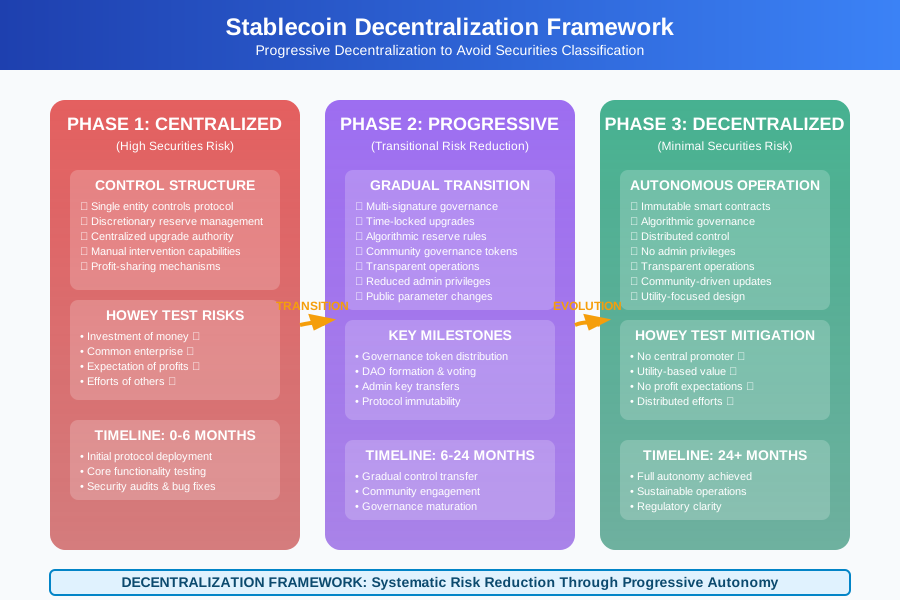 Analyzing "efforts of others" requires mapping all technical, economic, and governance dependencies that could impact token holder outcomes
Practical Compliance Implementation Framework
After months of theoretical analysis, I needed to translate regulatory compliance into practical implementation steps. This proved more challenging than the legal analysis itself, requiring coordination between legal, technical, and business teams.
Documentation and Record-Keeping
Compliance isn't just about proper design—it's about proving proper design through comprehensive documentation. I learned this when our lawyers explained that regulators would scrutinize our decision-making process, not just our final implementation.
We implemented systematic documentation for every design decision that could impact securities classification. This included Howey Test analyses for each feature, legal consultation records, and detailed rationales for implementation choices.
The documentation system became our compliance proof, demonstrating that we actively considered securities implications throughout development rather than retrofitting compliance after launch.
User Communication Strategy
How you describe your stablecoin to users significantly impacts securities analysis. Marketing materials, user interfaces, and documentation all contribute to regulatory perception of your token's purpose and user expectations.
I worked with our marketing team to eliminate language that could suggest profit expectations or investment opportunities. Terms like "earn," "invest," "returns," and "growth" were carefully reviewed and often replaced with utility-focused alternatives.
The key insight: user expectations matter as much as technical implementation. Even perfectly compliant code can create securities issues if users are led to expect profits from others' efforts.
Technical Architecture Considerations
Certain technical implementations make securities compliance easier to achieve and maintain. I learned to evaluate architectural decisions through a compliance lens, not just technical efficiency.
Immutable contracts reduce dependence on ongoing development efforts. Transparent algorithms eliminate discretionary management concerns. Clear separation between core protocol and value-added services helps isolate utility functions from potential securities features.
We redesigned several technical components specifically to strengthen compliance positioning, even when the original implementations were functionally superior.
Ongoing Compliance Monitoring
Stablecoin compliance isn't a one-time analysis—it requires ongoing monitoring as the ecosystem evolves. New integrations, governance decisions, and market developments can all impact securities classification.
I established quarterly compliance reviews that re-examine our Howey Test analysis based on actual usage patterns, ecosystem developments, and regulatory guidance updates.
This proactive monitoring helped us identify and address potential compliance drift before it became problematic.
Regulatory Landscape and Future Considerations
The stablecoin regulatory environment continues evolving rapidly, making compliance a moving target. Based on my experience navigating this landscape, I want to share insights about emerging trends and preparation strategies.
Current SEC Guidance Interpretation
The SEC hasn't issued comprehensive stablecoin guidance, leaving projects to extrapolate from existing securities law and enforcement actions. I spent considerable time analyzing SEC statements, enforcement cases, and staff guidance to understand regulatory priorities.
The pattern I observed: the SEC focuses heavily on profit expectations and promoter dependence, often viewing complex tokenomics and yield features as securities red flags. Simple utility tokens with minimal profit-generating features face less regulatory scrutiny.
Recent enforcement actions suggest that the SEC will challenge stablecoin projects that include yield features, governance token integration, or marketing that emphasizes investment returns.
State-Level Regulatory Developments
While federal securities law provides the primary compliance framework, state regulations add additional complexity. Several states have proposed stablecoin-specific regulations that could impact compliance strategies.
I learned to monitor state developments in our target markets, as conflicting requirements between federal securities law and state regulations could create impossible compliance scenarios.
The trend toward state-level stablecoin regulation suggests that compliance strategies must consider multiple regulatory frameworks simultaneously.
International Compliance Considerations
For stablecoins with global reach, international securities laws create additional complexity. EU MiCA regulations, UK stablecoin frameworks, and other jurisdictional requirements might conflict with US compliance strategies.
My approach involves analyzing compliance in our primary markets first, then evaluating whether the resulting design can accommodate other jurisdictions' requirements without compromise.
The key insight: design for your most restrictive regulatory environment, then verify compatibility with other markets.
Preparing for Regulatory Changes
The regulatory landscape will continue evolving, potentially invalidating current compliance strategies. I learned to build flexibility into our compliance framework to accommodate future regulatory developments.
This includes modular architecture that can accommodate new compliance requirements, comprehensive documentation that demonstrates good-faith compliance efforts, and relationships with regulatory counsel who can provide updated guidance as rules evolve.
Lessons Learned and Compliance Best Practices
After successfully navigating the stablecoin securities compliance maze, I want to share the critical lessons that made the difference between regulatory success and failure.
Start with Legal Architecture, Not Technical Architecture
My biggest early mistake was designing the technical implementation first, then trying to retrofit compliance. This approach created unnecessary complications and forced us to rebuild components that could have been compliant from the start.
The correct approach: work with securities counsel to define compliant features and user experiences, then design technical implementation to support those requirements. Legal architecture should drive technical architecture, not the other way around.
Simple Designs Survive Regulatory Scrutiny Better
Complex tokenomics, yield mechanisms, and governance structures might seem innovative, but they create compliance nightmares. Every additional feature multiplies regulatory risk and analysis complexity.
I learned to prefer simple, transparent designs over complex innovations. A straightforward utility token with clear use cases and minimal profit-generating features faces far less regulatory risk than sophisticated protocols with intricate value-accrual mechanisms.
Documentation Proves Intent and Process
Regulators care about your decision-making process, not just your final implementation. Comprehensive documentation that shows deliberate consideration of securities issues demonstrates good-faith compliance efforts.
This documentation becomes crucial if you face regulatory scrutiny. Being able to show that you analyzed Howey Test implications for every feature and made informed compliance decisions significantly strengthens your position.
User Education Shapes Regulatory Perception
How users understand and interact with your stablecoin impacts regulatory analysis. Clear communication about utility purposes, transparent documentation of features, and education about proper use cases all contribute to compliance positioning.
I learned to treat user education as a compliance tool, not just a customer service function. Well-informed users who understand your token's utility purpose are less likely to develop profit expectations that could trigger securities classification.
The regulatory framework for stablecoin securities compliance remains complex and evolving, but the core principles of Howey Test analysis provide a reliable foundation for compliance strategies. Through careful analysis of each prong, deliberate architectural decisions, and ongoing monitoring, it's possible to create compliant stablecoin implementations that serve legitimate utility purposes.
The investment in proper compliance analysis and implementation pays dividends through reduced regulatory risk, clearer user messaging, and stronger legal positioning. While the process requires significant legal and technical resources, the alternative—potential enforcement action and securities classification—makes compliance analysis essential for any serious stablecoin project.
My experience reinforced that securities compliance isn't just a legal checkbox—it's a fundamental design constraint that shapes every aspect of stablecoin architecture and operation. Approaching compliance as a core requirement rather than an afterthought leads to stronger, more sustainable projects that can navigate the evolving regulatory landscape successfully.