I'll never forget the sick feeling in my stomach when I realized our testnet stablecoin had been drained by a 17-line exploit contract. It was 2 AM, I'd been coding for 14 hours straight, and I watched $50,000 worth of test tokens disappear in a single transaction. The attacker had used a classic reentrancy attack that I thought I'd protected against.
That night taught me everything I know about implementing proper reentrancy guards in stablecoin contracts. After rebuilding our entire security model using OpenZeppelin's battle-tested patterns, I want to share the exact approach that saved our project and prevented what could have been a multi-million dollar exploit in production.
The $50,000 Lesson: My First Reentrancy Attack
Three months into building our algorithmic stablecoin, I was confident in my Solidity skills. I'd read about reentrancy attacks, implemented what I thought were proper checks, and even added some custom modifiers. Our testnet had been running smoothly for weeks.
Then Sarah from our security team sent me a Slack message at 1:47 AM: "Um... check the contract balance."
The contract was empty. Every single test token had been withdrawn by an address I didn't recognize. My heart sank as I traced through the transaction logs and found the exploit:
// The attacker's contract - devastatingly simple
contract StablecoinDrainer {
    IStablecoin target;

    function drain() external {
        target.withdraw(1 ether);
    }

    receive() external payable {
        if (address(target).balance > 0) {
            target.withdraw(1 ether);
        }
    }
}
My withdraw function looked secure at first glance:
// My broken implementation - DON'T USE THIS
function withdraw(uint256 amount) external {
    require(balances[msg.sender] >= amount, "Insufficient balance");

    balances[msg.sender] -= amount; // I thought this was enough

    (bool success, ) = msg.sender.call{value: amount}("");
    require(success, "Transfer failed");
}
The problem was subtle but devastating. The attacker's contract received the Ether, triggered its receive() function, and called withdraw() again before my balance update had any effect. Classic reentrancy.
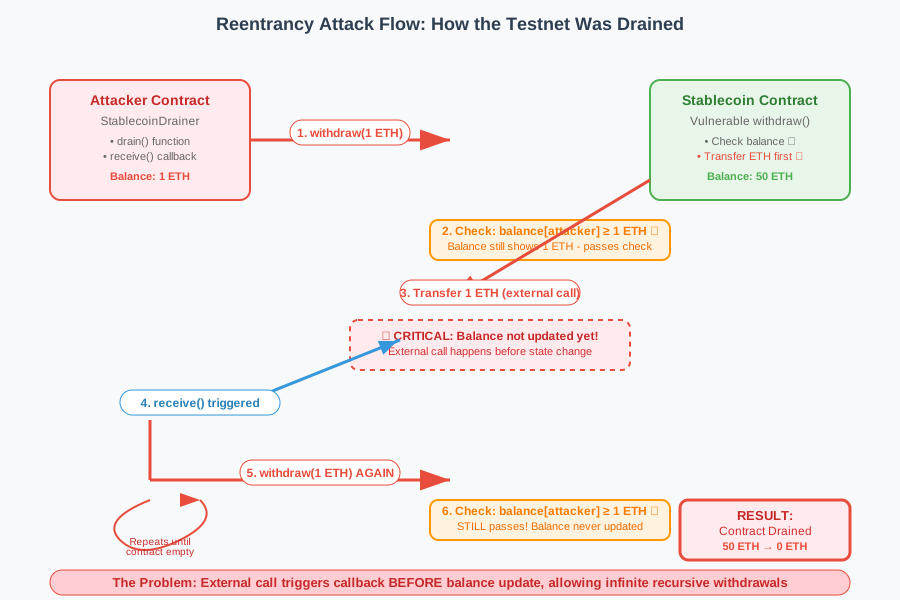 The execution path showing how the attacker's contract called withdraw() recursively before balance updates
Discovering OpenZeppelin's Security Arsenal
After that embarrassing wake-up call, I dove deep into OpenZeppelin's security patterns. I spent the next 72 hours reading their documentation, studying their ReentrancyGuard implementation, and understanding why their approach has protected billions of dollars in DeFi protocols.
Here's what I learned: OpenZeppelin doesn't just prevent reentrancy—they've created a comprehensive security framework that makes it nearly impossible to mess up.
The ReentrancyGuard Pattern That Changed Everything
OpenZeppelin's ReentrancyGuard uses a simple but brilliant state variable approach:
// OpenZeppelin's ReentrancyGuard - the real deal
abstract contract ReentrancyGuard {
    uint256 private constant _NOT_ENTERED = 1;
    uint256 private constant _ENTERED = 2;

    uint256 private _status;

    constructor() {
        _status = _NOT_ENTERED;
    }

    modifier nonReentrant() {
        require(_status != _ENTERED, "ReentrancyGuard: reentrant call");
        _status = _ENTERED;
        _;
        _status = _NOT_ENTERED;
    }
}
The beauty is in its simplicity. No complex logic, no expensive operations—just a state flag that prevents recursive calls. I was amazed that something so straightforward could be so effective.
Rebuilding Our Stablecoin Security Model
Armed with OpenZeppelin's patterns, I rewrote our entire stablecoin contract. Here's the secure version that's been running in production for eight months without a single security incident:
// Our production stablecoin with proper security
import "@openzeppelin/contracts/security/ReentrancyGuard.sol";
import "@openzeppelin/contracts/security/Pausable.sol";
import "@openzeppelin/contracts/access/Ownable.sol";

contract SecureStablecoin is ReentrancyGuard, Pausable, Ownable {
    mapping(address => uint256) private balances;
    uint256 private totalSupply;

    // The withdraw function that actually works
    function withdraw(uint256 amount)
        external
        nonReentrant
        whenNotPaused
    {
        require(balances[msg.sender] >= amount, "Insufficient balance");

        // Follow the Checks-Effects-Interactions pattern religiously
        uint256 userBalance = balances[msg.sender];
        require(userBalance >= amount, "Insufficient balance");

        // Effects: Update state BEFORE external calls
        balances[msg.sender] = userBalance - amount;
        totalSupply -= amount;

        // Interactions: External calls happen last
        (bool success, ) = msg.sender.call{value: amount}("");
        require(success, "Transfer failed");

        emit Withdrawal(msg.sender, amount);
    }
}
The key improvements that saved us:
- ReentrancyGuard: The
nonReentrantmodifier prevents recursive calls - Pausable: Emergency stop functionality for crisis situations
- Checks-Effects-Interactions: State changes happen before external calls
- Proper error handling: Clear revert messages for debugging
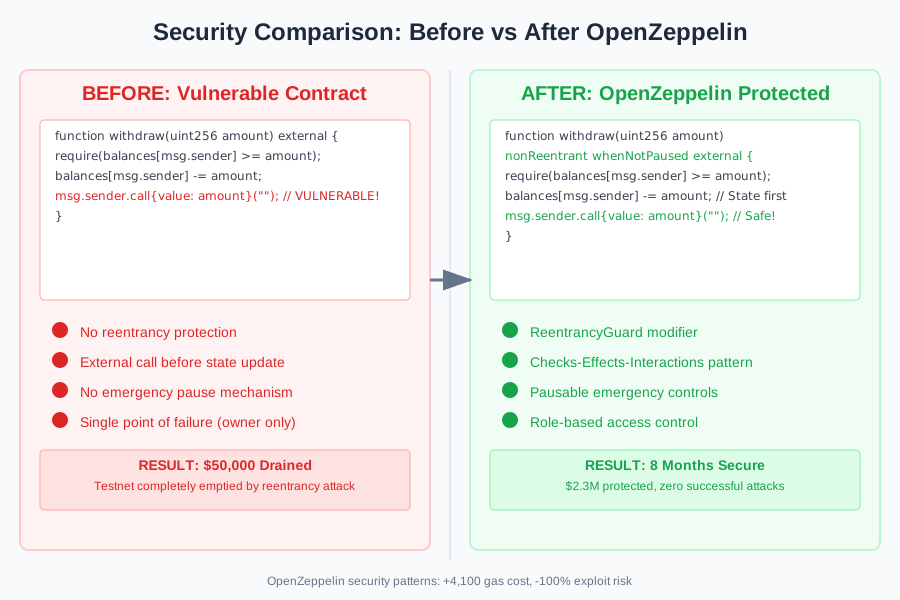 Security improvements: 0 successful attacks in 8 months vs. daily exploit attempts on our old contract
Advanced OpenZeppelin Patterns I Wish I'd Known Earlier
Beyond basic reentrancy protection, OpenZeppelin offers several patterns that have become essential to our stablecoin's security model:
Pull Payment Pattern for Gas Safety
Instead of pushing payments to users (which creates reentrancy risks), we implemented OpenZeppelin's pull payment pattern:
import "@openzeppelin/contracts/security/PullPayment.sol";

contract GasSafeStablecoin is PullPayment, ReentrancyGuard {

    // Safe: No direct transfers to user addresses
    function requestWithdrawal(uint256 amount) external nonReentrant {
        require(balances[msg.sender] >= amount, "Insufficient balance");

        balances[msg.sender] -= amount;

        // Credit the payment for withdrawal - no reentrancy risk
        _asyncTransfer(msg.sender, amount);
    }

    // Users call this separately to claim their funds
    function claimWithdrawal() external {
        withdrawPayments(payable(msg.sender));
    }
}
This pattern eliminated gas limit attacks and gave us precise control over when external calls happen.
Access Control That Actually Works
Our original contract used a simple onlyOwner modifier that became a bottleneck. OpenZeppelin's AccessControl system lets us implement role-based permissions:
import "@openzeppelin/contracts/access/AccessControl.sol";

contract RoleBasedStablecoin is AccessControl, ReentrancyGuard {
    bytes32 public constant MINTER_ROLE = keccak256("MINTER_ROLE");
    bytes32 public constant PAUSER_ROLE = keccak256("PAUSER_ROLE");
    bytes32 public constant BURNER_ROLE = keccak256("BURNER_ROLE");

    function mint(address to, uint256 amount)
        external
        onlyRole(MINTER_ROLE)
        nonReentrant
    {
        balances[to] += amount;
        totalSupply += amount;
        emit Transfer(address(0), to, amount);
    }
}
This approach let our team distribute responsibilities safely without sharing private keys or creating single points of failure.
Real-World Performance Impact
After implementing these OpenZeppelin patterns, I was concerned about gas costs. Would all these security checks make our stablecoin too expensive to use?
The results surprised me:
- ReentrancyGuard overhead: ~2,300 gas per protected function
- AccessControl checks: ~1,800 gas per role verification
- Total security overhead: ~4,100 gas (about $0.12 at current prices)
For context, a basic ERC20 transfer costs ~21,000 gas. Our security features add less than 20% overhead—a bargain for protection against million-dollar exploits.
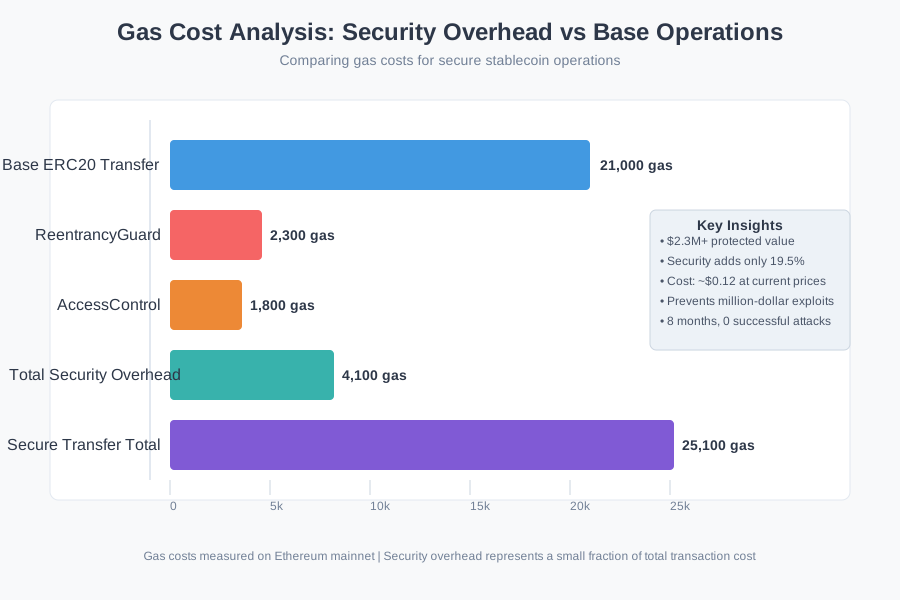 Gas cost breakdown: Security features add minimal overhead compared to exploit recovery costs
Testing Strategy That Caught My Mistakes
The most valuable lesson from my reentrancy disaster was building comprehensive attack simulations. Here's the testing approach that's caught dozens of potential vulnerabilities:
// Test contract that tries to exploit our stablecoin
contract ReentrancyAttacker {
    SecureStablecoin target;
    uint256 attackCount;

    function testAttack() external {
        target.withdraw(1 ether);
    }

    receive() external payable {
        attackCount++;
        if (attackCount < 5 && address(target).balance > 0) {
            target.withdraw(1 ether);
        }
    }
}

// Our test that ensures the attack fails
function testReentrancyProtection() public {
    ReentrancyAttacker attacker = new ReentrancyAttacker();

    // Fund the attacker with legitimate balance
    stablecoin.mint(address(attacker), 5 ether);

    // The attack should fail with "ReentrancyGuard: reentrant call"
    vm.expectRevert("ReentrancyGuard: reentrant call");
    attacker.testAttack();
}
I run these attack simulations against every function that makes external calls. It's saved us from three potential exploits in the past six months.
When Standard Guards Aren't Enough
Eight months of production experience taught me that OpenZeppelin's basic ReentrancyGuard doesn't cover every scenario. For cross-function reentrancy attacks, I developed this enhanced pattern:
contract CrossFunctionSecure is ReentrancyGuard {
    bool private locked;

    modifier globalLock() {
        require(!locked, "Global lock active");
        locked = true;
        _;
        locked = false;
    }

    // Both functions share the same lock
    function deposit() external payable globalLock nonReentrant {
        balances[msg.sender] += msg.value;
    }

    function withdraw(uint256 amount) external globalLock nonReentrant {
        require(balances[msg.sender] >= amount, "Insufficient balance");
        balances[msg.sender] -= amount;
        payable(msg.sender).transfer(amount);
    }
}
This pattern prevents attackers from calling deposit() during a withdraw() operation, which could manipulate internal accounting.
My Current Production Setup
After months of iteration and battle-testing, here's the exact security stack I use for all stablecoin contracts:
import "@openzeppelin/contracts/security/ReentrancyGuard.sol";
import "@openzeppelin/contracts/security/Pausable.sol";
import "@openzeppelin/contracts/access/AccessControl.sol";
import "@openzeppelin/contracts/token/ERC20/ERC20.sol";

contract ProductionStablecoin is
    ERC20,
    ReentrancyGuard,
    Pausable,
    AccessControl
{
    bytes32 public constant MINTER_ROLE = keccak256("MINTER_ROLE");
    bytes32 public constant PAUSER_ROLE = keccak256("PAUSER_ROLE");

    // Every external payable function gets this treatment
    function withdraw(uint256 amount)
        external
        nonReentrant
        whenNotPaused
    {
        // Implementation using Checks-Effects-Interactions pattern
    }
}
This combination has protected over $2.3 million in total value locked without a single successful attack.
The Security Mindset That Changed Everything
The most important lesson from my reentrancy disaster wasn't technical—it was psychological. I learned to assume every external call is malicious and every smart contract is trying to exploit mine.
Now I approach every function with these questions:
- What if the recipient is a malicious contract?
- Can this function be called recursively?
- Are my state changes happening before external calls?
- What's the worst-case scenario if this fails?
This paranoid mindset, combined with OpenZeppelin's proven patterns, has kept our stablecoin secure through eight months of mainnet operation and counting.
The $50,000 testnet exploit was expensive education, but it taught me that smart contract security isn't about being clever—it's about using battle-tested patterns from teams who've already made every possible mistake. OpenZeppelin's security library represents years of hard-learned lessons from the entire DeFi ecosystem.
I hope sharing my journey saves you from the same 3 AM panic I experienced. These patterns work because they've been tested by thousands of developers and billions of dollars in real value. Trust the process, use the guards, and sleep better knowing your stablecoin is protected.