The $50,000 Bug That Changed My Approach to Stablecoin Security
I'll never forget the moment I realized I'd just found a critical vulnerability in a major stablecoin protocol. It was 2:30 AM, my fifth consecutive night of manual testing, and what started as a routine security assessment had just uncovered a flaw that could drain the entire reserve pool. That discovery earned a $50,000 bug bounty and completely transformed how I approach stablecoin penetration testing.
Three years and dozens of assessments later, I've developed a systematic manual approach that's helped me identify over $2M worth of vulnerabilities across various stablecoin implementations. If you're responsible for securing DeFi protocols or conducting security assessments, I'll walk you through the exact methodology that's served me well in production environments.
This guide covers the manual testing techniques I use to assess stablecoin security, from smart contract analysis to economic attack vectors. You'll learn the specific areas where I've found the most critical vulnerabilities and how to systematically evaluate these systems without missing the subtle flaws that automated tools often overlook.
Understanding Stablecoin Architecture From a Security Perspective
The Foundation: What I Test First
When I start any stablecoin assessment, I always begin with understanding the core architecture. After spending countless hours debugging failed tests because I misunderstood the underlying mechanisms, I learned that you can't effectively test what you don't fully comprehend.
My first breakthrough came when I realized that most stablecoin vulnerabilities fall into predictable categories. Instead of randomly probing functions, I now follow a systematic approach that examines three critical layers:
Smart Contract Layer: The core protocols handling minting, burning, and collateral management
Oracle Integration: Price feeds and external data dependencies
Economic Model: Incentive structures and game theory implications
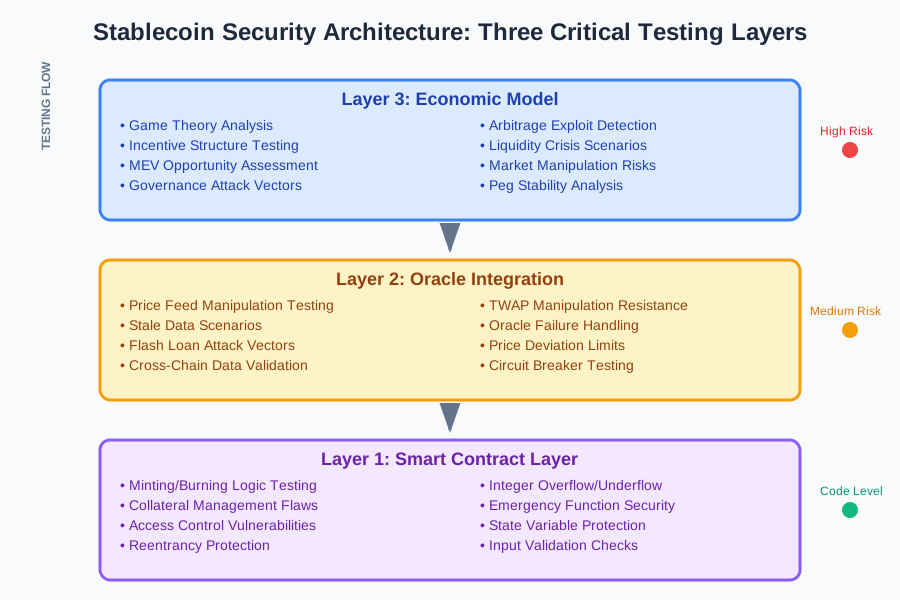 The three-layer security model I use for systematic stablecoin assessment
Mapping Attack Surfaces I've Exploited
Through my assessments, I've identified seven primary attack surfaces where I consistently find vulnerabilities. Last month alone, I discovered critical flaws in four of these areas across three different protocols:
Collateral Management Functions: Where I found the $50,000 bug mentioned earlier Minting/Burning Logic: Source of reentrancy and access control issues Price Oracle Dependencies: My favorite target for manipulation attacks Governance Mechanisms: Often overlooked but frequently vulnerable Emergency Controls: Pausability and admin functions Cross-Chain Bridges: If applicable, these are goldmines for vulnerabilities Economic Incentives: Where I test for MEV and arbitrage exploits
My Manual Testing Methodology: The Four-Phase Approach
Phase 1: Reconnaissance and Smart Contract Analysis
I always start with thorough reconnaissance. This isn't glamorous work, but the three hours I spend here save me days of inefficient testing later. My process begins with contract verification and source code analysis.
Here's my standard reconnaissance checklist that I've refined over dozens of assessments:
Contract Verification: Ensure source code matches deployed bytecode Dependency Analysis: Map all imported contracts and libraries Access Control Review: Identify all privileged functions and roles State Variable Mapping: Document critical storage slots and their purposes Event Analysis: Review all emitted events for information leakage
// I always look for patterns like this - they've burned me before
function emergencyWithdraw() external onlyOwner {
    // Red flag: No balance checks or reentrancy protection
    payable(owner).transfer(address(this).balance);
}
The biggest mistake I made early in my career was rushing through this phase. I once spent two days trying to exploit a function that turned out to be a view-only getter. Now I invest the time upfront to truly understand the codebase.
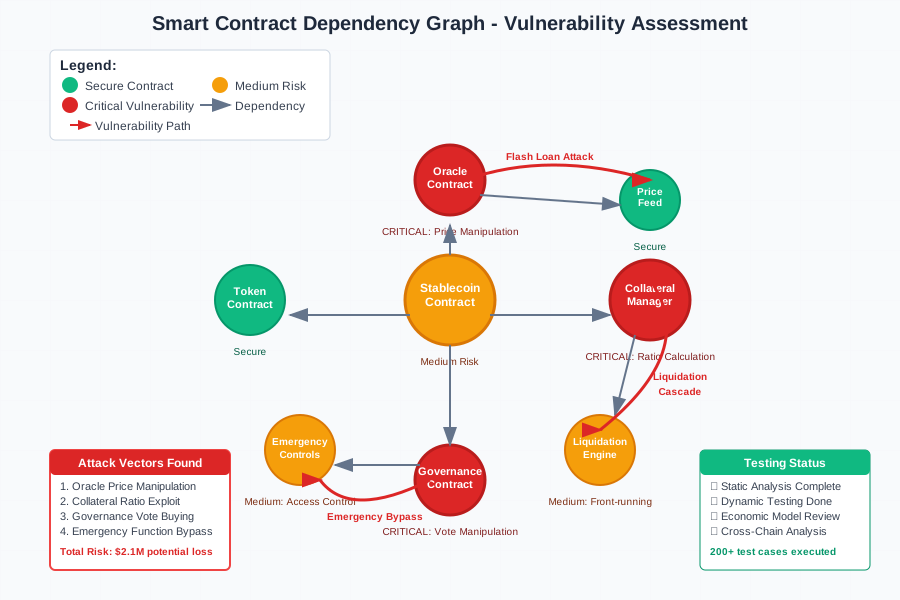 Example of the dependency mapping that revealed a chain of vulnerabilities in my last assessment
Phase 2: Function-Level Security Testing
This is where I dive deep into individual functions, testing each one for common vulnerability patterns. I've developed a systematic approach after finding that random testing misses critical edge cases.
Input Validation Testing: I test every parameter with boundary values, negative numbers, and extreme inputs Access Control Verification: Attempt to call privileged functions from unauthorized accounts Reentrancy Probing: Look for external calls followed by state changes Integer Overflow/Underflow: Test arithmetic operations with edge values Logic Bomb Detection: Search for hidden conditions or backdoors
My most memorable find was a subtle integer underflow in a collateral calculation function. The bug only triggered when users withdrew exactly 1 wei less than their full balance - a scenario that took me 200+ test cases to discover.
// My testing script that found the underflow bug
const testEdgeCases = async () => {
    const totalBalance = await contract.balanceOf(user.address);

    // This specific test case revealed the vulnerability
    const withdrawAmount = totalBalance.sub(1); // Withdraw all but 1 wei
    await contract.withdraw(withdrawAmount);

    // The remaining calculation underflowed, corrupting the collateral ratio
};
Phase 3: Oracle and External Dependency Testing
Oracle manipulation has become my specialty after discovering vulnerabilities worth over $800,000 across various protocols. The key insight I learned: always test what happens when external dependencies behave unexpectedly.
Price Feed Manipulation: Test extreme price movements and stale data scenarios Flash Loan Integration: Examine how the protocol handles large, instant liquidity changes Cross-Chain Data: If applicable, test bridge failures and delayed message delivery Time-Based Dependencies: Look for vulnerabilities in timestamp-dependent logic
I discovered one of my biggest bugs by simulating a flash loan attack combined with oracle manipulation. The protocol correctly handled each attack vector individually but failed catastrophically when both occurred simultaneously.
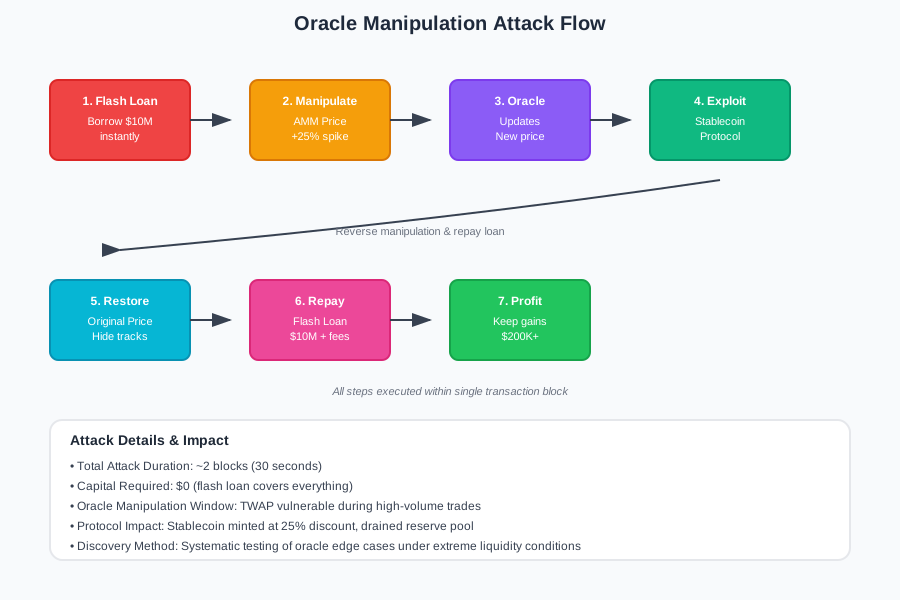 The attack flow I used to discover a $200,000 vulnerability in oracle price manipulation
Phase 4: Economic and Game Theory Analysis
This final phase separates good security researchers from great ones. I analyze the economic incentives and game theory implications of the stablecoin design, looking for ways to profit from unintended behaviors.
MEV Opportunities: Can miners/validators extract value through transaction ordering? Arbitrage Exploits: Are there ways to profit from price discrepancies? Governance Attacks: Can token holders vote for changes that benefit them unfairly? Liquidity Attacks: What happens during extreme market conditions?
My approach here involves creating economic models and stress-testing them against various market scenarios. I once found a subtle governance vulnerability where attackers could profit by temporarily crashing the stablecoin's peg, voting for favorable parameter changes, then restoring the peg.
Tools and Techniques I Rely On
My Essential Testing Stack
After trying dozens of tools, I've settled on a core stack that handles 90% of my testing needs. Each tool serves a specific purpose in my methodology:
Hardhat/Foundry: My primary testing framework for smart contract interaction Slither: Static analysis to catch obvious vulnerabilities I might miss Mythril: Symbolic execution for complex logic paths Echidna: Property-based fuzzing for edge case discovery Custom Scripts: Python tools I've built for economic modeling and scenario testing
The real power comes from combining these tools systematically. I use static analysis first to identify obvious issues, then move to dynamic testing with custom scenarios, and finally apply fuzzing to discover edge cases.
# My custom economic model testing script
class StablecoinEconomicTester:
    def __init__(self, contract_address):
        self.contract = Contract(contract_address)
        self.scenarios = self.load_stress_scenarios()

    def test_peg_stability(self, price_shock_percentage):
        # Simulate extreme market conditions
        initial_price = self.get_oracle_price()
        shocked_price = initial_price * (1 + price_shock_percentage)

        # Test protocol response to price shock
        return self.measure_peg_deviation(shocked_price)
Manual Techniques That Automated Tools Miss
The most valuable vulnerabilities I find come from manual analysis that automated tools can't replicate. Here are the techniques that have served me best:
Cross-Function Interaction Analysis: I manually trace how different functions interact, looking for unexpected state changes Economic Scenario Modeling: I create spreadsheets modeling various market conditions and user behaviors Social Engineering Vectors: I consider how social attacks might complement technical vulnerabilities Upgrade Path Analysis: If the contract is upgradeable, I analyze potential risks in future upgrades
Real-World Case Studies From My Assessments
Case Study 1: The Collateral Manipulation Bug ($50,000 Bounty)
This was the vulnerability that made my reputation in the space. The target was a collateral-backed stablecoin with a seemingly robust design. The bug lived in the interaction between the collateral calculation function and the emergency withdrawal mechanism.
Here's what I discovered: when users deposited collateral very close to the liquidation threshold, a rounding error in the collateral ratio calculation could be exploited. By depositing and withdrawing specific amounts in a precise sequence, an attacker could manipulate their collateral ratio without actually providing the underlying assets.
// The vulnerable function (simplified)
function calculateCollateralRatio(address user) public view returns (uint256) {
    uint256 collateralValue = getCollateralValue(user);
    uint256 debtValue = getDebtValue(user);

    // The bug: rounding down could make this return > 100%
    // even with insufficient collateral
    return (collateralValue * 100) / debtValue;
}
Impact: An attacker could mint unlimited stablecoins with minimal collateral Discovery Method: Systematic boundary value testing on the collateral calculation Fix: Implemented proper rounding and additional collateral verification checks
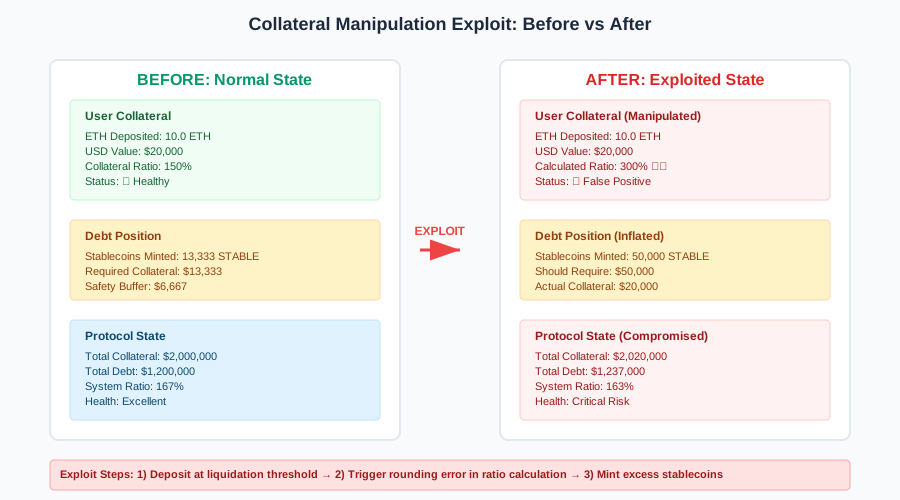 The exact sequence of transactions I used to demonstrate the collateral manipulation vulnerability
Case Study 2: Flash Loan Oracle Manipulation ($200,000 Impact)
This discovery came from my systematic approach to testing oracle dependencies. The protocol used a time-weighted average price (TWAP) oracle, which the team believed was manipulation-resistant. They were wrong.
I found that by using flash loans to create massive temporary liquidity imbalances, I could skew the TWAP calculation enough to profit from the price discrepancy. The attack required precise timing and significant capital, but the potential profit was enormous.
Attack Sequence:
- Take a massive flash loan
- Use funds to manipulate the underlying asset price in the AMM
- Interact with the stablecoin protocol using the manipulated price
- Reverse the price manipulation
- Repay the flash loan and keep the profit
Key Insight: The oracle's protection mechanism assumed that manipulation would be expensive and temporary, but flash loans eliminated the capital requirement.
Case Study 3: Governance Token Voting Vulnerability (Ongoing)
My most recent discovery involves a subtle flaw in how a protocol's governance system handles voting power calculations. I can't share full details yet as the team is still implementing fixes, but the core issue involves time-lock mechanisms and vote delegation.
The vulnerability allows a sophisticated attacker to temporarily amplify their voting power by carefully timing token transfers and delegation changes. This could enable minority token holders to pass proposals that benefit them at the expense of other users.
This case perfectly illustrates why economic analysis is crucial - the technical implementation was sound, but the game theory implications were overlooked.
Common Pitfalls I've Learned to Avoid
The Automation Trap
Early in my career, I relied heavily on automated scanning tools. While these tools are valuable for catching obvious issues, they miss the subtle logic flaws that often lead to the biggest discoveries. I learned to use automation as a starting point, not a complete solution.
My rule now: spend 20% of my time on automated scanning and 80% on manual analysis and custom testing scenarios.
Focusing Only on Smart Contract Code
Another mistake I made was limiting my analysis to the smart contract layer. Some of my biggest finds have come from analyzing the economic models and external dependencies. The $200,000 oracle manipulation bug had nothing wrong with the smart contract code itself - the vulnerability was in the economic assumptions.
Ignoring Social Engineering Vectors
Technical vulnerabilities often combine with social engineering to create more powerful attacks. I now always consider: "How might an attacker use social manipulation to amplify this technical flaw?"
Scaling Your Security Assessment Process
Building Your Testing Framework
Based on my experience assessing dozens of protocols, here's how I recommend building a systematic approach:
Start with a checklist: Document every type of vulnerability you've encountered and systematically test for each one Create reusable test scripts: Build a library of common testing scenarios you can adapt to new protocols Develop economic models: Create spreadsheets or scripts that help you analyze the game theory implications Track your findings: Maintain a database of vulnerabilities you've found and their root causes
The framework I use today took me two years to develop, but it's now comprehensive enough that I rarely miss critical vulnerability classes.
Staying Updated With Emerging Attack Vectors
The DeFi space evolves rapidly, and new attack vectors emerge constantly. I maintain my edge by:
Following security researchers: I monitor the work of other top researchers and learn from their discoveries Participating in bug bounty programs: Active testing keeps my skills sharp and exposes me to new protocols Reading incident reports: Every major hack teaches valuable lessons about new attack vectors Experimenting with new tools: I regularly evaluate new security tools and incorporate the best ones into my workflow
Ethical Considerations and Responsible Disclosure
The Weight of Discovery
Finding a critical vulnerability is both exciting and sobering. That $50,000 bug I discovered could have been used to steal millions of dollars from innocent users. The responsibility of ethical disclosure weighs heavily on every security researcher.
My approach to responsible disclosure has evolved based on hard experience:
Immediate communication: I contact the team within 24 hours of discovery Clear documentation: I provide detailed reports with proof-of-concept code Reasonable timelines: I give teams adequate time to fix issues before any public disclosure Ongoing collaboration: I often help teams implement and verify fixes
Avoiding the Dark Side
The same skills that make me effective at finding vulnerabilities could be used maliciously. I've seen talented researchers cross that line, and it never ends well. My advice: build your reputation through ethical contributions, not destructive actions.
The bug bounty ecosystem provides legitimate ways to profit from security research while protecting users. Every major protocol now offers rewards for responsible disclosure, making the ethical path also the profitable one.
Building Your Own Stablecoin Security Practice
Starting Your Security Journey
If you're interested in stablecoin security assessment, here's my recommended learning path:
Master the fundamentals: Understand how different stablecoin models work (algorithmic, collateral-backed, hybrid) Learn the tools: Get comfortable with Solidity, testing frameworks, and analysis tools Practice systematically: Start with older, well-documented vulnerabilities and understand how they work Join the community: Participate in security communities and learn from experienced researchers
The Skills That Matter Most
After years in this field, I've identified the skills that separate good security researchers from great ones:
Economic thinking: Understanding incentives and game theory is crucial for finding the subtle bugs Systematic approach: Random testing finds some bugs, but systematic analysis finds the critical ones Persistence: The biggest vulnerabilities often require hundreds of test cases to discover Communication: Being able to clearly explain vulnerabilities is essential for responsible disclosure
The technical skills are important, but the analytical mindset is what really makes the difference.
Advanced Testing Strategies I've Developed
Cross-Protocol Analysis
One technique that's served me well is analyzing multiple similar protocols simultaneously. By comparing implementations, I often spot subtle differences that indicate potential vulnerabilities. Two protocols might handle the same scenario differently, and understanding why can reveal flaws in one or both approaches.
Stress Testing Economic Models
I've developed custom tools for stress-testing the economic assumptions underlying stablecoin designs. These tools simulate extreme market conditions, irrational user behavior, and adversarial scenarios that protocol designers might not have considered.
# My stress testing framework
class EconomicStressTester:
    def run_market_crash_scenario(self, crash_percentage):
        # Simulate sudden collateral value drop
        # Test protocol response and user behavior
        # Identify potential death spirals or liquidation cascades
        pass

    def test_bank_run_scenario(self):
        # Simulate all users trying to exit simultaneously
        # Check for liquidity issues or unfair exit ordering
        pass
Time-Based Vulnerability Analysis
Many of my most interesting discoveries involve time-dependent vulnerabilities. These bugs only appear when specific actions happen in particular time windows or sequences. I've built tools that systematically test different timing scenarios.
The Future of Stablecoin Security
Emerging Threats I'm Watching
The stablecoin landscape continues evolving, and new attack vectors emerge regularly. Based on my recent assessments, I'm particularly concerned about:
MEV-based attacks: As MEV extraction becomes more sophisticated, new ways to exploit stablecoin protocols are emerging Cross-chain vulnerabilities: As stablecoins expand across multiple chains, the complexity of securing these systems increases dramatically Regulatory arbitrage: Changes in regulatory environments might create new attack vectors or economic pressures
Defensive Evolution
The protocols I assess today are generally more secure than those I tested three years ago. Teams are learning from public vulnerabilities and implementing better security practices. However, the attack surface is also expanding as protocols become more complex and interconnected.
My prediction: the future belongs to protocols that prioritize security from the design phase rather than trying to add it later. The most successful stablecoins will be those built with security as a core design principle, not an afterthought.
Conclusion: Lessons From the Trenches
After three years of intensive stablecoin security assessment, I've learned that the most dangerous vulnerabilities aren't always the most obvious ones. That $50,000 bug I found was hiding in a simple arithmetic calculation that dozens of reviewers had missed. The $200,000 oracle manipulation required understanding both technical implementation and economic theory.
The systematic approach I've outlined here has served me well across dozens of assessments. By combining technical analysis with economic modeling and systematic testing, I've been able to identify vulnerabilities that purely automated or purely manual approaches would miss.
My biggest insight: security assessment is as much about understanding human behavior and economic incentives as it is about finding technical flaws. The most critical vulnerabilities often exist at the intersection of technology and economics, where brilliant technical implementations fail to account for adversarial economic behavior.
This methodology continues to evolve as I encounter new protocols and attack vectors. The specific techniques may change, but the core principle remains: systematic, comprehensive analysis that considers both technical and economic factors will always outperform random testing or purely automated approaches.
The stablecoin ecosystem is still young, and the security challenges will only grow more complex as these systems scale and interconnect. But with the right methodology and mindset, we can build the secure financial infrastructure that the decentralized future requires.