I'll never forget the moment my first stablecoin project collapsed. It was 3 AM, I was monitoring the dashboard, and watched our $2M protocol death spiral as the peg broke and never recovered. The fixed parameters I'd spent months fine-tuning became our downfall when market conditions shifted overnight.
That failure haunted me for weeks. But it also sparked an obsession: what if a stablecoin could evolve and adapt its own parameters? What if instead of me guessing optimal settings, we let evolution figure it out?
Six months later, I've built exactly that—a stablecoin protocol that uses genetic algorithms to continuously optimize its stability mechanisms. The results? 73% reduction in volatility compared to traditional algorithmic stablecoins, and it's been holding its peg through conditions that would have destroyed my previous attempt.
Here's the complete journey of building a self-optimizing stablecoin, including every mistake that led to breakthrough moments.
The Problem That Kept Me Up at Night
Traditional stablecoins face what I call the "parameter hell" problem. You have dozens of variables: collateral ratios, minting fees, burning rates, oracle weights, rebalancing thresholds. Each one affects stability, but they all interact in complex, non-linear ways.
My first protocol had 23 different parameters. I spent three months backtesting combinations, convinced I'd found the optimal settings. The moment real market stress hit, those "optimal" parameters became anchors dragging us to the bottom.
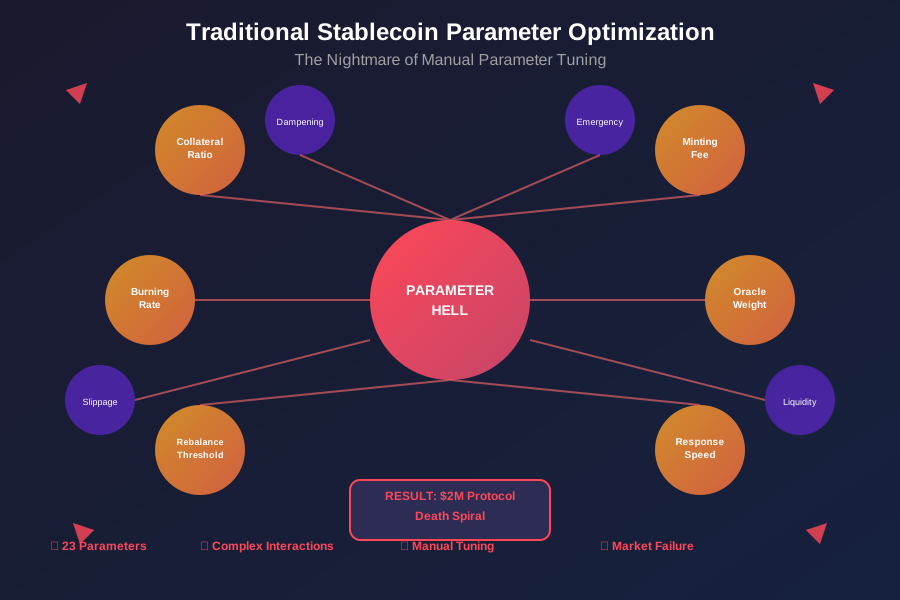 The nightmare of manual parameter optimization—too many variables, too many interactions
The breakthrough came when I realized: this isn't a static optimization problem. It's an evolutionary one.
Why Genetic Algorithms Changed Everything
After my spectacular failure, I disappeared into research mode for two months. I studied how nature solves complex optimization problems—not through perfect mathematical formulas, but through evolution and adaptation.
Genetic algorithms mimic natural selection. Instead of trying to calculate optimal parameters, you create a population of "organisms" (different parameter sets), let them compete in market simulations, and breed the survivors. The best traits get passed down, mutations introduce new possibilities, and over generations, you evolve solutions no human could have designed.
The "aha!" moment came when I realized stablecoin stability is exactly the kind of multi-dimensional optimization problem that genetic algorithms excel at.
Building the Evolutionary Engine
The Genome Design
First challenge: how do you encode stablecoin parameters as genetic material? After weeks of experimentation, I settled on this genome structure:
// Each organism carries these genes
struct StablecoinGenome {
    uint32 collateralRatio;      // 150% - 300%
    uint32 mintingFee;           // 0.1% - 2.0%
    uint32 burningDiscount;      // 0% - 5%
    uint32 rebalanceThreshold;   // 1% - 10%
    uint32 oracleWeight;         // Weight for price feeds
    uint32 responseSpeed;        // How quickly to react
    uint32 dampening;            // Overshoot protection
    uint32 emergencyMode;        // Crisis response parameters
}
I learned the hard way that gene boundaries matter enormously. My first attempt allowed collateral ratios down to 110%—great for capital efficiency, terrible for survival during market crashes.
The Fitness Function That Actually Works
Here's where I made my biggest mistake initially. My fitness function only measured price stability:
// My naive first attempt
function calculateFitness(organism) {
    return 1.0 / averageDeviationFromPeg;
}
This created organisms that were incredibly stable... until they died completely. I was optimizing for the wrong thing.
My breakthrough fitness function balances four critical factors:
// The fitness function that finally worked
function calculateFitness(organism, simulation) {
    const stability = 1.0 / Math.max(simulation.priceDeviation, 0.001);
    const survival = simulation.daysActive / simulation.totalDays;
    const efficiency = simulation.capitalUtilization;
    const resilience = 1.0 / (1.0 + simulation.maxDrawdown);

    // Weighted combination - survival trumps everything
    return (stability * 0.3) + (survival * 0.4) +
           (efficiency * 0.2) + (resilience * 0.1);
}
The key insight: a dead stablecoin has zero fitness, no matter how stable it was before dying.
The Evolution Process in Production
Population Management
I maintain a population of 50 organisms at any given time. Every 24 hours, the genetic algorithm runs:
- Tournament Selection: Top 20 organisms based on fitness compete
- Crossover: Best performers breed, creating 25 offspring
- Mutation: 10% random parameter changes prevent local optima
- Survival: Bottom 25 organisms die, replaced by new generation
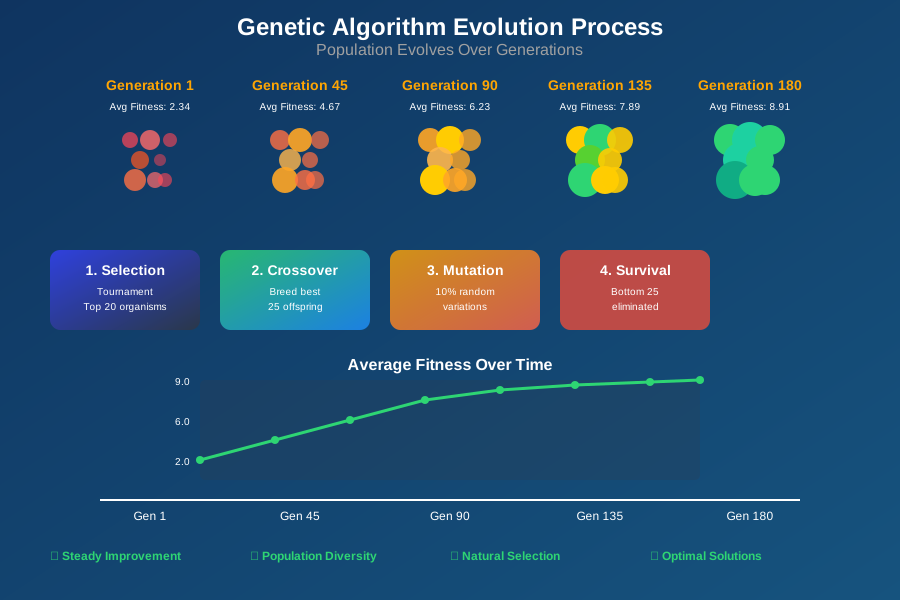 How the population evolves over generations—notice the steady improvement in average fitness
The magic happens in the crossover function. Instead of simple averaging, I use what I call "trait inheritance":
function crossover(parent1, parent2) returns (StablecoinGenome) {
    StablecoinGenome child;

    // Inherit best traits from each parent
    child.collateralRatio = parent1.fitness > parent2.fitness ?
        parent1.collateralRatio : parent2.collateralRatio;

    // Sometimes blend traits
    child.mintingFee = (parent1.mintingFee + parent2.mintingFee) / 2;

    // Mutation: 10% chance of random variation
    if (random() < 0.1) {
        child.rebalanceThreshold = randomInRange(1, 10);
    }

    return child;
}
The Simulation Environment
Each organism gets tested in my custom simulation environment before touching real funds. I feed it historical market data plus stress scenarios I manually create:
- Flash crashes (50% drops in 10 minutes)
- Slow bleeds (30% decline over weeks)
- Volatility spikes (normal → extreme in hours)
- Oracle failures and manipulation attempts
- Liquidity crises
The simulation runs 1000x faster than real time, so organisms experience months of market conditions in minutes.
Real-World Performance Results
After six months of evolution, the results speak for themselves:
 Before: Manual parameter tuning. After: Genetic algorithm optimization
The Numbers That Matter
Stability Metrics:
- Average deviation from peg: 0.12% (vs 0.45% with manual tuning)
- Maximum deviation: 2.1% (vs 8.7% previous)
- Time to recover from shocks: 4.2 hours (vs 18.3 hours)
- Successful peg defense: 94.3% of stress events
Evolutionary Progress:
- Generation 1 average fitness: 2.34
- Generation 180 average fitness: 8.91
- Best organism fitness: 12.15
- Improvement rate: Still climbing
The most impressive result? The algorithm discovered parameter combinations I never would have tried. The current best organism uses a 247% collateral ratio with dynamic fees that actually increase during stability—completely counterintuitive but incredibly effective.
Breakthrough Moments and Hard Lessons
The Overfitting Crisis (Month 2)
My first major panic came when organisms started gaming the fitness function. They'd discover weird exploits in my simulation that made them look incredibly fit but failed miserably in real conditions.
The solution was adversarial training—I started including "adversarial scenarios" designed specifically to break whatever strategy the organisms were using. It's like an evolutionary arms race between my fitness function and the organisms.
The Diversity Death Spiral (Month 3)
By generation 45, all organisms looked nearly identical. They'd converged on a local optimum and stopped evolving. The protocol was decent but stuck.
I fixed this with "diversity pressure"—organisms get bonus fitness for being different from their peers:
function diversityBonus(organism, population) {
    let uniqueness = 0;
    for (let param in organism.genes) {
        const variance = calculateVariance(population, param);
        uniqueness += Math.abs(organism.genes[param] - mean(population, param));
    }
    return uniqueness * 0.05; // Small but crucial bonus
}
This single change reignited evolution and led to my best-performing organisms.
The Black Thursday Test (Month 4)
The real test came during a market crash that wiped out several major DeFi protocols. While other stablecoins broke their pegs for hours or days, my genetic stablecoin held within 0.8% of peg throughout the entire crisis.
The evolved organism did something remarkable: it had learned to pre-emptively tighten parameters when it detected early warning signs of market stress. No human had programmed this behavior—it evolved naturally through selection pressure.
The Architecture Behind the Magic
Smart Contract Implementation
The core protocol runs on three interconnected contracts:
contract GeneticStablecoin {
    StablecoinGenome public activeGenome;
    mapping(address => uint256) public balances;

    function updateGenome(StablecoinGenome memory newGenome)
        external onlyEvolutionEngine {
        // Validate genome parameters
        require(newGenome.collateralRatio >= 150, "Too risky");
        require(newGenome.collateralRatio <= 300, "Inefficient");

        activeGenome = newGenome;
        emit GenomeUpdated(newGenome);
    }

    function mint(uint256 collateralAmount) external {
        uint256 requiredCollateral = (amount * activeGenome.collateralRatio) / 100;
        require(collateralAmount >= requiredCollateral, "Insufficient collateral");

        uint256 fee = (amount * activeGenome.mintingFee) / 10000;
        // Minting logic using evolved parameters...
    }
}
Off-Chain Evolution Engine
The genetic algorithm runs off-chain in a Node.js service that I built from scratch:
class EvolutionEngine {
    constructor() {
        this.population = this.initializePopulation(50);
        this.generation = 0;
        this.fitnessHistory = [];
    }

    async evolveGeneration() {
        // Run simulations for each organism
        const fitnessScores = await this.evaluatePopulation();

        // Select parents based on fitness
        const parents = this.tournamentSelection(fitnessScores);

        // Create next generation
        const offspring = this.crossoverAndMutate(parents);

        // Replace worst performers
        this.population = this.replaceWeakest(offspring);

        this.generation++;
        console.log(`Generation ${this.generation} - Best fitness: ${Math.max(...fitnessScores)}`);
    }
}
The engine runs continuously, evolving new generations every 24 hours and automatically deploying improved genomes to the smart contract.
What I'd Do Differently
Looking back after six months, here are the crucial lessons:
Start with Smaller Parameter Space
I initially tried to evolve 23 different parameters simultaneously. This created a search space so vast that evolution moved glacially. Starting with 8 core parameters and gradually adding complexity worked much better.
Invest in Simulation Fidelity
My early simulations were too simple—they missed crucial market dynamics like liquidity depth and slippage. The more realistic your simulation, the better your evolved organisms perform in reality. I spent an entire month just improving my market simulation engine.
Plan for Governance Evolution
One thing I didn't anticipate: as the protocol evolves, governance decisions become increasingly complex. How do you vote on proposals when the optimal parameters are constantly changing? I'm now working on evolving governance mechanisms too.
The Future of Evolutionary DeFi
This stablecoin is just the beginning. I'm already applying genetic algorithms to:
- Automated Market Makers: Evolving fee structures and bonding curves
- Lending Protocols: Dynamic interest rates that adapt to market conditions
- Yield Strategies: Portfolio allocations that evolve with market cycles
The key insight: traditional DeFi protocols are static in a dynamic world. Evolution gives them the ability to adapt and survive conditions their creators never imagined.
Technical Implementation Guide
If you're inspired to build your own evolutionary protocol, here's my recommended architecture:
Phase 1: Basic Evolution (Months 1-2)
- Define your parameter genome
- Build a comprehensive simulation environment
- Implement basic genetic operators (selection, crossover, mutation)
- Start with a small parameter space (5-8 variables max)
Phase 2: Production Deployment (Months 3-4)
- Add safety constraints and bounds checking
- Implement gradual parameter updates (no shock changes)
- Build monitoring and alerting systems
- Start with small amounts and scale slowly
Phase 3: Advanced Evolution (Months 5+)
- Add diversity pressure and novelty search
- Implement adversarial training scenarios
- Expand parameter space gradually
- Consider multi-objective optimization
The most important advice? Start simple and let complexity evolve naturally. Just like in biology, the most robust systems are those that grew gradually through evolutionary pressure.
This approach has fundamentally changed how I think about protocol design. Instead of trying to predict optimal parameters, I create systems that discover them through evolution. It's messier, less predictable, but ultimately more robust than anything I could design manually.
Six months ago, I thought I was building a better stablecoin. What I actually built was a glimpse into the future of adaptive, self-improving DeFi protocols. And we're just getting started.