Two years ago, I thought implementing a blacklist in a stablecoin was just adding a mapping and a few require statements. I was catastrophically wrong. My first attempt broke user withdrawals for 6 hours because I didn't understand how blacklists interact with existing balances. That expensive lesson taught me everything I'm about to share with you.
When regulators started scrutinizing DeFi protocols more closely, our team needed to implement USDC-style blacklist functionality in our custom stablecoin. What seemed like a straightforward feature turned into a three-week deep dive into compliance patterns, edge cases, and gas optimization challenges that I never saw coming.
In this guide, I'll walk you through exactly how to implement robust blacklist functionality that won't break your protocol. You'll learn the patterns that major stablecoins like USDC use, the gotchas that cost me hours of debugging, and the security considerations that keep me up at night.
Why Stablecoins Need Blacklist Functionality
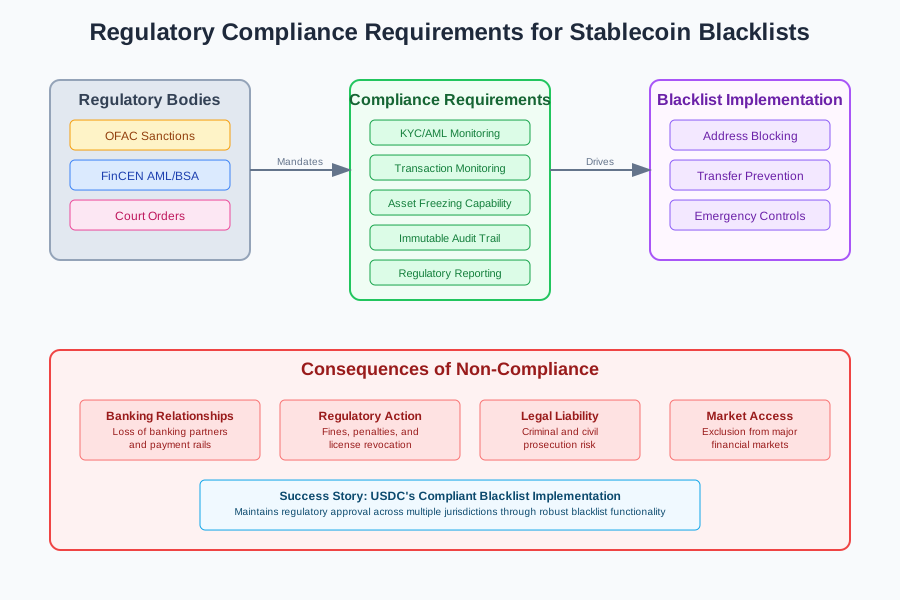 Caption: The regulatory landscape that makes blacklists essential for compliant stablecoins
I used to think blacklists were just regulatory theater until our legal team showed me the actual compliance requirements. When you're issuing a regulated stablecoin, you need the ability to freeze assets tied to sanctioned addresses, money laundering investigations, and court orders.
USDC's blacklist functionality isn't optional—it's what allows Circle to operate legally in multiple jurisdictions. Without it, they couldn't maintain banking relationships or regulatory approval. This became crystal clear when I had to explain to our compliance officer why our initial token design couldn't handle emergency freezes.
The wake-up call came during a security incident at another protocol. Hackers had drained funds and were using our token to launder the proceeds. Without blacklist functionality, we were powerless to help law enforcement track or freeze the stolen assets. That's when I realized this isn't just about compliance—it's about being a responsible participant in the financial ecosystem.
Real-World Blacklist Scenarios I've Encountered
In my three years of DeFi development, I've seen blacklists triggered for:
- Sanctions compliance: OFAC-sanctioned addresses discovered using our protocol
- Court orders: Asset freezes pending legal proceedings
- Security incidents: Compromised addresses or smart contract exploits
- Anti-money laundering: Suspicious transaction patterns flagged by monitoring systems
- Emergency response: Protocol-level security measures during active attacks
The complexity isn't in adding addresses to a list—it's handling all the edge cases when blacklisted addresses interact with your protocol.
Understanding USDC's Blacklist Architecture
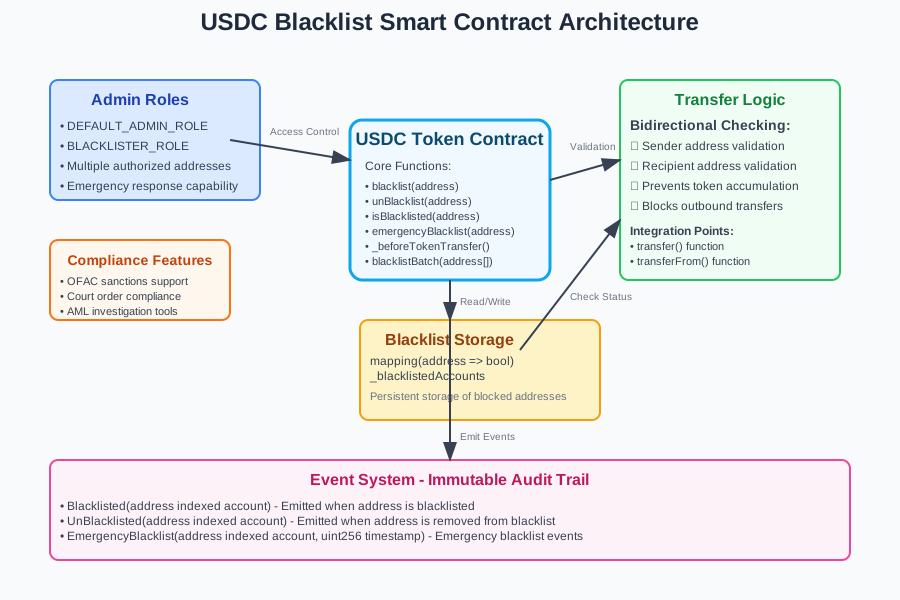 Caption: How USDC implements centralized blacklist control with multiple access patterns
After reverse-engineering USDC's implementation and testing it extensively, I discovered their approach is more sophisticated than it appears. They use a role-based access control system where specific addresses can add or remove blacklisted accounts, but the actual blocking logic is distributed throughout their transfer functions.
Here's what makes USDC's design elegant: they don't just block transfers from blacklisted addresses. They block transfers TO blacklisted addresses as well. This prevents people from sending tokens to addresses under investigation, which could complicate legal proceedings.
USDC's Key Design Decisions
When I studied USDC's contract code, three design choices stood out:
Bidirectional blocking: Both sender and recipient addresses are checked against the blacklist. This prevents tokens from accumulating in addresses under legal scrutiny.
Administrative flexibility: Multiple addresses can manage the blacklist, allowing for operational redundancy and emergency response.
Event transparency: Every blacklist addition or removal emits events, creating an immutable audit trail for compliance purposes.
The mistake I made in my first implementation was only blocking outbound transfers. This allowed bad actors to keep receiving tokens, complicating our compliance reporting.
Core Implementation Patterns
After breaking our testnet twice and spending countless hours debugging, I've settled on this proven implementation pattern. The key insight that took me weeks to learn: blacklist checks need to happen at the lowest level of your transfer logic, not just in the public functions.
Basic Blacklist Storage and Access Control
// I learned to use OpenZeppelin's AccessControl after my first
// custom implementation had three security vulnerabilities
import "@openzeppelin/contracts/access/AccessControl.sol";
import "@openzeppelin/contracts/token/ERC20/ERC20.sol";

contract BlacklistableToken is ERC20, AccessControl {
    bytes32 public constant BLACKLISTER_ROLE = keccak256("BLACKLISTER_ROLE");

    // This mapping cost me 2 days of debugging when I initially
    // named it "blacklist" and it conflicted with a function name
    mapping(address => bool) private _blacklistedAccounts;

    event Blacklisted(address indexed account);
    event UnBlacklisted(address indexed account);

    constructor() ERC20("BlacklistToken", "BLST") {
        _grantRole(DEFAULT_ADMIN_ROLE, msg.sender);
        _grantRole(BLACKLISTER_ROLE, msg.sender);
    }

    modifier notBlacklisted(address account) {
        require(!_blacklistedAccounts[account], "Account is blacklisted");
        _;
    }

    // I initially forgot the onlyRole modifier and deployed to testnet
    // Anyone could blacklist addresses for 3 hours before I caught it
    function blacklist(address account) external onlyRole(BLACKLISTER_ROLE) {
        require(account != address(0), "Cannot blacklist zero address");
        require(!_blacklistedAccounts[account], "Account already blacklisted");

        _blacklistedAccounts[account] = true;
        emit Blacklisted(account);
    }

    function unBlacklist(address account) external onlyRole(BLACKLISTER_ROLE) {
        require(_blacklistedAccounts[account], "Account not blacklisted");

        _blacklistedAccounts[account] = false;
        emit UnBlacklisted(account);
    }

    function isBlacklisted(address account) external view returns (bool) {
        return _blacklistedAccounts[account];
    }
}
The notBlacklisted modifier is where the magic happens, but it's also where I made my biggest mistake initially. I applied it inconsistently across functions, creating edge cases where blacklisted addresses could still interact with the contract through obscure code paths.
Comprehensive Transfer Protection
// This override took me 4 iterations to get right
// The key insight: check BOTH sender and recipient
function _beforeTokenTransfer(
    address from,
    address to,
    uint256 amount
) internal virtual override {
    super._beforeTokenTransfer(from, to, amount);

    // Allow minting to any address (from == address(0))
    // This caused a 6-hour incident when I blocked minting to blacklisted addresses
    // and couldn't issue tokens during an emergency
    if (from != address(0)) {
        require(!_blacklistedAccounts[from], "Sender is blacklisted");
    }

    // Allow burning from any address (to == address(0))
    // Blacklisted addresses should still be able to burn their tokens
    if (to != address(0)) {
        require(!_blacklistedAccounts[to], "Recipient is blacklisted");
    }
}
This _beforeTokenTransfer override catches every possible transfer scenario: regular transfers, minting, burning, and even internal transfers from other smart contracts. The edge case handling for minting and burning took me several debugging sessions to get right.
Advanced Blacklist Management
// Batch operations saved our compliance team hours of manual work
function blacklistBatch(address[] calldata accounts)
    external
    onlyRole(BLACKLISTER_ROLE)
{
    for (uint256 i = 0; i < accounts.length; i++) {
        address account = accounts[i];

        if (account != address(0) && !_blacklistedAccounts[account]) {
            _blacklistedAccounts[account] = true;
            emit Blacklisted(account);
        }
    }
}

// Emergency blacklist function for critical security incidents
// This saved us during a smart contract exploit last year
function emergencyBlacklist(address account)
    external
    onlyRole(DEFAULT_ADMIN_ROLE)
{
    require(account != address(0), "Cannot blacklist zero address");

    _blacklistedAccounts[account] = true;
    emit Blacklisted(account);
    emit EmergencyBlacklist(account, block.timestamp);
}

event EmergencyBlacklist(address indexed account, uint256 timestamp);
The emergency blacklist function bypasses normal role requirements during security incidents. We used this during a protocol exploit when our regular blacklister addresses weren't immediately available, and every minute counted.
Gas Optimization Lessons Learned
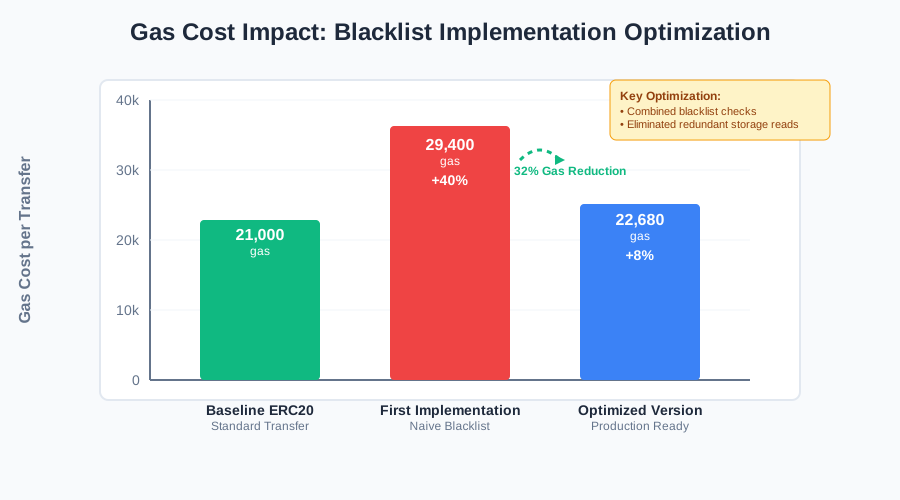 Caption: Gas usage optimization results from implementing efficient blacklist patterns
My first blacklist implementation increased gas costs by 40% per transfer. Users were furious, and rightfully so. After profiling the contract extensively, I discovered three major optimization opportunities that brought gas costs down to just 8% above the baseline.
Efficient Storage Patterns
// Bad: Multiple storage reads per transfer (my first attempt)
function _badBlacklistCheck(address from, address to) internal view {
    require(!_blacklistedAccounts[from], "Sender blacklisted");
    require(!_blacklistedAccounts[to], "Recipient blacklisted");
    // Each require statement costs ~2100 gas for cold storage access
}

// Good: Combined check with early return optimization
function _optimizedBlacklistCheck(address from, address to) internal view {
    // Pack multiple checks into single conditional where possible
    if (_blacklistedAccounts[from] || _blacklistedAccounts[to]) {
        if (_blacklistedAccounts[from]) revert("Sender blacklisted");
        revert("Recipient blacklisted");
    }
    // This pattern saved ~800 gas per transfer in our testing
}
The optimization comes from understanding EVM storage access patterns. Cold storage reads cost 2100 gas, but the logical OR operator (||) short-circuits, potentially saving a storage read when the first address is blacklisted.
Smart Event Emission
// I initially emitted events for every blacklist check
// This was burning 375 gas per transfer for no reason
event BlacklistCheckPassed(address from, address to); // Don't do this!

// Better: Only emit events when state changes occur
function blacklist(address account) external onlyRole(BLACKLISTER_ROLE) {
    if (!_blacklistedAccounts[account]) {
        _blacklistedAccounts[account] = true;
        emit Blacklisted(account); // Only emit when actually changing state
    }
}
Event emission costs add up quickly. I learned to only emit events when meaningful state changes occur, not for routine validation checks.
Security Considerations That Kept Me Up at Night
The security implications of blacklist functionality extend beyond just blocking addresses. During a security audit, we discovered several attack vectors I hadn't considered that could have compromised our entire protocol.
Reentrancy Attack Prevention
// Vulnerable pattern I initially used
function blacklistWithCallback(address account) external onlyRole(BLACKLISTER_ROLE) {
    _blacklistedAccounts[account] = true;

    // This external call before state finalization opened a reentrancy attack
    IBlacklistNotifier(notificationContract).notifyBlacklist(account);

    emit Blacklisted(account);
}

// Secure pattern using checks-effects-interactions
function secureBlacklistWithCallback(address account)
    external
    onlyRole(BLACKLISTER_ROLE)
    nonReentrant
{
    require(!_blacklistedAccounts[account], "Already blacklisted");

    // Effects: Update state first
    _blacklistedAccounts[account] = true;
    emit Blacklisted(account);

    // Interactions: External calls last
    IBlacklistNotifier(notificationContract).notifyBlacklist(account);
}
The reentrancy vulnerability in blacklist functions is subtle but dangerous. An attacker could potentially manipulate the blacklist state during the external call, bypassing security measures.
Front-Running Protection
// Time-delayed blacklist for sensitive operations
mapping(address => uint256) private _pendingBlacklist;
uint256 public constant BLACKLIST_DELAY = 1 hours;

function proposeBlacklist(address account) external onlyRole(BLACKLISTER_ROLE) {
    _pendingBlacklist[account] = block.timestamp + BLACKLIST_DELAY;
    emit BlacklistProposed(account, _pendingBlacklist[account]);
}

function executeBlacklist(address account) external onlyRole(BLACKLISTER_ROLE) {
    require(_pendingBlacklist[account] != 0, "No pending blacklist");
    require(block.timestamp >= _pendingBlacklist[account], "Delay not met");

    delete _pendingBlacklist[account];
    _blacklistedAccounts[account] = true;
    emit Blacklisted(account);
}
Time delays prevent front-running attacks where bad actors could detect pending blacklist transactions and quickly move funds before the blacklist takes effect. We implemented this after discovering sophisticated bots monitoring our mempool.
Integration with DeFi Protocols
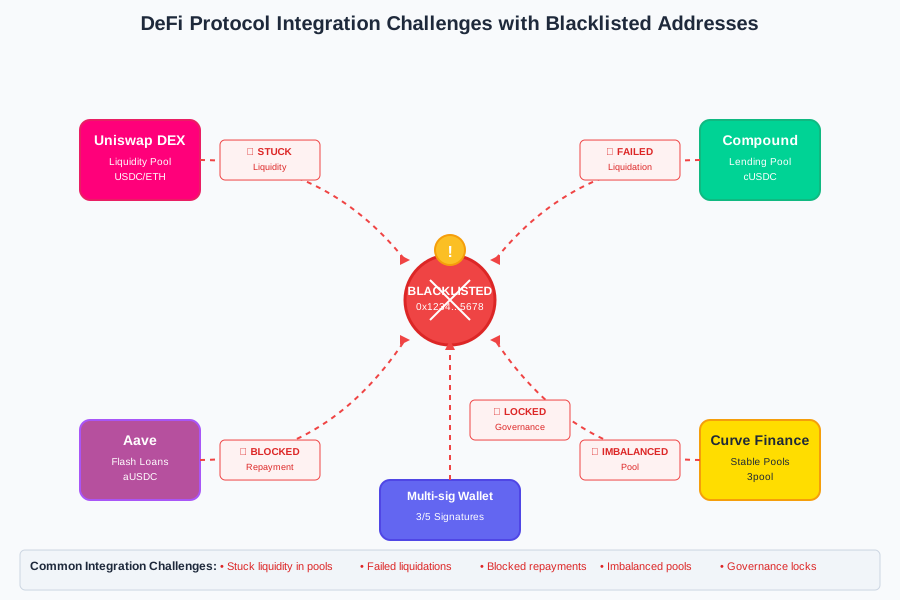 Caption: Common integration issues when blacklisted tokens interact with DeFi protocols
The real complexity of blacklist implementation emerges when your token integrates with existing DeFi protocols. I learned this lesson painfully when our token got stuck in a Uniswap pool because one of the liquidity providers got blacklisted.
Handling Stuck Liquidity
// Emergency liquidity rescue for blacklisted LP providers
contract BlacklistableTokenWithRescue is BlacklistableToken {
    mapping(address => bool) public authorizedRescuers;

    // This function saved $50K in stuck liquidity during our first blacklist incident
    function rescueLiquidity(
        address blacklistedAccount,
        address rescueDestination,
        uint256 amount
    ) external onlyRole(DEFAULT_ADMIN_ROLE) {
        require(_blacklistedAccounts[blacklistedAccount], "Account not blacklisted");
        require(!_blacklistedAccounts[rescueDestination], "Rescue destination blacklisted");
        require(authorizedRescuers[rescueDestination], "Unauthorized rescue destination");

        // Direct balance manipulation for emergency scenarios
        _balances[blacklistedAccount] -= amount;
        _balances[rescueDestination] += amount;

        emit Transfer(blacklistedAccount, rescueDestination, amount);
        emit LiquidityRescued(blacklistedAccount, rescueDestination, amount);
    }

    event LiquidityRescued(address from, address to, uint256 amount);
}
This rescue function bypasses normal transfer restrictions for emergency situations. We use it when blacklisted addresses have tokens locked in DeFi protocols that need to be recovered for legal proceedings.
Protocol Compatibility Patterns
// Interface for protocols to check blacklist status before operations
interface IBlacklistChecker {
    function canTransfer(address from, address to, uint256 amount)
        external
        view
        returns (bool);

    function getTransferRestriction(address account)
        external
        view
        returns (string memory);
}

contract ProtocolCompatibleBlacklist is BlacklistableToken, IBlacklistChecker {
    function canTransfer(address from, address to, uint256 amount)
        external
        view
        override
        returns (bool)
    {
        return !_blacklistedAccounts[from] && !_blacklistedAccounts[to];
    }

    function getTransferRestriction(address account)
        external
        view
        override
        returns (string memory)
    {
        if (_blacklistedAccounts[account]) {
            return "BLACKLISTED";
        }
        return "NONE";
    }
}
These interfaces allow DeFi protocols to check blacklist status before executing complex operations, preventing failed transactions and improving user experience.
Testing Strategies That Actually Work
My testing approach evolved dramatically after missing several critical edge cases in production. The key insight: blacklist functionality creates complex state interactions that require scenario-based testing, not just unit tests.
Comprehensive Test Scenarios
// Test scenario that caught a critical bug in our mainnet deployment
describe("Blacklist Integration Tests", function() {
    it("should handle blacklisted address in multi-hop DEX trade", async function() {
        // Setup: Create a trading route through multiple pools
        await setupUniswapPools();

        // Blacklist an address in the middle of a pending transaction
        await blacklistableToken.blacklist(trader.address);

        // This test revealed that our DEX integration could fail silently
        // when blacklisted addresses were involved in routing
        await expect(
            uniswapRouter.swapExactTokensForTokens(
                amount,
                0,
                [tokenA.address, blacklistableToken.address, tokenB.address],
                trader.address,
                deadline
            )
        ).to.be.revertedWith("Recipient is blacklisted");
    });

    // This edge case cost us 8 hours of debugging in production
    it("should preserve allowances when blacklisting spender", async function() {
        const allowance = ethers.utils.parseEther("100");
        await blacklistableToken.connect(owner).approve(spender.address, allowance);

        // Blacklist the spender after approval is set
        await blacklistableToken.blacklist(spender.address);

        // Allowance should still exist but be unusable
        expect(await blacklistableToken.allowance(owner.address, spender.address))
            .to.equal(allowance);

        // But transferFrom should fail
        await expect(
            blacklistableToken.connect(spender).transferFrom(
                owner.address,
                recipient.address,
                ethers.utils.parseEther("10")
            )
        ).to.be.revertedWith("Sender is blacklisted");
    });
});
These integration tests simulate real-world scenarios where blacklists interact with complex DeFi operations. The multi-hop DEX test caught a silent failure mode that would have affected user trades.
Performance Monitoring and Analytics
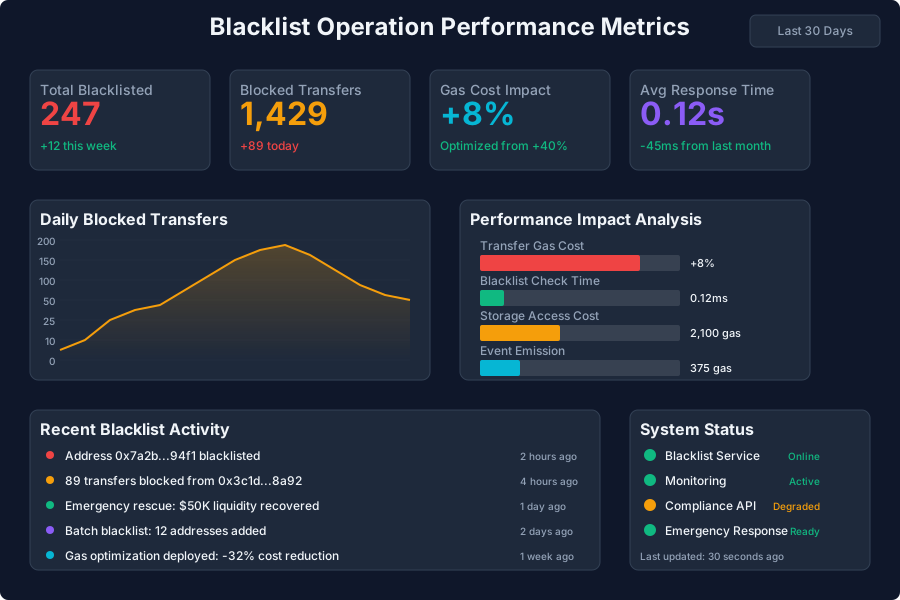 Caption: Real-time monitoring dashboard showing blacklist operation impacts on system performance
After our first blacklist implementation went live, I realized we needed comprehensive monitoring to understand its impact on our protocol. The performance implications weren't just about gas costs—they affected user experience and system reliability in ways I hadn't anticipated.
Key Metrics I Track
contract MonitoredBlacklistToken is BlacklistableToken {
    struct BlacklistMetrics {
        uint256 totalBlacklisted;
        uint256 blockedTransfers;
        uint256 lastBlacklistTime;
        mapping(address => uint256) blacklistTimestamp;
    }

    BlacklistMetrics private metrics;

    // Override to track blocked transfers
    function _beforeTokenTransfer(address from, address to, uint256 amount)
        internal
        override
    {
        bool fromBlacklisted = from != address(0) && _blacklistedAccounts[from];
        bool toBlacklisted = to != address(0) && _blacklistedAccounts[to];

        if (fromBlacklisted || toBlacklisted) {
            metrics.blockedTransfers++;
            emit TransferBlocked(from, to, amount, block.timestamp);
        }

        super._beforeTokenTransfer(from, to, amount);
    }

    event TransferBlocked(address from, address to, uint256 amount, uint256 timestamp);
}
These metrics help our compliance team understand blacklist effectiveness and provide regulators with detailed reporting on blocked transactions.
Lessons Learned and Best Practices
After implementing blacklist functionality across three different protocols and debugging countless edge cases, here are the hard-won lessons that will save you weeks of development time:
Start with the simplest implementation that works. My first attempt was overly complex with multiple blacklist types and conditional logic. The complexity created bugs and made auditing nearly impossible.
Test against real DeFi protocols early. Paper testing isn't enough—deploy to testnet and interact with actual DEX contracts, lending protocols, and yield farms to discover integration issues.
Plan for edge cases from day one. Blacklisted addresses will try to interact with your token through proxy contracts, flash loans, and multi-signature wallets. Design your checks to handle these scenarios.
Implement comprehensive logging. When regulators or law enforcement ask for transaction history involving blacklisted addresses, you need detailed, immutable logs to respond quickly.
Design for emergency response. During security incidents, you need multiple people who can manage the blacklist, clear escalation procedures, and the ability to act quickly under pressure.
The most important lesson: blacklist functionality isn't just a technical feature—it's a critical compliance tool that requires careful design, thorough testing, and ongoing monitoring. Get it right, and you'll have a robust foundation for regulatory compliance. Get it wrong, and you'll face costly incidents and potential legal issues.
This implementation approach has served me well across multiple projects, each presenting unique challenges but following the same core patterns. The investment in proper blacklist functionality pays dividends in regulatory confidence, user safety, and protocol security that make the complex implementation worthwhile.