Remember when farming meant getting dirt under your fingernails? Welcome to 2025, where the most profitable crops grow in digital pools, and your harvest depends on smart contracts, not sunshine. Solana yield farming has transformed from a niche DeFi experiment into a sophisticated income strategy that can generate double-digit returns for savvy investors.
This comprehensive guide walks you through setting up yield farming operations on Solana's two powerhouse protocols: Raydium and Orca. You'll learn to maximize returns while managing risks in the fast-paced world of decentralized finance.
What Makes Solana Yield Farming Different
Solana's blockchain architecture delivers sub-second transaction speeds and fees under $0.01, making it ideal for active yield farming strategies. Unlike Ethereum's expensive gas fees that can eat into small positions, Solana enables profitable farming with modest capital.
The ecosystem features over 400 active protocols, with Raydium and Orca leading the automated market maker (AMM) space. These platforms offer:
- High liquidity pools with consistent trading volume
- Competitive APY rates often exceeding 15-30%
- Advanced farming mechanisms including dual rewards and boosted yields
- Integration capabilities with major Solana DeFi protocols
Prerequisites for Solana Yield Farming
Before diving into protocol setup, ensure you have these essential components:
Wallet Requirements
- Phantom Wallet (recommended) or Solflare
- Minimum 0.1 SOL for transaction fees
- Browser extension installed and configured
Capital Allocation
- Starting amount: $100-500 for learning
- Risk tolerance: Only invest what you can afford to lose
- Diversification: Spread across multiple pools
Technical Knowledge
- Basic understanding of impermanent loss
- Familiarity with smart contract interactions
- Ability to read transaction confirmations
Raydium Protocol Setup: Step-by-Step Guide
Raydium operates as Solana's first automated market maker, built on the Serum DEX infrastructure. This integration provides unique advantages for yield farmers.
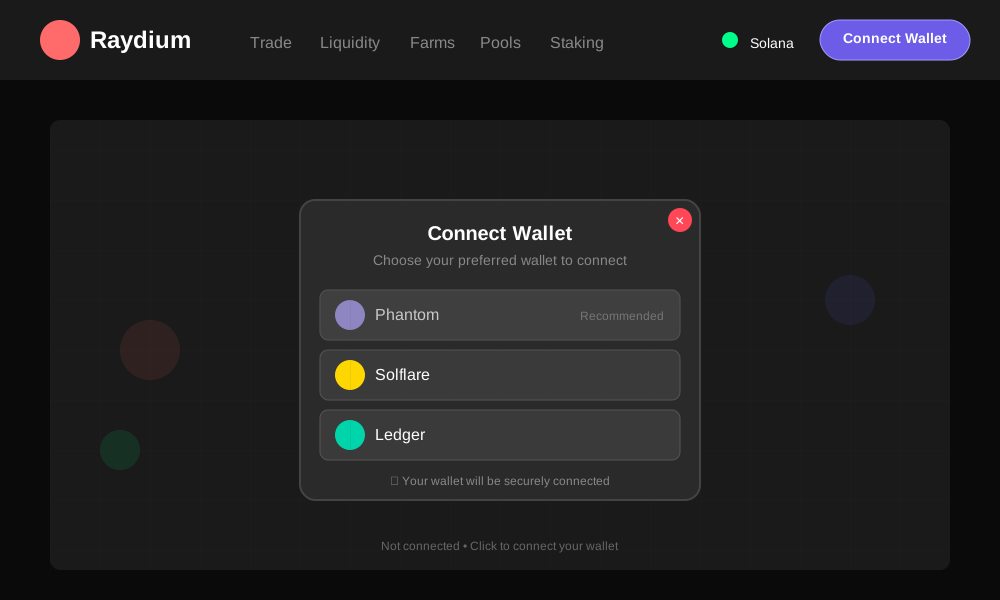
Step 1: Connect Your Wallet to Raydium
- Navigate to raydium.io
- Click "Connect Wallet" in the top-right corner
- Select your wallet provider (Phantom recommended)
- Approve the connection request
- Verify your wallet address appears correctly
Step 2: Analyze Available Pools
Raydium's pool selection directly impacts your farming success. Focus on these key metrics:
// Example pool analysis criteria
const poolAnalysis = {
  tvl: "> $1,000,000", // Total Value Locked
  volume24h: "> $100,000", // Daily trading volume
  apy: "15-40%", // Annual percentage yield
  impermanentLoss: "< 5%", // Historical IL risk
  tokenPair: "SOL/USDC" // Stable pair recommendation
};
Top-performing Raydium pools:
- SOL/USDC: 18-25% APY, low impermanent loss
- RAY/SOL: 22-35% APY, moderate volatility
- mSOL/SOL: 12-18% APY, minimal impermanent loss
Step 3: Provide Liquidity
- Select your target pool from the "Liquidity" tab
- Click "Add Liquidity"
- Enter token amounts (maintain 50/50 ratio)
- Review price impact and slippage settings
- Confirm transaction in your wallet
The platform automatically calculates optimal ratios. For a $1,000 position in SOL/USDC:
- 2.5 SOL (assuming $200 SOL price)
- 500 USDC
Step 4: Stake LP Tokens for Farming
After providing liquidity, you'll receive LP tokens representing your pool share. Stake these tokens to earn additional rewards:
- Navigate to "Farms" section
- Find your corresponding pool
- Click "Stake LP"
- Enter your LP token amount
- Confirm staking transaction
Expected rewards structure:
- Trading fees: 0.25% of pool volume
- RAY tokens: 15-20% APY
- Bonus rewards: Seasonal promotional tokens
Orca Protocol Setup: Advanced Yield Strategies
Orca differentiates itself through user-friendly design and innovative farming mechanisms. The protocol emphasizes concentrated liquidity and dynamic fee structures.
Understanding Orca's Whirlpool Model
Orca's Whirlpool technology enables concentrated liquidity positions, similar to Uniswap V3. This approach can significantly boost capital efficiency:
// Concentrated liquidity example
Position memory position = Position({
  lower_tick: -887220, // Price range minimum
  upper_tick: 887220,  // Price range maximum
  liquidity: 1000000,  // Concentrated amount
  fee_tier: 0.05       // 0.05% fee tier
});
Step 1: Access Orca Interface
- Visit orca.so
- Connect your Solana wallet
- Approve site permissions
- Verify connection status
Step 2: Choose Your Farming Strategy
Orca offers multiple farming approaches:
Standard Pools:
- Equal weight token pairs
- Predictable returns
- Lower maintenance requirements
Concentrated Liquidity:
- Higher capital efficiency
- Active management needed
- Potential for 2-5x returns
Double Dip Pools:
- Dual reward mechanisms
- Higher APY potential
- Increased complexity
Step 3: Execute Concentrated Liquidity Position
For advanced farmers, concentrated liquidity maximizes returns:
- Select "Concentrated Liquidity" from the menu
- Choose your token pair
- Set price range parameters
- Deposit tokens within range
- Monitor position performance
Price range strategy for SOL/USDC:
- Current price: $200
- Range: $180-220 (10% on each side)
- Capital efficiency: 3-4x compared to full range
Step 4: Manage Active Positions
Concentrated positions require regular monitoring:
// Position monitoring checklist
const monitoringTasks = {
  daily: "Check if price is within range",
  weekly: "Analyze fee accumulation",
  monthly: "Rebalance position if needed",
  emergency: "Exit if price moves beyond range"
};
Risk Management and Security Best Practices
Successful yield farming requires disciplined risk management:
Impermanent Loss Protection
Calculate potential impermanent loss before entering positions:
# Impermanent loss formula
def calculate_impermanent_loss(price_ratio):
    return 2 * (price_ratio ** 0.5) / (1 + price_ratio) - 1

# Example: If SOL doubles in price
il_percentage = calculate_impermanent_loss(2.0)
# Result: ~5.7% impermanent loss
Portfolio Diversification
Spread risk across multiple protocols and strategies:
- 40% in stable pairs (SOL/USDC, mSOL/SOL)
- 35% in growth pairs (RAY/SOL, ORCA/SOL)
- 25% in experimental positions
Security Measures
Protect your farming operations:
- Hardware wallet for large positions
- Regular audits of approved contracts
- Slippage limits set to 1-2%
- Emergency exit plans for market volatility
Performance Optimization Strategies
Compounding Rewards
Maximize returns through regular compounding:
// Auto-compounding frequency
const compoundingStrategy = {
  daily: "For positions > $10,000",
  weekly: "For positions $1,000-10,000",
  monthly: "For positions < $1,000"
};
Fee Minimization
Reduce transaction costs:
- Batch multiple operations
- Use priority fees during network congestion
- Time transactions during low-activity periods
Yield Optimization
Compare returns across protocols:
| Protocol | Pool | APY | TVL | Risk Level |
|---|---|---|---|---|
| Raydium | SOL/USDC | 22% | $45M | Low |
| Orca | SOL/USDC | 18% | $32M | Low |
| Raydium | RAY/SOL | 35% | $12M | Medium |
| Orca | ORCA/SOL | 28% | $8M | Medium |
Common Mistakes to Avoid
Learn from these frequent farming errors:
Overconcentration Risk
Don't put all capital in one pool. Diversify across multiple protocols and token pairs.
Ignoring Impermanent Loss
Calculate potential losses before entering volatile pairs. Use tools like impermanent-loss-calculator.com.
FOMO Farming
Avoid chasing unsustainable APY rates. Focus on established pools with consistent returns.
Poor Timing
Don't enter positions during extreme market volatility. Wait for stable conditions.
Advanced Yield Farming Techniques
Leveraged Farming
Use platforms like Tulip Protocol for leveraged positions:
// Leveraged farming example
LeveragedPosition memory position = LeveragedPosition({
  baseAmount: 1000,      // Initial capital
  leverage: 2,           // 2x leverage
  borrowRate: 0.05,      // 5% borrowing cost
  expectedAPY: 0.30      // 30% farming yield
});
Cross-Protocol Strategies
Maximize returns by combining protocols:
- Arbitrage opportunities between Raydium and Orca
- Liquidity migration based on APY changes
- Reward token optimization through immediate selling or holding
Monitoring and Analytics Tools
Track your farming performance:
DeFi Pulse Dashboard
- Real-time APY tracking
- Pool performance metrics
- Historical return analysis
Step Finance
- Portfolio overview
- Transaction history
- Yield optimization suggestions
Custom Tracking Spreadsheets
// Farming performance tracker
Date | Protocol | Pool | Amount | APY | Daily Return | Fees Paid
Tax Considerations for Yield Farming
Understand tax implications:
Income Recognition
- Farming rewards are taxable income
- Use fair market value at receipt
- Track all reward distributions
Capital Gains
- LP token sales trigger capital gains
- Impermanent loss may be deductible
- Consult tax professionals for complex situations
Future of Solana Yield Farming
The ecosystem continues evolving with new innovations:
Upcoming Features
- Automated rebalancing for concentrated positions
- Cross-chain bridges for multi-chain farming
- AI-powered yield optimization tools
Market Trends
- Increasing institutional adoption
- Regulatory clarity development
- Enhanced security measures
Conclusion
Solana yield farming through Raydium and Orca protocols offers compelling opportunities for generating passive income in the DeFi space. The combination of low transaction costs, high throughput, and innovative farming mechanisms creates an ideal environment for both beginners and experienced farmers.
Success in Solana yield farming requires careful planning, consistent monitoring, and disciplined risk management. Start with small positions, diversify across protocols, and gradually scale your operations as you gain experience.
The protocols covered in this guide provide robust foundations for yield farming strategies. As the Solana ecosystem continues maturing, new opportunities will emerge for innovative farmers willing to adapt and evolve their approaches.
Remember that yield farming carries inherent risks, including impermanent loss, smart contract vulnerabilities, and market volatility. Never invest more than you can afford to lose, and always conduct thorough research before entering new positions.
Ready to start your Solana yield farming journey? Begin with a small position in a stable pool like SOL/USDC, and gradually expand your strategy as you become more comfortable with the protocols and market dynamics.