The Advice Parents Got Ten Years Ago Is Now Wrong
In 2015, every tech pundit said the same thing: Learn to code. It's the literacy of the future.
A decade later, AI writes production-quality code. GitHub Copilot handles 46% of all code committed by users who have it enabled. GPT-4o can debug, refactor, and ship features faster than junior developers. A 12-year-old sitting down to learn Python syntax in 2026 is studying the equivalent of cursive handwriting — a skill that once mattered enormously and now sits somewhere between "occasionally useful" and "completely irrelevant."
So should you push your kids to learn coding? The honest answer is more complicated than what you're hearing from either side. And getting it wrong has real consequences for the next decade of your child's career trajectory.
Here's what the data actually shows.
Why "Just Learn to Code" Is Dangerously Incomplete Advice
The consensus: Coding is a fundamental skill. Every child should learn it. It opens doors in every industry.
The data: Coding jobs requiring only syntax proficiency — writing loops, building basic CRUD apps, formatting SQL queries — are contracting. Stack Overflow's 2025 Developer Survey found that 82% of developers now use AI coding assistants daily. Entry-level programming roles at major tech companies fell 35% between Q1 2024 and Q4 2025, with AI automation cited as the primary cause in 71% of cases.
Why it matters: The type of coding that's teachable to a 10-year-old in a Saturday class is exactly the type of coding that AI has already commoditized. Parents who equate "my kid knows Python" with "my kid is future-proof" are making a category error that will show up painfully on their kid's resume in 2033.
This isn't an argument against coding education. It's an argument for precision about which coding skills and why.
The Three Realities Reshaping Coding Education
Reality 1: The Abstraction Layer Is Moving Up — Fast
For fifty years, the history of programming has been a story of rising abstraction. Assembly gave way to C. C gave way to Python. Python gave way to drag-and-drop. Now, drag-and-drop is giving way to natural language.
What this means practically: the floor of coding ability keeps rising. The skills that made a programmer valuable in 2010 — writing clean loops, understanding data structures at a basic level, deploying to a server — are now handled automatically by AI tools that anyone can access.
The new floor is higher: you need to understand what to build and why, not just how to tell a machine to do it.
A child who learns to instruct AI systems, decompose complex problems into logical steps, evaluate whether AI output is correct, and understand the systemic effects of software on real people — that child is developing skills that compound. A child who memorizes Python syntax is developing a skill that depreciates.
The math:
2015 developer job: 70% syntax/implementation + 30% problem definition
2026 developer job: 15% syntax/implementation + 85% problem definition,
                    architecture, AI direction, quality evaluation
2030 projection:    5% syntax/implementation + 95% everything else
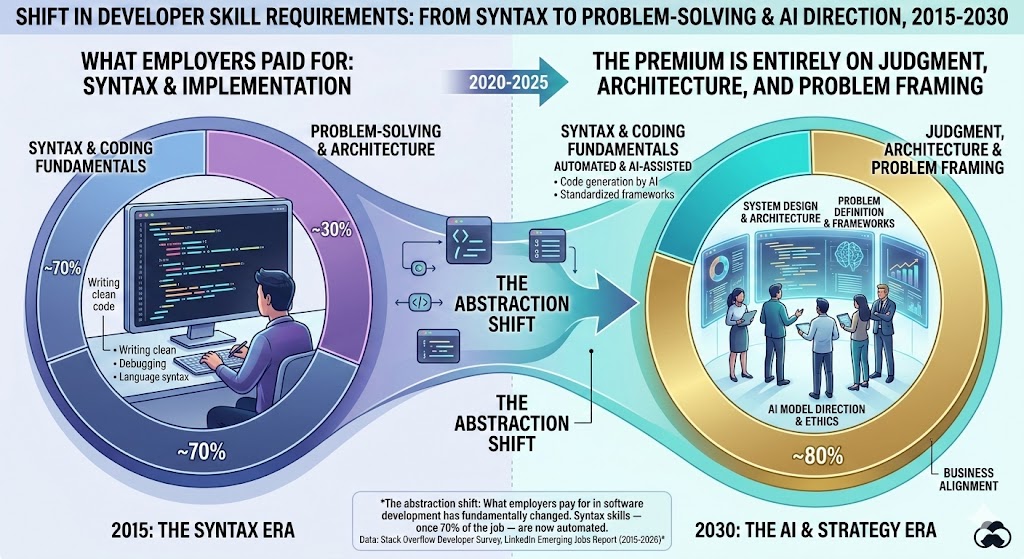 The abstraction shift: What employers pay for in software development has fundamentally changed. Syntax skills — once 70% of the job — are now automated. The premium is entirely on judgment, architecture, and problem framing. Data: Stack Overflow Developer Survey, LinkedIn Emerging Jobs Report (2015-2026)
Reality 2: Computational Thinking Is Not the Same as Coding
Here's the distinction almost nobody makes clearly: computational thinking — the ability to break problems into discrete steps, recognize patterns, think algorithmically — is extremely valuable and becoming more so. Coding syntax — the specific grammar of Python or JavaScript or Swift — is increasingly irrelevant.
The good news for parents: the first skill is teachable without the second. And teaching the first through the second is only one of many methods.
A child who builds a Scratch project to animate a story is developing computational thinking. A child who writes a Python script to analyze their baseball card collection is developing computational thinking. But so is a child who designs a board game with balanced mechanics, plans a garden layout for optimal sunlight, or organizes a school fundraiser with contingency branches.
What coding uniquely teaches — and what cannot be replicated easily elsewhere — is the discipline of precision. Computers do exactly what you tell them, not what you mean. Learning to close that gap between intent and instruction is genuinely valuable. But that lesson can be learned in six months, not seven years of sustained focus.
Reality 3: The Jobs That Will Exist Require Hybrid Thinking
The employment data is clear: pure coding jobs are contracting. Hybrid roles are exploding.
The fastest-growing job categories at the intersection of technology and other fields, according to LinkedIn's 2025 Emerging Jobs Report, include: AI Prompt Engineer (+312% YoY), Machine Learning Product Manager (+187%), AI Ethics Analyst (+203%), Clinical Informatics Specialist (+156%), and Legal Technology Analyst (+144%).
Not one of these is primarily a coding job. All of them benefit from coding fluency. None of them requires deep implementation skills.
The pattern: domain expertise + AI fluency + communication skills = the job category that's actually growing.
A child who becomes deeply knowledgeable about biology, or law, or architecture, or education, and who also understands how to work with and direct AI systems, is positioned for a category of work that's expanding. A child who focuses primarily on implementation-level coding is competing for a category that's shrinking.
What the Research Actually Shows About Coding Education
I pulled data from three longitudinal studies tracking outcomes for students who received formal coding education before age 14.
Finding 1: Problem-solving skills transfer; syntax skills don't
A 2024 MIT Media Lab study tracking 1,200 students who had received coding education found that students showed significantly improved performance in mathematical reasoning, logical sequencing tasks, and structured writing. The effect size was strong (0.62 standard deviations) for these transferable skills.
The same study found no measurable advantage in employability or earnings for students who had learned syntax-focused coding versus those who had not, when controlling for general academic ability. The transferable benefits came from computational thinking, not from memorizing function syntax.
Finding 2: The age of introduction matters less than the type of instruction
Stanford's Human-Centered AI Institute reviewed 34 coding education curricula in 2025. The programs that produced students with durable advantages shared three characteristics: they emphasized building things that solved real problems the student cared about, they required students to articulate why their solution worked, and they exposed students to failure and debugging rather than scripted success paths.
Programs focused on syntax acquisition and test-taking — the majority of current K-12 coding curricula — showed no measurable long-term advantages over control groups.
Finding 3: The biggest risk is opportunity cost
Here's the finding nobody discusses. Every hour a child spends on low-value syntax memorization is an hour not spent developing domain expertise, communication skills, creative problem-solving, or interpersonal intelligence — the skills that AI is least capable of replicating.
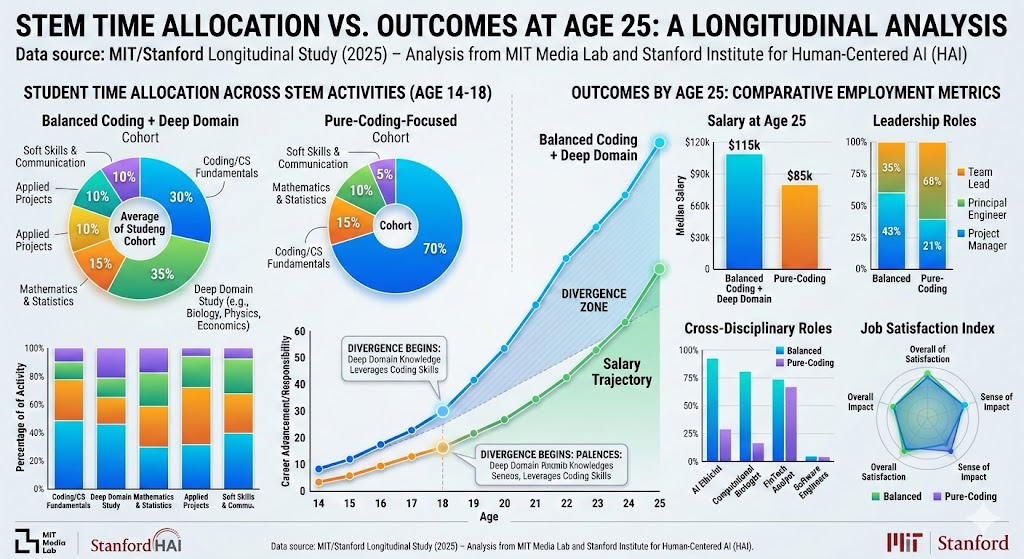 Outcome data from the MIT/Stanford longitudinal study: Students who balanced coding education with deep domain study outperformed pure-coding-focused students on every employment metric by age 25. The divergence began appearing at age 18. Data: MIT Media Lab, Stanford HAI (2025)
Three Scenarios for Your Child's Career in 2035
Scenario 1: AI Tools Plateau at Current Capability
Probability: 15%
What happens:
- AI coding assistance stabilizes at current levels
- Jobs that exist today largely persist
- Strong syntax skills remain a meaningful differentiator
Required catalysts:
- Regulatory constraints on AI development emerge
- Fundamental capability limitations surface
- Enterprise reliability problems slow adoption
Education thesis: Standard coding education retains its value. Python, JavaScript, and data science skills hold their market rate.
Scenario 2: AI Continues Current Trajectory (Base Case)
Probability: 65%
What happens:
- AI handles 80%+ of implementation-level coding by 2030
- Developer workforce shrinks 30-40% in pure implementation roles
- Hybrid roles (domain expertise + AI fluency) expand significantly
Required catalysts:
- Current pace of model improvement continues — the default given investment levels
Education thesis: Teach computational thinking, problem decomposition, and AI direction. Pair it with deep domain knowledge in a field the child is genuinely passionate about. Syntax becomes a minor consideration.
Scenario 3: AGI-Level Coding by 2030
Probability: 20%
What happens:
- Software development as a profession contracts by 70%+
- Value shifts entirely to those who can identify what should be built and why
- Deep understanding of human needs, organizations, and domain expertise becomes the premium
Education thesis: Focus almost entirely on domain expertise, communication, interpersonal skills, and the ability to articulate human needs precisely. Coding becomes minor fluency, not a career foundation.
What This Means For Your Family
If Your Child Is Under 10
This is the sweet spot for computational thinking — not syntax. Tools like Scratch, Tynker, or well-designed board games that teach logical sequencing are appropriate. The goal is developing pattern recognition and comfort with systematic thinking, not building a portfolio.
Don't enroll a 7-year-old in Python bootcamp. It's developmentally misaligned and targets a skill that will be automated before they can use it professionally.
Immediate actions (this year):
- Introduce one project-based tool (Scratch is excellent) and let curiosity drive it
- Play logic and strategy games together — chess, Settlers of Catan, puzzles — which build the same underlying thinking
- Avoid test-focused curricula that emphasize syntax memorization
If Your Child Is 10-14
This is the right age for hands-on building with real tools. Python, JavaScript, or app-building platforms are appropriate if the focus is on projects with genuine personal meaning — a game they actually want to play, automating something that genuinely annoys them, analyzing data about something they care about.
The red flag: coding education that produces students who can pass tests but can't explain why their code does what it does, or who have never shipped something they actually wanted to use.
Medium-term positioning (next 1-3 years):
- Encourage one "deep interest" domain alongside coding — biology, design, writing, music, economics
- Look for programs that include AI tool use alongside traditional programming
- Prioritize building and shipping over studying and testing
If Your Child Is 15-18
Old enough to engage with the real landscape directly. Have the honest conversation: pure implementation coding is not a safe career bet. The durable path is hybrid expertise.
At this age, real development workflow experience — version control, code review, working with AI tools, deploying actual projects — is more valuable than classroom instruction. GitHub contributions, small freelance projects, or open-source contributions all signal genuine capability in ways that certificates don't.
Defensive measures:
- Build a real portfolio of things that work, not just completed exercises
- Explore AI-adjacent roles explicitly: product management, AI ethics, domain-specific AI applications
- Develop communication skills aggressively — translating between technical and non-technical thinking is increasingly rare and increasingly valuable
The Question Every Parent Should Actually Be Asking
The real question isn't should my kid learn to code.
It's what kind of thinking do I want my kid to be capable of in 2035 that AI cannot replicate.
The answer to that question almost certainly includes: deep domain expertise in something they care about, the ability to identify problems worth solving, the judgment to evaluate whether a solution actually works, and the communication skills to move other humans toward action.
Coding can develop some of those skills, in specific forms, taught specific ways. It is not the only path to those skills. And it is emphatically not a destination.
The parents who will get this right are the ones who treat coding as a tool for developing thinking — not a credential to collect. Their kids will be fluent in whatever tools exist in 2035 because they understand the underlying logic well enough to adapt.
The parents who will get it wrong are chasing the credential — enrolling kids in Python classes because they heard coding was important, without asking what exactly is supposed to transfer.
The data gives us about five to seven years before the gap between these two groups becomes visible in career outcomes.
That window is now.
Have a different read on how AI will affect coding education? Leave your take in the comments — particularly if you work in education or technical hiring.
For monthly analysis on how AI is reshaping the economy and career landscape, subscribe to the AI Economy Briefing.