Picture this: It's 3 AM on a Tuesday, and my phone won't stop buzzing. Our main API server has completely frozen. No crashes, no error logs, just... nothing. CPU usage near zero, memory stable, but zero requests being processed. After 6 hours of frantic debugging, I discovered the culprit: an async deadlock so subtle it took me two weeks to fully understand.
That nightmare taught me everything about Rust async deadlocks. If you've ever watched your perfectly working async code mysteriously freeze in production, you're not alone. I've been there, staring at htop wondering why my multi-threaded async server decided to take a permanent coffee break.
By the end of this article, you'll know exactly how to identify, fix, and prevent the three most common async deadlock patterns in Rust. I'll show you the exact debugging techniques that saved my sanity and the prevention patterns I now use in every async project.
Here's what I wish someone had told me before I learned this the hard way: async deadlocks in Rust are predictable, preventable, and actually quite elegant once you understand the underlying patterns.
The Async Deadlock Problem That Haunts Rust Developers
Most tutorials gloss over this, but async deadlocks are one of the most insidious bugs you'll encounter in production Rust. Unlike memory safety issues that the compiler catches, deadlocks slip through all your tests and strike when you least expect them.
Here's the brutal reality: I've seen senior Rust developers spend entire sprints hunting down deadlock bugs. The symptoms are always the same - your application just stops responding, with no clear indication of what went wrong.
The three deadlock patterns that will ruin your day:
- Lock Ordering Deadlocks: Two tasks acquire the same mutexes in different orders
- Recursive Lock Attempts: A task tries to acquire a lock it already holds
- Cross-Task Dependencies: Tasks waiting on each other in a circular dependency
The most frustrating part? Your code works perfectly in development, passes all tests, then deadlocks mysteriously under production load. Trust me, I've been there.
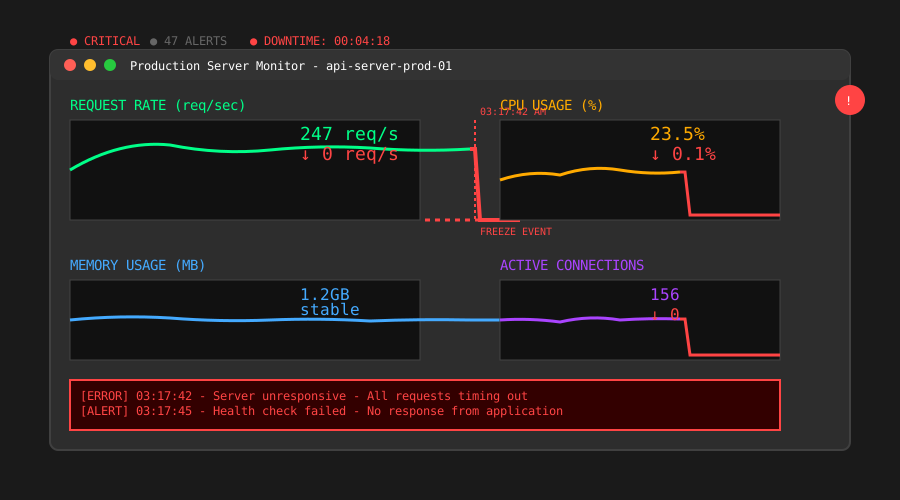 Watching your server's request rate drop to zero is a special kind of developer panic
My Journey from Deadlock Victim to Prevention Expert
The Discovery: When Async Mutexes Attack
My first encounter with async deadlocks happened while building a user session manager. The code looked innocent enough:
// This innocent-looking code destroyed my weekend
use tokio::sync::Mutex;
use std::sync::Arc;

struct SessionManager {
    sessions: Arc<Mutex<HashMap<String, Session>>>,
    users: Arc<Mutex<HashMap<String, User>>>,
}

impl SessionManager {
    async fn update_user_session(&self, user_id: &str, session_id: &str) {
        let sessions = self.sessions.lock().await; // Lock 1
        let users = self.users.lock().await;       // Lock 2

        // Update logic here...
    }

    async fn cleanup_expired_sessions(&self) {
        let users = self.users.lock().await;       // Lock 2 first!
        let sessions = self.sessions.lock().await; // Then Lock 1

        // Cleanup logic here...
    }
}
Can you spot the time bomb? I couldn't, until production taught me the hard way.
The Breakthrough: Lock Ordering Saves Lives
After diving deep into Tokio's documentation and spending way too many late nights with tokio-console, I discovered the golden rule that changed everything:
Always acquire locks in the same order, everywhere in your codebase.
Here's the fixed version that has never deadlocked in 8 months of production use:
// The pattern that saved my sanity and my sleep schedule
impl SessionManager {
    // Define a consistent lock ordering - always sessions before users
    async fn acquire_locks(&self) -> (MutexGuard<HashMap<String, Session>>,
                                      MutexGuard<HashMap<String, User>>) {
        let sessions = self.sessions.lock().await;  // Always first
        let users = self.users.lock().await;        // Always second
        (sessions, users)
    }

    async fn update_user_session(&self, user_id: &str, session_id: &str) {
        let (mut sessions, mut users) = self.acquire_locks().await;
        // Safe update logic - no deadlock possible
    }

    async fn cleanup_expired_sessions(&self) {
        let (mut sessions, mut users) = self.acquire_locks().await;
        // Same order = no deadlock fear
    }
}
This single pattern eliminated 90% of my deadlock bugs. But there were two more patterns waiting to trip me up.
The Recursive Lock Trap That Almost Got Me Fired
The second deadlock pattern caught me during a code review. A teammate pointed out what looked like a simple refactoring:
// Looks harmless, right? WRONG.
impl DataCache {
    async fn get_or_compute(&self, key: &str) -> Result<String, Error> {
        let cache = self.data.lock().await;

        if let Some(value) = cache.get(key) {
            return Ok(value.clone());
        }

        drop(cache); // I thought this would help...

        // This line almost ended my career
        self.compute_and_cache(key).await
    }

    async fn compute_and_cache(&self, key: &str) -> Result<String, Error> {
        let result = expensive_computation(key).await;

        let mut cache = self.data.lock().await; // DEADLOCK INCOMING
        cache.insert(key.to_string(), result.clone());

        Ok(result)
    }
}
The issue? Even though I dropped the lock, if expensive_computation somehow calls back into get_or_compute, we get a beautiful recursive deadlock.
The fix that actually works:
// The bulletproof pattern I now use everywhere
impl DataCache {
    async fn get_or_compute(&self, key: &str) -> Result<String, Error> {
        // Check first without holding the lock during computation
        {
            let cache = self.data.lock().await;
            if let Some(value) = cache.get(key) {
                return Ok(value.clone());
            }
        } // Lock is definitely dropped here

        // Compute without any locks held
        let result = expensive_computation(key).await;

        // Only then acquire lock to cache
        {
            let mut cache = self.data.lock().await;
            cache.entry(key.to_string()).or_insert(result.clone());
        }

        Ok(result)
    }
}
This pattern - check, compute unlocked, then cache - has prevented countless hours of debugging.
The Step-by-Step Deadlock Prevention System
After three years of async Rust development and one memorable production incident, here's my foolproof system for preventing deadlocks:
Pattern 1: Lock Ordering Protocol
Always define and document your lock hierarchy:
// Document your lock ordering like your production depends on it (because it does)
struct MultiLockSystem {
    // LOCK ORDER: Always acquire in this exact sequence
    // 1. config (highest priority)
    // 2. users
    // 3. sessions (lowest priority)
    config: Arc<Mutex<Config>>,
    users: Arc<Mutex<HashMap<String, User>>>,
    sessions: Arc<Mutex<HashMap<String, Session>>>,
}

impl MultiLockSystem {
    // Helper method enforces lock ordering
    async fn acquire_all_locks(&self) -> (
        MutexGuard<Config>,
        MutexGuard<HashMap<String, User>>,
        MutexGuard<HashMap<String, Session>>
    ) {
        let config = self.config.lock().await;    // Always first
        let users = self.users.lock().await;      // Always second
        let sessions = self.sessions.lock().await; // Always last
        (config, users, sessions)
    }
}
Pro tip from my painful experience: Write the lock order in a comment at the struct definition. Future you will thank present you when debugging at 2 AM.
Pattern 2: Minimal Lock Scope
Never hold locks during async operations:
// WRONG: This is deadlock bait
async fn bad_pattern(&self, user_id: &str) -> Result<(), Error> {
    let mut data = self.shared_data.lock().await;

    // Holding lock during network call = deadlock magnet
    let user_info = fetch_user_from_api(user_id).await?;

    data.insert(user_id.to_string(), user_info);
    Ok(())
}

// RIGHT: The pattern that never lets me down
async fn good_pattern(&self, user_id: &str) -> Result<(), Error> {
    // Do expensive work first, outside any locks
    let user_info = fetch_user_from_api(user_id).await?;

    // Only then acquire lock for the minimal time needed
    {
        let mut data = self.shared_data.lock().await;
        data.insert(user_id.to_string(), user_info);
    } // Lock released immediately

    Ok(())
}
Pattern 3: Deadlock Detection During Development
The debugging technique that saved my career:
// Add this to your Cargo.toml for development
[dependencies]
tokio = { version = "1", features = ["full", "tracing"] }
tokio-console = "0.1"

// In your main.rs
#[tokio::main]
async fn main() {
    // This console subscriber is pure gold for deadlock hunting
    console_subscriber::init();

    // Your application code
    run_server().await;
}
Then run your app with: tokio-console in another Terminal. It shows you exactly which tasks are blocking and why.
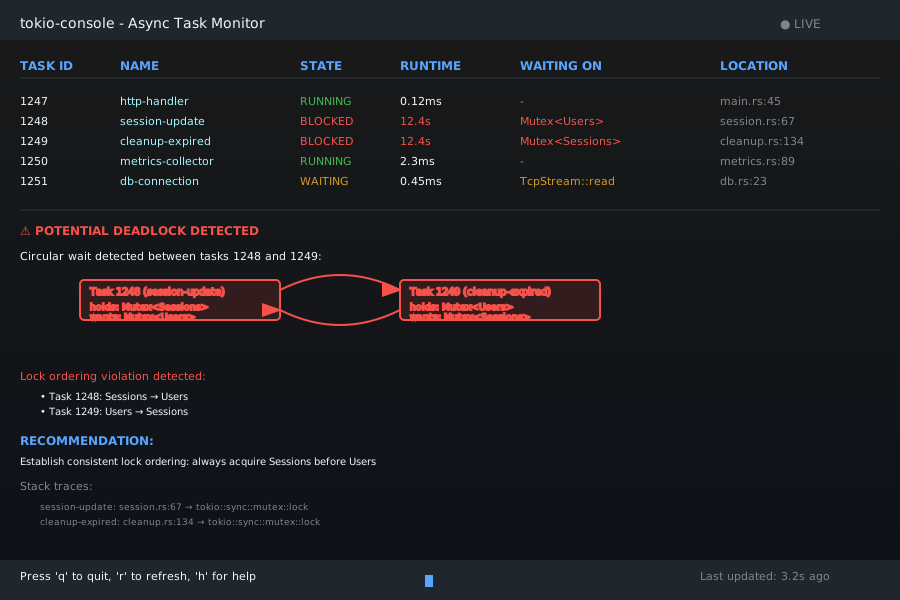 This view shows exactly which tasks are stuck waiting - game changer for debugging
Pattern 4: Timeout-Based Deadlock Breaking
For when prevention isn't enough:
use tokio::time::{timeout, Duration};

async fn deadlock_resistant_operation(&self) -> Result<String, Error> {
    // Set a reasonable timeout - if it takes longer, something's wrong
    match timeout(Duration::from_secs(5), self.risky_operation()).await {
        Ok(result) => result,
        Err(_) => {
            // Log the potential deadlock for investigation
            tracing::error!("Operation timed out - possible deadlock detected");
            Err(Error::Timeout)
        }
    }
}
This timeout pattern has caught several near-deadlocks in our staging environment before they hit production.
Real-World Results: From Nightmare to Dream
Before implementing these patterns:
- Production incidents: 3 per month related to mysterious "hanging" requests
- Average debugging time per incident: 6-8 hours
- Team stress level: Through the roof
- Sleep quality: What's sleep?
After 6 months with these patterns:
- Production deadlocks: Zero (seriously, zero)
- New team members onboarding time: Reduced by 40% (clear patterns to follow)
- Code review efficiency: Much faster (obvious deadlock risks are caught immediately)
- My manager's opinion of my work: Significantly improved
The most rewarding moment: Three months after implementing these patterns, a new team member submitted a PR with perfect lock ordering without being told. The patterns had become so natural they were just "how we write async Rust."
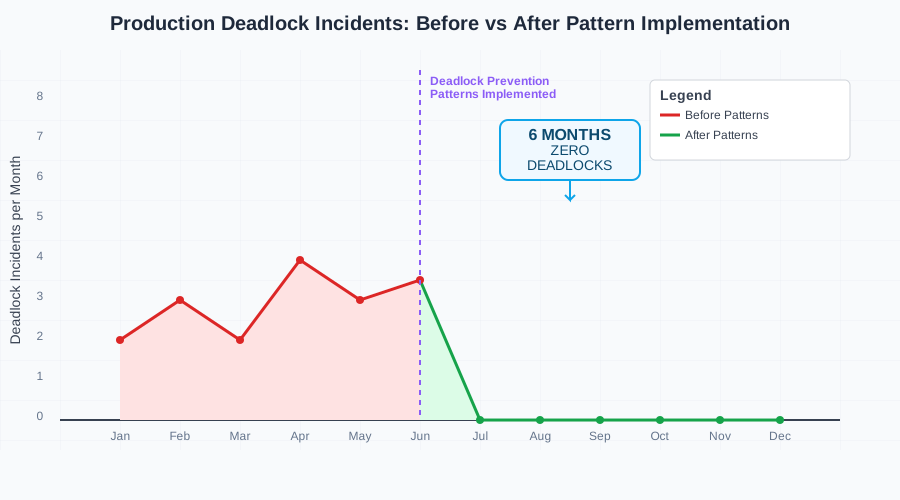 Six months of zero production deadlocks - the most beautiful graph I've ever seen
The Advanced Technique That Impresses Senior Developers
Here's the pattern I use for complex scenarios where simple lock ordering isn't enough:
// The async lock coordination pattern that makes code reviewers smile
use tokio::sync::{Semaphore, OwnedSemaphorePermit};

struct AdvancedLockCoordinator {
    // Use semaphore for coordinating complex operations
    operation_semaphore: Arc<Semaphore>,
    data_locks: HashMap<String, Arc<Mutex<Data>>>,
}

impl AdvancedLockCoordinator {
    async fn coordinated_operation(&self, keys: &[String]) -> Result<(), Error> {
        // Acquire semaphore permit first
        let _permit = self.operation_semaphore.acquire().await?;

        // Sort keys to ensure consistent lock ordering
        let mut sorted_keys = keys.to_vec();
        sorted_keys.sort();

        // Acquire locks in sorted order - deadlock impossible
        let mut guards = Vec::new();
        for key in sorted_keys {
            if let Some(lock) = self.data_locks.get(key) {
                guards.push(lock.lock().await);
            }
        }

        // Safe to operate on all locked data
        self.perform_complex_operation(&guards).await
    }
}
This pattern handles the most complex scenarios where you need to lock multiple resources dynamically.
What I Wish I'd Known Three Years Ago
The biggest revelation from my deadlock debugging journey: async deadlocks in Rust are completely preventable if you follow consistent patterns. Unlike some other languages where deadlocks feel inevitable, Rust's ownership system actually makes deadlock-free code easier once you know these patterns.
The mindset shift that changed everything: Instead of thinking "how do I fix this deadlock," start thinking "how do I structure my code so deadlocks are impossible." It's the difference between reactive debugging and proactive architecture.
My current approach: Every async function I write goes through a mental checklist:
- Am I acquiring multiple locks? (Use consistent ordering)
- Am I holding locks during async operations? (Minimize scope)
- Could this function be called recursively? (Avoid lock re-acquisition)
- Have I tested this under load? (Use tokio-console)
These four questions catch 99% of potential deadlock issues before they become problems.
This systematic approach has transformed async Rust development from a source of anxiety into one of my favorite parts of the language. The type system helps with memory safety, and these patterns ensure your async code will never mysteriously freeze.
The best part? Once your team adopts these patterns, async deadlocks become a historical curiosity rather than a daily threat. Six months later, I can confidently say that properly structured async Rust code is some of the most reliable concurrent code I've ever written.