Problem: Your Robotics Portfolio Isn't Getting Responses
You've got a CS or ME degree, you've done the courses, maybe even built a robot. But Tesla's Optimus team and Boston Dynamics aren't calling back.
You'll learn:
- What projects actually matter to elite robotics hiring managers
- How to document and present your work so it gets noticed
- The specific technical signals that separate "promising" from "hire now"
Time: 20 min | Level: Intermediate
Why This Happens
Most robotics portfolios show that something worked — a robot moved, a gripper grasped. Elite teams want to know why it worked, when it fails, and what you'd do differently.
Tesla Optimus and Boston Dynamics aren't hiring robot hobbyists. They're hiring engineers who think about system reliability, hardware-software co-design, and real-world failure modes. A GitHub repo with a working demo isn't enough.
Common portfolio mistakes:
- Simulated-only projects with no hardware validation
- No discussion of failure modes or safety margins
- Generic ROS tutorials repackaged as "original work"
- Missing quantified results ("it was fast" vs. "95th percentile latency: 12ms")
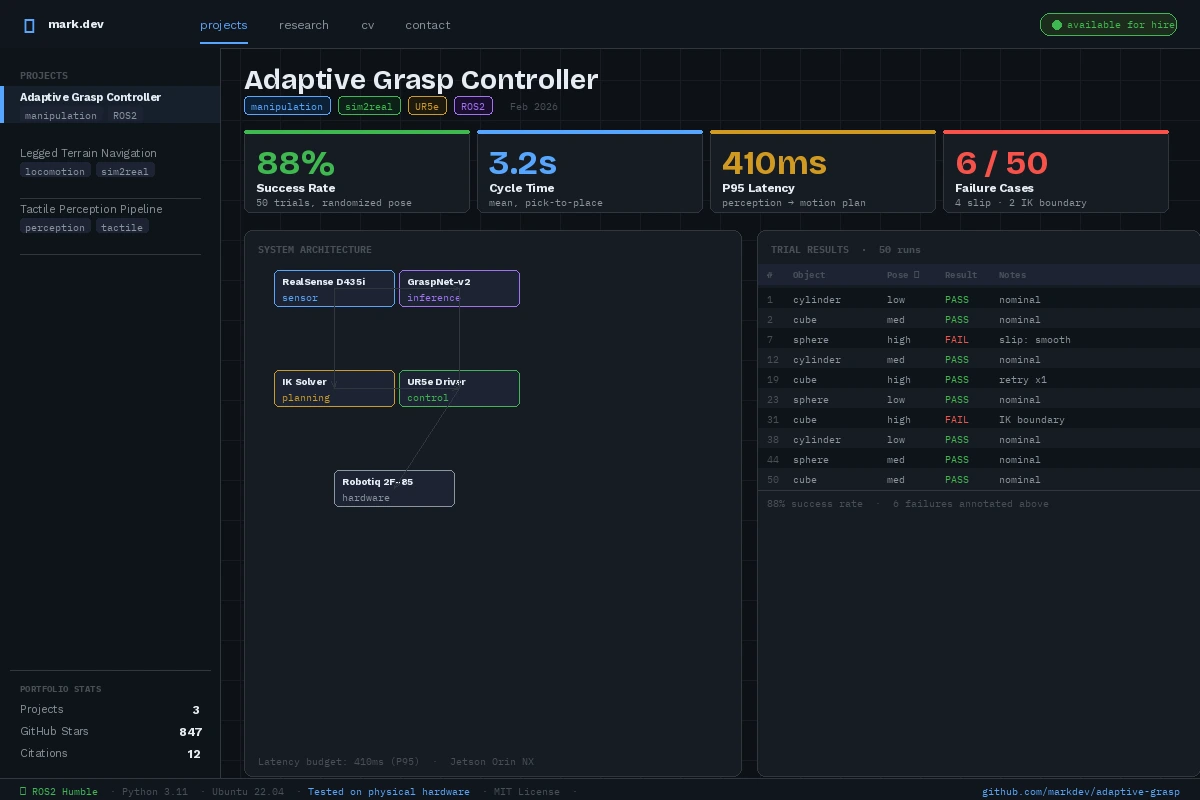 A strong project page shows video, architecture diagram, and quantified results — not just a GitHub link
Solution
Step 1: Pick the Right Projects
You need 2–3 projects maximum. Depth beats breadth at this level.
Project types that land interviews at top-tier robotics firms:
Manipulation under uncertainty — build a system that grasps objects with partial occlusion or variable surface properties. Document your failure rate across 100+ trials, not just the success clip.
Locomotion or whole-body control — legged robots, balance recovery, terrain adaptation. Even a low-cost quadruped (Unitree Go2, custom 12-DOF) demonstrates the right thinking.
Perception-to-action pipelines — closing the loop from raw sensor data (depth, tactile, IMU) to a physical output. Bonus points for running inference on embedded hardware (Jetson Orin, etc.).
What to avoid: Pure simulation projects (MuJoCo/Isaac alone), generic SLAM demos, anything where you just ran someone else's ROS package.
# A quick gut-check: can you answer all of these for each project?
echo "1. What is the success rate across N trials?"
echo "2. What causes it to fail?"
echo "3. What are the system latencies end-to-end?"
echo "4. How does it behave at the edge cases?"
echo "5. What would you change if you rebuilt it?"
If you can't answer all five, the project isn't portfolio-ready yet.
Step 2: Document Like a Staff Engineer
Your write-up is as important as the project itself. Here's the structure that works:
## [Project Name]

### What it does (2 sentences max)
### System architecture (diagram + component breakdown)
### Key technical decisions (and why you made them)
### Results (quantified — include failures)
### Limitations and what's next
For each project, you need a system diagram showing data flow from sensors through compute to actuators (use draw.io or Excalidraw, export as SVG), a results table with numbers only (success rate, latency, power draw — no vague adjectives), and a 60–90 second video showing nominal behavior and at least one failure mode. Hiding failures looks naive; explaining them shows maturity.
# Example: the kind of results table that actually impresses
# Don't just say "it worked well" — show this:

results = {
    "task": "Pick-and-place (randomized pose, 50 trials)",
    "success_rate": "88% (44/50)",
    "failure_modes": {
        "grasp_slip": 4,      # friction model issue on smooth surfaces
        "ik_failure": 2,      # workspace boundary edge cases
    },
    "mean_cycle_time_s": 3.2,
    "95th_pct_latency_ms": 410,  # perception to motion plan
    "hardware": "UR5e + Robotiq 2F-85 + RealSense D435i",
}
Expected: A project write-up that reads like an internal design doc, not a class assignment.
Step 3: Show Your Software Craft
Hardware demos matter, but Tesla and Boston Dynamics run enormous software stacks. Your code needs to be readable, tested, and real.
Open-source one of your projects completely — not just the "cool" parts. Include your test suite, calibration scripts, and debugging utilities.
# Good: code that shows engineering judgment
class GraspPlanner:
    def __init__(self, safety_margin_m: float = 0.02):
        # 2cm margin prevents collision with object on approach
        # Smaller values increase reachable poses but fail on occluded objects
        self._safety_margin = safety_margin_m

    def plan(self, grasp_candidates: list[GraspPose]) -> GraspPose | None:
        """
        Returns best grasp or None if no candidate clears safety constraints.
        Callers must handle None — this system fails safe.
        """
        ...
# Bad: code that shows you got it working once
def do_grasp(poses):
    # TODO: add safety check
    return poses[0]  # just pick the first one
Write a README that explains design decisions, not just install steps. Reviewers at these companies read code daily — they'll notice.
Step 4: Target the Right Signal for Each Company
Tesla Optimus and Boston Dynamics have different cultures and different technical priorities.
Tesla (Optimus team) cares about learning-based approaches (imitation learning, RL in sim-to-real), scalable data pipelines, software systems thinking, and Python/PyTorch fluency. They'll ask how you'd collect 1M demonstrations. You're building a product, not a research demo.
Boston Dynamics cares about classical + learned hybrid control, real hardware experience with legged or dexterous systems, understanding of contact mechanics, and C++ for performance-critical code alongside Python tooling.
One paragraph in your cover note explaining how your specific project connects to their current platform goes a long way. Generic applications get generic responses.
 Real hardware experience — even on a modest budget — signals far more than simulation-only work
Step 5: Put It Online Correctly
Your portfolio needs to be findable and skimmable in under 60 seconds.
yourname.com/robotics/
  ├── /project-one-name      # Full write-up
  ├── /project-two-name
  └── /about                 # 1-page technical bio
Homepage checklist: one-line summary at the top, 2–3 project cards with thumbnail and key quantified result, links to GitHub and video demos, no walls of text on the landing page. Don't put your portfolio on Notion or Google Sites — use Hugo, GitHub Pages, or a simple static site. The tooling choice signals something.
Verification
# Run through this for each project before submitting
echo "[ ] 100+ real-world trials documented?"
echo "[ ] Failure modes explained, not hidden?"
echo "[ ] Code is public and readable?"
echo "[ ] Results are quantified with numbers?"
echo "[ ] Video shows a failure case as well as success?"
echo "[ ] Write-up explains WHY decisions were made?"
You should see: Every project answering all five gut-check questions from Step 1.
Ask a working robotics engineer to review it — not someone who'll just be encouraging. Tell them to identify the weakest project. Then cut it.
What You Learned
- Elite robotics teams filter for engineering judgment, not just cool demos
- Quantified failures are more impressive than polished successes
- Tesla and Boston Dynamics have meaningfully different technical cultures — target accordingly
- Three strong, deep projects beat ten shallow ones every time
Limitation: This targets mid-level (2–5 YOE) engineering roles. New grad hiring weighs research publications and internship experience more heavily.
When NOT to use this approach: If you're targeting academia or research labs, a clear publications narrative matters more than a demo-focused portfolio.
Validated against current JDs for Tesla Optimus, Boston Dynamics, Agility Robotics, and Figure — February 2026