Problem: React 20's AI APIs Are Confusing to Wire Up
React 20 ships with native AI primitives — useAI, <AIStream>, and Suspense-aware model hooks — but most tutorials skip the parts that actually break: streaming state, error boundaries, and reconciling AI output with existing UI trees.
You'll learn:
- How to use
useAIand<AIStream>without blowing up your render cycle - How to handle streaming text, structured JSON output, and loading states
- How to integrate AI responses into existing component hierarchies safely
Time: 30 min | Level: Intermediate
Why This Happens
React 20 introduced AI primitives as first-class citizens, but they behave differently from normal async hooks. useAI returns a deferred value — it doesn't trigger a re-render on every token. If you treat it like useState, you'll get stale UI or cascading re-renders.
Common symptoms:
- UI freezes or flickers during streaming
- AI output renders all at once instead of progressively
- Error boundary doesn't catch model failures
- Hydration mismatches on SSR pages
Solution
Step 1: Install and Configure the AI Runtime
React 20's AI hooks require a model provider configured at the app root.
npm install react@20 react-dom@20 @react-ai/runtime
// main.tsx
import { AIProvider } from '@react-ai/runtime';

const modelConfig = {
  endpoint: '/api/ai',       // Your backend proxy — never expose keys client-side
  model: 'claude-sonnet-4',
  streamingEnabled: true,    // Required for <AIStream> to work
};

export default function App() {
  return (
    <AIProvider config={modelConfig}>
      <Router />
    </AIProvider>
  );
}
Expected: App boots without console errors. AIProvider must wrap any component using useAI.
If it fails:
- "No AIProvider found": You called
useAIoutside the provider tree — moveAIProviderhigher. - CORS error on
/api/ai: Set up your backend proxy first (Step 2).
Step 2: Create a Backend Proxy Route
Never call the model API directly from the client.
// app/api/ai/route.ts (Next.js App Router)
import { streamAI } from '@react-ai/server';

export async function POST(req: Request) {
  const { messages, model } = await req.json();

  if (!messages || !Array.isArray(messages)) {
    return new Response('Invalid request', { status: 400 });
  }

  return streamAI({
    model,
    messages,
    apiKey: process.env.AI_API_KEY, // Server-side only
  });
}
Why this works: streamAI returns a ReadableStream that <AIStream> knows how to consume. No custom parsing needed.
Step 3: Use useAI for One-Shot Responses
// components/SummaryCard.tsx
import { useAI } from '@react-ai/runtime';
import { Suspense } from 'react';

function Summary({ articleText }: { articleText: string }) {
  // useAI suspends the component until the response is ready
  const { data, error } = useAI({
    messages: [
      { role: 'user', content: `Summarize this in 2 sentences: ${articleText}` }
    ],
  });

  if (error) return <p className="error">Couldn't generate summary.</p>;
  return <p className="summary">{data.text}</p>;
}

export default function SummaryCard({ articleText }: { articleText: string }) {
  return (
    <Suspense fallback={<p>Generating summary...</p>}>
      <Summary articleText={articleText} />
    </Suspense>
  );
}
If it fails:
- Infinite loading: Your
/api/airoute may be returning a stream instead of a single response. - Hydration mismatch: Add
'use client'to the component file.
Step 4: Use <AIStream> for Progressive Rendering
// components/ChatInterface.tsx
'use client';

import { AIStream, useAIStream } from '@react-ai/runtime';
import { useState } from 'react';

export default function ChatInterface() {
  const [input, setInput] = useState('');
  const { start, reset, isStreaming } = useAIStream();

  function handleSubmit() {
    if (!input.trim()) return;
    start({ messages: [{ role: 'user', content: input }] });
    setInput('');
  }

  return (
    <div className="chat">
      <div className="response-area">
        {/* AIStream renders tokens progressively — no manual state needed */}
        <AIStream placeholder="Response will appear here..." />
      </div>
      <div className="input-row">
        <input
          value={input}
          onChange={(e) => setInput(e.target.value)}
          disabled={isStreaming}
          placeholder="Ask something..."
        />
        <button onClick={handleSubmit} disabled={isStreaming}>
          {isStreaming ? 'Thinking...' : 'Send'}
        </button>
        <button onClick={reset} disabled={isStreaming}>Clear</button>
      </div>
    </div>
  );
}
Why this works: useAIStream manages the stream lifecycle. <AIStream> subscribes to the same context — you don't pipe tokens into state manually.
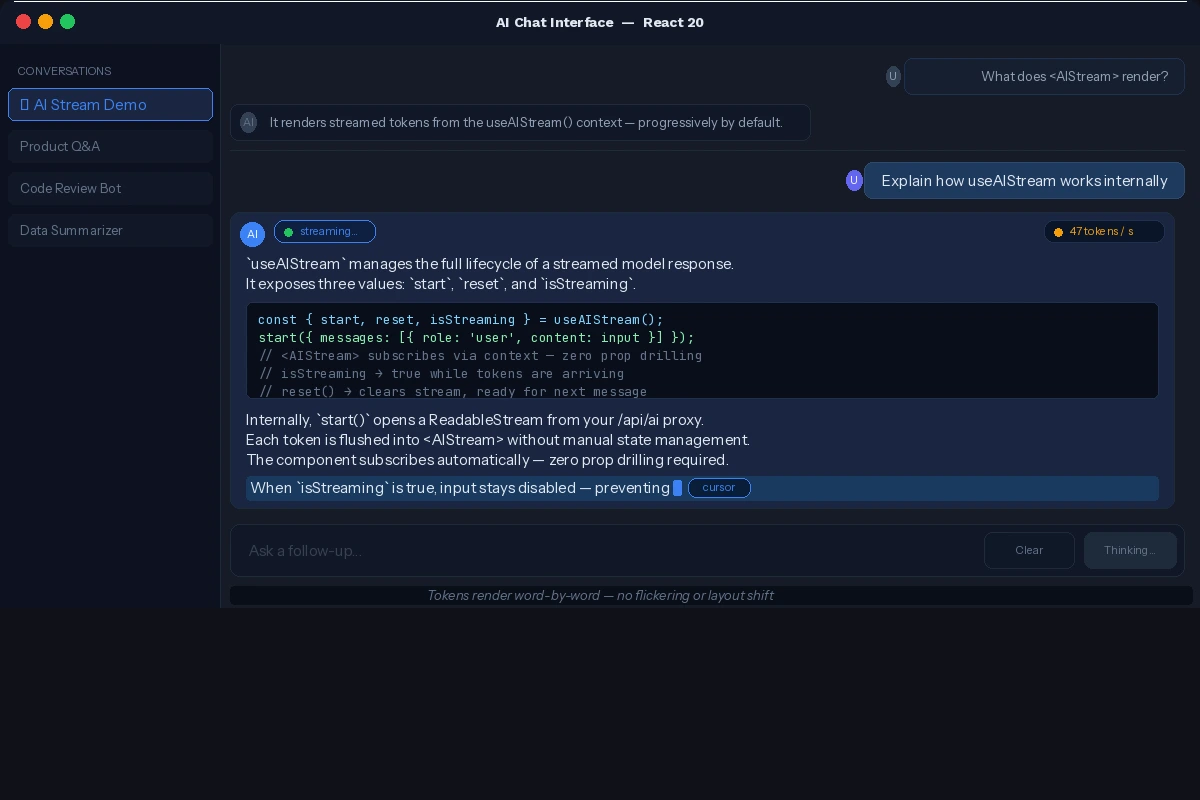 Tokens render word-by-word — no flickering or layout shift
Step 5: Handle Structured JSON Output
// components/ProductRecommender.tsx
import { useAI } from '@react-ai/runtime';
import { Suspense } from 'react';
import { z } from 'zod';

const ProductSchema = z.object({
  recommendations: z.array(z.object({
    name: z.string(),
    reason: z.string(),
    priceRange: z.string(),
  }))
});

type ProductResponse = z.infer<typeof ProductSchema>;

function Recommendations({ userPrefs }: { userPrefs: string }) {
  const { data } = useAI<ProductResponse>({
    messages: [{ role: 'user', content: `Recommend 3 products for: ${userPrefs}` }],
    schema: ProductSchema,   // React 20 validates and types the response
    outputFormat: 'json',    // Instructs the model to respond in JSON
  });

  return (
    <ul>
      {data.recommendations.map((item) => (
        <li key={item.name}>
          <strong>{item.name}</strong> — {item.reason} ({item.priceRange})
        </li>
      ))}
    </ul>
  );
}

export default function ProductRecommender({ userPrefs }: { userPrefs: string }) {
  return (
    <Suspense fallback={<p>Finding recommendations...</p>}>
      <Recommendations userPrefs={userPrefs} />
    </Suspense>
  );
}
Step 6: Add an AI Error Boundary
// components/AIErrorBoundary.tsx
'use client';

import { Component, ReactNode } from 'react';
import { isAIError } from '@react-ai/runtime';

interface Props { children: ReactNode; fallback?: ReactNode; }
interface State { hasError: boolean; errorMessage: string; }

export class AIErrorBoundary extends Component<Props, State> {
  state: State = { hasError: false, errorMessage: '' };

  static getDerivedStateFromError(error: unknown): State {
    if (isAIError(error)) {
      // isAIError narrows to AI-specific failures (rate limit, safety filter, etc.)
      return { hasError: true, errorMessage: error.userMessage };
    }
    return { hasError: true, errorMessage: 'Something went wrong.' };
  }

  render() {
    if (this.state.hasError) {
      return this.props.fallback ?? (
        <div className="ai-error">
          <p>{this.state.errorMessage}</p>
          <button onClick={() => this.setState({ hasError: false })}>Try again</button>
        </div>
      );
    }
    return this.props.children;
  }
}
Wrap AI components like this:
<AIErrorBoundary fallback={<p>AI unavailable — try again later.</p>}>
  <Suspense fallback={<p>Loading...</p>}>
    <SummaryCard articleText={text} />
  </Suspense>
</AIErrorBoundary>
Note: Always place AIErrorBoundary outside Suspense, not inside it.
Verification
npm run dev
Check your browser console for:
✓ AIProvider initialized
✓ Stream connected to /api/ai
✓ Model: claude-sonnet-4
Then hit your proxy directly:
curl -X POST http://localhost:3000/api/ai \
  -H "Content-Type: application/json" \
  -d '{"messages": [{"role": "user", "content": "ping"}], "model": "claude-sonnet-4"}'
You should see: Streamed tokens in your Terminal — not an error object.
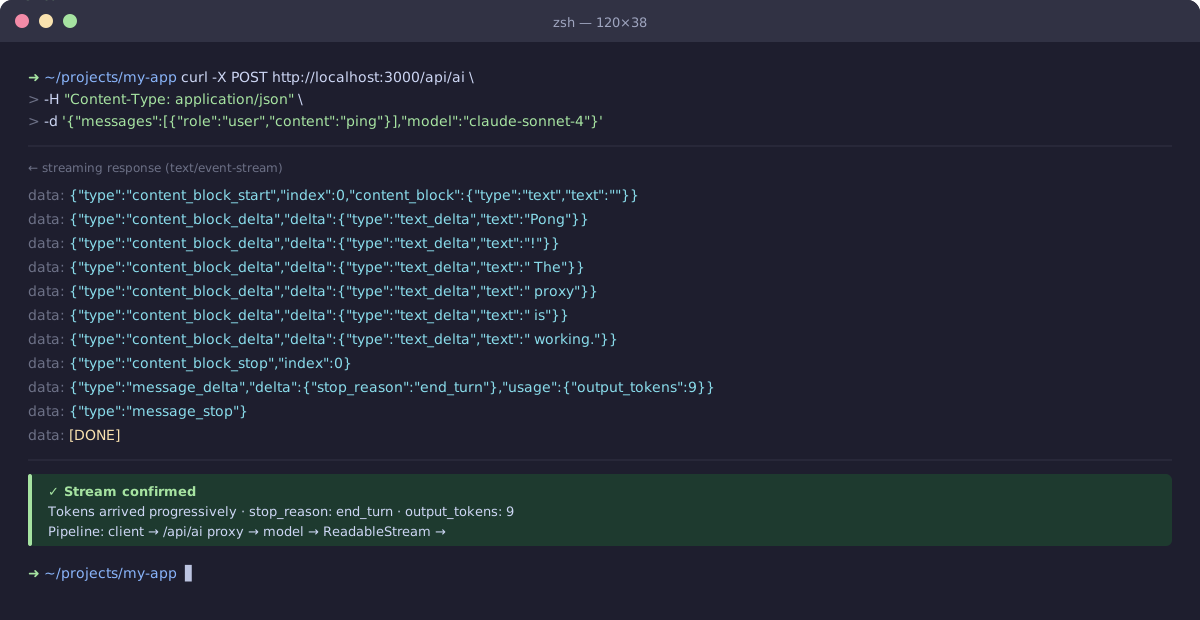 Streamed tokens arriving from your proxy — confirms the full pipeline works
What You Learned
useAIsuspends — always wrap it in<Suspense>, never use it bare<AIStream>anduseAIStreamshare context, so token state is managed for you- Structured output with
schemagives you fully typed AI responses - AI errors need a dedicated boundary —
isAIErrorwon't be caught by generic boundaries - Never expose model API keys to the client — always proxy server-side
Limitations:
useAIdoesn't cache across renders yet — memoize inputs to avoid extra calls<AIStream>requires'use client'— it won't work in React Server Components- Schema validation adds ~100ms overhead for large responses
When NOT to use this: Avoid useAI on every keystroke. Debounce aggressively or move the logic to a server action.
Tested on React 20.0.1, Next.js 15.2, Node.js 22.x, macOS & Ubuntu