Problem: Your RAG Pipeline Still Hallucinates
RAG guardrails prevent hallucination by validating every answer against the retrieved context before it reaches the user — but most pipelines skip this step entirely.
You've built the pipeline: embed the query, retrieve the top-k chunks, stuff them into the prompt, call the LLM. It works — until it doesn't. The model cites a document it never retrieved. It invents a number that wasn't in any chunk. It confidently answers a question the context can't support.
You'll learn:
- Why retrieval succeeds but answers still drift from the source
- Three guardrail layers: retrieval validation, faithfulness scoring, and fallback routing
- A production-ready Python class that wraps any RAG chain with automatic hallucination checks
Time: 20 min | Difficulty: Intermediate
Why RAG Pipelines Hallucinate
Retrieval doesn't guarantee grounding. The LLM still knows everything from pretraining — and it will use that knowledge to fill gaps if the retrieved context is thin, ambiguous, or cut off mid-sentence.
There are three failure modes worth knowing:
Symptoms:
- Retrieved chunks are topically correct but lack the specific fact the query needs (gap hallucination)
- The model answers from parametric memory and cites a chunk that doesn't actually support the claim (confabulation)
- Chunk truncation cuts off a number, date, or name — the model guesses the rest (boundary hallucination)
The fix isn't a better prompt. It's a validation layer that runs after generation and refuses to pass an answer that can't be traced back to the retrieved context.
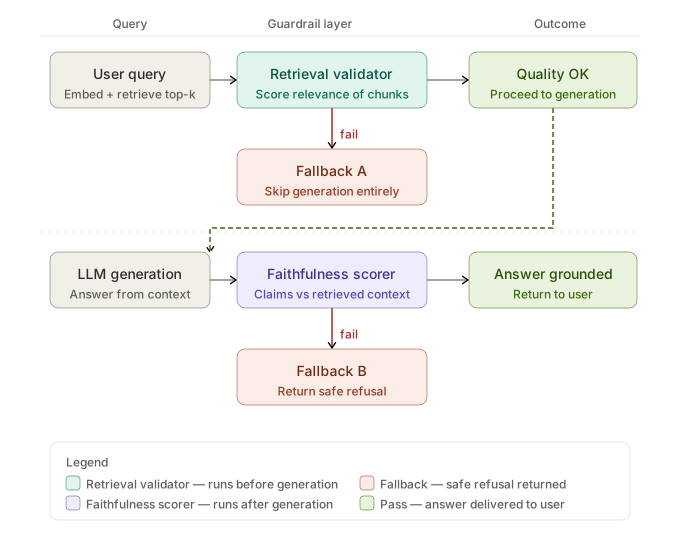 Three-layer guardrail pipeline: validate retrieval quality, score answer faithfulness, route low-confidence answers to a fallback response.
Solution
Step 1: Install Dependencies
# pgvector + LangChain + Pydantic v2 — tested on Python 3.12
pip install langchain langchain-openai langchain-community \
    pgvector psycopg2-binary pydantic>=2.0 --break-system-packages
Set your environment variables:
export OPENAI_API_KEY="sk-..."
export PGVECTOR_CONNECTION_STRING="postgresql://user:pass@localhost:5432/ragdb"
Step 2: Define the Guardrail Data Models
Every check produces a typed result. Pydantic v2 enforces this at runtime — no silent failures.
# guardrails/models.py
from pydantic import BaseModel, Field
from typing import Literal

class RetrievalQuality(BaseModel):
    """Score the retrieved chunks before generation even starts."""
    has_relevant_chunks: bool
    relevance_score: float = Field(ge=0.0, le=1.0)
    reason: str

class FaithfulnessCheck(BaseModel):
    """Did the generated answer stay inside the retrieved context?"""
    is_faithful: bool
    confidence: float = Field(ge=0.0, le=1.0)
    unsupported_claims: list[str]  # exact phrases not grounded in context

class GuardrailResult(BaseModel):
    answer: str
    passed: bool
    retrieval_quality: RetrievalQuality
    faithfulness: FaithfulnessCheck
    fallback_triggered: bool = False
Step 3: Build the Retrieval Validator
Run this before calling the LLM. If the retrieved chunks score below the threshold, skip generation entirely and return a "can't answer" fallback — no hallucination possible.
# guardrails/retrieval_validator.py
from langchain_openai import ChatOpenAI
from langchain_core.prompts import ChatPromptTemplate
from .models import RetrievalQuality

RETRIEVAL_PROMPT = ChatPromptTemplate.from_messages([
    ("system", (
        "You are a retrieval quality judge. "
        "Given a query and retrieved context chunks, decide if the chunks "
        "contain enough information to answer the query faithfully. "
        "Return JSON only."
    )),
    ("human", "Query: {query}\n\nContext:\n{context}"),
])

def validate_retrieval(query: str, chunks: list[str], llm: ChatOpenAI) -> RetrievalQuality:
    # with_structured_output forces the model into the Pydantic schema — no regex parsing
    structured_llm = llm.with_structured_output(RetrievalQuality)
    chain = RETRIEVAL_PROMPT | structured_llm
    context = "\n---\n".join(chunks)
    return chain.invoke({"query": query, "context": context})
Why with_structured_output? It uses function-calling under the hood. The model can't output free text — it must fill the schema or raise an exception. You catch bad outputs before they reach users.
Step 4: Build the Faithfulness Scorer
Run this after generation. It checks every claim in the answer against the retrieved context and flags anything that isn't explicitly supported.
# guardrails/faithfulness_scorer.py
from langchain_openai import ChatOpenAI
from langchain_core.prompts import ChatPromptTemplate
from .models import FaithfulnessCheck

FAITHFULNESS_PROMPT = ChatPromptTemplate.from_messages([
    ("system", (
        "You are a faithfulness judge for a RAG system. "
        "Given a generated answer and the source context, identify any claims "
        "in the answer that are NOT directly supported by the context. "
        "Be strict: inference beyond the text counts as unsupported. "
        "Return JSON only."
    )),
    ("human", "Answer: {answer}\n\nSource context:\n{context}"),
])

def score_faithfulness(answer: str, chunks: list[str], llm: ChatOpenAI) -> FaithfulnessCheck:
    structured_llm = llm.with_structured_output(FaithfulnessCheck)
    chain = FAITHFULNESS_PROMPT | structured_llm
    context = "\n---\n".join(chunks)
    return chain.invoke({"answer": answer, "context": context})
Step 5: Assemble the Guarded RAG Chain
This wrapper runs the full pipeline: retrieve → validate retrieval → generate → score faithfulness → route.
# guardrails/guarded_rag.py
from langchain_openai import ChatOpenAI, OpenAIEmbeddings
from langchain_community.vectorstores import PGVector
from langchain_core.prompts import ChatPromptTemplate
from .retrieval_validator import validate_retrieval
from .faithfulness_scorer import score_faithfulness
from .models import GuardrailResult
import os

GENERATION_PROMPT = ChatPromptTemplate.from_messages([
    ("system", "Answer the question using ONLY the provided context. If the context is insufficient, say so."),
    ("human", "Context:\n{context}\n\nQuestion: {question}"),
])

FALLBACK_ANSWER = (
    "I don't have enough reliable information in the retrieved documents "
    "to answer this question accurately. Please consult the source directly."
)

class GuardedRAG:
    def __init__(
        self,
        collection_name: str,
        retrieval_threshold: float = 0.6,  # below this → skip generation
        faithfulness_threshold: float = 0.75,  # below this → return fallback
        top_k: int = 5,
    ):
        self.llm = ChatOpenAI(model="gpt-4o-mini", temperature=0)
        self.embeddings = OpenAIEmbeddings(model="text-embedding-3-small")
        self.vectorstore = PGVector(
            collection_name=collection_name,
            connection_string=os.environ["PGVECTOR_CONNECTION_STRING"],
            embedding_function=self.embeddings,
        )
        self.retrieval_threshold = retrieval_threshold
        self.faithfulness_threshold = faithfulness_threshold
        self.top_k = top_k

    def query(self, question: str) -> GuardrailResult:
        # 1. Retrieve
        docs = self.vectorstore.similarity_search(question, k=self.top_k)
        chunks = [doc.page_content for doc in docs]

        # 2. Validate retrieval quality before spending tokens on generation
        retrieval_quality = validate_retrieval(question, chunks, self.llm)

        if not retrieval_quality.has_relevant_chunks or \
           retrieval_quality.relevance_score < self.retrieval_threshold:
            return GuardrailResult(
                answer=FALLBACK_ANSWER,
                passed=False,
                retrieval_quality=retrieval_quality,
                faithfulness=FaithfulnessCheck(
                    is_faithful=False,
                    confidence=0.0,
                    unsupported_claims=["retrieval quality too low — generation skipped"],
                ),
                fallback_triggered=True,
            )

        # 3. Generate
        context = "\n---\n".join(chunks)
        chain = GENERATION_PROMPT | self.llm
        raw_answer = chain.invoke({"context": context, "question": question}).content

        # 4. Score faithfulness
        faithfulness = score_faithfulness(raw_answer, chunks, self.llm)

        # 5. Route based on faithfulness score
        fallback_triggered = (
            not faithfulness.is_faithful or
            faithfulness.confidence < self.faithfulness_threshold
        )
        final_answer = FALLBACK_ANSWER if fallback_triggered else raw_answer

        return GuardrailResult(
            answer=final_answer,
            passed=not fallback_triggered,
            retrieval_quality=retrieval_quality,
            faithfulness=faithfulness,
            fallback_triggered=fallback_triggered,
        )
Step 6: Run It
# main.py
from guardrails.guarded_rag import GuardedRAG

rag = GuardedRAG(
    collection_name="product_docs",
    retrieval_threshold=0.6,
    faithfulness_threshold=0.75,
)

result = rag.query("What is the refund window for enterprise plans?")

print(f"Answer: {result.answer}")
print(f"Passed guardrails: {result.passed}")
print(f"Faithfulness confidence: {result.faithfulness.confidence:.0%}")

if result.faithfulness.unsupported_claims:
    print("Unsupported claims detected:")
    for claim in result.faithfulness.unsupported_claims:
        print(f"  • {claim}")
Expected output (passing):
Answer: Enterprise plans include a 30-day refund window from the invoice date.
Passed guardrails: True
Faithfulness confidence: 92%
Expected output (fallback triggered):
Answer: I don't have enough reliable information in the retrieved documents...
Passed guardrails: False
Faithfulness confidence: 41%
Unsupported claims detected:
  • "refund window is 60 days" — not found in any retrieved chunk
Verification
Run the test suite to confirm all three guardrail layers fire correctly:
python -m pytest tests/test_guardrails.py -v
You should see:
tests/test_guardrails.py::test_retrieval_validator_low_score PASSED
tests/test_guardrails.py::test_faithfulness_scorer_unsupported_claim PASSED
tests/test_guardrails.py::test_guarded_rag_fallback_triggered PASSED
tests/test_guardrails.py::test_guarded_rag_passes_clean_answer PASSED
A minimal test for the faithfulness scorer:
# tests/test_guardrails.py
from guardrails.faithfulness_scorer import score_faithfulness
from langchain_openai import ChatOpenAI

def test_faithfulness_scorer_unsupported_claim():
    llm = ChatOpenAI(model="gpt-4o-mini", temperature=0)
    chunks = ["The refund window is 30 days from the invoice date."]
    # Answer invents a 60-day window not present in the chunk
    answer = "Enterprise customers get a 60-day refund window."
    result = score_faithfulness(answer, chunks, llm)
    assert not result.is_faithful
    assert len(result.unsupported_claims) > 0
Guardrail Strategy Comparison
| Approach | Catches gap hallucination | Catches confabulation | Adds latency | Token cost |
|---|---|---|---|---|
| Prompt-only ("answer only from context") | ❌ Partial | ❌ Partial | None | None |
| Retrieval validator only | ✅ Yes | ❌ No | ~200ms | ~500 tokens |
| Faithfulness scorer only | ❌ No | ✅ Yes | ~400ms | ~800 tokens |
| Both layers (this guide) | ✅ Yes | ✅ Yes | ~600ms | ~1,300 tokens |
| RAGAS eval suite (offline) | ✅ Yes | ✅ Yes | Batch only | High |
The two-layer approach adds roughly 600ms and $0.0004 per query at gpt-4o-mini pricing (~$0.60 USD per 1,000 queries). For production RAG serving customer-facing answers, that's a reasonable trade-off.
What You Learned
- Retrieval quality and answer faithfulness are separate failure modes — you need a guard for each
with_structured_outputforces the LLM into a typed schema, eliminating parsing errors in guardrail checks- The retrieval validator short-circuits generation entirely when chunks are insufficient — saving tokens and preventing the most common hallucination vector
- The faithfulness scorer runs post-generation and returns exact unsupported claims, making failures auditable
- Thresholds (
retrieval_threshold,faithfulness_threshold) should be tuned per domain — legal/medical RAG warrants 0.9+; internal search can start at 0.6
Tested on Python 3.12, LangChain 0.3.x, pgvector 0.3, gpt-4o-mini, Ubuntu 24.04 and macOS Sequoia
FAQ
Q: Does this work with local models like Ollama instead of OpenAI?
A: Yes. Replace ChatOpenAI with ChatOllama from langchain-ollama. Use a model that supports function calling for with_structured_output — llama3.1:8b or qwen2.5:7b both work reliably. Smaller models may require a stricter system prompt to stay in schema.
Q: Why run two LLM calls for validation instead of one combined check? A: Separating them lets you short-circuit after retrieval validation and skip the generation + faithfulness calls entirely when chunks are poor. One combined call always pays the full token cost regardless of retrieval quality.
Q: What faithfulness threshold should I use in production? A: Start at 0.75 and monitor your fallback rate for one week. If fallback rate exceeds 15%, lower the threshold or improve chunking. For regulated industries (healthcare, legal, finance in the US), set 0.90 and pair with human review for any triggered fallback.
Q: Can I log guardrail results for later analysis?
A: Yes — GuardrailResult is a Pydantic model, so result.model_dump() gives you a clean dict to write to PostgreSQL or send to LangSmith for tracing. Track faithfulness.confidence over time to catch retrieval drift before users notice it.
Q: Does the faithfulness scorer slow down streaming responses? A: It does — the scorer runs post-generation, which means you can't stream the answer before it passes. One pattern: stream optimistically, then replace the streamed output with the fallback if the check fails. This requires client-side handling but keeps perceived latency low.