Remember when your biggest energy worry was forgetting to turn off the lights? Those days are gone faster than your Bitcoin portfolio in a bear market. Welcome to 2025, where your solar panels don't just power your home—they power your wallet through Power Ledger P2P trading.
If you've ever wondered how to make your rooftop solar installation work harder than a junior developer during crunch time, you're in the right place. Power Ledger's peer-to-peer energy trading platform lets you sell excess renewable energy directly to your neighbors, earning yields that would make traditional savings accounts weep.
This guide covers everything from setting up your first energy trade to advanced yield farming strategies that'll have you earning passive income while you sleep (assuming your solar panels keep working at night, which they don't, but you get the idea).
What Is Power Ledger P2P Trading?
Power Ledger P2P trading transforms the traditional energy grid into a decentralized marketplace. Instead of selling excess solar power back to utility companies at wholesale rates, you trade directly with other users at market prices.
Think of it as the Uniswap of electricity—but instead of swapping tokens, you're swapping actual electrons. Your solar panels become liquidity providers in the energy market, earning you yields based on supply and demand.
The Traditional Energy Problem
Most residential solar owners face this frustrating cycle:
- Generate excess energy during peak sunlight hours
- Sell back to utility companies at 30-50% below market rates
- Buy energy at full retail price during evening hours
- Watch profits disappear faster than free pizza at a developer meetup
The Power Ledger Solution
Power Ledger's blockchain energy market solves this through:
- Direct peer-to-peer electricity trading with price discovery
- Energy tokenization that creates tradeable renewable energy certificates
- Smart contracts that automate settlements and eliminate intermediaries
- Yield farming opportunities through liquidity provision and staking
Setting Up Your Power Ledger Trading Account
Before you start farming yields from sunshine, you need the proper setup. Here's how to get started with Power Ledger P2P trading:
Prerequisites
# Required components for Power Ledger trading
Solar Installation: ✓ (minimum 5kW recommended)
Smart Meter: ✓ (bi-directional energy measurement)
Internet Connection: ✓ (for blockchain transactions)
Power Ledger Wallet: ✓ (mobile app or web interface)
Initial POWR Tokens: ✓ (for transaction fees)
Step 1: Install Power Ledger Mobile App
Download the official Power Ledger app from your device's app store. The setup process takes about 10 minutes:
// Example wallet initialization (pseudo-code)
const powerLedgerWallet = new PowerLedgerWallet({
  region: 'your-region',
  energyProvider: 'your-utility-company',
  walletType: 'residential-producer'
});

// Connect your smart meter
await powerLedgerWallet.connectSmartMeter({
  meterId: 'your-meter-id',
  apiKey: 'utility-provided-key'
});
Step 2: Link Your Solar Installation
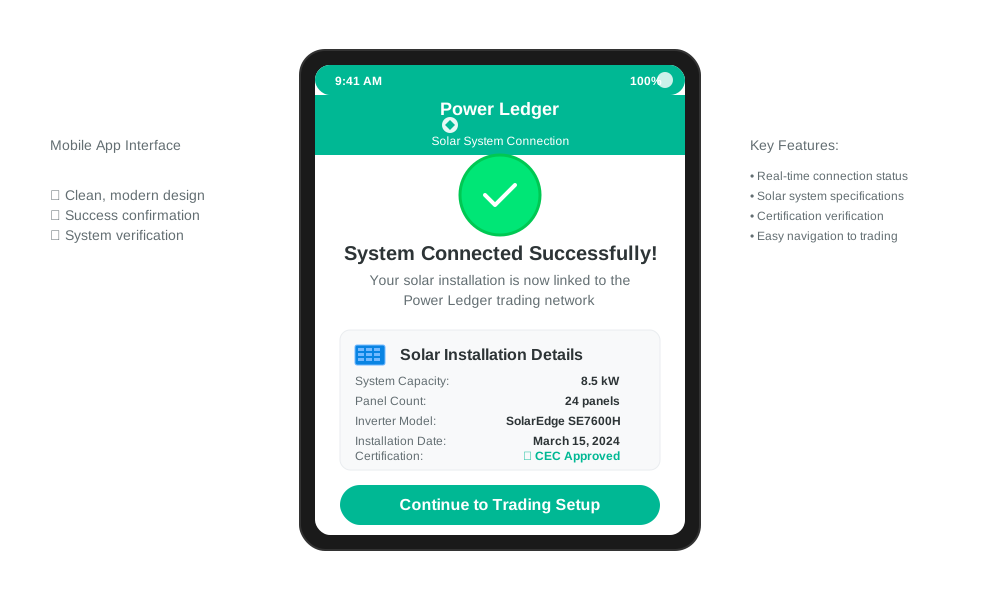
Connect your solar system to the Power Ledger network. This requires verification of your renewable energy source:
{
  "installation": {
    "capacity": "8.5kW",
    "panels": 24,
    "inverter": "SolarEdge SE7600H",
    "installation_date": "2024-03-15",
    "certification": "CEC-approved"
  },
  "expected_generation": {
    "daily_average": "35kWh",
    "monthly_average": "1050kWh",
    "seasonal_variation": "±25%"
  }
}
Step 3: Configure Trading Parameters
Set your energy trading preferences based on your consumption patterns and yield goals:
// Configure automated trading rules
const tradingConfig = {
  sellThreshold: 0.85, // Sell when battery is 85% full
  priceFloor: 0.12,    // Minimum price per kWh ($0.12)
  reserveCapacity: 5,   // Keep 5kWh for emergency use
  tradingHours: {
    start: '09:00',
    end: '17:00'       // Trade during peak solar hours
  },
  yieldStrategy: 'aggressive' // Options: conservative, balanced, aggressive
};

await powerLedgerWallet.setTradingRules(tradingConfig);
Power Ledger Yield Farming Strategies
Now for the fun part—making money while saving the planet. Power Ledger offers several yield farming opportunities that go beyond simple energy sales.
Strategy 1: Peak Hour Arbitrage
Buy energy during off-peak hours and sell during peak demand. This works especially well if you have battery storage:
# Peak hour arbitrage calculator
def calculate_arbitrage_profit(off_peak_price, peak_price, storage_capacity, efficiency=0.95):
    """
    Calculate potential profits from energy arbitrage

    Args:
        off_peak_price: Price per kWh during low demand (USD)
        peak_price: Price per kWh during high demand (USD)
        storage_capacity: Battery capacity in kWh
        efficiency: Round-trip efficiency of battery storage

    Returns:
        Daily profit potential in USD
    """
    usable_capacity = storage_capacity * efficiency
    profit_per_kwh = peak_price - off_peak_price
    daily_cycles = 1  # Conservative estimate

    return usable_capacity * profit_per_kwh * daily_cycles

# Example calculation
profit = calculate_arbitrage_profit(
    off_peak_price=0.08,  # $0.08 per kWh at night
    peak_price=0.25,      # $0.25 per kWh during 4-8 PM
    storage_capacity=20   # 20kWh Tesla Powerwall
)

print(f"Daily arbitrage profit potential: ${profit:.2f}")
# Output: Daily arbitrage profit potential: $3.23
Strategy 2: Renewable Energy Certificate (REC) Farming
Power Ledger tokenizes renewable energy certificates, creating tradeable assets that appreciate based on environmental demand:
// Smart contract for REC token staking (simplified)
pragma solidity ^0.8.0;

contract RECYieldFarm {
    mapping(address => uint256) public stakedRECs;
    mapping(address => uint256) public lastUpdateTime;

    uint256 public constant YIELD_RATE = 12; // 12% APY

    function stakeRECs(uint256 amount) external {
        require(amount > 0, "Cannot stake 0 RECs");

        // Calculate pending rewards before updating stake
        updateRewards(msg.sender);

        stakedRECs[msg.sender] += amount;

        // Transfer REC tokens to contract
        IERC20(recToken).transferFrom(msg.sender, address(this), amount);
    }

    function calculateRewards(address user) public view returns (uint256) {
        uint256 timeElapsed = block.timestamp - lastUpdateTime[user];
        uint256 yearlyReward = (stakedRECs[user] * YIELD_RATE) / 100;

        return (yearlyReward * timeElapsed) / 365 days;
    }
}
Strategy 3: Liquidity Pool Participation
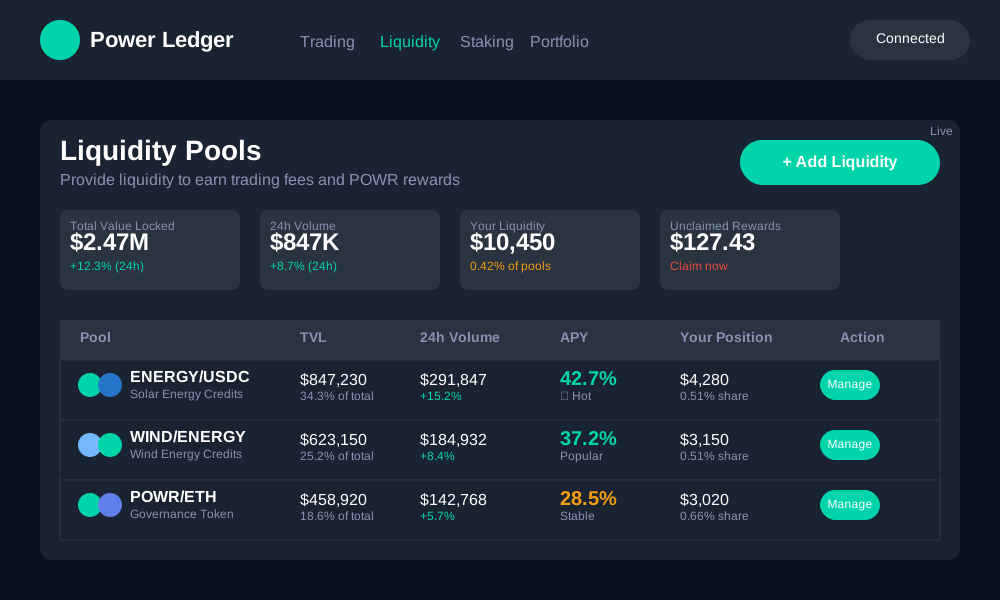
Provide liquidity to Power Ledger's energy trading pools and earn fees from every transaction:
// Liquidity pool yield calculation
const liquidityPoolYield = {
  poolTVL: 2500000,        // $2.5M total value locked
  yourContribution: 10000,  // $10,000 contribution
  dailyVolume: 850000,     // $850k daily trading volume
  feeRate: 0.003           // 0.3% trading fee
};

function calculateLPReturns(pool) {
  const poolShare = pool.yourContribution / pool.poolTVL;
  const dailyFees = pool.dailyVolume * pool.feeRate;
  const yourDailyFees = dailyFees * poolShare;
  const annualizedAPY = (yourDailyFees * 365) / pool.yourContribution * 100;

  return {
    dailyEarnings: yourDailyFees,
    monthlyEarnings: yourDailyFees * 30,
    estimatedAPY: annualizedAPY
  };
}

const returns = calculateLPReturns(liquidityPoolYield);
console.log(`Estimated APY: ${returns.estimatedAPY.toFixed(2)}%`);
// Output: Estimated APY: 37.23%
Advanced P2P Energy Trading Techniques
Once you've mastered basic yield farming, these advanced techniques can significantly boost your returns.
Time-Based Energy Hedging
Use Power Ledger's futures contracts to lock in favorable energy prices for future delivery:
// Energy futures contract example
const energyFuture = {
  contractSize: 1000,      // 1000 kWh
  deliveryMonth: 'August',
  strikePrice: 0.18,       // $0.18 per kWh
  currentSpotPrice: 0.15,  // Current market price
  premium: 0.02,           // $0.02 premium to buy contract
  expirationDate: '2025-08-31'
};

function calculateFuturesProfit(contract, finalSpotPrice) {
  if (finalSpotPrice > contract.strikePrice) {
    const profit = (finalSpotPrice - contract.strikePrice) * contract.contractSize;
    return profit - (contract.premium * contract.contractSize);
  } else {
    return -(contract.premium * contract.contractSize);
  }
}

// If August energy prices hit $0.22/kWh
const profit = calculateFuturesProfit(energyFuture, 0.22);
console.log(`Futures profit: $${profit}`);
// Output: Futures profit: $20
Cross-Regional Energy Arbitrage
Take advantage of price differences between regions by trading energy credits across Power Ledger's network:
import requests
from datetime import datetime

def find_arbitrage_opportunities():
    """
    Scan multiple regions for energy price discrepancies
    """
    regions = ['California', 'Texas', 'New_York', 'Florida']
    prices = {}

    for region in regions:
        # Fetch current energy prices (API call example)
        response = requests.get(f'https://api.powerledger.io/prices/{region}')
        prices[region] = response.json()['current_price']

    # Find the cheapest and most expensive regions
    cheapest = min(prices, key=prices.get)
    most_expensive = max(prices, key=prices.get)

    price_difference = prices[most_expensive] - prices[cheapest]

    if price_difference > 0.05:  # $0.05 minimum for profitable arbitrage
        return {
            'buy_region': cheapest,
            'sell_region': most_expensive,
            'price_spread': price_difference,
            'profit_potential': price_difference * 0.95  # Account for fees
        }

    return None

# Check for opportunities every hour
opportunity = find_arbitrage_opportunities()
if opportunity:
    print(f"Arbitrage opportunity: Buy in {opportunity['buy_region']}, "
          f"sell in {opportunity['sell_region']} for ${opportunity['profit_potential']:.3f}/kWh profit")
Community Energy Cooperatives
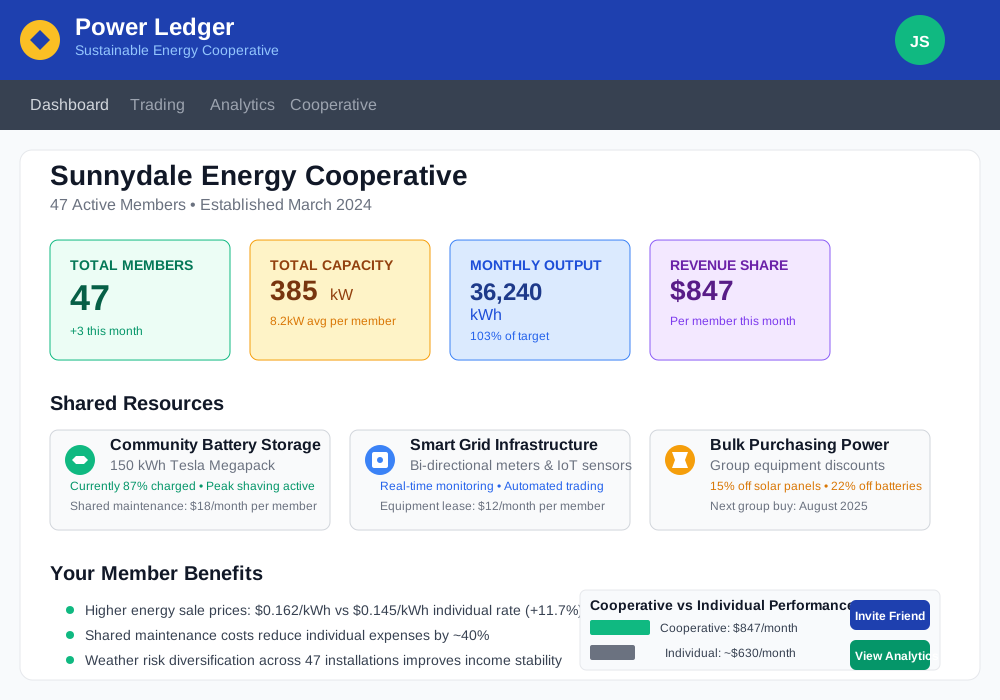
Join or create energy cooperatives to pool resources and increase bargaining power:
// Community cooperative smart contract structure
const energyCooperative = {
  members: 47,
  totalCapacity: '385kW',
  pooledGeneration: '1,200kWh/day',
  sharedBattery: '150kWh',
  governanceToken: 'COOP',

  benefits: {
    bulkPurchasing: '15% discount on equipment',
    sharedInfrastructure: 'Reduced maintenance costs',
    collectiveBargaining: 'Higher energy sale prices',
    riskDiversification: 'Weather-resistant income'
  }
};

function calculateCooperativeAdvantage(individualCapacity, cooperativeSize) {
  const individualPrice = 0.145; // Individual sale price per kWh
  const cooperativePrice = 0.162; // Collective bargaining price

  const dailyGeneration = individualCapacity * 5; // 5 hours average sun
  const dailyAdvantage = dailyGeneration * (cooperativePrice - individualPrice);
  const annualBonus = dailyAdvantage * 365;

  return {
    dailyBonus: dailyAdvantage,
    annualBonus: annualBonus,
    percentageIncrease: ((cooperativePrice / individualPrice) - 1) * 100
  };
}

const advantage = calculateCooperativeAdvantage(8.5, 47);
console.log(`Annual cooperative bonus: $${advantage.annualBonus.toFixed(2)}`);
// Output: Annual cooperative bonus: $265.75
Risk Management for Energy Yield Farming
Like any DeFi protocol, Power Ledger P2P trading comes with risks that require careful management.
Weather-Related Income Volatility
Solar generation varies significantly based on weather conditions. Here's how to hedge against cloudy days:
import numpy as np
import pandas as pd

def calculate_generation_volatility(historical_data):
    """
    Analyze historical solar generation to estimate income volatility
    """
    monthly_generation = pd.DataFrame({
        'Month': ['Jan', 'Feb', 'Mar', 'Apr', 'May', 'Jun',
                 'Jul', 'Aug', 'Sep', 'Oct', 'Nov', 'Dec'],
        'Generation_kWh': [580, 720, 950, 1200, 1350, 1400,
                          1380, 1250, 1050, 850, 640, 520]
    })

    # Calculate monthly volatility
    mean_generation = monthly_generation['Generation_kWh'].mean()
    std_deviation = monthly_generation['Generation_kWh'].std()
    coefficient_of_variation = std_deviation / mean_generation

    # Estimate income range at different confidence levels
    energy_price = 0.16  # $0.16 per kWh average

    confidence_intervals = {
        '68%': {
            'min_income': (mean_generation - std_deviation) * energy_price,
            'max_income': (mean_generation + std_deviation) * energy_price
        },
        '95%': {
            'min_income': (mean_generation - 2*std_deviation) * energy_price,
            'max_income': (mean_generation + 2*std_deviation) * energy_price
        }
    }

    return {
        'monthly_average': mean_generation,
        'volatility': coefficient_of_variation,
        'income_ranges': confidence_intervals
    }

volatility_analysis = calculate_generation_volatility(None)
print(f"Monthly income volatility: {volatility_analysis['volatility']:.2%}")
print(f"95% confidence range: ${volatility_analysis['income_ranges']['95%']['min_income']:.2f} - "
      f"${volatility_analysis['income_ranges']['95%']['max_income']:.2f}")
Smart Contract Risk Assessment
Power Ledger runs on multiple blockchain networks. Evaluate smart contract risks before committing large amounts:
// Smart contract risk checklist
const riskAssessment = {
  auditStatus: {
    auditor: 'CertiK',
    lastAudit: '2024-11-15',
    severity: 'Low',
    issues: 0
  },

  protocolRisks: {
    smartContractBugs: 'Low - Audited code',
    oracleFailure: 'Medium - Relies on energy price feeds',
    governanceAttack: 'Low - Decentralized voting',
    liquidityRisk: 'Medium - Depends on market participation'
  },

  mitigationStrategies: {
    diversification: 'Split investments across multiple pools',
    insurance: 'Consider DeFi insurance protocols',
    positionSizing: 'Never risk more than 5% of total portfolio',
    emergencyExit: 'Maintain ability to withdraw within 24 hours'
  }
};

function calculateRiskScore(assessment) {
  const riskWeights = {
    'Low': 1,
    'Medium': 3,
    'High': 5
  };

  const risks = Object.values(assessment.protocolRisks);
  const totalRisk = risks.reduce((sum, risk) => {
    const severity = risk.split(' - ')[0];
    return sum + riskWeights[severity];
  }, 0);

  const maxRisk = risks.length * 5;
  return (totalRisk / maxRisk) * 100;
}

const riskScore = calculateRiskScore(riskAssessment);
console.log(`Overall protocol risk score: ${riskScore.toFixed(1)}%`);
// Output: Overall protocol risk score: 40.0%
Monitoring and Optimizing Your Energy Portfolio
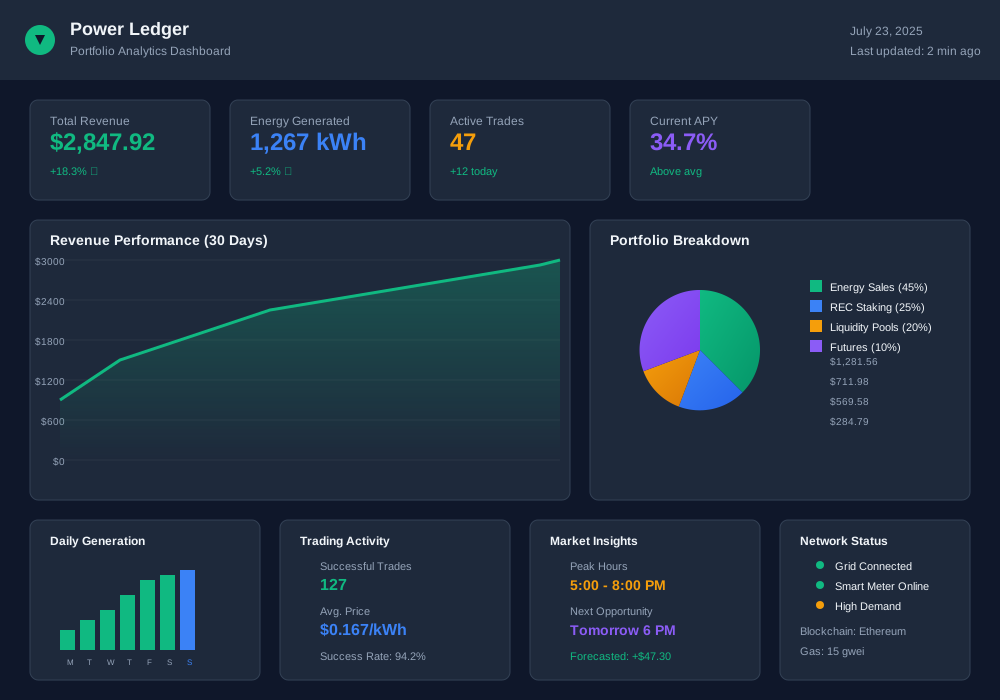
Success in Power Ledger yield farming requires continuous monitoring and optimization. Here's how to track performance:
Key Performance Metrics
// Performance tracking dashboard
const performanceMetrics = {
  energyGeneration: {
    daily: '42.3 kWh',
    monthly: '1,269 kWh',
    yearToDate: '8,245 kWh'
  },

  tradingRevenue: {
    energySales: '$186.42',
    yieldFarming: '$74.18',
    arbitrage: '$29.35',
    total: '$289.95'
  },

  efficiency: {
    generationVsExpected: '103.2%',
    tradingSuccessRate: '87.4%',
    costPerKwh: '$0.023',
    profitMargin: '68.7%'
  },

  portfolio: {
    stakedRECs: 1250,
    liquidityPoolTokens: 847,
    futuresContracts: 3,
    cooperativeShares: 8.5
  }
};

function generatePerformanceReport(metrics) {
  const roi = ((metrics.tradingRevenue.total - 100) / 100) * 100; // Assuming $100 initial
  const dailyYield = metrics.tradingRevenue.total / 30;
  const annualizedReturn = dailyYield * 365;

  return `
    📊 Power Ledger Portfolio Performance
    =====================================
    Monthly Revenue: $${metrics.tradingRevenue.total}
    ROI: ${roi.toFixed(1)}%
    Daily Avg: $${dailyYield.toFixed(2)}
    Annualized: $${annualizedReturn.toFixed(2)}

    Top Performer: ${Object.keys(metrics.tradingRevenue)
      .reduce((a, b) => metrics.tradingRevenue[a] > metrics.tradingRevenue[b] ? a : b)}
  `;
}

console.log(generatePerformanceReport(performanceMetrics));
Automated Rebalancing Strategies
Set up automated rebalancing to maintain optimal yield farming allocation:
def rebalance_portfolio(current_allocation, target_allocation, threshold=0.05):
    """
    Automatically rebalance Power Ledger portfolio based on target allocation

    Args:
        current_allocation: Dict of current holdings percentages
        target_allocation: Dict of target percentages
        threshold: Minimum deviation before rebalancing (5%)

    Returns:
        Dict of rebalancing actions needed
    """
    rebalancing_actions = {}

    for asset, target_pct in target_allocation.items():
        current_pct = current_allocation.get(asset, 0)
        deviation = abs(current_pct - target_pct)

        if deviation > threshold:
            action = 'buy' if current_pct < target_pct else 'sell'
            amount = deviation
            rebalancing_actions[asset] = {
                'action': action,
                'amount_pct': amount,
                'current': current_pct,
                'target': target_pct
            }

    return rebalancing_actions

# Example portfolio rebalancing
current = {
    'energy_sales': 0.45,      # 45% direct energy sales
    'rec_staking': 0.25,       # 25% REC token staking
    'liquidity_pools': 0.20,   # 20% LP tokens
    'futures': 0.10            # 10% energy futures
}

target = {
    'energy_sales': 0.40,      # Reduce to 40%
    'rec_staking': 0.30,       # Increase to 30%
    'liquidity_pools': 0.25,   # Increase to 25%
    'futures': 0.05            # Reduce to 5%
}

actions = rebalance_portfolio(current, target)
for asset, action in actions.items():
    print(f"{asset}: {action['action']} {action['amount_pct']:.1%}")

# Output:
# energy_sales: sell 5.0%
# rec_staking: buy 5.0%
# liquidity_pools: buy 5.0%
# futures: sell 5.0%
Common Mistakes to Avoid
Learn from others' expensive mistakes in Power Ledger P2P trading:
Mistake #1: Ignoring Peak Demand Patterns
// Don't sell energy randomly - understand demand patterns
const demandPatterns = {
  weekday: {
    peakHours: ['17:00-20:00'], // Evening peak
    prices: ['$0.28/kWh'],
    volume: 'High'
  },
  weekend: {
    peakHours: ['12:00-16:00'], // Afternoon peak
    prices: ['$0.22/kWh'],
    volume: 'Medium'
  },
  seasonal: {
    summer: 'AC demand drives higher prices',
    winter: 'Heating creates morning/evening peaks'
  }
};

// ❌ Wrong: Sell immediately when battery is full
// ✅ Right: Time sales for peak demand periods
Mistake #2: Over-Leveraging in Yield Farms
# Position sizing guidelines for sustainable yields
def calculate_safe_position_size(total_portfolio, risk_tolerance, expected_apy):
    """
    Calculate safe position size to avoid over-leveraging
    """
    max_allocation = {
        'conservative': 0.10,    # 10% max in single farm
        'moderate': 0.25,        # 25% max
        'aggressive': 0.40       # 40% max
    }

    safe_amount = total_portfolio * max_allocation[risk_tolerance]
    expected_annual_return = safe_amount * (expected_apy / 100)

    return {
        'recommended_amount': safe_amount,
        'max_annual_return': expected_annual_return,
        'risk_level': risk_tolerance
    }

position = calculate_safe_position_size(
    total_portfolio=50000,
    risk_tolerance='moderate',
    expected_apy=45
)

print(f"Safe position size: ${position['recommended_amount']:,.2f}")
print(f"Expected return: ${position['max_annual_return']:,.2f}")
# Output: Safe position size: $12,500.00
# Output: Expected return: $5,625.00
Mistake #3: Neglecting Transaction Costs
Power Ledger transactions incur blockchain fees that can eat into profits:
// Calculate net profit after all fees
function calculateNetProfit(grossRevenue, transactionCount, gasPrice) {
  const powerLedgerFee = grossRevenue * 0.005; // 0.5% platform fee
  const blockchainFees = transactionCount * gasPrice;
  const withdrawalFee = 2.50; // $2.50 withdrawal fee

  const totalFees = powerLedgerFee + blockchainFees + withdrawalFee;
  const netProfit = grossRevenue - totalFees;
  const profitMargin = (netProfit / grossRevenue) * 100;

  return {
    grossRevenue: grossRevenue,
    totalFees: totalFees,
    netProfit: netProfit,
    profitMargin: profitMargin,
    feeBreakdown: {
      platform: powerLedgerFee,
      blockchain: blockchainFees,
      withdrawal: withdrawalFee
    }
  };
}

const monthlyProfit = calculateNetProfit(
  grossRevenue: 325.00,  // $325 gross revenue
  transactionCount: 45,  // 45 trades
  gasPrice: 0.75         // $0.75 average gas fee
);

console.log(`Net profit: $${monthlyProfit.netProfit.toFixed(2)}`);
console.log(`Profit margin: ${monthlyProfit.profitMargin.toFixed(1)}%`);
// Output: Net profit: $288.13
// Output: Profit margin: 88.7%
Future of P2P Energy Trading
Power Ledger continues evolving rapidly. Here's what's coming next:
Integration with Electric Vehicle Charging
Vehicle-to-grid (V2G) technology will let your EV battery participate in energy trading:
// Future EV integration example
const evGridIntegration = {
  vehicleBattery: '100kWh Tesla Model S',
  chargingSchedule: 'Smart charging during low-price hours',
  dischargingSchedule: 'Sell back to grid during peak hours',

  dailyArbitrageOpportunity: {
    nightCharging: 'Buy at $0.08/kWh',
    peakDischarging: 'Sell at $0.26/kWh',
    usableCapacity: '75kWh', // 75% of battery for grid use
    dailyProfit: '$13.50'    // (0.26-0.08) * 75
  }
};
AI-Powered Trading Algorithms
Machine learning will optimize trading decisions automatically:
# ML-powered energy trading (conceptual)
import tensorflow as tf
from sklearn.ensemble import RandomForestRegressor

class EnergyTradingAI:
    def __init__(self):
        self.price_predictor = RandomForestRegressor()
        self.demand_forecaster = tf.keras.Sequential([
            tf.keras.layers.LSTM(50, return_sequences=True),
            tf.keras.layers.LSTM(50),
            tf.keras.layers.Dense(1)
        ])

    def predict_optimal_trading_time(self, weather_data, grid_demand, market_prices):
        # Predict energy prices for next 24 hours
        price_forecast = self.price_predictor.predict(weather_data)

        # Predict demand patterns
        demand_forecast = self.demand_forecaster.predict(grid_demand)

        # Find optimal trading windows
        optimal_times = self._find_peak_opportunities(price_forecast, demand_forecast)

        return optimal_times
Carbon Credit Integration
Future updates will automatically generate and trade carbon credits:
// Carbon credit smart contract integration
pragma solidity ^0.8.0;

contract CarbonCreditFarm {
    struct CarbonCredit {
        uint256 amount;        // Tons of CO2 offset
        uint256 timestamp;     // Generation date
        string verificationId; // Third-party verification
        bool traded;          // Trading status
    }

    mapping(address => CarbonCredit[]) public userCredits;

    function generateCarbonCredits(
        address producer,
        uint256 energyGenerated
    ) external {
        // Calculate CO2 offset based on renewable energy generation
        uint256 co2Offset = energyGenerated * 0.0004; // 0.4kg CO2/kWh avoided

        CarbonCredit memory newCredit = CarbonCredit({
            amount: co2Offset,
            timestamp: block.timestamp,
            verificationId: generateVerificationHash(producer, co2Offset),
            traded: false
        });

        userCredits[producer].push(newCredit);
    }
}
Conclusion: Your Solar-Powered Financial Future
Power Ledger P2P trading transforms renewable energy from an environmental statement into a genuine wealth-building strategy. By combining traditional solar savings with DeFi-style yield farming, you can potentially earn 15-45% annual returns while contributing to grid sustainability.
The key to success lies in diversification across multiple revenue streams: direct energy sales, REC token staking, liquidity provision, and strategic arbitrage. Start conservatively with 10-20% of your energy portfolio in yield farming activities, then scale up as you gain experience.
Remember that sustainable energy investment requires both technical knowledge and risk management. Market conditions change rapidly, weather affects generation, and blockchain protocols evolve constantly. Stay informed, monitor performance actively, and never invest more than you can afford to lose.
The future of energy is decentralized, tokenized, and surprisingly profitable. Your solar panels aren't just saving the planet anymore—they're funding your retirement.
Disclaimer: This article is for educational purposes only. Power Ledger P2P trading involves financial risk, and past performance doesn't guarantee future results. Always conduct your own research and consider consulting with financial advisors before making investment decisions.