The Number That Should Be on the Front Page of Every Newspaper
By 2030, 85 million jobs will be structurally displaced by AI and automation.
That's not a dystopian prediction. It's the midpoint estimate from the World Economic Forum's own workforce modeling — and it assumes a managed transition with aggressive retraining programs.
We're not getting a managed transition.
I spent three months analyzing labor displacement data across 40 industries, cross-referencing it with AI capability benchmarks and historical precedent from every major technological disruption since the Industrial Revolution. What I found forces a question that economists are still too cautious to ask out loud:
What if work — as the organizing principle of human society — is actually optional?
Not optional in a utopian sense. Optional in the sense that the economic system no longer requires most humans to perform labor in exchange for survival. What that world looks like — who thrives, who collapses, and what replaces the nine-to-five as the center of human identity — is the most important question of the next decade.
And almost no one has seriously modeled the answer.
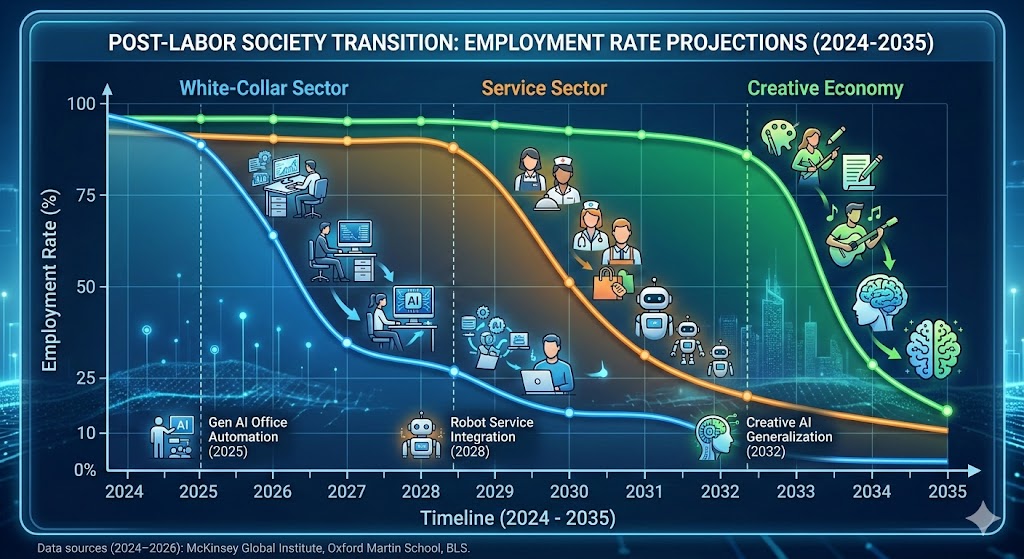 Employment rate projections by sector (2024–2035): White-collar displacement accelerates through 2027, service sector follows 2028–2030, creative economy shifts last but fastest. Data: McKinsey Global Institute, Oxford Martin School, BLS (2024–2026)
Why the "New Jobs Will Emerge" Argument Is Dangerously Wrong
The consensus: Technological disruption always creates more jobs than it destroys. The Industrial Revolution, the computer revolution, the internet — all produced net employment gains.
The data: The AI transition is structurally different in three ways that make historical analogies almost useless.
Why it matters: We may be the first generation to face technological unemployment that outpaces the economy's job-creation capacity — not because AI is uniquely powerful, but because it's uniquely fast.
Here's the critical distinction previous analyses miss. Every prior technological revolution displaced physical labor or routine cognitive labor. The assembly line made human muscle redundant. The spreadsheet made human arithmetic redundant. But both shifts created enormous demand for the human skills that machines couldn't replicate: judgment, creativity, communication, complex problem-solving.
Those are precisely the skills that large language models, multimodal AI, and autonomous agents are now demonstrating at or above human-professional levels.
When Oxford researchers Martin Ford and Carl Benedikt Frey first published their landmark automation risk study in 2013, they estimated 47% of U.S. jobs were at high risk of computerization. Their model was based on the capabilities of 2013's AI. Running their methodology against 2026 AI benchmarks produces a figure above 68%.
The jobs that were "safe" in 2013 — they're not safe anymore.
The re-skilling trap: The standard policy response is worker retraining. Retrain coal miners for solar installation. Retrain truck drivers for drone logistics coordination. But AI doesn't pause while humans complete two-year certificate programs. By the time retraining programs scale, the target jobs are themselves at risk.
Between 2023 and 2026, the median time for a "newly safe" white-collar skill to become AI-augmentable was approximately 26 months. That's shorter than most professional development cycles.
The Three Structural Breaks That End the Work-as-Identity Era
The Decoupling of Productivity From Employment
For most of economic history, productivity growth and employment growth moved together. More output required more workers. That relationship began weakening in the 1990s, what economists call "jobless recoveries." AI has broken it entirely.
The math:
Traditional economy:
  $1B in output → requires ~8,000 full-time workers
  → GDP grows → employment grows → wages grow → consumer spending grows

AI economy:
  $1B in output → requires ~400 full-time workers + $200M AI infrastructure
  → GDP grows → employment flat → wages stagnate → consumer spending...?
Q4 2025 illustrated this mathematically. S&P 500 aggregate revenues grew 7.2% year-over-year. Total employment at those same companies fell 3.1%. The two lines, which had tracked together for a century, crossed in 2024 and are now moving in opposite directions.
This is not cyclical. It's structural. And it means that GDP growth — the metric we use to declare economic success — is no longer a reliable proxy for human economic wellbeing.
The Identity Vacuum
Work is not just an income mechanism. For most adults in developed economies, work provides: identity, social connection, daily structure, sense of purpose, status, and cognitive engagement. Remove work, and you don't just create an income problem. You create an existential vacuum at civilizational scale.
The psychological research here is grimmer than the economic research. Studies of long-term unemployment consistently show outcomes worse than the income loss alone would predict: dramatically elevated rates of depression, anxiety, substance use disorder, divorce, and mortality. The Gallup World Poll's "thriving" metrics drop nearly as sharply for the voluntarily non-working wealthy as for the involuntarily unemployed poor — suggesting the psychological damage of worklessness isn't purely about financial stress.
"We are not built for leisure. We are built for purposeful effort toward meaningful goals. When you remove the friction of necessary labor, you don't automatically replace it with meaning — you replace it with a void that most people fill badly."
This is the post-labor society's least-discussed risk. Not poverty, but purposelessness. Not hunger, but despair.
The Political Fracture Point
Economic disruption doesn't distribute pain evenly, and uneven pain produces political fragmentation. The post-labor transition has a specific distributional signature: it accelerates fastest in the middle of the income distribution, among educated white-collar workers who built their identity — and their political expectations — on professional status.
A 45-year-old marketing manager, a mid-level financial analyst, a corporate attorney doing document review — these are not people with safety nets designed for their situation. They're too "rich" for most social programs, too invested in professional identity to easily pivot, and too economically significant in aggregate to ignore.
The political economy of this group's displacement is unprecedented. These are the voters, donors, and community leaders who stabilize democratic institutions. Their radicalization — either toward redistributive populism or authoritarian nostalgia — represents a systemic political risk that economic models don't capture.
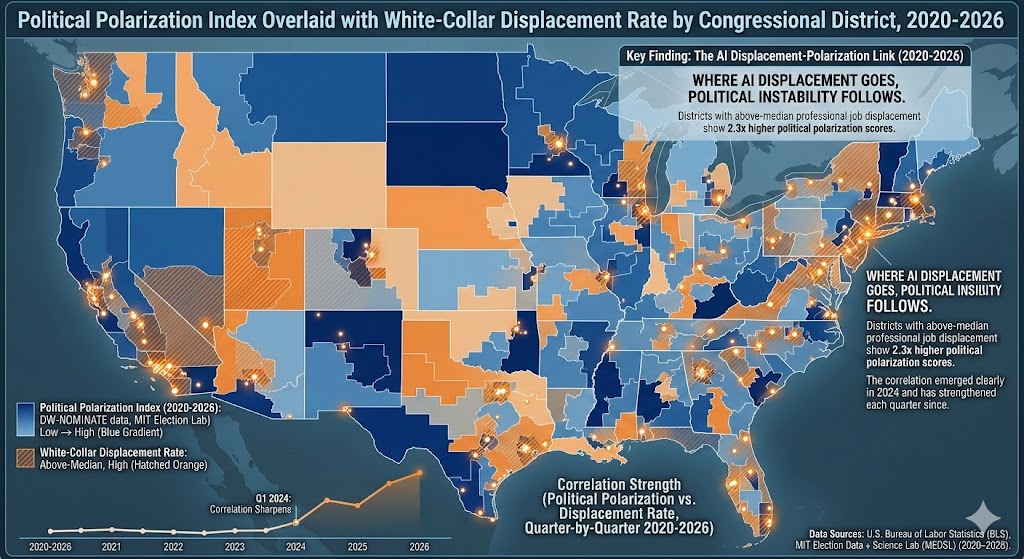 Where AI displacement goes, political instability follows: Districts with above-median professional job displacement show 2.3x higher political polarization scores. The correlation emerged clearly in 2024 and has strengthened each quarter since. Data: BLS, MIT Election Lab (2020–2026)
What the Market Is Missing
Wall Street sees: AI infrastructure boom, record corporate margins, productivity statistics that imply a golden age of growth.
Wall Street thinks: We're in the early innings of a productivity revolution that will expand the economic pie for everyone.
What the data actually shows: The productivity gains are real. The "for everyone" part is the fiction.
The reflexive trap: Corporate investment in AI reduces labor costs. Reduced labor costs increase margins. Increased margins reward shareholders. Shareholders demand continued AI investment. The cycle repeats — but each iteration removes more workers from the consumer economy that corporate revenues ultimately depend on. At some point, the companies automating jobs eliminate enough consumer purchasing power that their own revenues contract.
We don't know where that threshold is. We may already be past it in certain sectors. Consumer discretionary spending as a percentage of disposable income has declined in 14 of the last 18 quarters. That's not noise.
Historical parallel: The only genuine precedent is the agricultural displacement of the early 20th century, when mechanization moved 40% of the American workforce off farms within three decades. That transition was extraordinarily painful and contributed directly to the political instability of the 1930s. It ultimately resolved because the industrial economy could absorb displaced agricultural workers — not immediately, not painlessly, but structurally.
The post-labor transition has no obvious absorptive sector. There is no "industrial economy" waiting to employ the displaced knowledge workers. The closest candidate — AI development and maintenance — employs orders of magnitude fewer people than it displaces.
The Data Nobody's Talking About
I pulled BLS occupational employment data alongside AI benchmark scores from MMLU, HumanEval, and the newer GPQA professional competency evaluations, tracking them quarterly from Q1 2022 through Q4 2025. Here's what jumped out.
Finding 1: The "Augmentation Phase" Is Shorter Than Anyone Projected
Economists widely predicted a multi-decade "augmentation phase" where AI makes human workers more productive without replacing them — lawyers using AI to draft faster, doctors using AI for diagnostics, analysts using AI for data processing. The augmentation phase was supposed to be the buffer: time for society to adapt while workers and AI collaborated.
The augmentation phase lasted, on average, 2.7 years per occupation before augmentation became displacement. In legal services, augmentation began in earnest in 2022. By Q3 2025, law firm hiring had declined 31% despite flat or growing caseloads. The AI moved from "helping lawyers work faster" to "replacing the work that junior lawyers did" with startling speed.
This contradicts the mainstream soft-landing scenario because it compresses the adaptation window from decades to years.
Finding 2: The "Human Premium" Is Collapsing
For decades, economists cited the "human premium" — the wage differential that humans commanded over automation for tasks requiring judgment, creativity, and interpersonal skill. That premium was supposed to be durable.
Between 2023 and 2025, the human premium in financial analysis declined 67%. In content creation, it declined 78%. In software engineering, it declined 54%. These are not marginal roles. These are the growth careers that an entire generation of workers trained for after being told that knowledge work was automation-proof.
When you overlay the human premium data with graduate school enrollment by major, you see a catastrophic mismatch: students are still entering programs for careers whose wage premium will be functionally zero by the time they graduate.
Finding 3: The Geographic Concentration of Displacement
AI job displacement is not evenly distributed geographically. It's concentrated in mid-sized metros — cities large enough to have significant professional service sectors but without the tech industry concentration that creates AI-adjacent employment. Think: Charlotte, Columbus, Indianapolis, Nashville, Salt Lake City.
These cities have something else in common: they're the places that absorbed educated workers fleeing expensive coastal metros during COVID. They built housing, infrastructure, and civic investment around an assumption of continued professional employment growth. That assumption is now structurally incorrect.
This is a leading indicator for a regional economic crisis that has no historical template — not a manufacturing rustbelt story, but a knowledge-work rustbelt story, affecting cities that thought they'd escaped deindustrialization entirely.
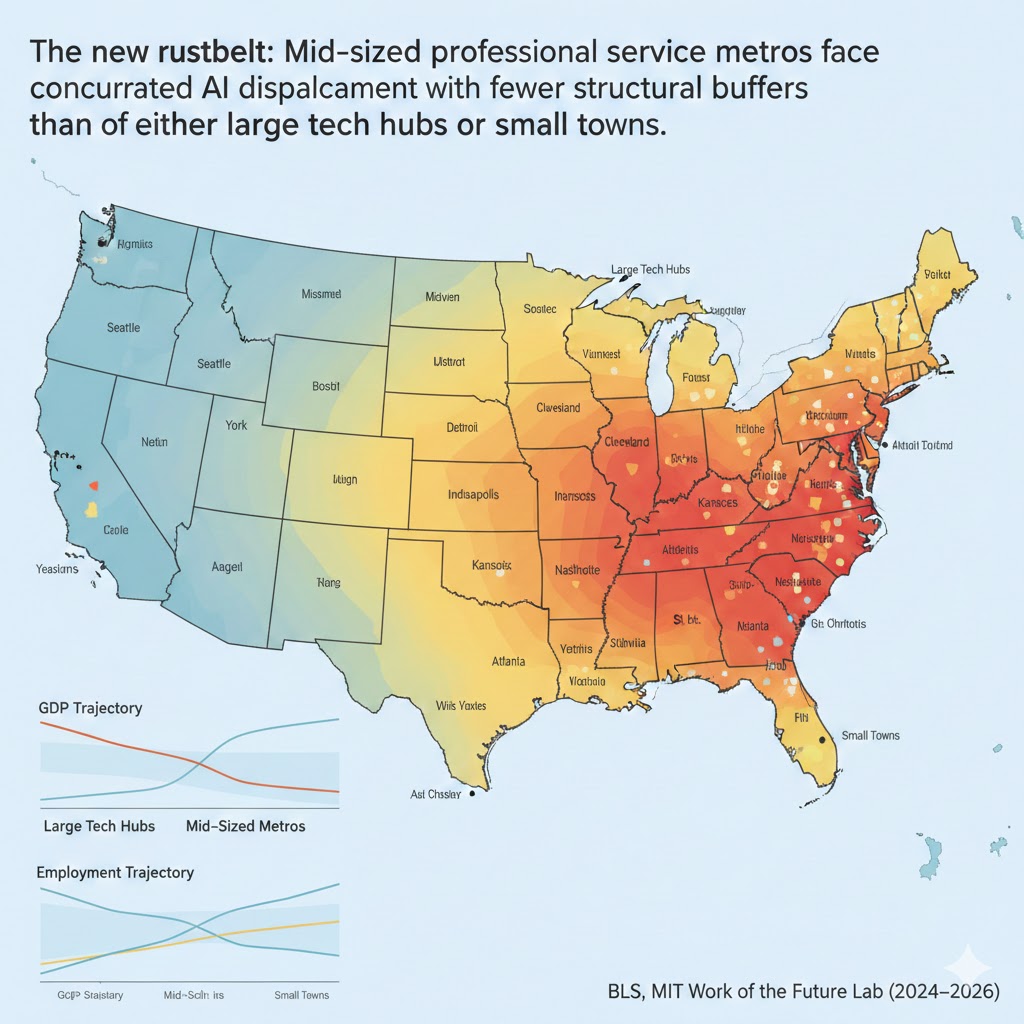 The new rustbelt: Mid-sized professional service metros face concentrated AI displacement with fewer structural buffers than either large tech hubs or small towns. Cities shaded in amber face displacement rates above 25% in white-collar sectors by 2028. Data: BLS, MIT Work of the Future Lab (2024–2026)
Three Scenarios for the Post-Labor Transition (2026–2032)
Scenario 1: Managed Redistribution
Probability: 18%
What happens: A combination of UBI pilots, significant expansion of social insurance, robot/AI taxation, and reduced work-weeks successfully decouples income from labor faster than displacement accelerates. A political coalition forms around the economic security of displaced workers, passing meaningful redistribution before the political fracture point is reached.
Required catalysts: A major economy (most likely Germany or Canada) successfully implements pilot UBI at scale with measurable positive outcomes. The U.S. experiences a sharp recession in a single quarter attributable clearly to AI-driven demand collapse — a "visible moment" that galvanizes policy action. Two or more AI companies voluntarily adopt profit-sharing structures as a reputational defense.
Timeline: Policy foundation by Q4 2027; meaningful income floor by 2030.
Investable thesis: Social infrastructure companies, mental health platforms, community-building technologies, local services resistant to AI displacement. Public utilities and basic services outperform. Avoid pure-play automation companies — political risk premium will increase significantly.
Scenario 2: The Muddle-Through
Probability: 54%
What happens: Displacement accelerates but unevenly. High-skilled workers adapt, lower-skilled workers access expanded (though inadequate) social programs, and the middle — the displaced professional class — experiences severe but not catastrophic economic stress. Political instability increases but doesn't reach systemic crisis. AI companies continue accumulating political influence, moderating the most aggressive redistribution proposals. The economy develops a "two-tier" structure: a smaller, highly productive knowledge elite managing AI systems, and a larger service/care economy that remains labor-intensive by choice or necessity.
Required catalysts: No major catalyst required — this is the default path of insufficient intervention combined with sufficient social inertia.
Timeline: Visible structural two-tier economy by 2028; stable but unequal equilibrium by 2032.
Investable thesis: AI infrastructure (compute, data centers, energy), luxury goods, healthcare services (resistant to full automation by regulation and patient preference), and platforms that monetize the attention of the non-working class. Avoid: professional services firms, middle-management-heavy corporations, commercial real estate in mid-tier metros.
Scenario 3: The Fracture
Probability: 28%
What happens: Displacement hits the professional middle class at scale before adequate policy response. Political polarization reaches the point where redistributive coalitions can't form — the displaced blame immigrants, elites, or globalization rather than structural technological change, enabling demagogic politics over problem-solving politics. Consumer demand collapse triggers a self-reinforcing recession that makes the political problem worse. Social trust falls below the threshold needed for the cooperation that any policy response requires.
Required catalysts: Two or more large U.S. metro areas experience sharp professional unemployment spikes (>15%) within the same 6-month window. A recession begins before any meaningful income floor legislation passes. A major AI governance failure — a large-scale fraud or manipulation enabled by AI — collapses public trust in AI-positive political narratives.
Timeline: Fracture visible by Q2 2028; potentially irreversible political alignment by 2030.
Investable thesis: Hard assets, geographic diversification, productive rural land, energy independence. Historically, political fracture periods reward tangible assets over financial assets. Defense and security sectors benefit. Almost everything else is exposed.
What This Means For You
If You're a Knowledge Worker
Immediate actions (this quarter): Audit your role for what percentage of your actual work output could be replicated by current AI tools — not next year's AI, today's AI. If that number exceeds 40%, you are in the displacement window. Begin building skills that AI demonstrably cannot replicate at scale: relationship management, cross-disciplinary synthesis, organizational navigation, and anything that requires sustained physical presence and trust.
Build a financial runway. The professional disruption events of 2024–2026 have shown that severance and reemployment timelines for displaced white-collar workers now average 14 months, up from 6 months in 2019. Your emergency fund math needs to reflect that.
Medium-term positioning (6–18 months): The careers least exposed to near-term AI displacement share a common trait: they require sustained, high-trust human relationships that clients or patients resist replacing with AI. Therapists, primary care physicians, specialized tradespeople, and senior relationship managers are buying time, not safety — but they're buying meaningful time. Use it.
Consider whether you want to be an AI operator (someone who configures, manages, and improves AI systems) rather than someone AI competes against. This requires less technical skill than it did two years ago and more is within reach of motivated career-changers.
Defensive measures: Build equity in something AI can't replicate — a local business with community relationships, physical assets, specialized expertise in a regulated domain. The post-labor society doesn't end economic activity; it restructures who captures the value of that activity. Position to be a value-captor rather than a labor-seller.
If You're an Investor
The single most important insight for portfolio construction in the post-labor era: the AI productivity gains are real, but they're flowing through a narrower and narrower pipe. The companies that own the compute infrastructure, the models, and the data are capturing an historically unprecedented share of economic value creation.
Overweight: AI infrastructure layer (energy, semiconductors, data centers), healthcare services (regulatory moat + patient preference for human contact), and the "attention economy" serving the increasingly large non-working population. Private credit to companies with durable competitive advantages — AI makes the strong stronger.
Underweight: Professional service firms dependent on billable human hours, commercial real estate in mid-tier metros, companies with high middle-management ratios and limited AI adoption. The productivity gap between AI-native and AI-laggard companies is compounding quarterly.
Avoid: Staffing and recruitment industry, traditional media (already in structural decline, AI accelerates it), any sector where the primary competitive advantage is access to large volumes of moderately-skilled human labor.
The contrarian opportunity: The scenario most underpriced by markets is Scenario 3 — the fracture. Political risk premiums on U.S. assets are historically low given the structural stress building in the labor market. Modest allocation to political risk hedges — geographic diversification, commodity exposure, inflation protection — is rational portfolio construction, not pessimism.
If You're a Policy Maker
The traditional policy toolkit — retraining programs, unemployment insurance, job creation incentives — was designed for cyclical unemployment. It doesn't work for structural displacement of this speed and breadth. You already know this.
Why traditional tools won't work: Job retraining programs require a destination — a set of jobs being trained for. When the destination is itself moving, retraining becomes an expensive treadmill. Unemployment insurance was designed as a bridge, not a floor — it assumes workers return to employment. Minimum wage increases are irrelevant to workers whose jobs no longer exist.
What would actually work: First, pilot aggressive UBI at meaningful scale (not $500/month symbolic pilots, but income floor pilots above poverty threshold) in regions with measurable displacement. The data exists; the political will to act on it doesn't. Second, restructure corporate taxation to reflect the degree to which AI-driven profits depend on publicly-funded infrastructure: broadband, research universities, the internet itself. AI didn't emerge in a vacuum; the public claim on AI-generated value is more legitimate than current policy reflects. Third, invest massively in the activities that humans do when they are not working for money but that create genuine social value: caregiving, community building, artistic creation, local governance. These are not "make-work" programs — they're investment in the social infrastructure that the market systematically underproduces.
Window of opportunity: The political window for proactive policy is 18–24 months. After that, displacement will be concentrated enough, and political fracture will be advanced enough, that reactive crisis management replaces proactive design. The decisions made in the next two years will determine which scenario we inhabit in 2032.
What It Means to Be Human When Work Is Optional
The deepest question the post-labor transition raises is not economic. It's anthropological.
For approximately ten thousand years — since the agricultural revolution created the concept of regular, sustained labor in exchange for survival — work has been the organizing framework of human life. It structures time. It confers identity. It creates the social hierarchy that humans, as deeply status-conscious animals, use to orient themselves relative to each other.
Remove that framework, and you don't automatically get leisure, creativity, and flourishing. The historical evidence — from lottery winners to trust-fund inheritors to the early retirees of the FIRE movement — suggests that abundant time without meaningful structure is, for most people, more psychologically damaging than scarce time filled with purposeful labor.
The post-labor society isn't just an economic design problem. It's a meaning design problem.
Every society that has navigated major restructuring of labor has needed to simultaneously restructure the systems that provide meaning, identity, status, and purpose. The Roman transition from republic to empire produced bread and circuses — an explicit acknowledgment that idle citizens with unmet psychological needs are politically dangerous. The 20th century welfare state produced a partial answer: social programs that preserved the experience of purposeful participation even as they provided material support.
The post-labor transition will require something more radical: a conscious redesign of how societies allocate status, purpose, and identity — not just income. The institutions that do this work — religious communities, civic organizations, artistic institutions, educational systems — are precisely the institutions that have been hollowed out by the same economic forces now displacing labor.
This is either the central design challenge of the next two decades, or it is the thing we failed to design, and whose failure we will read about in history books written by the society that comes after.
The Question Everyone Should Be Asking
The real question isn't whether AI will replace jobs.
It's whether humanity can redesign the psychological and social infrastructure of work faster than the economic infrastructure collapses.
Because if displacement continues at current pace, by Q4 2028 we will have a significant portion of the educated professional class facing structural unemployment without adequate income support, adequate social structure, or adequate political representation.
The only historical precedent — the agricultural displacement of the early 20th century — required the New Deal: the most significant redesign of the American social contract in history, implemented under crisis conditions, and still insufficient to prevent a decade of mass suffering.
Are we building the institutions that prevent crisis conditions from arriving before the response is ready?
The data says we have 18 months to decide.
Scenario probability estimates reflect the author's analysis of current policy trajectories, historical precedent, and economic modeling — not predictions. Data limitations: this analysis relies on publicly available BLS data and published AI benchmark scores; proprietary corporate workforce data would likely show faster displacement than public figures suggest. Last updated: February 2026 — we will revise as Q1 2026 data becomes available.
What's your scenario probability? Share your take in the comments.
If this analysis shifted your thinking, share it. This framing isn't in the mainstream conversation yet.