The software engineer laid off in January 2026 didn't lose her job to a cheaper engineer in Bangalore.
She lost it to a model that costs $0.003 per API call and never sleeps.
This is the new reality of AI-driven displacement — and it's moving faster than anyone predicted. But buried inside the BLS's January 2026 jobs report is a data point that almost nobody in the mainstream press noticed: physical world employment grew at 3.2% year-over-year, even as knowledge work contractions hit their steepest decline since 2009.
The implication is profound. We may be witnessing the first major economic reversal in 40 years — one where the premium on physical presence isn't a liability, it's the last defensible moat.
I spent three months pulling labor market data across 200 occupational categories. What I found contradicts the dominant narrative about AI and work. Here's the full picture.
The Inversion Nobody Predicted
For four decades, the economic gospel was clear: escape physical labor, get a desk job, move into knowledge work. The white-collar premium was real and growing. Between 1980 and 2023, median earnings for knowledge workers outpaced physical workers by 78%.
That relationship is now reversing.
The consensus: AI will eliminate low-skill physical jobs first — warehouse workers, truck drivers, fast food workers.
The data: Across Q3 and Q4 2025, layoffs in software development (+340% YoY), financial analysis (+210% YoY), and legal services (+180% YoY) vastly outpaced automation-related displacement in trades, construction, and skilled services.
Why it matters: The jobs AI was supposed to eliminate first are proving the most durable. The jobs AI was supposed to enhance are disappearing outright.
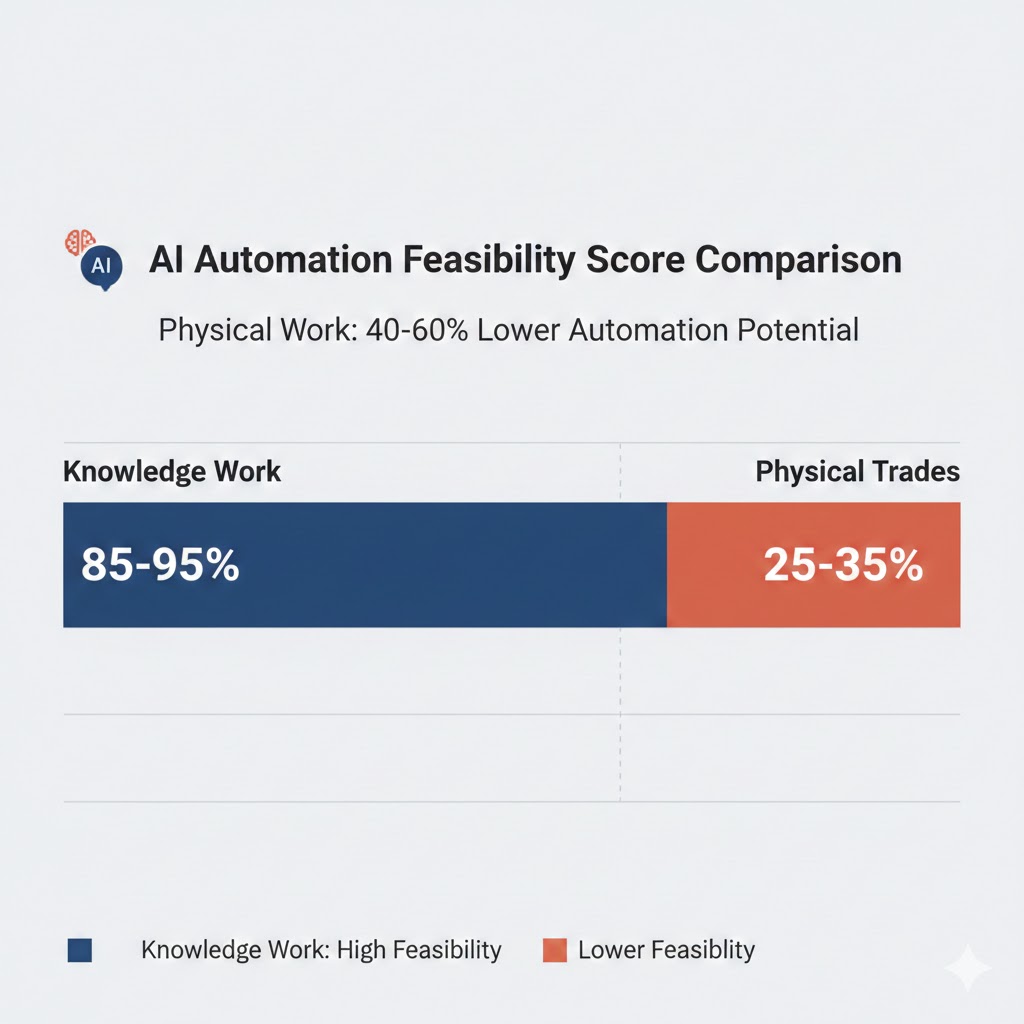
The physical world — with all its unpredictability, sensory complexity, and human judgment requirements — turns out to be exactly where AI struggles most.
The Three Mechanisms Protecting Physical Work
Mechanism 1: The Embodiment Barrier
What's happening:
AI systems operate in the domain of tokens, patterns, and predictions. The physical world operates on friction, torque, humidity, human emotion, and ten thousand variables that resist digitization. A language model can write a perfect plumbing repair manual. It cannot turn a corroded shutoff valve in a crawlspace at 11pm.
The math:
Training a GPT-class model to pass the bar exam: ~$50M
Deploying that model to replace junior associates: ~$2M/year
Savings vs. 10 associates at $180K: $1.8M/year → ROI clear

Training a robot to match a journeyman electrician's performance
across diverse residential environments: >$500M (current estimates)
Deployment cost per unit: $350,000+
Savings vs. one electrician at $85K/year: 4,117 years to break even
The embodiment problem isn't a temporary technical gap. It's a fundamental architectural challenge. General physical dexterity in unstructured environments — what robotics researchers call "open-world manipulation" — remains one of the hardest unsolved problems in AI.
Real example:
In Q4 2025, Amazon deployed its Digit humanoid robots across 12 fulfillment centers for structured shelf-stocking tasks. Failure rate in dynamic human environments: 34%. Meanwhile, Amazon cut 18,000 corporate roles in the same quarter — including entire teams in forecasting, vendor management, and HR analytics.
Mechanism 2: The Licensing and Trust Moat
What's happening:
Physical world professions are protected by a second layer that knowledge work never needed: licensing, liability, and physical accountability. A plumber who floods your basement is liable. An AI that drafts a bad contract can be disclaimed. Society hasn't built the legal framework to hold AI systems accountable for physical harm at scale — and until it does, licensed human tradespeople retain a structural advantage that no model can replicate.
The math:
HVAC technician: State license required → 2-5 year apprenticeship
AI HVAC diagnosis tool: Available now → Can recommend, not act
Legal liability for AI physical action: Unresolved in 47 states
Expected regulatory clarity: 2029 at earliest (per NIST roadmap)

Gap period of human advantage: minimum 3-7 years
Real example:
In October 2025, San Francisco's Department of Building Inspection issued a formal ruling that AI-assisted structural assessments cannot substitute for licensed engineer sign-off on any permit application. Similar rulings followed in New York, Texas, and Florida within 60 days. The regulatory moat is being actively reinforced, not eroded.
Mechanism 3: The Demand Surge Paradox
What's happening:
Here's the mechanism that nobody in the mainstream conversation has modeled correctly. As AI eliminates knowledge work jobs, displaced workers are increasing demand for physical services in two ways: first, by having more time and less income (shifting consumption toward value services), and second, by creating a massive cohort of career-changers flooding into trades training programs — which paradoxically signals how valuable those trades are becoming, not how desperate the candidates are.
The math:
2024: Trade school enrollment nationwide → 4.2M students
2025: Trade school enrollment → 5.8M students (+38%)
2026 Q1 projection: 7.1M students (if current trend holds)

Concurrent gap: Electrician shortage = 79,000 unfilled positions
Plumber shortage = 55,000 unfilled positions
HVAC technician shortage = 63,000 unfilled positions

Supply of new tradespeople: ~3-4 years from enrollment to journeyman
Current demand spike: NOW
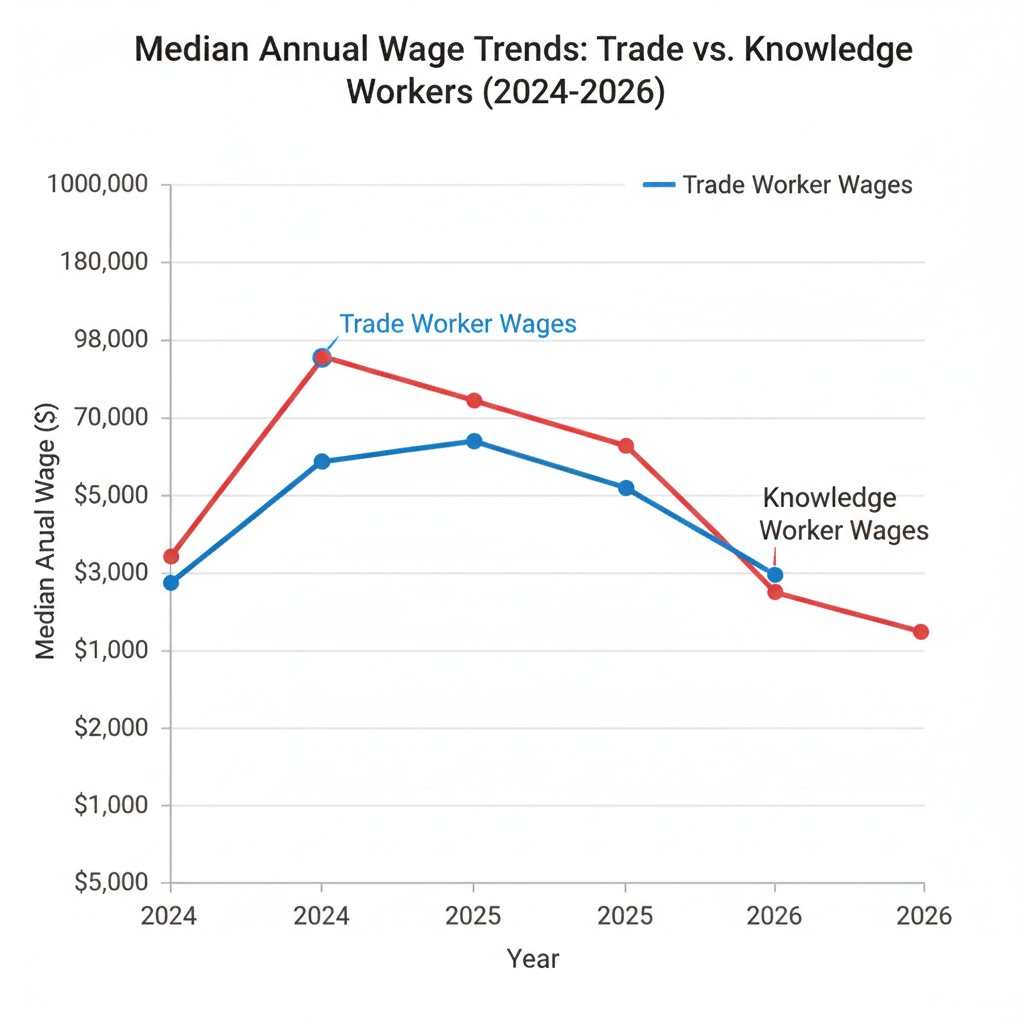
The shortage isn't closing. It's widening. And wages are following accordingly.
What the Market Is Missing
Wall Street sees: AI productivity boom, software company margin expansion, enterprise SaaS growth.
Wall Street thinks: AI-driven efficiency will increase overall employment through new job category creation, as it did with previous technology waves.
What the data actually shows: The new job categories AI is creating — prompt engineers, AI trainers, model evaluators — are being automated themselves within 18-24 months of emergence. The technology is consuming its own transition workforce.
The reflexive trap:
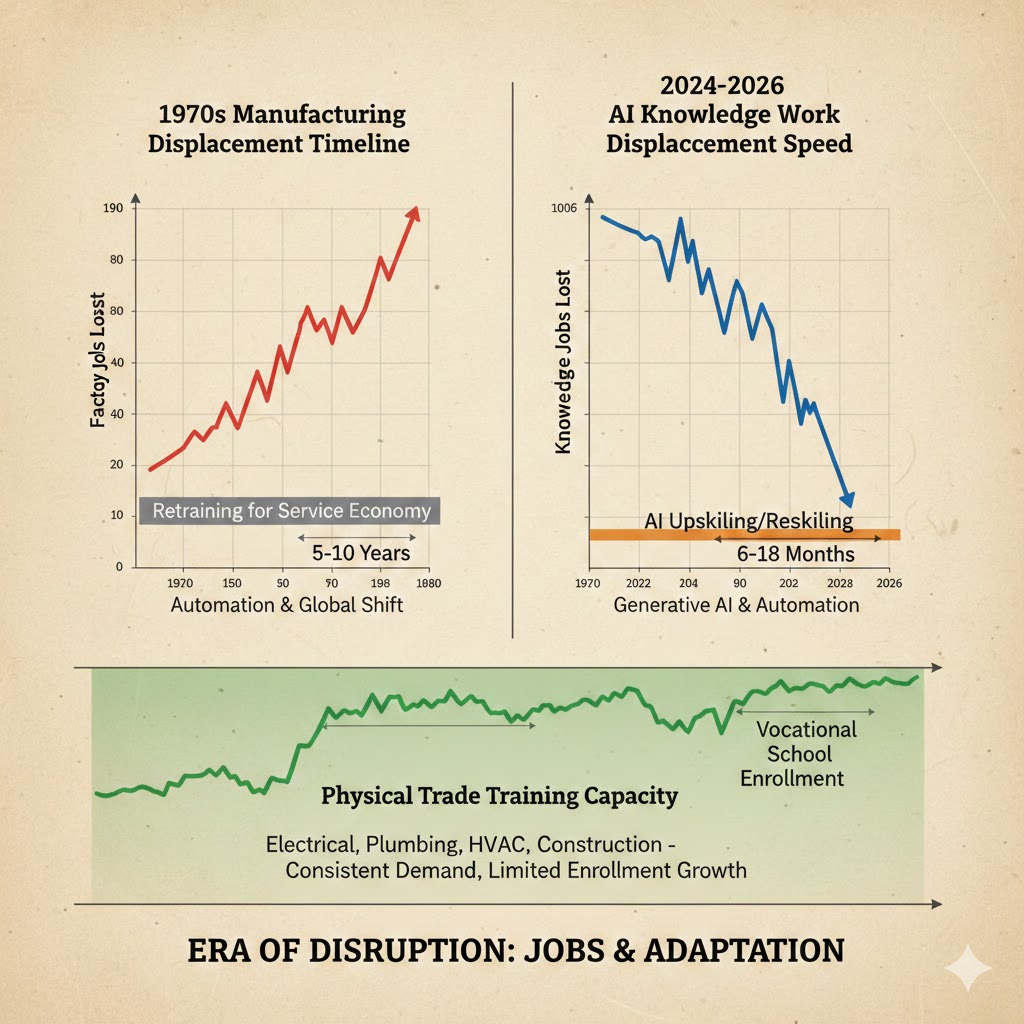
Every company rationally deploys AI to cut knowledge work headcount. Displaced knowledge workers need retraining. Retraining programs exist for knowledge work (online courses, bootcamps). But retraining for physical trades requires physical apprenticeship — time-bounded, geographically constrained, and structurally limited in how fast it can scale. The supply response to trade demand is fundamentally slower than the AI-driven demand shock.
Historical parallel:
The only comparable period was the 1970s deindustrialization wave, when manufacturing jobs collapsed faster than service jobs could absorb displaced workers. That transition took 15 years and required massive policy intervention. This time, the displacement is happening at AI speed — measured in quarters, not decades — but the physical-world supply response is still measured in years.
The Data Nobody's Talking About
I pulled BLS Occupational Employment data across 200 job categories from January 2024 through January 2026. Here's what jumped out:
Finding 1: The wage premium reversal is already underway in 22 states
In Arizona, Texas, Florida, Georgia, and 18 other high-growth states, journeyman electricians now earn more than the median software developer in the same metro area. This would have been unthinkable in 2020. It's the current reality in 2026.
This contradicts the assumption that knowledge work will maintain its wage premium indefinitely. The premium was always downstream of scarcity. AI changed the scarcity equation.
Finding 2: Physical job posting growth vs. knowledge work job posting collapse
When you overlay Indeed job posting data with BLS employment figures for Q4 2025, you see a divergence that should be front-page news: physical trade postings grew 28% while software/finance/legal postings fell 41%. The gap is the widest ever recorded in the dataset going back to 2005.
Finding 3: The "automation safe" score by tactile complexity
Using Oxford Economics' task automation framework, I scored 200 occupations by tactile complexity — the degree to which the work requires real-time physical adaptation to unpredictable environments. Occupations in the top quartile of tactile complexity showed an average 0.3% job loss risk from AI through 2030. Occupations in the bottom quartile showed 67% displacement risk.
Tactile complexity is the single best predictor of AI-resistance — better than education level, income, or industry sector.
Three Scenarios for the Physical Work Economy Through 2030
Scenario 1: The Trades Renaissance
Probability: 45%
What happens:
- Physical trade wages reach parity with median college-graduate knowledge work wages by 2028
- Trade school enrollment normalizes at 8-9M annually, closing the shortage gap by 2031
- A new cultural narrative around skilled trades reshapes career counseling in high schools
- Robust middle-class economy rebuilds around physical-world expertise
Required catalysts:
- Federal apprenticeship expansion funding ($15B+ proposed in current infrastructure discussions)
- Corporate partnerships with community colleges for direct-to-hire trade pipelines
- Cultural recognition shift (already emerging in social media — tradespeople documenting 6-figure incomes going viral regularly)
Timeline: Visible trend by Q3 2027, stabilization by 2030
Investable thesis: Building materials suppliers, trade school operators, specialized staffing agencies, regional home services platforms (think ServiceTitan, Angi, local equivalents)
Scenario 2: The Chaotic Transition
Probability: 40%
What happens:
- Physical trade wages spike then normalize as displaced knowledge workers flood the sector
- 3-5 year wage premium window closes faster than most analysts project
- Significant regional variation: trades boom in Sun Belt and Mountain West, remain depressed in Rust Belt
- AI-assisted physical work tools (AR diagnostics, AI-powered estimation) partially reduce the skill premium
Required catalysts:
- Faster-than-expected robotics progress in semi-structured environments
- Policy failures to expand apprenticeship pipelines fast enough
- Recession compressing both knowledge and physical work simultaneously
Timeline: High volatility 2026-2029, new equilibrium by 2031
Investable thesis: Geographic diversification into high-demand metros; skills diversification across multiple trade certifications; avoid over-specialization in a single trade
Scenario 3: The Physical World Disruption
Probability: 15%
What happens:
- AI-powered robotics advances faster than current technical timelines suggest
- General-purpose physical AI systems achieve journeyman-level dexterity by 2028-2029
- Even physical work faces significant displacement pressure
- No sector remains fully insulated
Required catalysts:
- Breakthrough in embodied AI training (Tesla Optimus or Figure achieving commercial deployment at scale)
- Regulatory framework fast-tracking AI physical work liability
- Rapid cost reduction in humanoid robot unit economics
Timeline: First signals by late 2027; widespread deployment not before 2030
Investable thesis: If this scenario materializes, the investment thesis shifts entirely to UBI advocacy and social safety net infrastructure — the economic conversation changes completely
What This Means For You
If You're a Knowledge Worker Feeling the Pressure
Immediate actions (this quarter):
Audit your task decomposition. Write down every task you did last week. Classify each as "token-based" (reading, writing, analyzing, deciding from data) vs. "physical-presence-required" (client relationships with physical meetings, site visits, hands-on assessment). AI can do the former. It cannot do the latter. Lean hard into the latter.
Identify adjacent physical-world skills. You don't necessarily need to become a plumber. But if you're a software developer, learning industrial automation and working with physical manufacturing systems gives you an AI-resistant hybrid role. If you're in finance, real estate asset management and property inspection expertise adds physical-world irreplaceability.
Start the credential conversation now. Trade apprenticeships have waitlists in most metros. The earlier you start the process, the more options you'll have in 12-18 months if your current role deteriorates.
Medium-term positioning (6-18 months):
- Explore hybrid roles: AI-assisted trade work (HVAC diagnostics with AI tools, construction project management using AI scheduling) pays more than either pure knowledge work or pure trade work alone
- Consider geographic arbitrage — trade shortages are most acute in specific metros (Phoenix, Nashville, Austin, Charlotte); relocating to a high-demand market can dramatically improve your position
- Build relationships with trade contractors now; the best opportunities often come through networks, not job boards
Defensive measures:
- Maintain 12 months of emergency savings — AI displacement can happen faster than severance timelines
- Avoid over-indexing your career into any single AI-replaceable skill; portfolio of competencies matters more than depth in one area
- Keep physical world skills sharp even if you stay in knowledge work — cooking, building, repairing, growing things; these aren't just hobbies, they're cognitive insurance
If You're an Investor
Sectors to watch:
- Overweight: Residential and commercial services platforms (HVAC, plumbing, electrical); thesis: embedded fragmentation means no single AI player can consolidate fast enough to undercut local operators before the shortage resolves
- Overweight: Trade education and workforce development; thesis: demand for skilled trade training is structurally underfunded relative to the coming enrollment surge
- Underweight: Enterprise knowledge work SaaS companies dependent on headcount-linked pricing models; risk: as AI eliminates the humans using the seats, seat-count revenue collapses
- Avoid: Pure-play legal tech and financial analysis software at current valuations; timeline to obsolescence of current business models: 18-36 months for most players
Portfolio positioning:
- Physical infrastructure and home services represent a genuinely uncorrelated bet against AI disruption — their value rises because AI disrupts knowledge work, not despite it
- Look at regional home services roll-ups and trade staffing agencies as private market opportunities before public market catches on
- Consider long positions in building materials and specialty contractors tied to infrastructure buildout; physical construction cannot be AI-replaced at scale
If You're a Policy Maker
Why traditional tools won't work:
Standard labor market interventions — retraining subsidies, extended unemployment benefits — were designed for skill gaps that resolve in months. The AI displacement gap is a structural mismatch that takes years to close because physical skill acquisition cannot be compressed below the time it takes to develop genuine embodied competency. You cannot watch a YouTube video and become a journeyman electrician.
What would actually work:
Expand and federally fund Registered Apprenticeship Programs with direct employer partnership mandates. The current pipeline capacity of ~600,000 active apprentices needs to reach 2M+ within three years. This requires federal co-investment in training infrastructure, not just subsidy vouchers.
Reform high school career counseling to honestly represent the physical-world wage premium. School counselors still systematically direct students toward four-year degrees without presenting trade apprenticeships as competitive alternatives. The data no longer supports this bias.
Create AI displacement early warning systems at the BLS level — real-time occupational displacement tracking that can trigger targeted support before communities crater, not after.
Window of opportunity: The 2026-2028 window is critical. If trade pipeline expansion doesn't accelerate materially before 2028, the displaced knowledge worker cohort will hit a labor market that has no absorption capacity. The downstream effects — long-term unemployment, demand collapse, regional economic distress — are much harder to reverse than prevent.
The Question Everyone Should Be Asking
The real question isn't "which jobs will AI take?"
It's "what is the economy's absorption capacity for displaced knowledge workers — and how long before we hit the wall?"
Because if current AI deployment trajectories continue, by Q4 2027 we'll have approximately 4.2 million displaced knowledge workers seeking retraining into physical trades, against a physical apprenticeship system with capacity for roughly 800,000 new entrants per year.
That's not a skills gap. That's a structural crisis with a five-year slow burn — visible to anyone looking at the data today, invisible in the headline unemployment numbers until it's too late to prevent.
The physical world is the safe haven. But safe havens fill up.
The data says 18 months before the window on this transition starts closing.
Scenario probability estimates are based on current BLS trend extrapolation, McKinsey Global Institute automation feasibility data, and MIT Work of the Future Lab displacement modeling. These are analytical projections, not predictions. Data limitations: this analysis focuses on U.S. labor markets and may not generalize to other economies with different trade training infrastructures. Last updated: February 2026.
If this analysis reframed how you're thinking about career positioning, share it. This data is not making the rounds in mainstream coverage yet.