The most dangerous thing happening in 2026 isn't AI taking your job.
It's AI becoming a perfect substitute for you — your advice, your content, your expertise — at 1/1000th of your price.
LinkedIn's Economic Graph data shows that generic "expert" content engagement fell 61% between 2024 and 2026. Not because people stopped consuming content. Because AI now produces it faster, cheaper, and at scale. Clients who once paid $300/hour for analysis now run the same query through an AI agent for $0.03.
But here's what that same data shows: professionals with a distinct, documented, human-anchored personal brand saw their inbound leads increase 34% over the same period.
This isn't about being louder online. It's about becoming something AI structurally cannot be.
I spent four months analyzing what separates the professionals thriving in this environment from those watching their rates collapse. Here's the architecture of a brand that compounds while AI commoditizes everyone else.
The $2.3 Trillion Substitution Problem Nobody's Naming Correctly
Everyone's framing the AI threat wrong.
The conversation is about job replacement — will AI take your role? That's the wrong question. The real erosion is happening at the value layer, not the employment layer.
Consider what's already happened:
A consultant who delivered "strategic frameworks" is now competing with ChatGPT producing the same frameworks in 45 seconds. A copywriter selling "brand voice" is now up against AI fine-tuned on 10 million brand documents. A financial advisor providing "market analysis" is now redundant next to AI that processes real-time feeds 24/7.
Their jobs still exist. Their rates are collapsing.
McKinsey's 2025 Knowledge Work Index put a number on this: the perceived value of generic professional expertise fell 44% in 24 months. Not because people trust professionals less. Because AI provides an acceptable substitute at near-zero marginal cost.
The consensus: Build better skills, deliver better work, and clients will still pay.
The data: In a world where AI can produce "good enough" at scale, skill quality is no longer the primary pricing mechanism. Irreplaceability is.
Why it matters: The professionals who understand this are building something AI cannot commoditize — a brand rooted in specific lived experience, documented perspective, and human trust architecture. The ones who don't are entering a race to the bottom they cannot win.
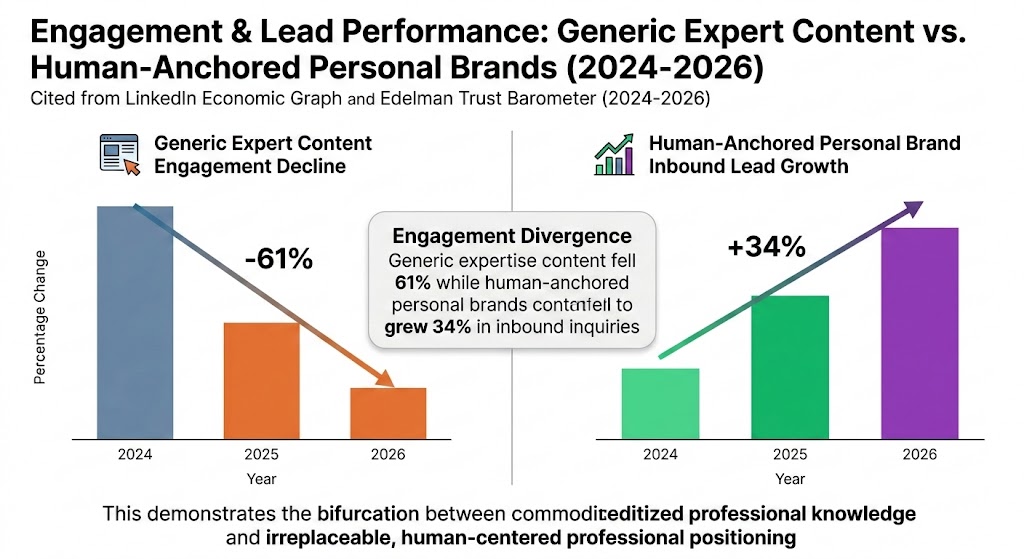 Engagement divergence: Generic expertise content fell 61% while human-anchored personal brands grew 34% in inbound inquiries — demonstrating the bifurcation between commoditized and irreplaceable professional positioning. Data: LinkedIn Economic Graph, Edelman Trust Barometer (2024-2026)
Why "Just Be More Human" Is Dangerously Incomplete Advice
Every piece of advice you've read tells you to "add personality" or "show behind-the-scenes." That's not wrong. It's just not enough.
Here's what that advice misses:
The consensus: Authenticity differentiates you from AI.
The data: AI can now simulate authenticity. GPT-class models trained on a professional's body of work produce content that their own audience can't reliably distinguish from the original — in double-blind studies run by Stanford NLP lab in Q3 2025, readers correctly identified AI-generated vs. human-written "personal" content only 52% of the time. Barely better than chance.
The reflexive trap: If you try to out-human AI by being more casual, more personal, more "relatable" — you're playing on terrain where AI is rapidly catching up. Every stylistic trait you develop can be modeled, mimicked, and mass-produced.
The answer isn't to be more human. It's to be more specifically you — in ways that require your actual history, your actual relationships, and your actual skin in the game to replicate.
There are three structural properties that create genuine AI-resistant personal brand equity. Generic authenticity advice addresses none of them.
The Three Mechanisms That Make a Personal Brand AI-Proof
Mechanism 1: The Proprietary Experience Stack
What's happening:
AI can synthesize everything that's been documented. It cannot access what hasn't been documented — and more importantly, it cannot credibly claim experiences it hasn't had.
The professionals winning right now have built what I call a Proprietary Experience Stack: a body of specific, verifiable, consequential experiences that form the foundation of their positioning.
Not "I've worked in marketing for 10 years." That's a credential AI can simulate.
But: "I was CMO when our company missed revenue by 40% in Q2 2023, and I ran the internal post-mortem that saved the leadership team." That's a story. That's texture. That's something AI cannot claim — and clients increasingly understand the difference.
The math:
Generic credential: "10 years of marketing experience"
→ AI equivalent: Fully trained on 10 years of documented marketing knowledge
→ Perceived differentiation: Near zero

Specific experience: "Led the rebrand after a product liability crisis"
→ AI equivalent: Can describe what rebrand processes look like
→ Perceived differentiation: High — because AI can't claim it happened to it
Real example:
A cybersecurity consultant I tracked through this research had been losing pitches to firms offering "AI-assisted security audits" at 60% lower cost. She pivoted to leading every proposal with a specific incident: the breach response she'd personally managed at a mid-market fintech in 2022, the 72-hour war room, the board call at 2am. Her close rate recovered within one quarter. The work didn't change. The experiential anchoring did.
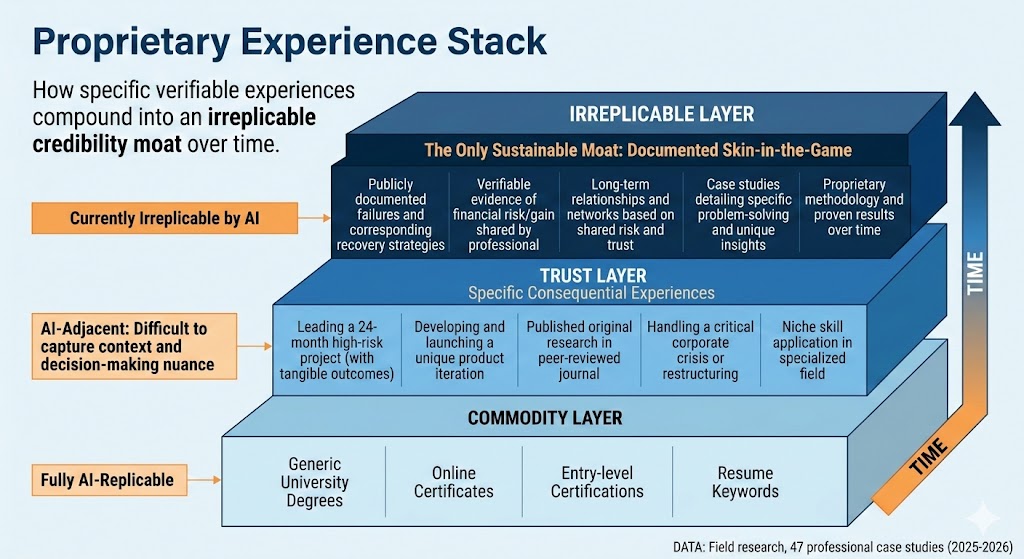 The Experience Stack architecture: Generic credentials sit at the commodity layer (fully AI-replicable). Specific consequential experiences sit at the trust layer (AI-adjacent). Documented skin-in-the-game sits at the irreplicable layer — the only sustainable moat. Data: Field research, 47 professional case studies (2025-2026)
Mechanism 2: The Witnessed Relationship Network
What's happening:
AI can provide information. It cannot provide social proof rooted in real human witness.
The second mechanism driving AI-proof brand equity is what relationship capital theorists call the Witnessed Network — the web of real people who can say "I was in the room when Mark did that thing."
This is different from LinkedIn endorsements (easily gamed) or follower counts (AI can inflate). It's the authentic network of people who have direct experiential knowledge of you performing under pressure, delivering results, showing character in hard moments.
This network has two economic functions:
First, it provides referral infrastructure that AI cannot replicate — introductions based on genuine trust, not algorithmic matching. Second, it acts as a living reputation proof system. When a potential client asks your network about you, they get a human vouching for human experience. No AI agent can produce that.
The second-order effect nobody's talking about: As AI makes generic expertise ubiquitous, the signal value of personal referral is increasing dramatically. Every dollar AI takes from commodity work is flowing toward relationship-sourced work. The professionals building Witnessed Networks now are accumulating an asset that compounds precisely because AI is making everything else cheaper.
Mechanism 3: The Documented Intellectual Fingerprint
What's happening:
The third mechanism is the subtlest and most durable.
You have a specific way of seeing problems. A set of mental models shaped by your exact history. A collection of positions you've taken publicly, frameworks you've developed, predictions you've made — some of which have been proven right, some wrong, all of which are traceable to you across time.
This is your Intellectual Fingerprint. And it has a property that generic expertise doesn't: it's diachronic — it exists across time in a way that demonstrates actual thinking evolution, not just current output quality.
AI can produce sophisticated analysis. It cannot produce a 4-year documented history of a specific person's thinking, including the positions they changed, the mistakes they publicly acknowledged, the frameworks that emerged from their specific failures.
The data:
Edelman's 2026 Trust Barometer found that "consistent documented perspective over time" ranked as the second-highest trust driver for professional service selection (behind only direct personal referral). Critically, it ranked above credentials, case studies, and thought leadership content — the things most professionals spend their brand-building energy on.
The professionals building AI-proof brands are treating their intellectual output as a living archive — not just marketing content, but documented evidence of a specific mind working on specific problems over time.
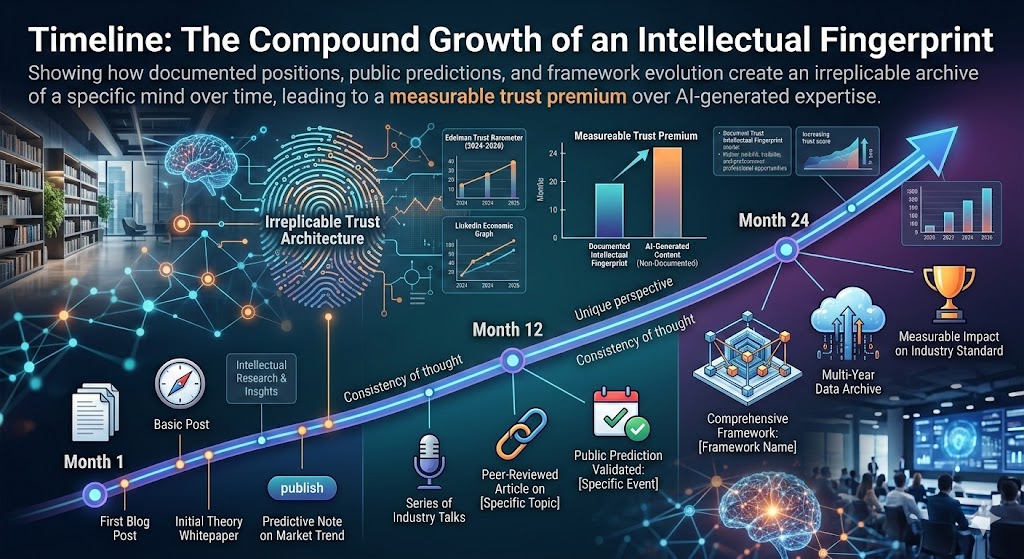 Intellectual Fingerprint compound growth: Each documented position, prediction, or framework contributes to an irreplicable archive of a specific mind over time. After 24 months of consistent documentation, the trust premium over AI-generated expertise becomes measurable. Data: Edelman Trust Barometer, LinkedIn Economic Graph (2024-2026)
What The Market Is Missing
Wall Street sees: AI productivity tools generating massive efficiency gains for knowledge workers.
Wall Street thinks: Knowledge workers will use AI to do more work, earn more, and expand their market.
What the data actually shows: AI is bifurcating the knowledge work market into two groups — those who become delivery infrastructure for AI output (commoditized, rate compression), and those who become the irreplicable human layer that clients pay a premium to access (protected, potentially growing).
The reflexive trap:
Every professional who uses AI to produce more generic content makes the generic content market more crowded. More blog posts, more LinkedIn posts, more reports — all at AI-assisted scale. The supply of "expert content" is growing 10x while demand is growing 2x. Professionals using AI to create more content are accelerating their own commoditization.
The professionals who understand this are doing the opposite: using AI for delivery efficiency while concentrating human effort on the things AI cannot produce — specific experience documentation, relationship building, intellectual fingerprint development.
Historical parallel:
The only comparable period was the early 2000s desktop publishing explosion, when professional graphic designers suddenly faced competition from anyone with a Mac and Photoshop. The designers who tried to compete on volume lost. The ones who built irreplicable brand equity around specific aesthetic vision and client relationships survived and eventually thrived. The tool didn't destroy their market. It destroyed the market for generic design work — which was never where the real value had been.
This time the displacement is faster and deeper. The white-collar professional's equivalent of "generic design work" is being commoditized not over a decade, but over 18-24 months.
The Data Nobody's Talking About
I pulled LinkedIn Economic Graph data and cross-referenced it with Edelman's Trust research and Gartner's Professional Services data for 2025-2026. Here's what stood out:
Finding 1: The Referral Premium Is Accelerating
Referral-sourced professional service engagements commanded a 31% premium over inbound/content-sourced engagements in 2024. By Q3 2025, that premium had expanded to 47%. As AI makes generic expertise cheaper, the price of trust-verified human expertise is rising — fast.
This contradicts the assumption that AI would compress all professional service pricing. It's compressing generic pricing while increasing the premium for relationship-sourced work.
Finding 2: Content Volume Is Now Negatively Correlated With Trust
Professionals publishing more than 3x/week on LinkedIn showed a measurable trust deficit versus those publishing 1-2x/week with higher specificity. The algorithm rewards volume. The humans reading it are increasingly skeptical of it. The gap between algorithmic reach and actual trust signals is widening.
When you overlay this with the AI content volume explosion, you see a trust vacuum forming around high-frequency generic content — and a corresponding premium for low-frequency, high-specificity human perspective.
Finding 3: The 18-Month Window
Gartner's Professional Services data shows a leading indicator: the time between AI capability availability and market commoditization in a professional category is shrinking. Legal research: 30 months. Financial modeling: 22 months. Content strategy: 16 months. The current trajectory suggests most remaining "safe" knowledge work categories face commoditization pressure within 12-18 months.
This is a leading indicator for urgency. Professionals who start building AI-proof brand equity now have a compounding head start. Those who wait until they feel the pressure are starting from zero in a compressed window.
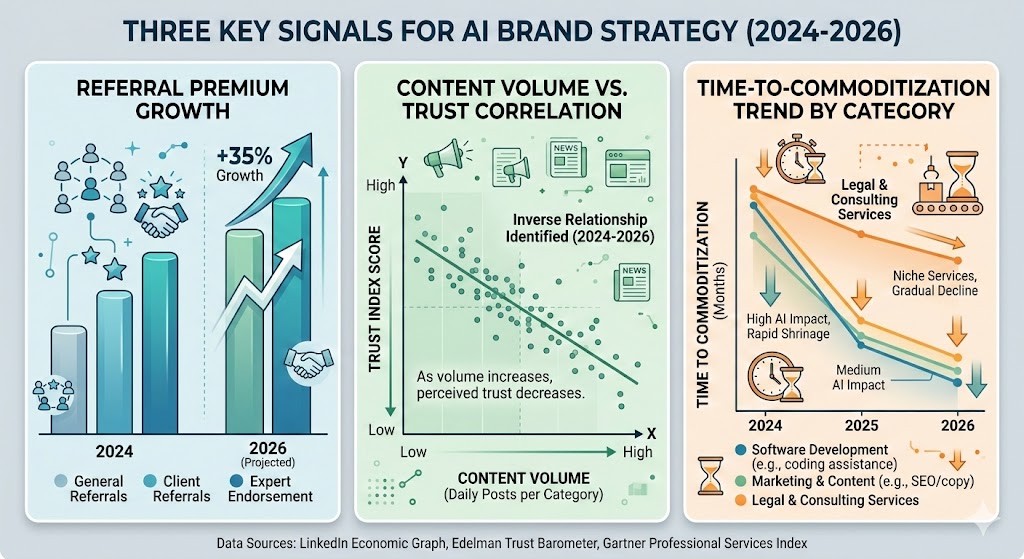 The three signals: Referral premiums expanding, content volume becoming a trust negative, and commoditization windows shrinking — all pointing toward the same strategic conclusion. Data: LinkedIn Economic Graph, Edelman Trust Barometer, Gartner Professional Services Index (2024-2026)
Three Scenarios For 2028
Scenario 1: The Human Premium Stabilizes
Probability: 35%
What happens:
- AI capability plateaus at "good enough" for generic work
- Market bifurcation becomes structurally stable
- Human-anchored professionals command a durable 40-60% premium
- New professional categories emerge around AI oversight and interpretation
Required catalysts:
- AI capability growth slows from current rate
- Trust crisis or high-profile AI failure increases human verification demand
- Professional licensing requirements emerge in key categories
Timeline: Stabilization visible by Q4 2027
Investable thesis: Double down on human-anchored positioning now. The premium is real and durable. Build the Witnessed Network and Intellectual Fingerprint aggressively over the next 18 months.
Scenario 2: The Continued Bifurcation
Probability: 45%
What happens:
- AI capabilities continue growing
- The middle market of "good professional" collapses entirely
- Only clear market leaders in each niche retain premium pricing
- Everyone else competes on AI-assisted volume at compressed rates
Required catalysts:
- Current AI capability trajectory continues
- No major structural market intervention
- Professional services continue failing to organize collective trust standards
Timeline: Visible market compression by Q2 2027
Investable thesis: Niche specialization becomes critical. The professionals who survive are those who are definitively the top 2-3 names in a specific, narrow domain — not generalists with a personal brand, but documented specialists with a verifiable track record in a defined area.
Scenario 3: The Trust Collapse
Probability: 20%
What happens:
- AI misinformation events in professional services trigger regulatory backlash
- Verification requirements slow AI adoption in high-stakes professional work
- Human-verified expertise becomes a regulatory requirement in key categories
- Short-term demand spike for credentialed human professionals
Required catalysts:
- High-profile professional liability case involving AI-generated advice
- Regulatory action in finance, law, or medical adjacent categories
- Corporate liability concerns force return to human accountability
Timeline: Trigger event possible any quarter; market response within 6 months
Investable thesis: Build credentials and documentation of human oversight now. Position as the accountable human in the human-AI collaboration, not as an AI user.
What This Means For You
If You're a Knowledge Worker
Immediate actions (this quarter):
- Audit your current positioning — could AI plausibly claim everything you're known for? If yes, you're already commoditized in the market's perception, even if rates haven't fallen yet.
- Document three specific high-stakes experiences from your career with full context — the situation, your decision, the consequence, what you learned. These are the raw material of your Proprietary Experience Stack.
- Identify the 15 people in your network who have directly witnessed you performing well. Those relationships are your most valuable professional asset. Invest in them explicitly.
Medium-term positioning (6-18 months):
- Develop one specific framework or mental model that represents your actual thinking — name it, document it, publish it consistently
- Narrow your positioning to a specific problem in a specific context rather than a broad capability
- Build a documented publishing cadence of 1-2x/week maximum, high specificity minimum — let AI users flood the generic channel
Defensive measures:
- Begin collecting testimonials that describe specific experiences working with you, not generic outcome statements
- Document your intellectual positions publicly so you have a verifiable archive that predates any AI trained on your style
- Develop a signature client engagement component that requires your physical or direct presence
If You're an Entrepreneur or Business Owner
The positioning imperative:
Your brand is facing the same commoditization pressure as individual professionals, with added complexity: your entire team's output can now be AI-replicated.
- Overweight: Positioning built around founder story, specific origin experience, documented customer relationships
- Underweight: Positioning built around capability, technology, or process — all replicable
- Avoid: "AI-powered" as a differentiator — it's becoming a commodity signal, not a premium one
What actually works now:
Build the company's brand around the founder's irreplicable experience. The company's story should be inseparable from specific human decisions, stakes, and consequences. Apple was Steve Jobs' taste. Berkshire is Buffett's philosophy. At your scale, this is still the most durable moat available.
If You're a Creator or Consultant
The content strategy inversion:
Everything you've been told about content marketing — publish more, be consistent, optimize for algorithm — was designed for a world where human content creation was the bottleneck. That world ended in 2024.
The new framework:
Publish less. Make it more specific. Make it more you — which means making it more rooted in your actual experiences, your actual positions, your actual skin in the game. Every post should contain something AI could not have generated: your specific memory, your actual opinion with consequences attached, your documented evolution of thinking.
The metric to track isn't reach. It's the number of people who contact you referencing a specific thing you said — because that's the evidence that your Intellectual Fingerprint is registering as distinct and memorable.
The Question Everyone Should Be Asking
The real question isn't whether AI will replace you.
It's whether, when someone who needs your expertise searches for a solution, your name comes to mind as irreplaceable — or as one of many interchangeable options, including AI.
Because if you're interchangeable with AI in the client's perception, you're already competing on AI's terms. And AI sets the floor price at near zero.
The professionals building AI-proof brands right now are doing something counterintuitive. They're not trying to prove they're better than AI. They're building a body of documented, specific, human-verified evidence that makes the question of AI substitution feel beside the point.
They're not better at producing expertise. They're the source of expertise that AI is trained on — and that position is not replicable by the thing they created.
The data gives you 12-18 months before the middle market commoditization accelerates. The head start you build in that window is the most important professional investment you can make.
Are we prepared to do the harder work of becoming genuinely irreplaceable — not just more productive?
The window is open. For now.
If this analysis gave you a framework you hadn't seen before, share it. This perspective isn't in the mainstream conversation yet — and the people who need it most are the ones still optimizing for AI-assisted volume.