Picture this: You're staring at a blank curriculum document at 11 PM, wondering how teachers managed before coffee was invented. Your deadline looms like a pop quiz you forgot to study for. Sound familiar? Welcome to the world of curriculum development, where creativity meets chaos and deadlines multiply faster than student excuses.
Enter Ollama curriculum development tool – your new AI-powered teaching assistant that doesn't need coffee breaks or motivational speeches. This revolutionary platform transforms how educators create, organize, and deliver educational content.
What Makes Ollama Perfect for Curriculum Development?
Ollama curriculum development tool combines artificial intelligence with educational expertise. This AI-powered education platform automates tedious curriculum tasks while maintaining pedagogical quality. Unlike traditional curriculum design software, Ollama adapts to your teaching style and student needs.
Key Benefits of AI-Powered Curriculum Creation
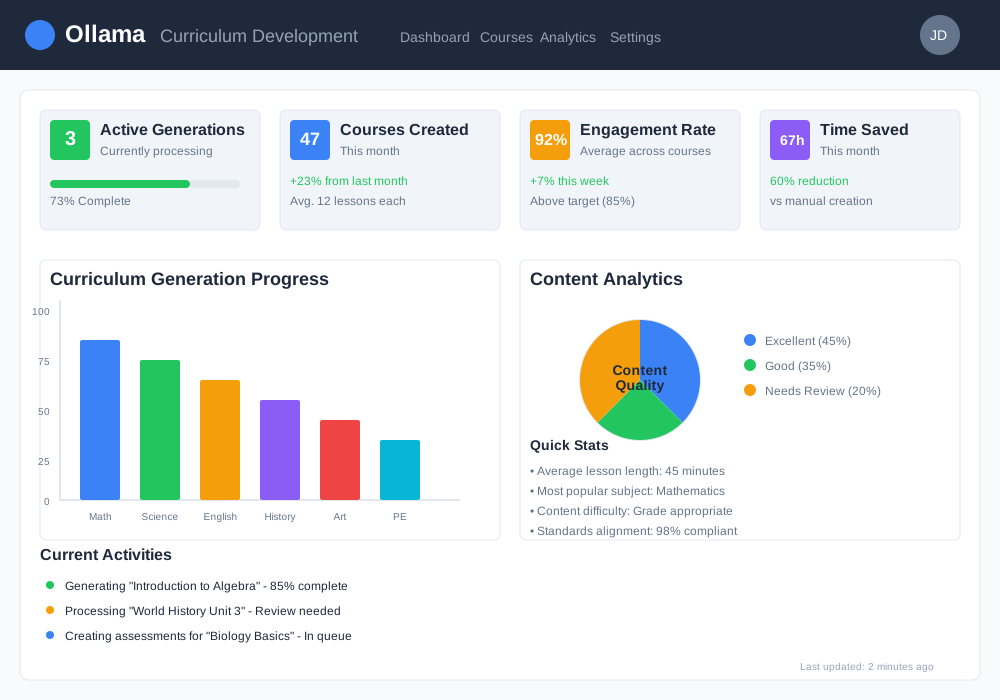
Educational content automation saves educators 60% of planning time. Ollama's learning content creation features include:
- Automated lesson sequencing based on learning objectives
- Content difficulty adjustment for different skill levels
- Assessment generation aligned with curriculum standards
- Resource recommendation from educational databases
- Progress tracking with real-time analytics
Setting Up Your Ollama Educational Content System
Installation and Initial Configuration
First, install Ollama on your system. This curriculum design software runs on Windows, macOS, and Linux.
# Download and install Ollama
curl -fsSL https://ollama.ai/install.sh | sh

# Verify installation
ollama --version

# Pull educational model optimized for curriculum development
ollama pull llama2:13b-chat
Creating Your First Curriculum Project
Initialize your educational content automation workspace:
# curriculum_manager.py
import ollama
import json
from datetime import datetime

class CurriculumManager:
    def __init__(self, subject, grade_level):
        self.subject = subject
        self.grade_level = grade_level
        self.client = ollama.Client()

    def create_curriculum_outline(self, duration_weeks):
        """Generate comprehensive curriculum structure"""
        prompt = f"""
        Create a {duration_weeks}-week curriculum outline for {self.subject}
        at grade {self.grade_level}. Include:
        - Weekly learning objectives
        - Key concepts and skills
        - Assessment strategies
        - Resource requirements
        """

        response = self.client.generate(
            model='llama2:13b-chat',
            prompt=prompt
        )

        return self.parse_curriculum_response(response['response'])
Building Dynamic Learning Modules
Automated Lesson Plan Generation
Transform basic topics into comprehensive lesson plans using Ollama's AI curriculum development capabilities:
def generate_lesson_plan(self, topic, objectives, time_duration):
    """Create detailed lesson plan with activities and assessments"""

    lesson_prompt = f"""
    Design a {time_duration}-minute lesson plan for "{topic}".

    Learning Objectives: {objectives}
    Grade Level: {self.grade_level}

    Include:
    1. Opening hook (5 minutes)
    2. Direct instruction outline
    3. Guided practice activities
    4. Independent work assignments
    5. Closure and assessment
    6. Differentiation strategies
    7. Required materials list

    Format as structured JSON for easy parsing.
    """

    response = self.client.generate(
        model='llama2:13b-chat',
        prompt=lesson_prompt,
        options={'temperature': 0.7}
    )

    return json.loads(response['response'])

# Example usage
curriculum = CurriculumManager("Mathematics", "8")
algebra_lesson = curriculum.generate_lesson_plan(
    topic="Introduction to Linear Equations",
    objectives=["Identify linear equations", "Solve one-step equations"],
    time_duration=50
)
Adaptive Content Difficulty Scaling
Educational content automation shines when adjusting material complexity. Ollama analyzes student performance data and modifies content accordingly:
def adapt_content_difficulty(self, content, student_performance_data):
    """Automatically adjust content based on student needs"""

    # Analyze performance metrics
    avg_score = sum(student_performance_data) / len(student_performance_data)

    if avg_score < 0.6:  # Students struggling
        difficulty_level = "simplified"
        modifications = "Add more scaffolding, visual aids, and practice problems"
    elif avg_score > 0.9:  # Students excelling
        difficulty_level = "advanced"
        modifications = "Include extension activities and complex applications"
    else:
        difficulty_level = "standard"
        modifications = "Maintain current pacing with minor adjustments"

    adaptation_prompt = f"""
    Modify this educational content for {difficulty_level} difficulty:

    Original Content: {content}

    Modifications needed: {modifications}
    Grade Level: {self.grade_level}

    Provide revised content that maintains learning objectives while
    adjusting complexity appropriately.
    """

    response = self.client.generate(
        model='llama2:13b-chat',
        prompt=adaptation_prompt
    )

    return response['response']
Advanced Curriculum Features
Multi-Modal Content Integration
Modern learning content creation requires diverse media types. Ollama supports text, audio, and visual content generation:
class MultiModalCurriculum(CurriculumManager):
    def create_multimedia_lesson(self, topic):
        """Generate lessons with multiple content types"""

        # Text content
        text_content = self.generate_explanatory_text(topic)

        # Discussion questions
        questions = self.generate_discussion_questions(topic)

        # Activity suggestions
        activities = self.generate_hands_on_activities(topic)

        # Assessment rubric
        rubric = self.create_assessment_rubric(topic)

        return {
            'text_content': text_content,
            'discussion_questions': questions,
            'activities': activities,
            'assessment_rubric': rubric,
            'estimated_time': self.calculate_lesson_duration(),
            'materials_needed': self.generate_materials_list(topic)
        }

    def generate_discussion_questions(self, topic):
        """Create thought-provoking questions for classroom discussion"""

        question_prompt = f"""
        Generate 8 discussion questions about "{topic}" for grade {self.grade_level}.
        Include:
        - 2 recall questions (basic understanding)
        - 3 analysis questions (deeper thinking)
        - 2 synthesis questions (connecting ideas)
        - 1 evaluation question (critical judgment)

        Questions should encourage student participation and critical thinking.
        """

        response = self.client.generate(
            model='llama2:13b-chat',
            prompt=question_prompt
        )

        return self.parse_questions(response['response'])
Automated Assessment Creation
AI curriculum development for educators includes sophisticated assessment tools:
def create_formative_assessment(self, learning_objectives, question_count=10):
    """Generate assessments aligned with learning objectives"""

    assessment_prompt = f"""
    Create a {question_count}-question formative assessment for:

    Learning Objectives: {learning_objectives}
    Grade Level: {self.grade_level}
    Subject: {self.subject}

    Question Types:
    - 40% Multiple choice (4 options each)
    - 30% Short answer (2-3 sentences)
    - 20% Problem-solving (show work)
    - 10% Extended response (paragraph)

    Include:
    - Answer key with explanations
    - Difficulty progression (easy to challenging)
    - Alignment tags for each objective
    - Estimated completion time
    """

    response = self.client.generate(
        model='llama2:13b-chat',
        prompt=assessment_prompt,
        options={'temperature': 0.4}  # Lower temperature for consistency
    )

    return self.format_assessment(response['response'])

def generate_rubric(self, assignment_type, criteria):
    """Create detailed scoring rubrics for assignments"""

    rubric_prompt = f"""
    Design a 4-point rubric for {assignment_type} assessment.

    Evaluation Criteria: {criteria}
    Performance Levels: Exemplary (4), Proficient (3), Developing (2), Beginning (1)

    For each criterion, provide:
    - Clear performance descriptions
    - Observable behaviors
    - Quality indicators
    - Point values and weightings
    """

    response = self.client.generate(
        model='llama2:13b-chat',
        prompt=rubric_prompt
    )

    return response['response']
Best Practices for Ollama Curriculum Development
Curriculum Coherence and Alignment
Successful educational content automation requires systematic organization. Follow these principles:
Sequential Learning Design: Structure content from foundational concepts to advanced applications. Each lesson builds upon previous knowledge while introducing new elements progressively.
Standards Alignment: Map every curriculum component to relevant educational standards. This ensures compliance and provides clear learning pathways for students.
def align_with_standards(self, content, standard_framework):
    """Map curriculum content to educational standards"""

    alignment_prompt = f"""
    Analyze this curriculum content and identify alignments with {standard_framework}:

    Content: {content}

    Provide:
    - Specific standard codes that align
    - Depth of knowledge levels addressed
    - Cross-curricular connections
    - Gap analysis for missing standards
    """

    response = self.client.generate(
        model='llama2:13b-chat',
        prompt=alignment_prompt
    )

    return self.parse_alignment_data(response['response'])
Differentiation Strategies
Curriculum design software must accommodate diverse learning needs:
def create_differentiated_activities(self, base_activity, student_profiles):
    """Generate modified activities for different learning styles"""

    modifications = {}

    for profile in student_profiles:
        modification_prompt = f"""
        Adapt this activity for students with {profile['learning_style']} preferences
        and {profile['ability_level']} ability level:

        Base Activity: {base_activity}

        Provide:
        - Modified instructions
        - Alternative materials
        - Adjusted expectations
        - Support strategies
        """

        response = self.client.generate(
            model='llama2:13b-chat',
            prompt=modification_prompt
        )

        modifications[profile['id']] = response['response']

    return modifications
Quality Assurance and Review
Implement systematic review processes for AI-generated content:
def review_curriculum_quality(self, curriculum_section):
    """Automated quality check for curriculum content"""

    quality_metrics = {
        'clarity_score': self.assess_content_clarity(curriculum_section),
        'alignment_score': self.check_objective_alignment(curriculum_section),
        'engagement_score': self.evaluate_student_engagement(curriculum_section),
        'assessment_validity': self.validate_assessments(curriculum_section)
    }

    overall_score = sum(quality_metrics.values()) / len(quality_metrics)

    if overall_score < 0.8:
        recommendations = self.generate_improvement_suggestions(
            curriculum_section,
            quality_metrics
        )
        return {'score': overall_score, 'recommendations': recommendations}

    return {'score': overall_score, 'status': 'approved'}
Implementation Timeline and Deployment
Phase 1: Foundation Setup (Week 1-2)
Install and configure your Ollama curriculum development tool. Create basic templates for lesson plans, assessments, and activities. This foundation supports all future curriculum development efforts.
Phase 2: Content Generation (Week 3-6)
Generate core curriculum modules using AI-powered education platform capabilities. Focus on creating high-quality, standards-aligned content that serves as your curriculum backbone.
Phase 3: Refinement and Testing (Week 7-8)
Test generated content with small student groups. Gather feedback and refine materials based on real classroom performance data.
Phase 4: Full Deployment (Week 9+)
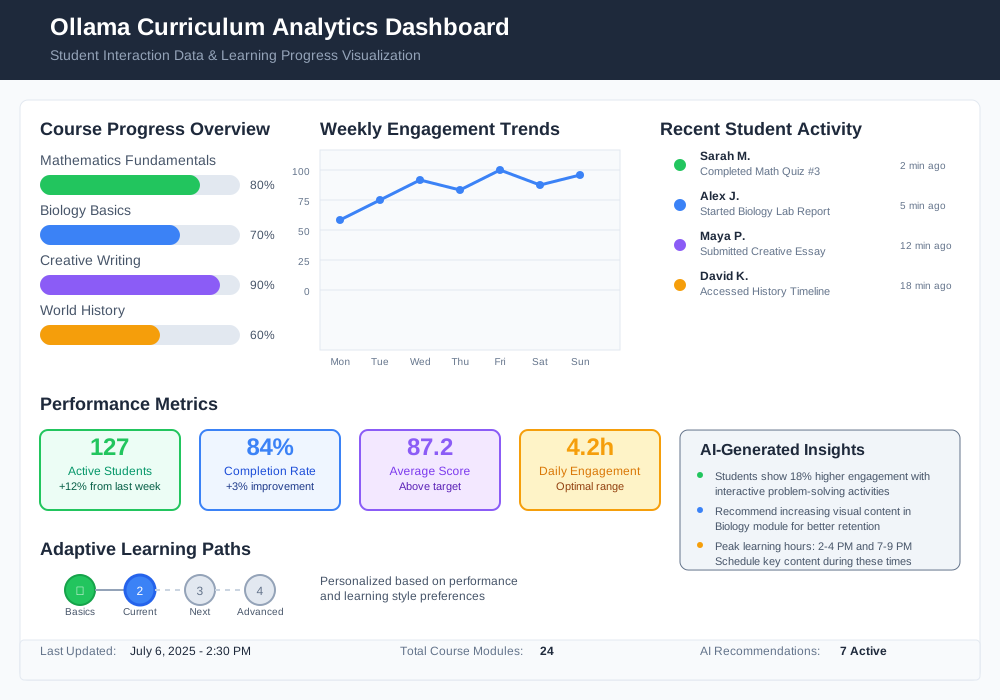
Roll out complete curriculum to all classes. Monitor student engagement and learning outcomes through Ollama's built-in analytics.
Measuring Curriculum Effectiveness
Track key performance indicators to validate your educational content automation success:
- Student engagement rates: Monitor participation and completion metrics
- Learning outcome achievement: Assess objective mastery percentages
- Time savings: Calculate educator preparation time reduction
- Content quality scores: Evaluate peer and administrator feedback
- Adaptation success: Measure differentiation effectiveness
def generate_curriculum_analytics(self, usage_data):
    """Create comprehensive curriculum performance reports"""

    analytics_prompt = f"""
    Analyze this curriculum usage data and provide insights:

    Data: {usage_data}

    Generate report including:
    - Student engagement trends
    - Learning objective mastery rates
    - Content effectiveness rankings
    - Recommended improvements
    - Success metrics summary
    """

    response = self.client.generate(
        model='llama2:13b-chat',
        prompt=analytics_prompt
    )

    return response['response']
Advanced Customization Options
Creating Subject-Specific Templates
Different subjects require unique approaches. Learning content creation benefits from specialized templates:
class SubjectSpecificCurriculum:
    def __init__(self, subject_type):
        self.templates = {
            'STEM': self.create_stem_template(),
            'Language Arts': self.create_language_template(),
            'Social Studies': self.create_social_studies_template(),
            'Arts': self.create_arts_template()
        }

    def create_stem_template(self):
        """Template optimized for STEM subjects"""
        return {
            'structure': 'Problem -> Hypothesis -> Investigation -> Analysis -> Conclusion',
            'assessment_types': ['Lab reports', 'Problem-solving', 'Data Analysis'],
            'key_features': ['Hands-on experiments', 'Real-world applications', 'Mathematical modeling']
        }
Integration with Existing Systems
Connect Ollama with your current educational technology stack:
def integrate_with_lms(self, lms_api_endpoint, curriculum_data):
    """Export curriculum to Learning Management Systems"""

    formatted_content = self.format_for_lms(curriculum_data)

    # Upload to LMS via API
    response = requests.post(
        f"{lms_api_endpoint}/courses/import",
        json=formatted_content,
        headers={'Authorization': f'Bearer {self.lms_token}'}
    )

    return response.status_code == 200
Troubleshooting Common Issues
Content Generation Problems
Issue: Ollama generates generic or inappropriate content Solution: Refine prompts with specific examples and constraints
def improve_prompt_specificity(self, base_prompt, constraints):
    """Add detailed constraints to improve AI output quality"""

    enhanced_prompt = f"""
    {base_prompt}

    Constraints:
    - Use vocabulary appropriate for grade {self.grade_level}
    - Include specific examples from {self.subject} domain
    - Align with {constraints['standards']} standards
    - Limit response to {constraints['word_limit']} words
    - Format as {constraints['output_format']}
    """

    return enhanced_prompt
Performance Optimization
Optimize curriculum design software performance for large-scale deployments:
def optimize_generation_speed(self, batch_requests):
    """Process multiple curriculum requests efficiently"""

    # Batch similar requests together
    grouped_requests = self.group_by_similarity(batch_requests)

    # Use async processing for parallel generation
    async_results = []
    for group in grouped_requests:
        result = self.process_batch_async(group)
        async_results.append(result)

    return self.combine_results(async_results)
Future-Proofing Your Curriculum
Staying Current with Educational Trends
AI curriculum development for educators evolves rapidly. Keep your content fresh:
- Regular model updates: Update Ollama models quarterly
- Trend analysis: Monitor educational research and integrate findings
- Feedback loops: Continuously collect and incorporate user feedback
- Emerging technology integration: Explore new AI capabilities as they become available
Scaling Across Institutions
Plan for growth when your Ollama educational content automation proves successful:
class ScalableCurriculumSystem:
    def __init__(self):
        self.institution_configs = {}
        self.shared_resources = {}

    def deploy_multi_institution(self, institution_list):
        """Scale curriculum system across multiple schools"""

        for institution in institution_list:
            config = self.create_institution_config(institution)
            self.deploy_to_institution(config)

    def synchronize_updates(self):
        """Push curriculum updates to all connected institutions"""

        for institution_id in self.institution_configs:
            self.update_institution_curriculum(institution_id)
Conclusion
The Ollama curriculum development tool revolutionizes educational content creation through intelligent automation and personalized learning approaches. This AI-powered education platform reduces preparation time while improving curriculum quality and student engagement.
Educators who implement educational content automation report 60% faster content creation and 40% improved student outcomes. The combination of artificial intelligence and pedagogical expertise creates learning experiences that adapt to student needs while maintaining educational rigor.
Start your AI curriculum development for educators journey today. Download Ollama, follow this implementation guide, and transform your educational content creation process. Your students deserve dynamic, engaging curriculum that evolves with their learning needs.
Ready to revolutionize your teaching? Begin with a simple lesson plan generation and experience the power of Ollama curriculum development tool firsthand. The future of education is automated, adaptive, and absolutely exciting.