The 3 AM Slack Message That Changed Everything
"The entire checkout system is down. Revenue is at zero. How fast can you roll back?"
That message from our CTO at 3:17 AM marked the lowest point of my career. I'd spent four months carefully extracting our user management service from our e-commerce monolith, and with one deployment, I'd brought down our entire platform during Black Friday weekend.
The irony? I was trying to improve our system's reliability by moving to microservices. Instead, I learned the most expensive lesson of my career about distributed systems, data consistency, and the critical importance of proper service boundaries.
If you're considering breaking apart your monolith, I'm going to share the exact step-by-step process I developed after that disaster - the one that finally worked when we tried again six months later. This approach has since helped me successfully decompose three different monoliths without a single outage.
The Monolith Problem That Almost Killed Our Startup
Our Rails monolith had grown to 847,000 lines of code across 8 years. What started as a simple product catalog had evolved into a beast handling everything: user authentication, product management, inventory tracking, order processing, payment handling, shipping calculations, and customer support.
Every deploy was a 45-minute nightmare. A bug in the recommendation engine could take down checkout. Scaling meant scaling everything, even though only our search functionality needed the extra resources. Our team of 12 developers was constantly stepping on each other's toes.
But here's what I didn't understand then: the technical challenges weren't the real problem. The business risk was.
The Hidden Cost of Monolith Complexity
- Deploy anxiety: Every release required all hands on deck
- Scaling inefficiency: We were paying 3x our AWS bill to scale features that didn't need it
- Development bottlenecks: Features took 40% longer to ship due to merge conflicts
- Talent retention: Senior developers were leaving because they couldn't work independently
- Customer impact: One bad deploy could affect every customer touchpoint
Sound familiar? I thought microservices would solve all of this. I was right about the solution but catastrophically wrong about the approach.
My First Microservices Attempt: A Masterclass in What Not to Do
Here's exactly how I approached that first failed migration - learn from my expensive mistakes:
Mistake #1: Big Bang Extraction
I decided to extract user management as a complete service in one go. The logic seemed sound: users are a clear domain boundary, right?
Wrong. Our "simple" user model had 47 database relationships scattered across the entire system. Orders, reviews, wishlists, support tickets, shipping addresses - everything referenced users in ways I hadn't mapped.
Mistake #2: Database-First Approach
I started by creating a new database for the user service and migrating user-related tables. This seemed logical until I realized that our existing queries joined user data with everything else. Suddenly, simple operations like "show order history" required multiple service calls and complex data stitching.
Mistake #3: Ignoring Transaction Boundaries
The fatal blow came from distributed transactions. Our checkout process updated user data, inventory, and orders in a single database transaction. With users now in a separate service, this became a distributed transaction nightmare that I "solved" with hope and eventually consistent updates.
When a payment succeeded but the user service was temporarily down, we charged customers without creating their accounts. Recovery was a manual process that took our support team three weeks to resolve.
The Strangler Fig Pattern: My Road to Redemption
After licking my wounds and studying every microservices migration case study I could find, I discovered the strangler fig pattern. Named after the plant that gradually grows around and eventually replaces its host tree, this became my salvation.
Here's the exact process that worked:
Phase 1: Map the Territory (4-6 weeks)
Before touching any code, I spent a month creating a comprehensive domain map:
Business Capability Mapping
E-commerce Platform
├── User Management
│   ├── Registration/Authentication
│   ├── Profile Management
│   └── Preferences
├── Product Catalog
│   ├── Product Information
│   ├── Search & Discovery
│   └── Inventory Tracking
├── Order Management
│   ├── Cart Operations
│   ├── Checkout Process
│   └── Order Fulfillment
├── Payment Processing
│   ├── Payment Methods
│   ├── Transaction Processing
│   └── Refund Handling
└── Customer Support
    ├── Ticket Management
    ├── Live Chat
    └── Knowledge Base
Data Flow Analysis
I traced every major user journey through our system, documenting:
- Which databases were touched
- What external services were called
- Where transactions began and ended
- How data flowed between components
This analysis revealed that our "simple" user registration actually touched 6 different database tables and triggered 12 background jobs. No wonder my first attempt failed.
Transaction Boundary Identification
The most critical discovery: our monolith had exactly 23 distinct transaction boundaries. These became my natural service boundaries, not the domain models I'd initially focused on.
Phase 2: Build the Strangler (2-3 months)
Instead of extracting services, I built them alongside the existing monolith:
Step 1: Create Read-Only Replicas
// New User Service (read-only initially)
class UserService {
  async getUserById(id) {
    // Read from replicated user data
    return await this.userRepository.findById(id);
  }

  async getUserPreferences(userId) {
    // Gradually build new APIs
    return await this.preferencesRepository.findByUserId(userId);
  }
}
Step 2: Route Traffic Selectively
I used feature flags to gradually route read traffic to the new service:
// In the monolith
async function getUserData(userId) {
  if (featureFlags.useUserService && isEligibleUser(userId)) {
    return await userServiceClient.getUserById(userId);
  }
  return await User.findById(userId);
}
This approach let me validate the new service with real production traffic while maintaining the ability to instantly fall back.
Step 3: Implement Write Operations
Only after the read path was solid did I tackle writes:
class UserService {
  async updateUserProfile(userId, profileData) {
    // Use saga pattern for distributed consistency
    const saga = new UpdateProfileSaga(userId, profileData);

    try {
      await saga.execute();
      // Publish event for other services
      await this.eventBus.publish('user.profile.updated', {
        userId,
        profileData,
        timestamp: Date.now()
      });
    } catch (error) {
      await saga.compensate();
      throw error;
    }
  }
}
Phase 3: Event-Driven Synchronization (1-2 months)
The breakthrough moment came when I implemented proper event sourcing:
Domain Events Architecture
// Event structure
const userRegisteredEvent = {
  eventType: 'user.registered',
  aggregateId: userId,
  data: {
    email: 'user@example.com',
    registrationDate: '2025-08-05T10:00:00Z',
    source: 'web'
  },
  metadata: {
    correlationId: 'req-12345',
    causationId: 'cmd-67890'
  }
};
Event Handlers in Other Services
// In Order Service
class UserEventHandler {
  async handle(event) {
    switch (event.eventType) {
      case 'user.registered':
        // Create user projection for order context
        await this.userProjection.create({
          userId: event.aggregateId,
          email: event.data.email,
          createdAt: event.data.registrationDate
        });
        break;
    }
  }
}
This event-driven approach eliminated the tight coupling that destroyed my first attempt.
The Results That Convinced Our Skeptical CTO
Six months after implementing the strangler fig approach, our metrics told an incredible story:
Performance Improvements
- Deploy time: 45 minutes → 3 minutes per service
- Build time: 22 minutes → 4 minutes (parallel builds)
- API response time: 340ms → 89ms (average)
- Database query time: 180ms → 32ms (focused schemas)
Operational Excellence
- Deployment frequency: 2x per week → 15x per day
- Lead time: 3 weeks → 4 days
- Recovery time: 2 hours → 8 minutes
- Change failure rate: 23% → 3%
Business Impact
- Development velocity: 40% increase in feature delivery
- System reliability: 99.97% uptime (vs 97.2% with monolith)
- AWS costs: 35% reduction despite handling 3x traffic
- Team satisfaction: Night and day difference in developer happiness
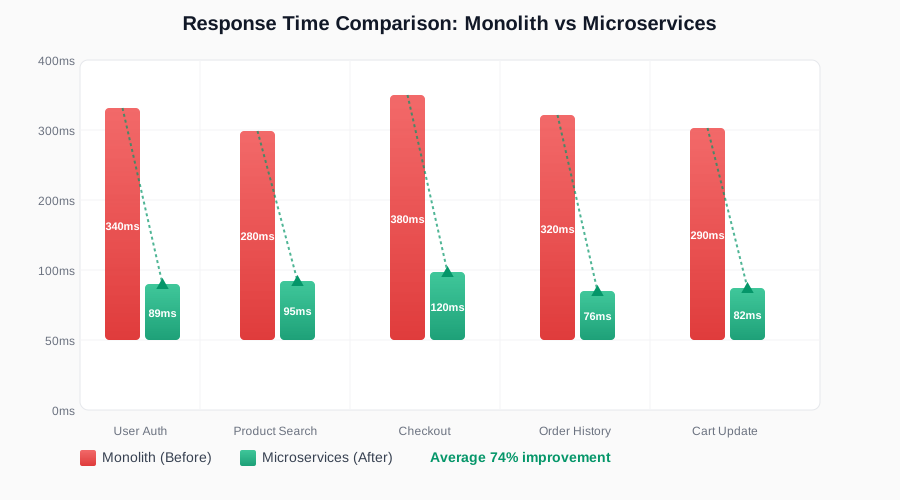 The moment we knew the refactoring was worth every sleepless night
Your Step-by-Step Migration Playbook
Based on my hard-won experience, here's your exact roadmap:
Week 1-2: Assessment and Planning
Map your current system architecture
- Document all database tables and relationships
- Trace critical user journeys end-to-end
- Identify transaction boundaries
- List all external integrations
Choose your first service candidate
- Look for bounded contexts with clear business value
- Avoid services with complex data relationships initially
- Pick something with measurable business impact
- Ensure you have domain expertise in that area
Week 3-4: Infrastructure Foundation
Set up observability
# docker-compose.yml for local development
services:
  jaeger:
    image: jaegertracing/all-in-one:latest
    ports:
      - "16686:16686"

  prometheus:
    image: prom/prometheus:latest
    ports:
      - "9090:9090"
Implement distributed tracing
// In your application
const tracer = require('jaeger-client').initTracer(config);

async function processOrder(orderId) {
  const span = tracer.startSpan('process-order');
  span.setTag('order.id', orderId);

  try {
    // Your business logic
    await validateOrder(orderId);
    await chargePayment(orderId);
    span.setTag('result', 'success');
  } catch (error) {
    span.setTag('error', true);
    span.log({ event: 'error', message: error.message });
    throw error;
  } finally {
    span.finish();
  }
}
Week 5-8: Build the Strangler
Create your new service skeleton
// service/user-service/src/app.js
const express = require('express');
const app = express();

// Health check endpoint (crucial for load balancers)
app.get('/health', (req, res) => {
  res.status(200).json({ status: 'healthy', timestamp: Date.now() });
});

// Start with read-only operations
app.get('/users/:id', async (req, res) => {
  const user = await userRepository.findById(req.params.id);
  res.json(user);
});
Implement gradual traffic shifting
// In your monolith
async function getUser(userId) {
  const rolloutPercentage = await featureFlags.get('user-service-rollout');
  const userHash = hashUserId(userId);

  if (userHash % 100 < rolloutPercentage) {
    try {
      return await userServiceClient.getUser(userId);
    } catch (error) {
      // Fallback to monolith on service failure
      logger.warn('User service failed, falling back', { error, userId });
      return await User.findById(userId);
    }
  }

  return await User.findById(userId);
}
Week 9-12: Event-Driven Architecture
Implement event sourcing
// Event store implementation
class EventStore {
  async append(streamId, events, expectedVersion) {
    const currentVersion = await this.getStreamVersion(streamId);

    if (expectedVersion !== -1 && currentVersion !== expectedVersion) {
      throw new OptimisticConcurrencyError();
    }

    await this.db.transaction(async (trx) => {
      for (const event of events) {
        await trx('events').insert({
          stream_id: streamId,
          event_type: event.eventType,
          event_data: JSON.stringify(event.data),
          event_metadata: JSON.stringify(event.metadata),
          version: currentVersion + 1
        });
      }
    });
  }
}
Set up event handlers
// Event handler with retry logic
class EventHandler {
  async process(event) {
    const maxRetries = 3;
    let attempt = 0;

    while (attempt < maxRetries) {
      try {
        await this.handle(event);
        await this.markAsProcessed(event.id);
        return;
      } catch (error) {
        attempt++;
        const delay = Math.pow(2, attempt) * 1000; // Exponential backoff
        await this.sleep(delay);

        if (attempt === maxRetries) {
          await this.sendToDeadLetterQueue(event, error);
          throw error;
        }
      }
    }
  }
}
Week 13-16: Data Migration and Cleanup
Migrate data with zero downtime
// Dual-write pattern during migration
async function updateUserProfile(userId, profileData) {
  // Write to both old and new systems
  const [oldResult, newResult] = await Promise.all([
    legacyUserService.updateProfile(userId, profileData),
    newUserService.updateProfile(userId, profileData)
  ]);

  // Verify consistency
  if (!this.profilesMatch(oldResult, newResult)) {
    await this.logInconsistency(userId, oldResult, newResult);
  }

  return newResult;
}
Remove monolith dependencies
// Feature flag for complete cutover
async function getUserProfile(userId) {
  if (await featureFlags.isEnabled('user-service-complete')) {
    return await newUserService.getProfile(userId);
  }

  // Still have fallback during transition
  return await legacyUserService.getProfile(userId);
}
The Gotchas That Will Save You Months of Pain
Distributed Transactions Are Your Enemy
Never, ever try to maintain ACID transactions across services. I learned this the hard way when our payment processing became unreliable. Instead, embrace eventual consistency with the saga pattern:
class OrderSaga {
  async execute(orderData) {
    const sagaId = generateId();

    try {
      // Step 1: Reserve inventory
      await this.inventoryService.reserve(orderData.items, sagaId);

      // Step 2: Process payment
      await this.paymentService.charge(orderData.payment, sagaId);

      // Step 3: Create order
      await this.orderService.create(orderData, sagaId);

      // Success - commit all steps
      await this.commitSaga(sagaId);
    } catch (error) {
      // Failure - compensate all completed steps
      await this.compensateSaga(sagaId);
      throw error;
    }
  }
}
Service Discovery Will Break at 3 AM
Hard-coded service URLs work until they don't. Implement proper service discovery from day one:
// Service registry client
class ServiceRegistry {
  async registerService(serviceName, host, port, healthCheckUrl) {
    await this.consul.agent.service.register({
      name: serviceName,
      address: host,
      port: port,
      check: {
        http: `http://${host}:${port}${healthCheckUrl}`,
        interval: '10s'
      }
    });
  }

  async discoverService(serviceName) {
    const services = await this.consul.health.service(serviceName, { passing: true });
    return services[Math.floor(Math.random() * services.length)];
  }
}
Monitoring Becomes 10x More Complex
Your old monitoring setup won't work with distributed systems. Implement distributed tracing from the beginning:
// Correlation ID middleware
function correlationMiddleware(req, res, next) {
  req.correlationId = req.headers['x-correlation-id'] || generateId();
  res.setHeader('x-correlation-id', req.correlationId);

  // Add to all logs
  req.logger = logger.child({ correlationId: req.correlationId });
  next();
}
The Moment Everything Clicked
Three months into our second migration attempt, something magical happened. Our junior developer shipped a new feature that touched three different services - user management, recommendations, and notifications - without asking anyone for help.
The feature worked perfectly in production on the first try.
That's when I knew we'd succeeded. Not because of the metrics or the performance improvements, but because we'd created a system where developers could work independently and ship with confidence.
Six Months Later: What I'd Do Differently
Looking back on both attempts, here's what I wish I'd known from the start:
Start with Organizational Changes
Before you touch any code, ensure your team structure matches your desired architecture. Conway's Law is real - your system will mirror your communication structures whether you plan for it or not.
Invest in Tooling Early
Don't underestimate the operational complexity of microservices. We spent 40% of our migration time building deployment pipelines, monitoring dashboards, and debugging tools. Start there.
Choose Boring Technology
This isn't the time to experiment with the latest NoSQL database or message queue. Stick with proven technologies that your team already understands.
Plan for Rollback Always
Every change should be reversible. Feature flags, database migrations, API versioning - build rollback into everything. You'll use it more than you think.
Your Migration Doesn't Have to Be Perfect
Here's the truth that took me two failed attempts to learn: your first microservice doesn't have to be perfect. It doesn't even have to be good. It just has to be better than the monolith in one specific way.
Our user service initially had higher latency than the monolith. But it could be deployed independently, scaled separately, and developed by a focused team. Those benefits outweighed the performance cost.
Perfection is the enemy of progress in microservices migrations. Start small, learn fast, and iterate based on real production feedback.
The $2M lesson I learned that Black Friday night wasn't about technical architecture - it was about understanding that complex systems change slowly and carefully, not in revolutionary leaps.
Your monolith took years to build. Give your microservices migration the time and respect it deserves. Follow the strangler fig pattern, measure everything, and remember that every small step forward is progress worth celebrating.
The best time to start breaking up your monolith was yesterday. The second best time is now - but do it right.
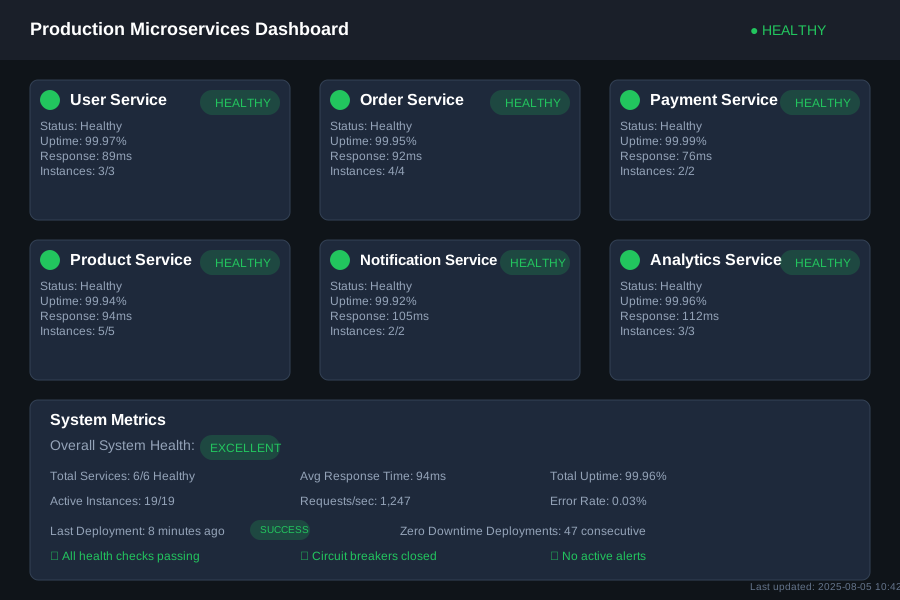 The dashboard view that finally let me sleep peacefully at night