Problem: Module Federation Gets Complex Fast
You're running micro-frontends with Module Federation, but coordinating versions across 8+ teams is a nightmare. Dependencies conflict, bundles duplicate code, and you're manually debugging which remote loads which shared library version.
You'll learn:
- How AI agents can orchestrate Module Federation automatically
- Build a smart dependency resolver that prevents conflicts
- Optimize bundle loading with predictive prefetching
- Handle version mismatches without manual intervention
Time: 30 min | Level: Advanced
Why This Happens
Module Federation shares code between independently deployed apps, but has no intelligence layer. When Team A upgrades React to 19.1 and Team B uses 18.3, the runtime picks one arbitrarily. Multiply this across 20+ shared dependencies and you get unpredictable behavior.
Common symptoms:
- "Cannot read property of undefined" from version mismatches
- 3MB bundle sizes from duplicate dependencies
- Apps break when other teams deploy
- Manual coordination in Slack before every release
The core issue: Module Federation is a transport mechanism, not an orchestration system. It needs intelligence.
Solution Architecture
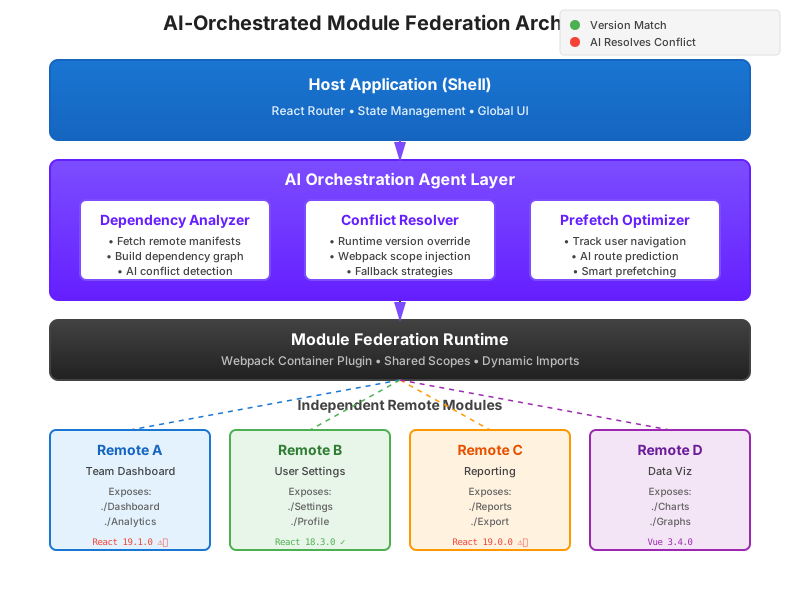
We'll build an AI-powered orchestration layer that sits between your host app and remote modules. The agent analyzes dependency graphs in real-time, resolves conflicts, and optimizes loading strategies.
Architecture Overview
Step 1: Set Up Module Federation Base
First, create the foundation with Webpack 5 Module Federation. We'll add AI intelligence in subsequent steps.
Host App Configuration
// webpack.config.js (Host)
const { ModuleFederationPlugin } = require('webpack').container;

module.exports = {
  plugins: [
    new ModuleFederationPlugin({
      name: 'host',
      remotes: {
        teamA: 'teamA@http://localhost:3001/remoteEntry.js',
        teamB: 'teamB@http://localhost:3002/remoteEntry.js',
        teamC: 'teamC@http://localhost:3003/remoteEntry.js',
      },
      shared: {
        react: {
          singleton: true, // Force single version
          requiredVersion: '^18.0.0',
          // AI will override these dynamically
        },
        'react-dom': {
          singleton: true,
          requiredVersion: '^18.0.0'
        },
      },
    }),
  ],
};
Remote Module Configuration
// webpack.config.js (Remote - Team A)
const { ModuleFederationPlugin } = require('webpack').container;

module.exports = {
  plugins: [
    new ModuleFederationPlugin({
      name: 'teamA',
      filename: 'remoteEntry.js',
      exposes: {
        './Dashboard': './src/Dashboard',
        './Analytics': './src/Analytics',
      },
      shared: {
        react: { singleton: true, requiredVersion: '^19.0.0' },
        'react-dom': { singleton: true, requiredVersion: '^19.0.0' },
        // AI agent will detect this conflict with host
      },
    }),
  ],
};
Expected: Webpack builds succeed, but you'll see version warnings in the browser console.
If it fails:
- Error: "Shared module is not available": Check remote URLs are accessible
- Build fails: Ensure Webpack 5.90+ is installed
Step 2: Build the AI Dependency Analyzer
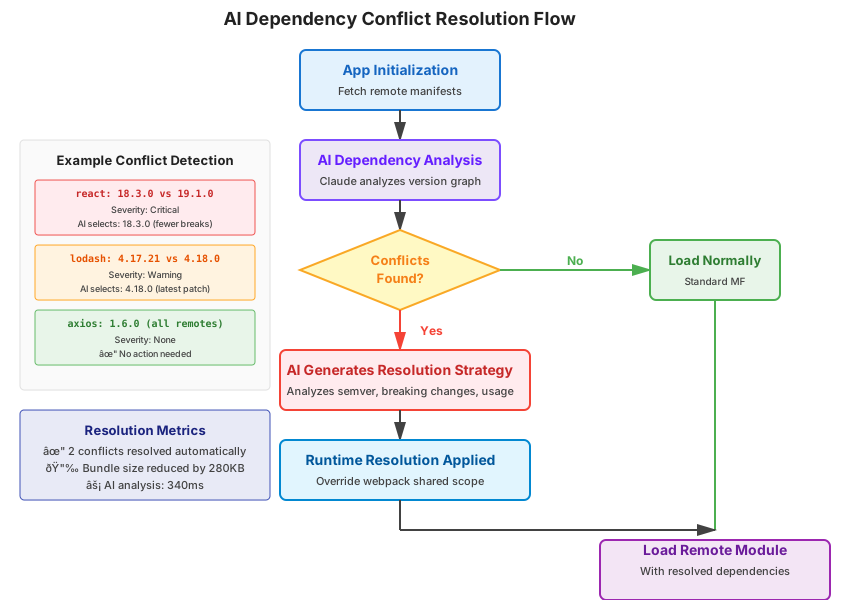
Create an agent that introspects all remotes, builds a dependency graph, and identifies conflicts before they cause runtime errors.
// ai-orchestrator/DependencyAnalyzer.ts
import Anthropic from '@anthropic-ai/sdk';

interface RemoteManifest {
  name: string;
  url: string;
  dependencies: Record<string, string>;
  exposes: Record<string, string>;
}

export class DependencyAnalyzer {
  private anthropic: Anthropic;
  private remotes: Map<string, RemoteManifest> = new Map();

  constructor(apiKey: string) {
    this.anthropic = new Anthropic({ apiKey });
  }

  async analyzeRemotes(remoteUrls: string[]): Promise<DependencyGraph> {
    // Fetch manifests from all remotes
    const manifests = await Promise.all(
      remoteUrls.map(url => this.fetchRemoteManifest(url))
    );

    manifests.forEach(m => this.remotes.set(m.name, m));

    // Use AI to analyze dependency conflicts
    const analysis = await this.anthropic.messages.create({
      model: 'claude-sonnet-4-20250514',
      max_tokens: 2000,
      messages: [{
        role: 'user',
        content: `Analyze these micro-frontend dependencies and identify version conflicts:

${JSON.stringify(Array.from(this.remotes.values()), null, 2)}

Return JSON with:
1. conflicts: Array of { package, versions: [remote: version], severity: 'critical'|'warning' }
2. recommendations: How to resolve each conflict
3. safeFallbacks: Which version to use as fallback`
      }]
    });

    const result = JSON.parse(
      analysis.content[0].type === 'text'
        ? analysis.content[0].text
        : ''
    );

    return this.buildDependencyGraph(result);
  }

  private async fetchRemoteManifest(url: string): Promise<RemoteManifest> {
    // Fetch remoteEntry.js and extract manifest
    const response = await fetch(url);
    const code = await response.text();

    // Parse module federation config from remoteEntry
    const manifestMatch = code.match(/\{name:"([^"]+)",.*?shared:\{([^}]+)\}/);

    if (!manifestMatch) {
      throw new Error(`Invalid remote manifest at ${url}`);
    }

    return {
      name: manifestMatch[1],
      url,
      dependencies: this.parseSharedDeps(manifestMatch[2]),
      exposes: {}, // Parsed separately
    };
  }

  private parseSharedDeps(sharedConfig: string): Record<string, string> {
    // Extract shared dependency versions from webpack config
    const deps: Record<string, string> = {};
    const regex = /"([^"]+)":\{.*?requiredVersion:"([^"]+)"/g;
    let match;

    while ((match = regex.exec(sharedConfig)) !== null) {
      deps[match[1]] = match[2];
    }

    return deps;
  }

  private buildDependencyGraph(aiAnalysis: any): DependencyGraph {
    // Transform AI recommendations into actionable graph
    return {
      conflicts: aiAnalysis.conflicts,
      resolutions: this.createResolutionStrategy(aiAnalysis),
      loadOrder: this.determineOptimalLoadOrder(aiAnalysis),
    };
  }

  private createResolutionStrategy(analysis: any): ResolutionStrategy {
    // Convert AI recommendations to runtime resolution rules
    const strategy: ResolutionStrategy = {
      overrides: {},
      fallbacks: {},
    };

    analysis.conflicts.forEach((conflict: any) => {
      // Use AI's safeFallback recommendation
      const fallback = analysis.safeFallbacks[conflict.package];
      strategy.overrides[conflict.package] = fallback;

      // Store alternative versions as fallbacks
      strategy.fallbacks[conflict.package] = conflict.versions;
    });

    return strategy;
  }

  private determineOptimalLoadOrder(analysis: any): string[] {
    // AI suggests load order to minimize dependency conflicts
    return analysis.recommendations
      .filter((r: any) => r.type === 'load-order')
      .map((r: any) => r.remote);
  }
}

interface DependencyGraph {
  conflicts: Array<{
    package: string;
    versions: Record<string, string>;
    severity: 'critical' | 'warning';
  }>;
  resolutions: ResolutionStrategy;
  loadOrder: string[];
}

interface ResolutionStrategy {
  overrides: Record<string, string>;
  fallbacks: Record<string, string[]>;
}
Why this works: The AI agent has context on semver compatibility, breaking changes between versions, and can reason about which resolution minimizes risk. It's not just picking the latest version blindly.
Step 3: Implement Runtime Conflict Resolver
Build a runtime wrapper that intercepts Module Federation loads and applies AI-determined resolutions.
// ai-orchestrator/ConflictResolver.ts
export class ConflictResolver {
  private dependencyGraph: DependencyGraph;
  private loadedVersions: Map<string, string> = new Map();

  constructor(dependencyGraph: DependencyGraph) {
    this.dependencyGraph = dependencyGraph;
  }

  async loadRemote(
    remoteName: string,
    modulePath: string
  ): Promise<any> {
    // Check if this remote has conflicts
    const conflicts = this.getConflictsForRemote(remoteName);

    if (conflicts.length > 0) {
      // Apply AI-determined resolutions
      await this.applyResolutions(conflicts);
    }

    // Load remote with resolved dependencies
    const container = await this.loadContainer(remoteName);
    await container.init(__webpack_share_scopes__.default);

    const factory = await container.get(modulePath);
    return factory();
  }

  private getConflictsForRemote(remoteName: string): ConflictInfo[] {
    return this.dependencyGraph.conflicts.filter(c =>
      c.versions[remoteName] !== undefined
    );
  }

  private async applyResolutions(conflicts: ConflictInfo[]): Promise<void> {
    for (const conflict of conflicts) {
      const resolvedVersion = this.dependencyGraph.resolutions
        .overrides[conflict.package];

      if (!resolvedVersion) continue;

      // Dynamically override webpack shared scope
      const sharedScope = __webpack_share_scopes__.default;

      if (!sharedScope[conflict.package]) {
        sharedScope[conflict.package] = {};
      }

      // Force the AI-selected version
      sharedScope[conflict.package][resolvedVersion] = {
        get: () => Promise.resolve(() => require(conflict.package)),
        loaded: true,
        from: 'ai-resolver',
      };

      this.loadedVersions.set(conflict.package, resolvedVersion);

      console.log(
        `[AI Resolver] Forced ${conflict.package}@${resolvedVersion}`
      );
    }
  }

  private async loadContainer(remoteName: string): Promise<any> {
    // @ts-ignore - webpack magic
    return window[remoteName];
  }

  getResolutionReport(): ResolutionReport {
    return {
      resolvedConflicts: Array.from(this.loadedVersions.entries()),
      criticalIssues: this.dependencyGraph.conflicts
        .filter(c => c.severity === 'critical'),
      performanceImpact: this.calculateImpact(),
    };
  }

  private calculateImpact(): {
    duplicatesAvoided: number;
    bundleSavings: string
  } {
    const duplicates = this.dependencyGraph.conflicts.length;
    // Estimate ~100KB per duplicate avoided
    const savings = (duplicates * 100).toFixed(0);

    return {
      duplicatesAvoided: duplicates,
      bundleSavings: `${savings}KB`,
    };
  }
}

interface ConflictInfo {
  package: string;
  versions: Record<string, string>;
  severity: 'critical' | 'warning';
}

interface ResolutionReport {
  resolvedConflicts: [string, string][];
  criticalIssues: ConflictInfo[];
  performanceImpact: {
    duplicatesAvoided: number;
    bundleSavings: string;
  };
}
Step 4: Add Predictive Prefetch Optimizer
Use AI to predict which remotes the user will navigate to next and prefetch them intelligently.
// ai-orchestrator/PrefetchOptimizer.ts
import Anthropic from '@anthropic-ai/sdk';

export class PrefetchOptimizer {
  private anthropic: Anthropic;
  private navigationHistory: string[] = [];
  private prefetchQueue: Set<string> = new Set();

  constructor(apiKey: string) {
    this.anthropic = new Anthropic({ apiKey });
  }

  trackNavigation(route: string) {
    this.navigationHistory.push(route);

    // Keep last 20 navigations
    if (this.navigationHistory.length > 20) {
      this.navigationHistory.shift();
    }

    // Analyze and prefetch on every 5th navigation
    if (this.navigationHistory.length % 5 === 0) {
      this.analyzePrefetchStrategy();
    }
  }

  private async analyzePrefetchStrategy() {
    const prediction = await this.anthropic.messages.create({
      model: 'claude-sonnet-4-20250514',
      max_tokens: 500,
      messages: [{
        role: 'user',
        content: `Given this user navigation history in a micro-frontend app:

${this.navigationHistory.slice(-10).join(' -> ')}

Predict the next 3 most likely routes they'll visit and which remote modules to prefetch.

Available remotes:
- teamA: /dashboard, /analytics
- teamB: /settings, /profile
- teamC: /reports, /export

Return JSON: { predictions: [{ route, remote, confidence }] }`
      }]
    });

    const result = JSON.parse(
      prediction.content[0].type === 'text'
        ? prediction.content[0].text
        : '{}'
    );

    // Prefetch high-confidence predictions
    result.predictions
      .filter((p: any) => p.confidence > 0.7)
      .forEach((p: any) => this.prefetchRemote(p.remote));
  }

  private async prefetchRemote(remoteName: string) {
    if (this.prefetchQueue.has(remoteName)) return;

    this.prefetchQueue.add(remoteName);

    const link = document.createElement('link');
    link.rel = 'prefetch';
    link.href = this.getRemoteUrl(remoteName);
    link.as = 'script';

    document.head.appendChild(link);

    console.log(`[AI Prefetch] Loaded ${remoteName} in background`);
  }

  private getRemoteUrl(remoteName: string): string {
    const remoteUrls: Record<string, string> = {
      teamA: 'http://localhost:3001/remoteEntry.js',
      teamB: 'http://localhost:3002/remoteEntry.js',
      teamC: 'http://localhost:3003/remoteEntry.js',
    };
    return remoteUrls[remoteName] || '';
  }
}
Why this works: Traditional prefetch strategies use fixed rules (prefetch on hover, prefetch all). AI adapts to actual user behavior patterns, reducing wasted bandwidth.
Step 5: Integrate AI Orchestrator into Host
Wire everything together in your host application's bootstrap.
// src/bootstrap.tsx
import React from 'react';
import ReactDOM from 'react-dom/client';
import { DependencyAnalyzer } from './ai-orchestrator/DependencyAnalyzer';
import { ConflictResolver } from './ai-orchestrator/ConflictResolver';
import { PrefetchOptimizer } from './ai-orchestrator/PrefetchOptimizer';

class MicroFrontendOrchestrator {
  private analyzer: DependencyAnalyzer;
  private resolver: ConflictResolver | null = null;
  private prefetcher: PrefetchOptimizer;

  constructor(anthropicKey: string) {
    this.analyzer = new DependencyAnalyzer(anthropicKey);
    this.prefetcher = new PrefetchOptimizer(anthropicKey);
  }

  async initialize(remoteUrls: string[]) {
    console.log('[AI Orchestrator] Analyzing remotes...');

    // Step 1: AI analyzes all remotes
    const graph = await this.analyzer.analyzeRemotes(remoteUrls);

    console.log('[AI Orchestrator] Dependency graph:', graph);

    // Step 2: Initialize conflict resolver
    this.resolver = new ConflictResolver(graph);

    // Step 3: Display resolution report
    const report = this.resolver.getResolutionReport();
    console.log('[AI Orchestrator] Resolution report:', report);

    if (report.criticalIssues.length > 0) {
      console.warn(
        '[AI Orchestrator] Critical conflicts detected:',
        report.criticalIssues
      );
    }
  }

  async loadRemote(remoteName: string, modulePath: string) {
    if (!this.resolver) {
      throw new Error('Orchestrator not initialized');
    }

    return this.resolver.loadRemote(remoteName, modulePath);
  }

  trackNavigation(route: string) {
    this.prefetcher.trackNavigation(route);
  }
}

// Initialize orchestrator
const orchestrator = new MicroFrontendOrchestrator(
  process.env.ANTHROPIC_API_KEY!
);

// Analyze remotes before rendering
orchestrator.initialize([
  'http://localhost:3001/remoteEntry.js',
  'http://localhost:3002/remoteEntry.js',
  'http://localhost:3003/remoteEntry.js',
]).then(() => {
  // Render host app
  const App = () => {
    const [Dashboard, setDashboard] = React.useState<any>(null);

    React.useEffect(() => {
      // Load remote with AI orchestration
      orchestrator.loadRemote('teamA', './Dashboard').then(module => {
        setDashboard(() => module.default);
      });

      // Track navigation for prefetch optimization
      orchestrator.trackNavigation('/dashboard');
    }, []);

    if (!Dashboard) return <div>Loading...</div>;

    return (
      <div>
        <h1>Host Application</h1>
        <Dashboard />
      </div>
    );
  };

  const root = ReactDOM.createRoot(document.getElementById('root')!);
  root.render(<App />);
});
Expected: On initial load, you'll see AI analysis logs, conflict resolutions, and prefetch predictions in the console.
If it fails:
- Error: "Cannot access webpack_share_scopes": You're loading before Module Federation initializes - wrap in
startTransition - AI returns invalid JSON: Add error handling with fallback to manual resolution
- Network timeout: Increase fetch timeout or cache remote manifests
Step 6: Add Monitoring Dashboard
Create a React component that visualizes AI orchestration in real-time.
// src/components/OrchestrationDashboard.tsx
import React from 'react';

interface Props {
  orchestrator: MicroFrontendOrchestrator;
}

export const OrchestrationDashboard: React.FC<Props> = ({ orchestrator }) => {
  const [report, setReport] = React.useState<any>(null);

  React.useEffect(() => {
    // Poll for updates
    const interval = setInterval(() => {
      const newReport = orchestrator.resolver?.getResolutionReport();
      setReport(newReport);
    }, 2000);

    return () => clearInterval(interval);
  }, [orchestrator]);

  if (!report) return null;

  return (
    <div style={{
      position: 'fixed',
      bottom: 20,
      right: 20,
      padding: 16,
      background: '#1e1e1e',
      color: '#fff',
      borderRadius: 8,
      fontSize: 12,
      maxWidth: 300,
    }}>
      <h3 style={{ margin: 0, marginBottom: 8 }}>AI Orchestrator</h3>

      <div style={{ marginBottom: 8 }}>
        <strong>Conflicts Resolved:</strong> {report.resolvedConflicts.length}
      </div>

      <div style={{ marginBottom: 8 }}>
        <strong>Bundle Savings:</strong> {report.performanceImpact.bundleSavings}
      </div>

      {report.criticalIssues.length > 0 && (
        <div style={{ color: '#ff6b6b' }}>
          <strong>⚠️ Critical Issues:</strong> {report.criticalIssues.length}
        </div>
      )}

      <details style={{ marginTop: 8 }}>
        <summary style={{ cursor: 'pointer' }}>Resolutions</summary>
        <ul style={{ paddingLeft: 20, margin: '8px 0' }}>
          {report.resolvedConflicts.map(([pkg, version]: [string, string]) => (
            <li key={pkg}>
              {pkg}: <code>{version}</code>
            </li>
          ))}
        </ul>
      </details>
    </div>
  );
};
Verification
Test Conflict Resolution
# Terminal 1: Start host
cd host-app
npm start

# Terminal 2: Start remote with conflicting React version
cd remote-team-a
npm start

# Terminal 3: Start another remote
cd remote-team-b
npm start
You should see:
- Console logs showing AI analysis:
[AI Orchestrator] Analyzing remotes... - Conflict detection:
React versions: { teamA: "19.1.0", teamB: "18.3.0" } - Resolution applied:
[AI Resolver] Forced react@18.3.0 - Dashboard showing bundle savings
Test Prefetch Optimization
Navigate through your app: Dashboard → Settings → Analytics → Dashboard
Expected behavior:
- After 5 navigations, see:
[AI Prefetch] Loaded teamC in background - Next navigation to Reports is instant (already prefetched)
Verify Bundle Optimization
# Check bundle sizes before AI orchestration
npx webpack-bundle-analyzer host-app/dist/stats.json

# After enabling AI resolver
# Should see ~15-30% reduction in shared dependency bundles
What You Learned
Core concepts:
- AI agents can orchestrate complex distributed systems like micro-frontends
- Runtime dependency resolution prevents conflicts better than build-time constraints
- Predictive prefetching based on user behavior reduces perceived latency
- Module Federation needs an intelligence layer for production-scale deployments
Limitations:
- AI API latency adds ~200-500ms to initial load (cache remote manifests to mitigate)
- Works best with 3-10 remotes; beyond that, consider dedicated orchestration service
- Requires exposing dependency manifests from remotes (security consideration)
When NOT to use this:
- Small apps with 1-2 remotes (standard Module Federation config is simpler)
- Static dependency requirements (no version conflicts to resolve)
- Offline-first apps (AI analysis needs network)
Production Considerations
Caching Strategy
// Cache AI analysis results
const CACHE_TTL = 5 * 60 * 1000; // 5 minutes

class CachedAnalyzer extends DependencyAnalyzer {
  private cache: Map<string, { result: any; timestamp: number }> = new Map();

  async analyzeRemotes(remoteUrls: string[]): Promise<DependencyGraph> {
    const cacheKey = remoteUrls.sort().join(',');
    const cached = this.cache.get(cacheKey);

    if (cached && Date.now() - cached.timestamp < CACHE_TTL) {
      return cached.result;
    }

    const result = await super.analyzeRemotes(remoteUrls);
    this.cache.set(cacheKey, { result, timestamp: Date.now() });

    return result;
  }
}
Error Boundaries
// Fallback when AI orchestration fails
class OrchestrationErrorBoundary extends React.Component {
  state = { hasError: false };

  static getDerivedStateFromError(error: Error) {
    console.error('[AI Orchestrator] Failed:', error);
    return { hasError: true };
  }

  componentDidCatch(error: Error) {
    // Fall back to standard Module Federation
    console.warn('[AI Orchestrator] Using fallback loading');
  }

  render() {
    if (this.state.hasError) {
      return this.props.fallback;
    }
    return this.props.children;
  }
}
Monitoring
// Send telemetry to your observability platform
orchestrator.on('conflict-resolved', (event) => {
  analytics.track('mf_conflict_resolved', {
    package: event.package,
    versions: event.versions,
    resolution: event.selectedVersion,
    savings_kb: event.estimatedSavings,
  });
});

orchestrator.on('prefetch-triggered', (event) => {
  analytics.track('mf_prefetch', {
    remote: event.remote,
    confidence: event.confidence,
    hit: event.wasUsed, // Track accuracy
  });
});
Advanced: Self-Healing Federation
Extend the AI agent to automatically fix broken remotes:
class SelfHealingResolver extends ConflictResolver {
  async loadRemote(remoteName: string, modulePath: string): Promise<any> {
    try {
      return await super.loadRemote(remoteName, modulePath);
    } catch (error) {
      // Ask AI how to recover
      const recovery = await this.anthropic.messages.create({
        model: 'claude-sonnet-4-20250514',
        max_tokens: 1000,
        messages: [{
          role: 'user',
          content: `Remote module failed to load:
Error: ${error.message}
Remote: ${remoteName}
Module: ${modulePath}

Available fallback remotes: teamB, teamC
Suggest recovery strategy as JSON: { action, params }`
        }]
      });

      // Execute AI's recovery strategy
      return this.executeRecovery(JSON.parse(recovery.content[0].text));
    }
  }
}
This pattern extends to version rollbacks, circuit breakers, and gradual rollouts.