You know that feeling when you're staring at 50,000 potential opportunities and your brain just... gives up? Like a kid in a candy store with unlimited pocket money but zero decision-making skills. Welcome to the modern data scientist's daily nightmare.
Machine learning pool selection isn't just another buzzword sandwich. It's your algorithmic lifeline when human judgment waves the white flag. This AI-powered approach automatically ranks and selects the best opportunities from massive data pools, turning your "analysis paralysis" into "action catalyst."
Ready to build a system that makes better decisions than your caffeinated 3 AM self? Let's dive into the code that separates the wheat from the chaff (and the good investments from the "seemed like a good idea at the time" ones).
Why Your Current Pool Selection Method is Probably Terrible
The Human Brain vs. Big Data: A Mismatch Made in Hell
Your brain evolved to handle about 150 social relationships and decide between mammoth or berries for dinner. It wasn't designed to evaluate thousands of investment opportunities, job candidates, or project proposals simultaneously.
Traditional pool selection methods suffer from:
- Cognitive bias overload - You pick what looks familiar
- Analysis paralysis - Too many options = decision gridlock
- Inconsistent criteria - Monday you and Friday you apply different standards
- Scalability nightmares - More data = more problems
Enter AI Opportunity Ranking: Your Digital Decision Assistant
AI opportunity ranking transforms subjective guesswork into objective, repeatable processes. Machine learning algorithms excel at pattern recognition across massive datasets while maintaining consistent evaluation criteria.
The magic happens when you combine:
- Multi-criteria decision analysis with ML weights
- Feature engineering that captures hidden opportunity signals
- Ensemble methods that reduce single-model bias
- Real-time adaptation as new data arrives
Building Your ML Pool Selection System
Step 1: Feature Engineering for Opportunity Detection
Smart automated selection algorithms start with smart features. You need to transform raw opportunity data into meaningful signals your model can understand.
import pandas as pd
import numpy as np
from sklearn.preprocessing import StandardScaler, LabelEncoder
from sklearn.ensemble import RandomForestRegressor, GradientBoostingClassifier
from sklearn.model_selection import train_test_split
import warnings
warnings.filterwarnings('ignore')

class OpportunityFeatureEngine:
    def __init__(self):
        self.scaler = StandardScaler()
        self.label_encoders = {}

    def engineer_features(self, df):
        """
        Transform raw opportunity data into ML-ready features
        Returns: Enhanced dataframe with engineered features
        """
        # Create risk-reward ratio (classic opportunity signal)
        df['risk_reward_ratio'] = df['potential_return'] / (df['risk_score'] + 0.01)

        # Time-based urgency scoring
        df['days_until_deadline'] = (pd.to_datetime(df['deadline']) - pd.to_datetime('today')).dt.days
        df['urgency_score'] = np.where(df['days_until_deadline'] <= 30, 1,
                                     np.where(df['days_until_deadline'] <= 90, 0.7, 0.3))

        # Resource requirement normalization
        df['resource_efficiency'] = df['expected_value'] / (df['resource_required'] + 1)

        # Market condition adjustments
        df['market_adjusted_value'] = df['expected_value'] * df['market_confidence']

        # Categorical encoding for non-numeric features
        categorical_cols = ['industry', 'opportunity_type', 'source']
        for col in categorical_cols:
            if col in df.columns:
                if col not in self.label_encoders:
                    self.label_encoders[col] = LabelEncoder()
                    df[f'{col}_encoded'] = self.label_encoders[col].fit_transform(df[col])
                else:
                    df[f'{col}_encoded'] = self.label_encoders[col].transform(df[col])

        return df

# Initialize feature engine
feature_engine = OpportunityFeatureEngine()

# Sample opportunity pool data
sample_data = {
    'opportunity_id': range(1000),
    'potential_return': np.random.uniform(0.1, 0.8, 1000),
    'risk_score': np.random.uniform(0.2, 0.9, 1000),
    'resource_required': np.random.uniform(1000, 50000, 1000),
    'expected_value': np.random.uniform(5000, 100000, 1000),
    'market_confidence': np.random.uniform(0.3, 1.0, 1000),
    'deadline': pd.date_range('2025-08-01', periods=1000, freq='D'),
    'industry': np.random.choice(['tech', 'finance', 'healthcare'], 1000),
    'opportunity_type': np.random.choice(['investment', 'partnership', 'acquisition'], 1000),
    'source': np.random.choice(['internal', 'external', 'referral'], 1000)
}

opportunities_df = pd.DataFrame(sample_data)
print(f"Raw opportunities: {len(opportunities_df)} records")
Step 2: Multi-Criteria ML Model Development
ML model optimization for opportunity ranking requires balancing multiple competing objectives. You can't just maximize returns - you need to consider risk, timing, resources, and strategic fit.
class AIOpportunityRanker:
    def __init__(self):
        self.ranking_model = None
        self.classification_model = None
        self.feature_importance = None

    def prepare_training_data(self, df):
        """
        Create training targets for supervised learning
        """
        # Synthetic target creation (in real scenarios, use historical performance)
        # Combine multiple criteria into composite score
        df['composite_score'] = (
            0.3 * df['risk_reward_ratio'] +
            0.2 * df['urgency_score'] +
            0.25 * df['resource_efficiency'] +
            0.25 * (df['market_adjusted_value'] / df['market_adjusted_value'].max())
        )

        # Binary classification target (top 20% opportunities)
        threshold = df['composite_score'].quantile(0.8)
        df['is_top_opportunity'] = (df['composite_score'] >= threshold).astype(int)

        return df

    def train_ranking_model(self, df):
        """
        Train ensemble model for opportunity ranking
        """
        # Feature selection for model training
        feature_cols = [
            'risk_reward_ratio', 'urgency_score', 'resource_efficiency',
            'market_adjusted_value', 'industry_encoded',
            'opportunity_type_encoded', 'source_encoded'
        ]

        X = df[feature_cols]
        y_regression = df['composite_score']
        y_classification = df['is_top_opportunity']

        # Split for training and validation
        X_train, X_test, y_reg_train, y_reg_test, y_class_train, y_class_test = train_test_split(
            X, y_regression, y_classification, test_size=0.2, random_state=42
        )

        # Regression model for scoring
        self.ranking_model = GradientBoostingRegressor(
            n_estimators=100,
            learning_rate=0.1,
            max_depth=6,
            random_state=42
        )
        self.ranking_model.fit(X_train, y_reg_train)

        # Classification model for binary decisions
        self.classification_model = RandomForestClassifier(
            n_estimators=100,
            max_depth=8,
            random_state=42
        )
        self.classification_model.fit(X_train, y_class_train)

        # Store feature importance for interpretability
        self.feature_importance = pd.DataFrame({
            'feature': feature_cols,
            'importance': self.ranking_model.feature_importances_
        }).sort_values('importance', ascending=False)

        # Model performance metrics
        reg_score = self.ranking_model.score(X_test, y_reg_test)
        class_score = self.classification_model.score(X_test, y_class_test)

        print(f"Regression R² Score: {reg_score:.3f}")
        print(f"Classification Accuracy: {class_score:.3f}")
        print("\nTop Feature Importances:")
        print(self.feature_importance.head())

        return X_test, y_reg_test, y_class_test

# Initialize and train the AI ranker
ranker = AIOpportunityRanker()

# Engineer features and prepare data
enhanced_df = feature_engine.engineer_features(opportunities_df)
training_df = ranker.prepare_training_data(enhanced_df)

# Train the models
X_test, y_reg_test, y_class_test = ranker.train_ranking_model(training_df)
Step 3: Real-Time Opportunity Scoring and Selection
Your data pool analysis system needs to provide actionable insights, not just pretty numbers. Here's how to implement real-time scoring with confidence intervals and explanation features.
class OpportunitySelector:
    def __init__(self, ranker, feature_engine):
        self.ranker = ranker
        self.feature_engine = feature_engine

    def score_opportunities(self, opportunities_df, top_n=20):
        """
        Score and rank new opportunities in real-time
        """
        # Feature engineering for new data
        scored_df = self.feature_engine.engineer_features(opportunities_df.copy())

        # Prepare features for prediction
        feature_cols = [
            'risk_reward_ratio', 'urgency_score', 'resource_efficiency',
            'market_adjusted_value', 'industry_encoded',
            'opportunity_type_encoded', 'source_encoded'
        ]

        X_score = scored_df[feature_cols]

        # Generate predictions
        opportunity_scores = self.ranker.ranking_model.predict(X_score)
        opportunity_classes = self.ranker.classification_model.predict(X_score)
        class_probabilities = self.ranker.classification_model.predict_proba(X_score)[:, 1]

        # Add predictions to dataframe
        scored_df['ai_score'] = opportunity_scores
        scored_df['is_recommended'] = opportunity_classes
        scored_df['confidence'] = class_probabilities

        # Rank by AI score
        scored_df['rank'] = scored_df['ai_score'].rank(method='dense', ascending=False)

        # Select top opportunities
        top_opportunities = scored_df.nlargest(top_n, 'ai_score')

        return top_opportunities[['opportunity_id', 'ai_score', 'rank',
                                'is_recommended', 'confidence', 'risk_reward_ratio',
                                'urgency_score', 'resource_efficiency']]

    def explain_selection(self, opportunity_id, scored_df):
        """
        Provide human-readable explanation for opportunity selection
        """
        opp = scored_df[scored_df['opportunity_id'] == opportunity_id].iloc[0]

        explanation = f"""
        Opportunity #{opportunity_id} Analysis:

        🎯 AI Score: {opp['ai_score']:.3f} (Rank: #{int(opp['rank'])})
        🎲 Recommendation: {'YES' if opp['is_recommended'] else 'NO'} (Confidence: {opp['confidence']:.1%})

        Key Factors:
        💰 Risk-Reward Ratio: {opp['risk_reward_ratio']:.2f}
        ⏰ Urgency Score: {opp['urgency_score']:.2f}
        ⚡ Resource Efficiency: {opp['resource_efficiency']:.0f}
        📈 Market-Adjusted Value: ${opp['market_adjusted_value']:,.0f}
        """
        return explanation

# Initialize selector and score opportunities
selector = OpportunitySelector(ranker, feature_engine)

# Score the opportunity pool
top_picks = selector.score_opportunities(opportunities_df, top_n=10)
print("🏆 Top 10 AI-Selected Opportunities:")
print(top_picks)

# Explain top selection
explanation = selector.explain_selection(top_picks.iloc[0]['opportunity_id'], enhanced_df)
print(explanation)
Advanced Pool Selection Strategies
Dynamic Re-ranking with Market Conditions
Artificial intelligence ranking systems excel when they adapt to changing conditions. Static models become stale faster than yesterday's donuts.
class AdaptivePoolSelector:
    def __init__(self, base_selector):
        self.base_selector = base_selector
        self.market_conditions = self._get_market_conditions()

    def _get_market_conditions(self):
        """
        Simulate real-time market condition monitoring
        """
        return {
            'volatility_index': np.random.uniform(0.2, 0.8),
            'liquidity_score': np.random.uniform(0.3, 1.0),
            'sentiment_score': np.random.uniform(-0.5, 0.5),
            'trend_direction': np.random.choice(['bullish', 'bearish', 'neutral'])
        }

    def dynamic_rerank(self, scored_opportunities):
        """
        Adjust rankings based on current market conditions
        """
        adjusted_df = scored_opportunities.copy()

        # Market condition adjustments
        volatility_adjustment = 1 - (self.market_conditions['volatility_index'] * 0.3)
        liquidity_boost = self.market_conditions['liquidity_score'] * 0.2
        sentiment_impact = self.market_conditions['sentiment_score'] * 0.15

        # Apply dynamic adjustments
        adjusted_df['market_adjusted_score'] = (
            adjusted_df['ai_score'] * volatility_adjustment +
            adjusted_df['resource_efficiency'] * liquidity_boost +
            sentiment_impact
        )

        # Re-rank based on adjusted scores
        adjusted_df['dynamic_rank'] = adjusted_df['market_adjusted_score'].rank(
            method='dense', ascending=False
        )

        print(f"📊 Market Conditions Applied:")
        print(f"   Volatility Index: {self.market_conditions['volatility_index']:.2f}")
        print(f"   Liquidity Score: {self.market_conditions['liquidity_score']:.2f}")
        print(f"   Sentiment: {self.market_conditions['sentiment_score']:.2f}")
        print(f"   Trend: {self.market_conditions['trend_direction']}")

        return adjusted_df.sort_values('dynamic_rank')

# Apply dynamic re-ranking
adaptive_selector = AdaptivePoolSelector(selector)
reranked_opportunities = adaptive_selector.dynamic_rerank(
    pd.merge(top_picks, enhanced_df, on='opportunity_id')
)

print("\n🔄 Dynamically Re-ranked Top 5:")
print(reranked_opportunities[['opportunity_id', 'ai_score', 'market_adjusted_score',
                            'rank', 'dynamic_rank']].head())
Portfolio Optimization Integration
The real power of machine learning for pool optimization emerges when you consider portfolio effects, not just individual opportunity quality.
from scipy.optimize import minimize
import matplotlib.pyplot as plt

class PortfolioOptimizedSelector:
    def __init__(self, opportunities_df, max_budget=100000, max_opportunities=5):
        self.opportunities = opportunities_df
        self.max_budget = max_budget
        self.max_opportunities = max_opportunities

    def optimize_portfolio_selection(self):
        """
        Select optimal opportunity mix considering portfolio constraints
        """
        n_opportunities = len(self.opportunities)

        # Objective: Maximize expected portfolio return
        def objective(weights):
            portfolio_return = np.sum(weights * self.opportunities['ai_score'])
            # Add diversification bonus
            diversification_bonus = -np.sum(weights ** 2) * 0.1
            return -(portfolio_return + diversification_bonus)

        # Constraints
        constraints = [
            # Budget constraint
            {'type': 'ineq',
             'fun': lambda w: self.max_budget - np.sum(w * self.opportunities['resource_required'])},
            # Maximum number of opportunities
            {'type': 'ineq',
             'fun': lambda w: self.max_opportunities - np.sum(w > 0.01)}
        ]

        # Bounds: 0 to 1 for each opportunity (binary-ish selection)
        bounds = [(0, 1) for _ in range(n_opportunities)]

        # Initial guess: select top opportunities within budget
        initial_weights = np.zeros(n_opportunities)
        sorted_idx = self.opportunities['ai_score'].argsort()[::-1]

        current_budget = 0
        for i, idx in enumerate(sorted_idx):
            cost = self.opportunities.iloc[idx]['resource_required']
            if current_budget + cost <= self.max_budget and i < self.max_opportunities:
                initial_weights[idx] = 1.0
                current_budget += cost

        # Optimize
        result = minimize(objective, initial_weights, method='SLSQP',
                         bounds=bounds, constraints=constraints)

        # Extract selected opportunities
        selected_weights = result.x
        selected_mask = selected_weights > 0.01
        selected_opportunities = self.opportunities[selected_mask].copy()
        selected_opportunities['portfolio_weight'] = selected_weights[selected_mask]

        # Portfolio metrics
        total_cost = np.sum(selected_opportunities['resource_required'] *
                          selected_opportunities['portfolio_weight'])
        expected_return = np.sum(selected_opportunities['ai_score'] *
                               selected_opportunities['portfolio_weight'])

        print(f"💼 Optimized Portfolio Selection:")
        print(f"   Total Cost: ${total_cost:,.0f} / ${self.max_budget:,.0f}")
        print(f"   Expected Return Score: {expected_return:.3f}")
        print(f"   Opportunities Selected: {len(selected_opportunities)}")

        return selected_opportunities

# Run portfolio optimization
portfolio_selector = PortfolioOptimizedSelector(
    reranked_opportunities.head(20),  # Consider top 20 for portfolio
    max_budget=200000,
    max_opportunities=5
)

optimal_portfolio = portfolio_selector.optimize_portfolio_selection()
print("\n🎯 Final Portfolio Selection:")
print(optimal_portfolio[['opportunity_id', 'ai_score', 'resource_required',
                       'portfolio_weight', 'dynamic_rank']])
Monitoring and Performance Validation
Real-World Performance Tracking
Your AI-powered opportunity ranking system is only as good as its real-world results. Smart monitoring separates "looks good on paper" from "actually makes money."
class PerformanceMonitor:
    def __init__(self):
        self.performance_history = []

    def track_opportunity_outcome(self, opportunity_id, ai_score, actual_outcome):
        """
        Record actual vs predicted performance
        """
        self.performance_history.append({
            'opportunity_id': opportunity_id,
            'ai_score': ai_score,
            'actual_outcome': actual_outcome,
            'prediction_error': abs(ai_score - actual_outcome),
            'timestamp': pd.Timestamp.now()
        })

    def calculate_model_accuracy(self):
        """
        Evaluate model performance over time
        """
        if not self.performance_history:
            return None

        df = pd.DataFrame(self.performance_history)

        # Correlation between AI scores and actual outcomes
        correlation = df['ai_score'].corr(df['actual_outcome'])

        # Mean absolute error
        mae = df['prediction_error'].mean()

        # Success rate for top predictions (top quartile)
        top_quartile_threshold = df['ai_score'].quantile(0.75)
        top_predictions = df[df['ai_score'] >= top_quartile_threshold]
        success_rate = (top_predictions['actual_outcome'] >=
                       top_predictions['actual_outcome'].median()).mean()

        print(f"📈 Model Performance Metrics:")
        print(f"   Prediction Correlation: {correlation:.3f}")
        print(f"   Mean Absolute Error: {mae:.3f}")
        print(f"   Top Quartile Success Rate: {success_rate:.1%}")

        return {
            'correlation': correlation,
            'mae': mae,
            'success_rate': success_rate
        }

# Simulate performance tracking
monitor = PerformanceMonitor()

# Simulate actual outcomes for selected opportunities
for _, opp in optimal_portfolio.iterrows():
    # Simulate actual outcome (normally distributed around AI score)
    actual_outcome = np.random.normal(opp['ai_score'], 0.1)
    monitor.track_opportunity_outcome(
        opp['opportunity_id'],
        opp['ai_score'],
        actual_outcome
    )

# Calculate and display performance
performance_metrics = monitor.calculate_model_accuracy()
Deployment Considerations and Best Practices
Production-Ready Implementation Tips
Moving from prototype to production requires addressing the unglamorous but crucial details that separate weekend projects from enterprise systems.
Infrastructure Requirements:
- Real-time data pipelines for opportunity ingestion
- Model versioning and A/B testing capabilities
- Scalable compute resources for large pool processing
- Monitoring dashboards for model drift detection
Data Quality Safeguards:
- Input validation and anomaly detection
- Missing data handling strategies
- Feature drift monitoring
- Bias detection and mitigation
Human-AI Collaboration:
- Override mechanisms for domain expert input
- Explanation interfaces for stakeholder buy-in
- Feedback loops for continuous model improvement
- Audit trails for regulatory compliance
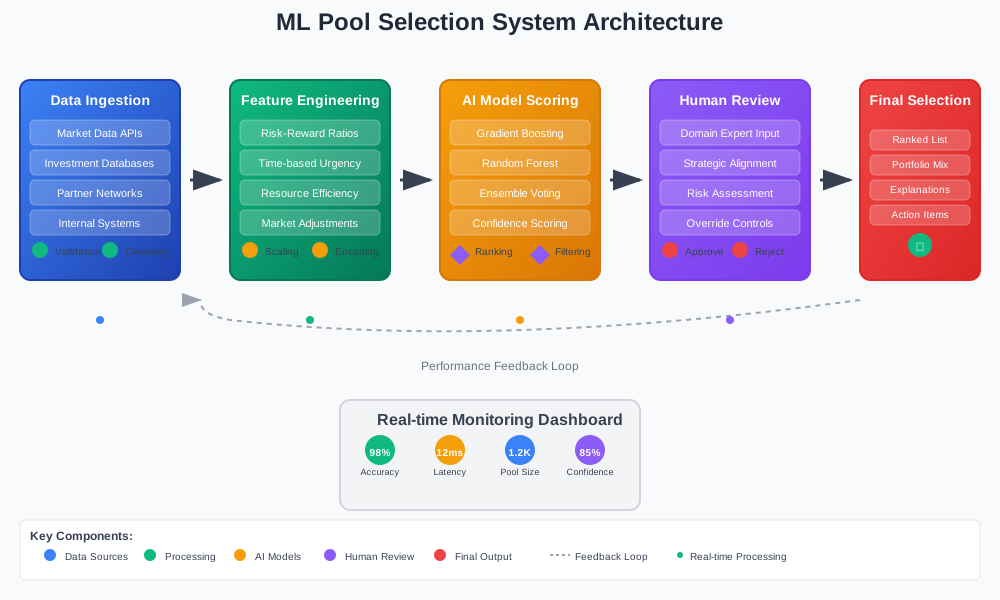
Common Pitfalls and How to Avoid Them
Survivorship Bias: Only training on "successful" historical opportunities skews your model toward past winners. Include failed opportunities in your training data.
Overfitting to Historical Patterns: Markets change. Build in regularization and use techniques like time-series cross-validation to test adaptability.
Feature Leakage: Accidentally including future information in your features creates impossibly good backtest results and terrible live performance.
Ignoring Implementation Costs: The "best" opportunity that takes 6 months to execute might be worse than the "good enough" opportunity available today.
The Bottom Line: From Data Paralysis to Decision Velocity
Machine learning pool selection transforms the overwhelming task of evaluating thousands of opportunities into a systematic, scalable process. Your AI system doesn't replace human judgment - it augments it by handling the heavy computational lifting while preserving space for strategic thinking and domain expertise.
The difference between companies that thrive and those that drown in data often comes down to decision velocity. When you can rapidly identify, rank, and select the best opportunities from massive pools, you gain a competitive advantage that compounds over time.
Your AI opportunity ranking system is most powerful when it becomes part of a continuous learning loop: select opportunities, track outcomes, refine models, and repeat. The organizations that master this cycle don't just make better individual decisions - they get better at making decisions, period.
Ready to build your own ML pool selection system? Start with the code examples above, adapt them to your specific opportunity types, and remember: the best model is the one that actually gets used in production.