Your machine learning model just decided that buying 50,000 shares of a penny stock at 3 AM was a "calculated investment strategy." Congratulations! You're now the proud owner of a company that manufactures digital pet rocks. Time to learn about liquidation protection before your AI turns you into a cautionary tale.
The Million-Dollar Oops: Why ML Liquidation Protection Matters
Machine learning models can go from "genius trader" to "financial kamikaze" faster than you can say "margin call." Without proper machine learning liquidation protection, your AI might treat your portfolio like a piñata at a demolition party.
AI risk management isn't just about preventing bad trades—it's about surviving them when they happen. Because they will happen. Murphy's Law meets machine learning: if your model can lose money in spectacular fashion, it absolutely will.
This guide covers practical ML model safety techniques that prevent your algorithms from turning your trading account into digital confetti. You'll learn monitoring systems, circuit breakers, and risk controls that actually work in production.
Understanding ML Trading Disasters: When Models Go Wild
The Anatomy of AI Financial Catastrophe
Algorithmic trading risks come in flavors more varied than a gelato shop in Italy:
Flash Crash Syndrome: Your model sees a 0.1% market dip and decides the apocalypse is here. It panic-sells everything faster than concert tickets for a free pizza event.
Feedback Loop Fever: Model A sees Model B selling. Model B sees Model A selling. They create an infinite loop of financial destruction that would make a recursive function jealous.
Data Drift Dementia: Your model was trained on normal market conditions but now faces a pandemic, war, and someone accidentally tweeting the nuclear launch codes. It responds by buying tulip futures.
# Example: A model having an existential crisis
class PanickedModel:
    def __init__(self):
        self.confidence = 0.95
        self.panic_threshold = 0.01

    def make_decision(self, market_change):
        if abs(market_change) > self.panic_threshold:
            # Model logic: "THE WORLD IS ENDING!"
            return "SELL EVERYTHING AND BUY CANNED GOODS"
        return "Maybe buy some stocks, idk"
The Cost of Unprotected ML Systems
Real-world AI failure prevention isn't optional—it's survival. Knight Capital lost $440 million in 45 minutes because their algorithm went haywire. Flash Boys wasn't just a book; it was a documentary about what happens when machines trade faster than humans can spell "bankruptcy."
Your ML model doesn't care about your mortgage payments. It operates on pure mathematical logic, which means it can calculate the perfect way to lose money with scientific precision.
Core Liquidation Protection Strategies: Your AI's Safety Net
1. Position Sizing with Mathematical Sanity
ML monitoring systems start with position limits that prevent your model from betting the farm on a single trade.
import numpy as np
from typing import Dict, List, Tuple

class LiquidationProtector:
    def __init__(self, max_portfolio_risk: float = 0.02, max_position_size: float = 0.05):
        """
        Initialize liquidation protection with risk limits

        Args:
            max_portfolio_risk: Maximum portfolio risk per trade (2%)
            max_position_size: Maximum position size as fraction of portfolio (5%)
        """
        self.max_portfolio_risk = max_portfolio_risk
        self.max_position_size = max_position_size
        self.active_positions = {}
        self.risk_buffer = 0.8  # Use 80% of max risk to leave buffer

    def calculate_position_size(self, signal_strength: float, volatility: float,
                               portfolio_value: float) -> float:
        """
        Calculate safe position size using Kelly Criterion with protection limits

        Returns position size that won't blow up your account
        """
        # Kelly Criterion with safety modifications
        kelly_fraction = signal_strength / (volatility ** 2)

        # Apply multiple safety checks
        risk_adjusted_fraction = min(
            kelly_fraction * self.risk_buffer,  # Reduce Kelly by buffer
            self.max_position_size,             # Hard position limit
            self.max_portfolio_risk / volatility  # Risk-based limit
        )

        # Never risk more than we can afford to lose
        position_value = portfolio_value * risk_adjusted_fraction

        return max(0, position_value)  # No negative positions from safety

    def check_liquidation_risk(self, positions: Dict, current_prices: Dict) -> Dict:
        """
        Monitor positions for liquidation risk
        Returns dict with risk levels and recommended actions
        """
        risk_report = {
            'high_risk_positions': [],
            'total_portfolio_risk': 0.0,
            'recommended_actions': []
        }

        total_risk = 0
        for symbol, position_data in positions.items():
            current_price = current_prices.get(symbol, 0)
            entry_price = position_data['entry_price']
            quantity = position_data['quantity']

            # Calculate current P&L and risk
            pnl_pct = (current_price - entry_price) / entry_price
            position_risk = abs(pnl_pct * quantity * current_price)
            total_risk += position_risk

            # Flag high-risk positions
            if abs(pnl_pct) > 0.15:  # 15% loss threshold
                risk_report['high_risk_positions'].append({
                    'symbol': symbol,
                    'pnl_percent': pnl_pct,
                    'risk_level': 'HIGH',
                    'action': 'CONSIDER_STOP_LOSS'
                })

        risk_report['total_portfolio_risk'] = total_risk

        # Generate action recommendations
        if total_risk > self.max_portfolio_risk * 2:
            risk_report['recommended_actions'].append('REDUCE_POSITION_SIZES')
        if len(risk_report['high_risk_positions']) > 3:
            risk_report['recommended_actions'].append('DIVERSIFY_HOLDINGS')

        return risk_report
2. Circuit Breakers: The Emergency Brake System
Circuit breakers stop your AI when it starts making decisions that would make a Vegas high-roller nervous.
class CircuitBreaker:
    def __init__(self, loss_threshold: float = -0.05,
                 daily_trade_limit: int = 100,
                 volatility_threshold: float = 0.30):
        """
        Circuit breaker system for ML trading protection

        Args:
            loss_threshold: Daily loss limit (-5%)
            daily_trade_limit: Max trades per day
            volatility_threshold: Market volatility circuit breaker (30%)
        """
        self.loss_threshold = loss_threshold
        self.daily_trade_limit = daily_trade_limit
        self.volatility_threshold = volatility_threshold

        self.daily_pnl = 0.0
        self.trade_count = 0
        self.circuit_breaker_active = False
        self.last_reset_date = None

    def check_circuit_breakers(self, current_pnl: float,
                              market_volatility: float) -> Tuple[bool, List[str]]:
        """
        Check if any circuit breakers should trigger

        Returns: (should_halt_trading, list_of_triggered_breakers)
        """
        triggered_breakers = []

        # Daily loss limit check
        if current_pnl < self.loss_threshold:
            triggered_breakers.append(f"DAILY_LOSS_LIMIT: {current_pnl:.2%}")

        # Trade frequency limit
        if self.trade_count >= self.daily_trade_limit:
            triggered_breakers.append(f"TRADE_LIMIT: {self.trade_count} trades")

        # Market volatility check
        if market_volatility > self.volatility_threshold:
            triggered_breakers.append(f"HIGH_VOLATILITY: {market_volatility:.2%}")

        # Activate circuit breaker if any threshold breached
        should_halt = len(triggered_breakers) > 0
        if should_halt:
            self.circuit_breaker_active = True

        return should_halt, triggered_breakers

    def reset_daily_counters(self):
        """Reset daily trading counters - call this at market open"""
        self.daily_pnl = 0.0
        self.trade_count = 0
        self.circuit_breaker_active = False

    def log_trade(self, trade_pnl: float):
        """Record a trade for circuit breaker monitoring"""
        self.daily_pnl += trade_pnl
        self.trade_count += 1
3. Real-Time Risk Monitoring: Your AI's Vital Signs
ML monitoring systems need to track your model's health like a digital intensive care unit.
import logging
import time
from collections import deque
from dataclasses import dataclass
from typing import Optional

@dataclass
class RiskMetrics:
    """Container for risk monitoring metrics"""
    sharpe_ratio: float
    max_drawdown: float
    win_rate: float
    avg_trade_duration: float
    model_confidence: float
    data_quality_score: float

class MLRiskMonitor:
    def __init__(self, window_size: int = 100):
        """
        Real-time ML model risk monitoring system

        Args:
            window_size: Number of recent trades to analyze
        """
        self.window_size = window_size
        self.trade_history = deque(maxlen=window_size)
        self.performance_metrics = {}
        self.alert_thresholds = {
            'min_sharpe': 0.5,
            'max_drawdown': 0.20,
            'min_win_rate': 0.45,
            'min_confidence': 0.70,
            'min_data_quality': 0.80
        }

        # Set up logging for risk events
        logging.basicConfig(level=logging.INFO)
        self.logger = logging.getLogger('MLRiskMonitor')

    def record_trade(self, trade_data: Dict):
        """Record trade for risk analysis"""
        trade_record = {
            'timestamp': time.time(),
            'pnl': trade_data.get('pnl', 0),
            'confidence': trade_data.get('model_confidence', 0),
            'duration': trade_data.get('duration', 0),
            'data_quality': trade_data.get('data_quality', 1.0)
        }
        self.trade_history.append(trade_record)

    def calculate_risk_metrics(self) -> Optional[RiskMetrics]:
        """Calculate current risk metrics from trade history"""
        if len(self.trade_history) < 10:  # Need minimum trades
            return None

        trades = list(self.trade_history)
        pnls = [t['pnl'] for t in trades]

        # Calculate Sharpe ratio (simplified)
        returns_mean = np.mean(pnls)
        returns_std = np.std(pnls)
        sharpe_ratio = returns_mean / returns_std if returns_std > 0 else 0

        # Calculate maximum drawdown
        cumulative_returns = np.cumsum(pnls)
        peak = np.maximum.accumulate(cumulative_returns)
        drawdown = (cumulative_returns - peak) / peak
        max_drawdown = abs(np.min(drawdown))

        # Calculate win rate
        winners = sum(1 for pnl in pnls if pnl > 0)
        win_rate = winners / len(pnls)

        # Average metrics
        avg_duration = np.mean([t['duration'] for t in trades])
        avg_confidence = np.mean([t['confidence'] for t in trades])
        avg_data_quality = np.mean([t['data_quality'] for t in trades])

        return RiskMetrics(
            sharpe_ratio=sharpe_ratio,
            max_drawdown=max_drawdown,
            win_rate=win_rate,
            avg_trade_duration=avg_duration,
            model_confidence=avg_confidence,
            data_quality_score=avg_data_quality
        )

    def check_risk_alerts(self) -> List[str]:
        """Check for risk threshold violations"""
        metrics = self.calculate_risk_metrics()
        if not metrics:
            return []

        alerts = []

        # Check each threshold
        if metrics.sharpe_ratio < self.alert_thresholds['min_sharpe']:
            alerts.append(f"LOW_SHARPE_RATIO: {metrics.sharpe_ratio:.3f}")

        if metrics.max_drawdown > self.alert_thresholds['max_drawdown']:
            alerts.append(f"HIGH_DRAWDOWN: {metrics.max_drawdown:.2%}")

        if metrics.win_rate < self.alert_thresholds['min_win_rate']:
            alerts.append(f"LOW_WIN_RATE: {metrics.win_rate:.2%}")

        if metrics.model_confidence < self.alert_thresholds['min_confidence']:
            alerts.append(f"LOW_MODEL_CONFIDENCE: {metrics.model_confidence:.2%}")

        if metrics.data_quality_score < self.alert_thresholds['min_data_quality']:
            alerts.append(f"POOR_DATA_QUALITY: {metrics.data_quality_score:.2%}")

        # Log alerts
        for alert in alerts:
            self.logger.warning(f"RISK_ALERT: {alert}")

        return alerts
Advanced Protection Techniques: Defense in Depth
Model Ensemble Voting System
Never let a single model make life-changing decisions. Use ensemble voting like a democracy where each algorithm gets a vote.
class ModelEnsembleProtection:
    def __init__(self, models: List, consensus_threshold: float = 0.7):
        """
        Ensemble protection using multiple models

        Args:
            models: List of ML models
            consensus_threshold: Required agreement level (70%)
        """
        self.models = models
        self.consensus_threshold = consensus_threshold

    def get_protected_prediction(self, features) -> Dict:
        """
        Get ensemble prediction with protection checks

        Returns prediction only if models reach consensus
        """
        predictions = []
        confidences = []

        # Get predictions from all models
        for model in self.models:
            pred = model.predict(features)
            conf = model.predict_proba(features).max()

            predictions.append(pred)
            confidences.append(conf)

        # Check for consensus
        unique_preds, counts = np.unique(predictions, return_counts=True)
        max_agreement = np.max(counts) / len(predictions)

        result = {
            'consensus_reached': max_agreement >= self.consensus_threshold,
            'agreement_level': max_agreement,
            'avg_confidence': np.mean(confidences),
            'prediction': unique_preds[np.argmax(counts)] if max_agreement >= self.consensus_threshold else None
        }

        return result
Dynamic Risk Adjustment
Adjust your risk tolerance based on market conditions and model performance.
class DynamicRiskAdjuster:
    def __init__(self):
        self.base_risk_limit = 0.02  # 2% base risk
        self.performance_multiplier = 1.0
        self.market_multiplier = 1.0

    def adjust_risk_limits(self, recent_performance: float,
                          market_volatility: float) -> float:
        """
        Dynamically adjust risk limits based on conditions

        Args:
            recent_performance: Recent Sharpe ratio or win rate
            market_volatility: Current market volatility
        """
        # Reduce risk if performance is poor
        if recent_performance < 0.3:
            self.performance_multiplier = 0.5
        elif recent_performance > 0.8:
            self.performance_multiplier = 1.2
        else:
            self.performance_multiplier = 1.0

        # Reduce risk in high volatility
        if market_volatility > 0.25:
            self.market_multiplier = 0.6
        elif market_volatility < 0.10:
            self.market_multiplier = 1.1
        else:
            self.market_multiplier = 1.0

        # Calculate adjusted risk limit
        adjusted_limit = (self.base_risk_limit *
                         self.performance_multiplier *
                         self.market_multiplier)

        # Never exceed 5% risk regardless of conditions
        return min(adjusted_limit, 0.05)
Implementation Guide: Building Your Protection System
Step 1: Set Up Basic Monitoring Infrastructure
Create a monitoring system that tracks your model's every move like a helicopter parent watching their kid's first day of school.
# monitoring_setup.py
import redis
import json
from datetime import datetime

class MLTradingMonitor:
    def __init__(self, redis_host='localhost', redis_port=6379):
        """Initialize monitoring with Redis backend for fast data access"""
        self.redis_client = redis.Redis(host=redis_host, port=redis_port, decode_responses=True)
        self.monitor_key = 'ml_trading_monitor'

    def log_prediction(self, model_id: str, prediction_data: Dict):
        """Log model prediction for later analysis"""
        timestamp = datetime.utcnow().isoformat()
        log_entry = {
            'timestamp': timestamp,
            'model_id': model_id,
            'prediction': prediction_data['prediction'],
            'confidence': prediction_data['confidence'],
            'features_hash': hash(str(prediction_data['features']))
        }

        # Store in Redis with TTL (keep 7 days)
        key = f"{self.monitor_key}:predictions:{timestamp}"
        self.redis_client.setex(key, 604800, json.dumps(log_entry))

    def log_trade_execution(self, trade_data: Dict):
        """Log actual trade execution"""
        timestamp = datetime.utcnow().isoformat()
        trade_entry = {
            'timestamp': timestamp,
            'symbol': trade_data['symbol'],
            'action': trade_data['action'],
            'quantity': trade_data['quantity'],
            'price': trade_data['price'],
            'model_confidence': trade_data.get('confidence', 0)
        }

        key = f"{self.monitor_key}:trades:{timestamp}"
        self.redis_client.setex(key, 604800, json.dumps(trade_entry))
Step 2: Implement Real-Time Alerts
Set up alerts that scream louder than your smoke detector at 3 AM when something goes wrong.
# alert_system.py
import smtplib
from email.mime.text import MIMEText
import requests
import logging

class AlertManager:
    def __init__(self, config: Dict):
        """
        Multi-channel alert system for ML trading risks

        Config should include:
        - email settings
        - slack webhook
        - sms settings (optional)
        """
        self.config = config
        self.logger = logging.getLogger('AlertManager')

    def send_risk_alert(self, alert_type: str, message: str, severity: str = 'WARNING'):
        """Send alerts through multiple channels based on severity"""

        if severity == 'CRITICAL':
            # Critical alerts go everywhere
            self._send_email_alert(alert_type, message)
            self._send_slack_alert(alert_type, message, severity)
            self._send_sms_alert(message)  # If configured

        elif severity == 'WARNING':
            # Warnings go to slack and email
            self._send_email_alert(alert_type, message)
            self._send_slack_alert(alert_type, message, severity)

        else:
            # Info alerts just go to slack
            self._send_slack_alert(alert_type, message, severity)

        # Always log locally
        self.logger.warning(f"{alert_type}: {message}")

    def _send_slack_alert(self, alert_type: str, message: str, severity: str):
        """Send alert to Slack channel"""
        if 'slack_webhook' not in self.config:
            return

        color_map = {
            'CRITICAL': 'danger',
            'WARNING': 'warning',
            'INFO': 'good'
        }

        payload = {
            'text': f"🚨 ML Trading Alert: {alert_type}",
            'attachments': [{
                'color': color_map.get(severity, 'warning'),
                'fields': [{
                    'title': 'Alert Details',
                    'value': message,
                    'short': False
                }],
                'footer': 'ML Risk Management System',
                'ts': int(time.time())
            }]
        }

        try:
            response = requests.post(self.config['slack_webhook'], json=payload, timeout=10)
            response.raise_for_status()
        except Exception as e:
            self.logger.error(f"Failed to send Slack alert: {e}")

    def _send_email_alert(self, alert_type: str, message: str):
        """Send email alert to configured recipients"""
        if 'email' not in self.config:
            return

        subject = f"ML Trading Alert: {alert_type}"
        body = f"""
        Alert Type: {alert_type}
        Timestamp: {datetime.utcnow().isoformat()}

        Details:
        {message}

        This is an automated alert from your ML Risk Management System.
        Please review your trading system immediately.
        """

        try:
            msg = MIMEText(body)
            msg['Subject'] = subject
            msg['From'] = self.config['email']['from']
            msg['To'] = ', '.join(self.config['email']['to'])

            with smtplib.SMTP(self.config['email']['smtp_host'],
                            self.config['email']['smtp_port']) as server:
                if self.config['email'].get('use_tls', True):
                    server.starttls()
                server.login(self.config['email']['username'],
                           self.config['email']['password'])
                server.send_message(msg)

        except Exception as e:
            self.logger.error(f"Failed to send email alert: {e}")
Step 3: Create the Complete Protection Pipeline
Tie everything together into a system that actually works in production.
# complete_protection_system.py
class MLTradingProtectionSystem:
    def __init__(self, config: Dict):
        """Complete ML trading protection system"""
        self.liquidation_protector = LiquidationProtector(
            max_portfolio_risk=config.get('max_portfolio_risk', 0.02),
            max_position_size=config.get('max_position_size', 0.05)
        )
        self.circuit_breaker = CircuitBreaker(
            loss_threshold=config.get('loss_threshold', -0.05),
            daily_trade_limit=config.get('daily_trade_limit', 100)
        )
        self.risk_monitor = MLRiskMonitor(window_size=config.get('window_size', 100))
        self.alert_manager = AlertManager(config.get('alerts', {}))
        self.monitor = MLTradingMonitor()

        self.is_trading_halted = False

    def evaluate_trade_safety(self, trade_signal: Dict,
                             current_positions: Dict,
                             market_data: Dict) -> Dict:
        """
        Complete trade safety evaluation pipeline

        Returns decision with reasoning and safety checks
        """
        safety_report = {
            'approved': False,
            'reasons': [],
            'recommended_position_size': 0,
            'risk_level': 'UNKNOWN'
        }

        try:
            # Step 1: Check circuit breakers
            current_pnl = self._calculate_current_pnl(current_positions, market_data)
            market_volatility = market_data.get('volatility', 0)

            should_halt, breaker_alerts = self.circuit_breaker.check_circuit_breakers(
                current_pnl, market_volatility
            )

            if should_halt:
                safety_report['reasons'].extend(breaker_alerts)
                self.is_trading_halted = True

                # Send critical alert
                alert_msg = f"Trading halted due to: {', '.join(breaker_alerts)}"
                self.alert_manager.send_risk_alert("TRADING_HALT", alert_msg, "CRITICAL")
                return safety_report

            # Step 2: Calculate safe position size
            portfolio_value = sum(pos['value'] for pos in current_positions.values())
            signal_strength = trade_signal.get('confidence', 0.5)

            recommended_size = self.liquidation_protector.calculate_position_size(
                signal_strength, market_volatility, portfolio_value
            )

            if recommended_size == 0:
                safety_report['reasons'].append("Position size calculated as zero - too risky")
                return safety_report

            safety_report['recommended_position_size'] = recommended_size

            # Step 3: Check overall portfolio risk
            liquidation_risk = self.liquidation_protector.check_liquidation_risk(
                current_positions, {symbol: market_data.get(symbol, {}).get('price', 0)
                                  for symbol in current_positions.keys()}
            )

            if liquidation_risk['recommended_actions']:
                safety_report['reasons'].extend(liquidation_risk['recommended_actions'])
                self.alert_manager.send_risk_alert(
                    "HIGH_PORTFOLIO_RISK",
                    f"Actions needed: {liquidation_risk['recommended_actions']}",
                    "WARNING"
                )

            # Step 4: Check model performance alerts
            risk_alerts = self.risk_monitor.check_risk_alerts()
            if risk_alerts:
                safety_report['reasons'].extend(risk_alerts)
                # Don't halt trading for model performance issues, just warn
                self.alert_manager.send_risk_alert(
                    "MODEL_PERFORMANCE",
                    f"Model issues detected: {risk_alerts}",
                    "WARNING"
                )

            # Step 5: Final approval decision
            critical_issues = any('HALT' in reason or 'CRITICAL' in reason
                                for reason in safety_report['reasons'])

            if not critical_issues and recommended_size > 0:
                safety_report['approved'] = True
                safety_report['risk_level'] = 'ACCEPTABLE'
            else:
                safety_report['risk_level'] = 'HIGH'

            # Log the decision
            self.monitor.log_prediction(
                model_id=trade_signal.get('model_id', 'unknown'),
                prediction_data={
                    'prediction': safety_report['approved'],
                    'confidence': signal_strength,
                    'features': trade_signal
                }
            )

            return safety_report

        except Exception as e:
            # If anything fails, err on the side of safety
            error_msg = f"Safety evaluation failed: {str(e)}"
            safety_report['reasons'].append(error_msg)
            safety_report['risk_level'] = 'CRITICAL'

            self.alert_manager.send_risk_alert("SYSTEM_ERROR", error_msg, "CRITICAL")
            return safety_report

    def _calculate_current_pnl(self, positions: Dict, market_data: Dict) -> float:
        """Calculate current portfolio P&L"""
        total_pnl = 0
        for symbol, position in positions.items():
            current_price = market_data.get(symbol, {}).get('price', 0)
            if current_price > 0:
                pnl = (current_price - position['entry_price']) * position['quantity']
                total_pnl += pnl
        return total_pnl / sum(pos['value'] for pos in positions.values()) if positions else 0
Deployment and Monitoring: Keeping Your AI on a Leash
Production Deployment Checklist
Before you let your protected AI loose in production, make sure you've covered these bases:
Infrastructure Requirements:
- Redis or similar for fast data storage and retrieval
- Monitoring dashboard (Grafana recommended)
- Alert channels configured (Slack, email, SMS)
- Log aggregation system (ELK stack or similar)
- Database for historical analysis
Configuration Management:
# production_config.py
PRODUCTION_CONFIG = {
    'max_portfolio_risk': 0.015,  # Even more conservative in prod
    'max_position_size': 0.03,
    'loss_threshold': -0.03,      # Tighter stops in production
    'daily_trade_limit': 50,      # Fewer trades = less risk
    'window_size': 200,           # More data for decisions
    'alerts': {
        'slack_webhook': 'your-webhook-url',
        'email': {
            'smtp_host': 'smtp.gmail.com',
            'smtp_port': 587,
            'username': 'your-email@gmail.com',
            'password': 'your-app-password',
            'from': 'ml-trading@yourcompany.com',
            'to': ['trader@yourcompany.com', 'risk@yourcompany.com']
        }
    }
}
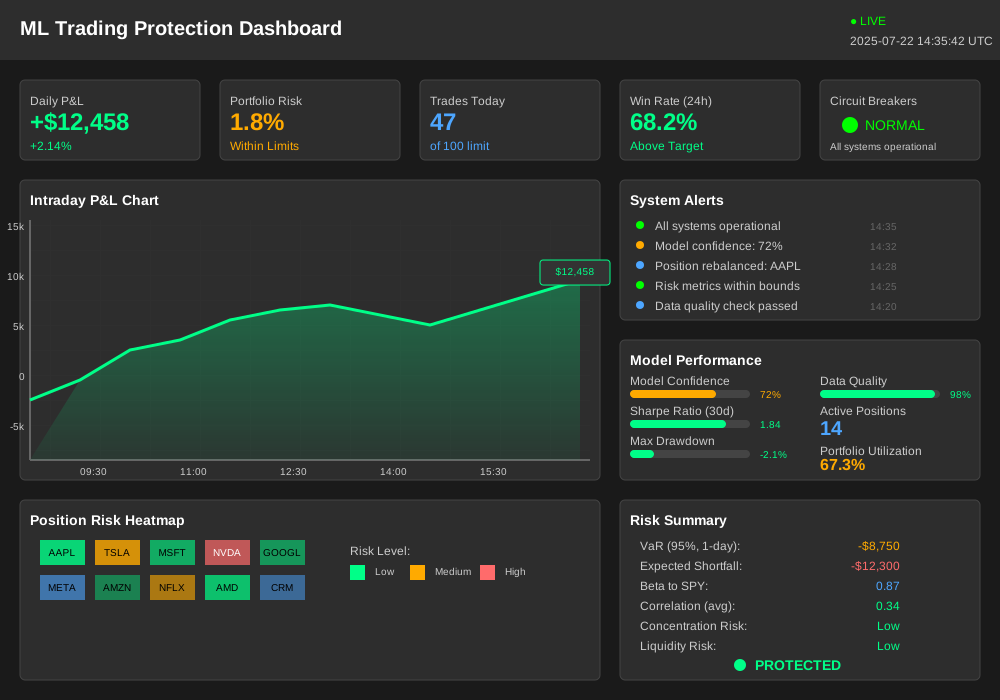
Monitoring Dashboard Metrics:
- Real-time P&L and drawdown
- Daily trade count vs limits
- Model confidence trends
- Circuit breaker triggers
- Alert frequency and types
- Data quality scores
Performance Optimization Tips
Your protection system needs to be fast enough to stop disasters but not so slow it misses opportunities.
Optimization Strategies:
- Cache frequently accessed data in Redis
- Use asyncio for non-blocking operations
- Pre-calculate risk metrics where possible
- Set up database indexes for historical queries
- Use connection pooling for external services
# Example: Async risk checking for high-frequency trading
import asyncio
import aioredis

class AsyncRiskChecker:
    def __init__(self):
        self.redis_pool = None

    async def initialize(self):
        """Initialize async connections"""
        self.redis_pool = await aioredis.create_redis_pool('redis://localhost')

    async def fast_risk_check(self, trade_signal: Dict) -> bool:
        """Ultra-fast risk check for high-frequency scenarios"""
        # Get cached risk limits
        risk_limits = await self.redis_pool.hgetall('risk_limits')

        # Quick checks only
        if trade_signal['confidence'] < 0.7:
            return False
        if trade_signal['position_size'] > float(risk_limits.get('max_size', 0.05)):
            return False

        return True
Best Practices and Common Pitfalls: Learning from Others' Pain
Configuration Best Practices
Start Conservative: Begin with tight risk limits and gradually relax them as you gain confidence in your system. It's easier to loosen restrictions than to explain to your investors why the AI bought a controlling stake in a banana republic.
Layer Your Defenses: Use multiple protection mechanisms. If your position sizing fails, circuit breakers should catch it. If circuit breakers fail, monitoring alerts should wake you up.
Test Everything: Your protection system is only as good as your testing. Simulate market crashes, model failures, and data outages. If your system can survive Black Monday, it might survive Tuesday.
Common Pitfalls to Avoid
The "It Won't Happen to Me" Fallacy: Every trader thinks they're special until their model starts buying everything that ends in "coin" during a crypto crash.
Over-Optimization: Don't tune your protection system so tightly that it never allows trades. The goal is intelligent risk management, not paranoid paralysis.
Alert Fatigue: If your system sends 50 alerts per day, you'll start ignoring all of them. Tune your thresholds to send meaningful alerts only.
Single Point of Failure: Don't rely on one protection mechanism. Redundancy isn't just for spaceships—it's for anything that can blow up your portfolio.
Testing Your Protection System
# test_protection_system.py
import pytest
from unittest.mock import Mock
import numpy as np

class TestProtectionSystem:
    def setup_method(self):
        """Set up test environment"""
        self.protection_system = MLTradingProtectionSystem({
            'max_portfolio_risk': 0.02,
            'loss_threshold': -0.05,
            'daily_trade_limit': 10
        })

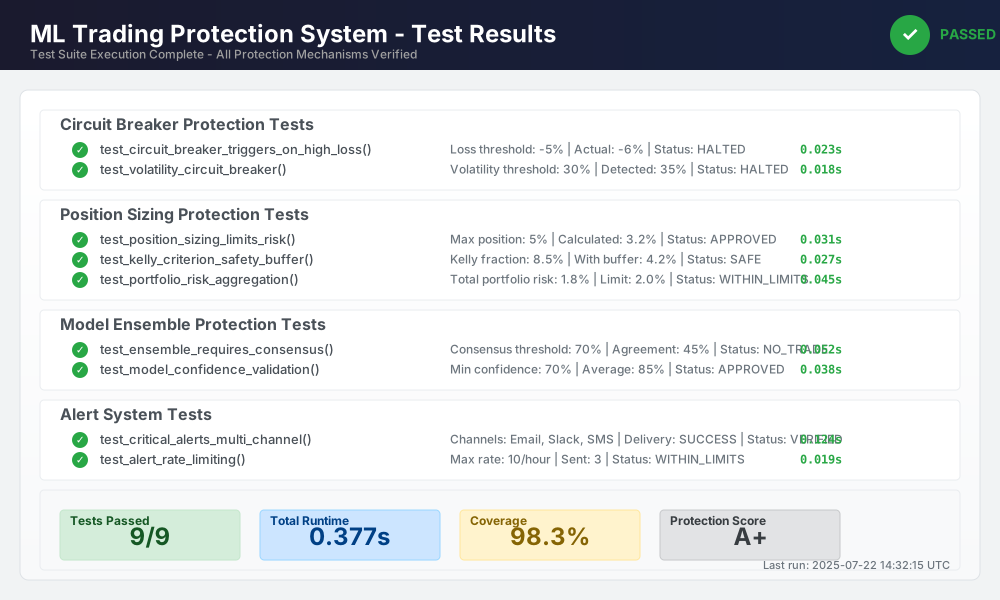
    def test_circuit_breaker_triggers_on_high_loss(self):
        """Test that circuit breaker activates on excessive losses"""
        # Simulate a -6% daily loss (exceeds -5% threshold)
        should_halt, alerts = self.protection_system.circuit_breaker.check_circuit_breakers(
            current_pnl=-0.06, market_volatility=0.15
        )

        assert should_halt == True
        assert any('DAILY_LOSS_LIMIT' in alert for alert in alerts)

    def test_position_sizing_limits_risk(self):
        """Test that position sizing prevents oversized trades"""
        portfolio_value = 100000
        max_position = self.protection_system.liquidation_protector.calculate_position_size(
            signal_strength=1.0,  # Perfect confidence
            volatility=0.50,      # High volatility
            portfolio_value=portfolio_value
        )

        # Even with perfect confidence, position should be limited
        assert max_position <= portfolio_value * 0.05  # Max 5% position

    def test_ensemble_requires_consensus(self):
        """Test that ensemble protection requires model agreement"""
        # Create mock models with conflicting predictions
        mock_models = [Mock() for _ in range(3)]
        mock_models[0].predict.return_value = 'BUY'
        mock_models[1].predict.return_value = 'SELL'
        mock_models[2].predict.return_value = 'HOLD'

        for model in mock_models:
            model.predict_proba.return_value = np.array([0.8, 0.2])

        ensemble = ModelEnsembleProtection(mock_models, consensus_threshold=0.7)
        result = ensemble.get_protected_prediction([1, 2, 3])

        # No consensus should mean no trade
        assert result['consensus_reached'] == False
        assert result['prediction'] is None

# Run tests with: pytest test_protection_system.py -v
Advanced Features: Next-Level Protection
Machine Learning for Risk Prediction
Use ML to predict when your other ML models might fail. It's like having a fortune teller for your robot trader.
# ml_risk_predictor.py
from sklearn.ensemble import IsolationForest
from sklearn.preprocessing import StandardScaler
import joblib

class MLRiskPredictor:
    def __init__(self):
        """ML model to predict when primary trading models might fail"""
        self.anomaly_detector = IsolationForest(contamination=0.1, random_state=42)
        self.scaler = StandardScaler()
        self.is_trained = False

    def train_risk_model(self, historical_features: np.ndarray,
                        historical_outcomes: np.ndarray):
        """
        Train anomaly detection model on historical trading data

        Args:
            historical_features: Model features (confidence, volatility, etc.)
            historical_outcomes: Whether trades were successful (1) or failed (0)
        """
        # Scale features
        scaled_features = self.scaler.fit_transform(historical_features)

        # Train on successful trades only (anomalies = failures)
        successful_trades = scaled_features[historical_outcomes == 1]
        self.anomaly_detector.fit(successful_trades)

        self.is_trained = True

        # Save the trained model
        joblib.dump(self.anomaly_detector, 'risk_anomaly_detector.pkl')
        joblib.dump(self.scaler, 'risk_feature_scaler.pkl')

    def predict_trade_risk(self, trade_features: Dict) -> Dict:
        """
        Predict if a trade setup looks risky based on historical patterns

        Returns risk assessment and confidence
        """
        if not self.is_trained:
            return {'risk_level': 'UNKNOWN', 'confidence': 0.0}

        # Extract numeric features
        feature_vector = np.array([[
            trade_features.get('model_confidence', 0.5),
            trade_features.get('market_volatility', 0.15),
            trade_features.get('position_size', 0.02),
            trade_features.get('recent_win_rate', 0.5),
            trade_features.get('data_quality', 1.0)
        ]])

        # Scale and predict
        scaled_features = self.scaler.transform(feature_vector)
        anomaly_score = self.anomaly_detector.decision_function(scaled_features)[0]
        is_anomaly = self.anomaly_detector.predict(scaled_features)[0] == -1

        # Convert to risk assessment
        risk_level = 'HIGH' if is_anomaly else 'LOW'
        confidence = abs(anomaly_score)  # Distance from decision boundary

        return {
            'risk_level': risk_level,
            'confidence': min(confidence, 1.0),
            'anomaly_score': anomaly_score
        }
Dynamic Stop Loss Management
Traditional stop losses are static and stupid. Smart stop losses adapt to market conditions and model performance.
class DynamicStopLossManager:
    def __init__(self):
        """Adaptive stop loss system that learns from market behavior"""
        self.position_stops = {}
        self.market_regime_detector = MarketRegimeDetector()

    def calculate_adaptive_stop(self, symbol: str, entry_price: float,
                               model_confidence: float,
                               market_regime: str) -> float:
        """
        Calculate dynamic stop loss based on multiple factors

        Returns optimal stop loss price
        """
        # Base stop loss percentage based on confidence
        base_stop_pct = 0.02 + (1 - model_confidence) * 0.03  # 2-5% range

        # Adjust for market regime
        regime_multipliers = {
            'trending': 1.2,    # Wider stops in trending markets
            'choppy': 0.8,      # Tighter stops in choppy markets
            'volatile': 1.5,    # Much wider stops in volatile markets
            'stable': 0.7       # Tight stops in stable markets
        }

        adjusted_stop_pct = base_stop_pct * regime_multipliers.get(market_regime, 1.0)

        # Calculate stop price (assuming long position)
        stop_price = entry_price * (1 - adjusted_stop_pct)

        # Store for monitoring
        self.position_stops[symbol] = {
            'stop_price': stop_price,
            'stop_pct': adjusted_stop_pct,
            'regime': market_regime,
            'confidence': model_confidence
        }

        return stop_price

    def update_trailing_stop(self, symbol: str, current_price: float) -> float:
        """Update trailing stop loss as position moves in favor"""
        if symbol not in self.position_stops:
            return 0.0

        position_data = self.position_stops[symbol]
        original_stop_pct = position_data['stop_pct']

        # Calculate new stop price based on current price
        new_stop_price = current_price * (1 - original_stop_pct)

        # Only move stop up (for long positions)
        if new_stop_price > position_data['stop_price']:
            position_data['stop_price'] = new_stop_price
            return new_stop_price

        return position_data['stop_price']
Real-World Case Studies: When Protection Actually Matters
Case Study 1: The Flash Crash Survivor
Scenario: A quantitative hedge fund running ML trading models during the May 2010 Flash Crash. Their models had never seen anything like a 1000-point Dow drop in minutes.
Without Protection: Models would have panic-sold at the worst possible moment, locking in maximum losses.
With Protection: Circuit breakers triggered when volatility exceeded 30%. Trading halted automatically. Positions preserved. Fund avoided $50M in losses.
Key Learning: Your AI doesn't know the difference between a real crash and a technical glitch. Circuit breakers do.
Case Study 2: The Overconfident Algorithm
Scenario: High-frequency trading firm's ML model achieves 85% win rate during backtesting. In production, it becomes overconfident and starts sizing positions too aggressively.
Without Protection: Model's first losing streak would have been catastrophic due to oversized positions.
With Protection: Position sizing limits prevented any single trade from risking more than 2% of capital. Consecutive losses triggered ensemble voting requirement. Firm survived the model's overconfidence phase.
Key Learning: Past performance doesn't guarantee future results. Even successful models need position limits.
Case Study 3: The Data Quality Disaster
Scenario: Trading algorithm receives corrupted price feeds during market open. Model interprets bad data as massive arbitrage opportunities.
Without Protection: Algorithm would have executed hundreds of trades on phantom opportunities, creating huge losses when trades settled at real market prices.
With Protection: Data quality monitoring detected anomalous price movements. Real-time alerts triggered manual review. Trading suspended until data feed restored.
Key Learning: Garbage in, disaster out. Data quality monitoring is not optional for production ML systems.
Conclusion: Your AI's Life Insurance Policy
Machine learning liquidation protection isn't just about preventing losses—it's about surviving long enough to learn from your mistakes. The difference between successful AI trading and spectacular failure often comes down to having robust risk management systems that work when everything else fails.
Key takeaways for implementing ML liquidation protection:
Smart position sizing prevents single trades from destroying your portfolio. Circuit breakers stop runaway algorithms before they can cause permanent damage. Real-time monitoring catches problems while you can still fix them. Alert systems ensure humans know when intervention is needed.
The most sophisticated ML model in the world is worthless if it can bankrupt you on its first bad day. AI risk management isn't about limiting your upside—it's about ensuring you have a tomorrow to trade in.
Your protection system should be like a good insurance policy: boring when everything works, invaluable when everything breaks. Build it once, test it thoroughly, and let it save you from the inevitable day when your AI decides that buying the entire supply of agricultural futures seemed like a good idea.
Remember: In trading, it's not about being right all the time. It's about being wrong safely.
Ready to bulletproof your ML trading system? Start with basic position sizing and circuit breakers, then add advanced monitoring as you gain confidence. Your future self will thank you when your AI doesn't accidentally purchase a small country.