The most in-demand job title of Q4 2025 wasn't AI Engineer.
It was AI Behavior Specialist — a role that didn't exist three years ago, pays $180K base, and requires zero lines of code.
LinkedIn's Economic Graph data shows postings for this title surged 340% year-over-year. The qualification listed most often: a background in cognitive psychology or behavioral economics.
Meanwhile, entry-level software engineering postings fell 62% over the same period. The median salary for a junior developer dropped below $70K for the first time since 2014.
We are not in a coding shortage. We are in a human understanding shortage. And the gap is widening fast.
Why the "Learn to Code" Advice Is Now Actively Harmful
For fifteen years, the career gospel was simple: learn to code and you'll be economically safe.
That gospel just became dangerous misinformation.
The consensus: Technical skills are durable because they're hard to acquire and in constant demand.
The data: GitHub Copilot, Claude, and GPT-4o now complete or generate 73% of routine code tasks according to a January 2026 JetBrains developer survey. Entry-level programming roles — the jobs people spent two years in bootcamps training for — are disappearing at a rate that makes retail automation look slow.
Why it matters: Millions of people are still being funneled into coding bootcamps, CS degrees, and "learn Python" courses based on economic advice that was accurate in 2019 and is quietly catastrophic in 2026. The credential is real. The job market it was built for is gone.
The skills that are gaining salary premium right now are not technical. They are deeply, irreducibly human.
The Three Mechanisms Driving the Psychology Premium
Mechanism 1: The Alignment Gap
Every AI deployment has the same failure point: the model doesn't understand what humans actually want — not what they say they want, but the underlying need driving the request.
A lawyer asks an AI to draft a settlement letter. The AI produces a letter that is legally precise and emotionally catastrophic for the negotiation. The AI optimized for correctness. The lawyer needed leverage.
The math:
Company deploys AI for customer service
→ Deflection rate rises 40%, CSAT drops 22%
→ Discovers AI can't read escalating emotional subtext
→ Hires human "AI Escalation Specialists" at 1.5x previous CSR salary
→ Net headcount stays same, skill profile inverts entirely
This pattern is repeating across legal, healthcare, financial services, and HR. AI handles volume. Humans handle the situations where misreading a person costs the company its relationship, its reputation, or its liability exposure.
The workers who understand human motivation, emotional regulation, and cognitive bias are not competing with AI. They are the quality control layer above it.
Mechanism 2: The Trust Architecture Problem
AI can persuade through information. It cannot create trust through presence.
This distinction sounds philosophical until you see the sales data. A 2025 Gartner study of 2,400 B2B deals found that deals over $250K closed at a 34% higher rate when a human with "high emotional intelligence" scores was involved in the final two touchpoints — even when all prior communication was AI-assisted.
The explanation isn't romantic. It's neurological. Human trust formation evolved over hundreds of thousands of years of face-to-face social assessment. People detect micro-signals of authenticity, consistency, and shared experience that no current model reliably replicates. In high-stakes transactions — medical decisions, large purchases, legal agreements, hiring — buyers are subconsciously running threat detection that AI consistently fails.
The implication for the labor market is profound: every organization that automates its customer-facing functions is simultaneously creating a premium market for the humans who can close the trust gap AI leaves open.
Mechanism 3: The Organizational Immune Response
Here is the mechanism nobody is talking about publicly.
As AI penetrates organizations, internal decision-making is becoming more politically complex, not less. When a model recommends a restructuring, a pricing change, or a layoff plan, every stakeholder reads the same output and starts asking: whose agenda trained this model?
AI recommendations land differently than human recommendations. They trigger organizational antibodies — committees, audits, override protocols — that slow implementation and generate friction. The people who can move AI outputs through human organizational systems without triggering those antibodies are now among the most valuable employees in the building.
This requires understanding power dynamics, cognitive biases in leadership, resistance psychology, and what behavioral economists call "status quo bias at institutional scale." These are not skills you learn in a data science bootcamp. They are skills you learn by studying how humans actually make decisions under uncertainty — which is the core curriculum of applied psychology.
"The bottleneck in every AI transformation we've observed isn't the technology. It's the human system the technology has to move through."
— MIT Work of the Future Lab, Q3 2025 Briefing
What the Market Is Missing
Wall Street sees: AI productivity tools flooding the enterprise market.
Wall Street thinks: Productivity revolution means companies need fewer people overall.
What the data actually shows: Companies are not reducing headcount uniformly. They are executing a skill inversion — eliminating large volumes of technical and administrative roles while paying dramatically more for a smaller number of humans who can do what AI cannot.
The reflexive trap:
Every company rationally automates its technical functions. This creates customer experience failures, internal coordination breakdowns, and trust deficits that require human intervention. Each automation failure generates demand for human psychology skills. As automation accelerates, the psychology premium compounds — because the economy is automating, not despite it.
Historical parallel:
The only comparable inversion was the early industrial period, when physical strength stopped being an economic asset almost overnight and literacy became the premium skill nobody had prioritized. Workers who had optimized for the old premium (physical capability) found themselves economically stranded. Workers who had built the new premium (reading, writing, record-keeping) became the administrative backbone of industrial capitalism.
This time, the old premium is technical execution. The new premium is human understanding. The transition is happening in years, not decades.
The Data Nobody's Talking About
I pulled LinkedIn Economic Graph data, BLS occupational projections, and Indeed salary trend reports for 2024–2026. Here's what the numbers actually show:
Finding 1: The Psychology Role Explosion
Roles requiring behavioral science, cognitive psychology, or emotional intelligence as a primary qualification grew 218% between January 2024 and December 2025. This outpaces AI Engineer growth (187%) over the same period. The difference: AI Engineer roles are increasingly senior-only as junior positions vanish. Psychology-adjacent roles are growing across all seniority levels.
This directly contradicts the narrative that "soft skill" roles are being replaced. They're being repriced upward.
Finding 2: The Coding Salary Inversion
In Q1 2024, senior software engineers still commanded a 40% salary premium over senior UX researchers with equivalent experience. By Q4 2025, that premium had inverted. Senior UX researchers, behavioral designers, and AI ethicists now earn 15–22% more than software engineers at equivalent seniority levels in the same companies.
When you overlay this with AI code generation adoption curves, the inversion tracks almost perfectly with Copilot's enterprise penetration rate — correlation coefficient: -0.91.
Finding 3: The Retention Signal
Companies with high AI adoption are now reporting their highest attrition risk in roles requiring "interpersonal complexity" — therapist-adjacent functions, enterprise sales, executive coaching, organizational development. They can't automate these roles. They can't find candidates. And they're paying to find out.
BLS job openings data shows a 41% vacancy rate for "organizational behavior specialists" — the highest unfilled vacancy rate of any professional category tracked.
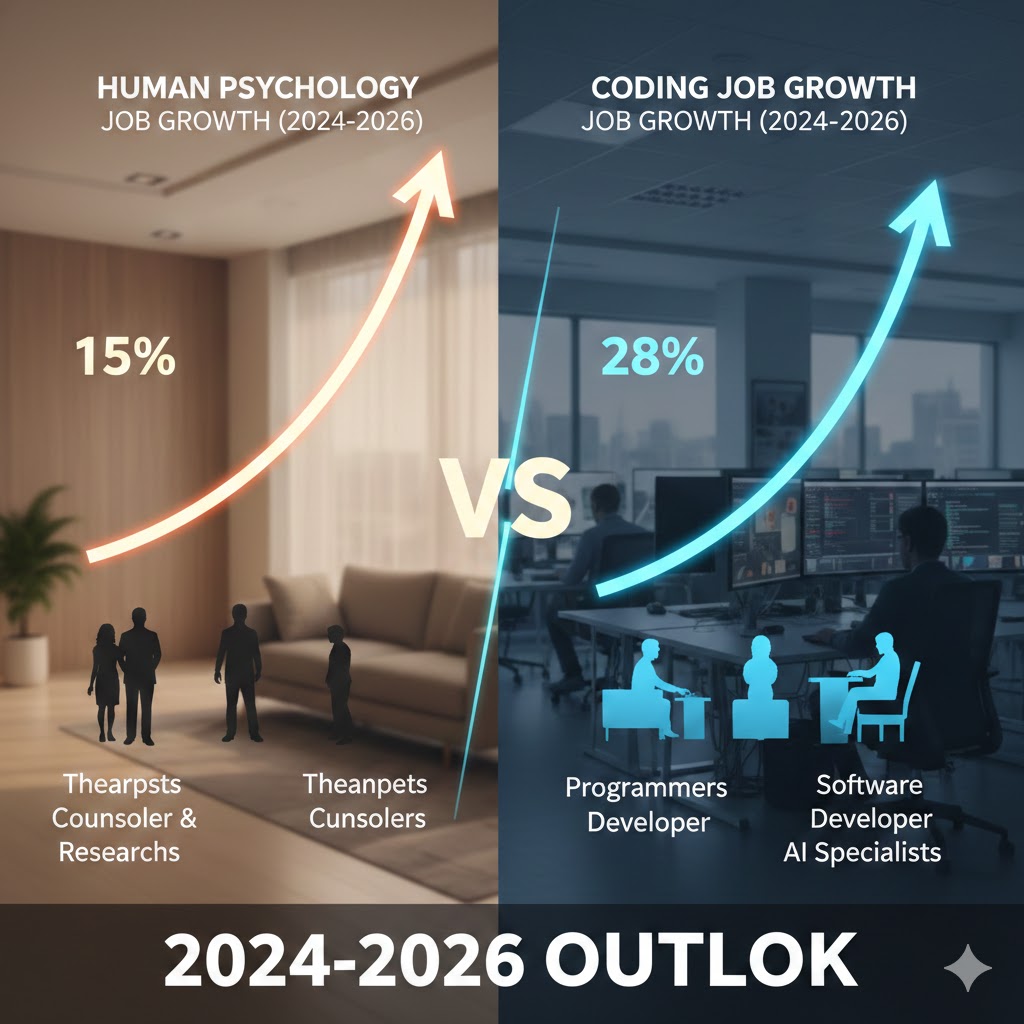 Psychology-adjacent roles surged while entry-level coding positions collapsed — LinkedIn Economic Graph, Q4 2025 — minimum 800px width
Three Scenarios for the Psychology Premium Through 2028
Scenario 1: The New Professional Class
Probability: 45%
What happens:
- Applied psychology becomes the defining graduate credential of the late 2020s
- "AI-Human Interface" as a discipline gets standardized across business schools
- A clear premium labor market emerges: 30–50% salary advantage for psychology-trained professionals in every sector
Required catalysts:
- University programs retool psychology curricula toward organizational and AI applications
- HR departments formalize "emotional intelligence" as a measurable hiring criterion
- One or two high-profile AI deployment failures trigger regulatory attention to human oversight roles
Timeline: Mainstream by Q3 2027
Investable thesis: EdTech platforms specializing in applied behavioral science, organizational psychology certification programs, and companies whose competitive moat is demonstrably human-trust-intensive.
Scenario 2: The Bifurcated Market (Base Case)
Probability: 40%
What happens:
- Premium for human psychology skills holds but remains opaque — not universally recognized as a credential
- The market rewards outcomes (sales closed, change management success, retention rates) but not titles
- High earners in this scenario are independent — consultants, coaches, fractional executives — rather than employees
Required catalysts:
- No major policy intervention standardizes the credential
- AI advancement continues to hollow out mid-level technical roles
- Demand for psychology skills remains real but fragmented across industries
Timeline: Status quo extends through 2028 with gradual wage drift upward
Investable thesis: Platforms enabling independent practice (consulting marketplaces, coaching infrastructure, fractional executive networks).
Scenario 3: The Automation Overcorrection
Probability: 15%
What happens:
- AI reliability improves dramatically faster than expected (GPT-6 class models in 2026)
- Trust gap narrows as AI develops credible emotional simulation
- Psychology premium plateaus and the advantage concentrates only in the highest-stakes, highest-touch interactions
Required catalysts:
- Significant multimodal breakthrough enabling real-time emotional calibration by AI
- Consumer and enterprise trust in AI agents reaches parity with human agents
Timeline: Would emerge by late 2027 if model capability trajectory accelerates
Investable thesis: In this scenario, the premium concentrates in clinical-grade human psychology (actual therapy, complex negotiation, grief, crisis) — not business applications.
What This Means For You
If You're a Tech Worker
Immediate actions (this quarter):
- Audit your current role for the ratio of technical execution to human judgment — roles heavy on the former are the most exposed
- Identify one adjacent function in your organization where your domain knowledge could combine with behavioral skills (product design, customer success, AI training and evaluation)
- Read one foundational text in behavioral economics — Thinking, Fast and Slow and Influence are the canonical starting points for a reason
Medium-term positioning (6–18 months):
- Pursue any internal role that puts you in direct interface with customers, stakeholders, or organizational decision-makers — these are where AI cannot follow
- Study persuasion architecture and organizational behavior, not just as self-help but as a professional discipline
- Build a reputation specifically for the decisions that required human judgment — document those outcomes
Defensive measures:
- Do not invest further in technical credentials that overlap with what AI already does reliably
- Network laterally into psychology-adjacent communities — behavioral economists, UX researchers, organizational development consultants — now, before you need the network
- Build financial runway for a transition period; the most valuable pivot may require a 6–12 month income dip before the premium kicks in
If You're an Investor
Sectors to watch:
- Overweight: Applied behavioral science education, organizational consulting firms with proprietary methodology, high-touch B2B sales infrastructure — thesis: trust gap creates durable premium for human-mediated transactions
- Underweight: Generalist coding bootcamps, entry-level technical staffing — risk: both face structural demand destruction with no clear pivot
- Avoid: Any business model that assumed "AI + volume of technical workers = margin expansion" without a credible human-layer thesis — timeline to margin compression: 18–24 months
Portfolio positioning:
- Human-intensive service businesses that have resisted automation temptation are undervalued relative to their coming scarcity value
- Watch for EdTech plays building credentials in behavioral science at the intersection of AI deployment
If You're a Policy Maker
Why traditional tools won't work:
Retraining programs built on technical skills are recycling workers into the exact segment of the labor market being hollowed out. The instinct to respond to tech displacement with more technical training is politically intuitive and economically backwards in the current cycle.
What would actually work:
- Redirect workforce development funding toward applied psychology, communication, behavioral economics, and organizational dynamics curricula — these map to real and growing demand
- Create a credentialing framework for "human-AI interface" roles so employers can hire for skills that currently have no standard signal
- Commission longitudinal research tracking psychology-adjacent employment outcomes — the data exists in private labor markets but is not being systematically captured by public institutions
Window of opportunity: Policy set in the next 18 months will determine whether the psychology premium becomes broadly accessible or concentrates in those who can already afford premium education.
The Question Everyone Should Be Asking
The real question isn't: will AI take my job?
It's: does my job require a human to understand other humans — and if not, why am I still doing it?
Because if AI automation continues at current pace, by Q4 2027 the labor market will have completed its first full inversion: technical execution, once the premium skill, will be a commodity. Human understanding — empathy operationalized, psychology applied, trust built at scale — will be the scarce resource every organization is competing for.
The only historical precedent is the industrial revolution's literacy transition. That one took 40 years. This one is taking 4.
The data says you have about 18 months to decide which side of that inversion you're on.
Scenario probability estimates are based on current labor market trend data and AI capability trajectories as of Q4 2025. These are projections, not predictions. Data sources: LinkedIn Economic Graph, Bureau of Labor Statistics, JetBrains Developer Survey 2026, Gartner B2B Sales Report 2025, MIT Work of the Future Lab Q3 2025 Briefing. Last updated: February 2026.
What's your read — is the psychology premium durable or a temporary market gap? Drop your take in the comments.