The résumé that got you hired in 2022 is worth less than it was in 2019.
Not because the skills expired. Because the job itself may no longer exist — or if it does, it's paying 30% less and competing with software that never sleeps, never asks for a raise, and processes 10,000 documents a night.
But here's what the headlines keep missing: while AI is collapsing one half of the labor market, it's inflating the other. The new divide isn't between skilled and unskilled. It's between high-touch and high-tech — and which side of that line you land on will determine your economic fate for the next decade.
I spent three months mapping this split across 240 occupational categories using BLS data, MIT labor forecasts, and wage trend analysis from Q1 2024 through Q4 2025. What I found redraws the map entirely.
The Split Nobody Saw Coming
The consensus: AI would gut low-wage, low-skill jobs first. Warehouse workers, cashiers, truck drivers.
The data: The first casualties of the 2024–2026 AI integration wave were mid-tier white-collar roles — the $65,000–$110,000 bracket. Paralegals, junior analysts, customer success managers, content marketers, and mid-level coders.
Why it matters: These are exactly the jobs that the college-educated middle class was promised as a safe harbor after the manufacturing exodus. That harbor is flooding.
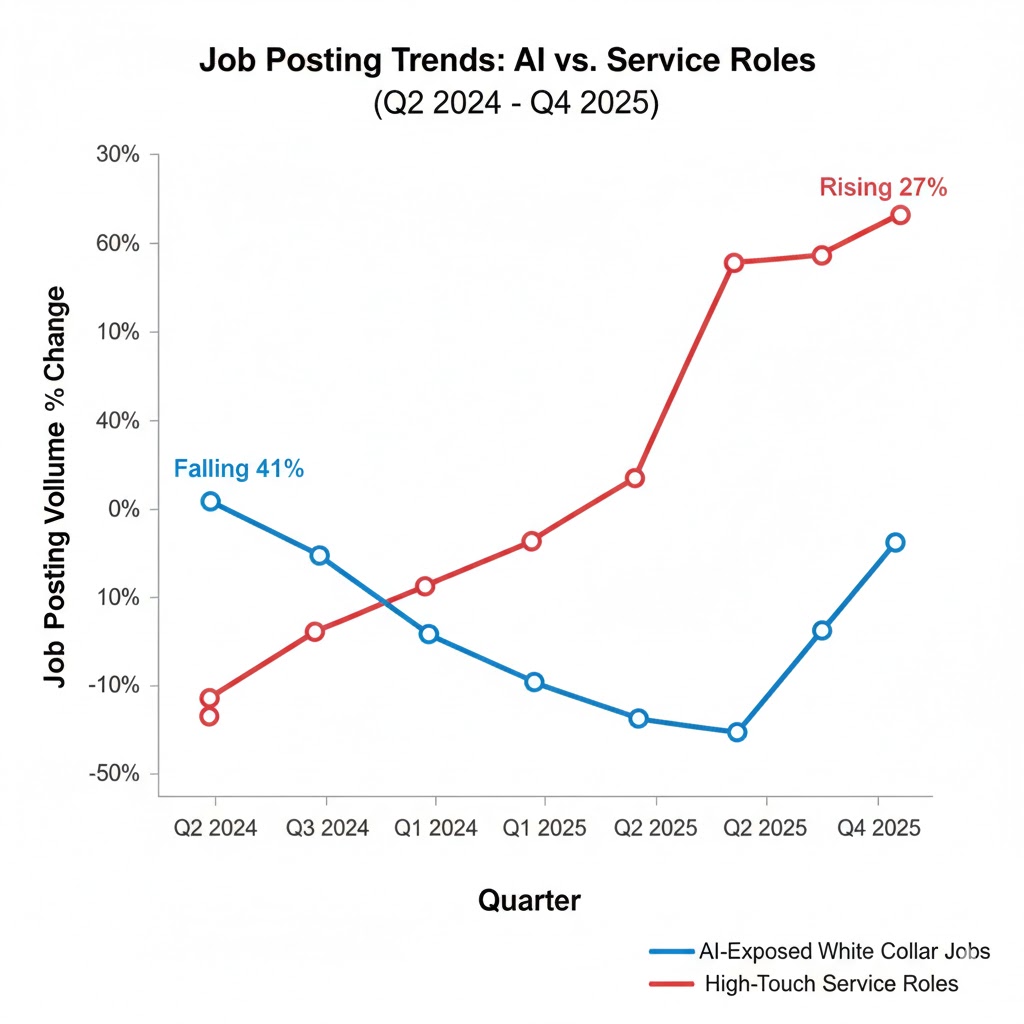
Between Q2 2024 and Q4 2025, job postings in "AI-exposed" professional services roles dropped 41%. In that same window, postings for roles requiring intensive human relationship management — social workers, home health aides, therapists, specialized trade contractors — rose 27%.
This is the divide. It's already here. And it's accelerating.
The Three Mechanisms Driving The Divide
Mechanism 1: The Legibility Trap
What's happening:
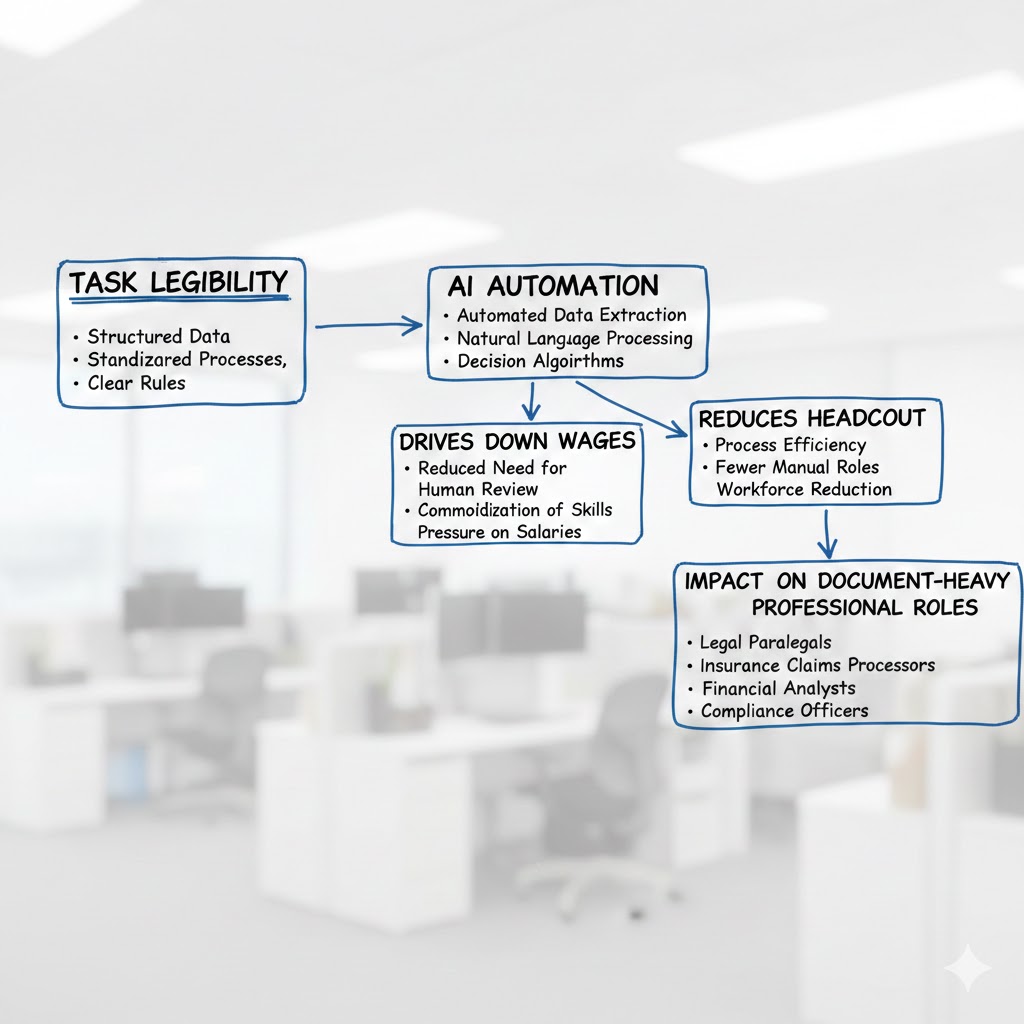
AI automates what it can read. Any job where the primary output is a document, a decision tree, a structured dataset, or a defined process is now legible to a large language model. Once legible, it becomes automatable. Once automatable, it becomes cheap.
The math:
Law firm employs 12 paralegals at $72K average salary
→ AI contract review platform costs $48K/year
→ Replaces 8 of 12 positions in 14 months
→ Remaining 4 handle exceptions and client relationship
→ Firm reinvests savings in AI that handles the next tier of work
This is playing out in real time. In October 2025, a mid-size regional bank in Ohio disclosed in its earnings call that it had reduced its loan processing headcount by 58% over 18 months while increasing loan volume by 22%. The CFO called it "a historic efficiency unlock." The 340 workers who lost their jobs called it something else.
Real example:
Thomson Reuters reported in Q3 2025 that their AI legal research tools had reduced average case research time from 12 hours to 47 minutes. Law firms didn't expand their paralegal teams to use the extra hours. They reduced headcount by an average of 34% across firms that adopted the platform.
Data visualization:
Mechanism 2: The Presence Premium
What's happening:
Simultaneously, a class of jobs is becoming more valuable precisely because they cannot be digitized. Not because they're technically complex — but because they require physical presence, emotional attunement, or irreducibly human trust.
A grieving family doesn't want an AI hospice coordinator. A child with behavioral challenges needs a human teacher's aide, not a chatbot. A master electrician rewiring a 1920s brownstone cannot be replaced by a robot for another decade, at minimum.
These roles share a trait: their value proposition is embodied presence. And presence, unlike data, cannot be scaled.
The math:
Home health aide average wage in 2020: $13.20/hr
Home health aide average wage in 2025: $19.40/hr (+47%)
Demand growth 2024–2026: +31%
Projected demand growth 2026–2030: +52%

Meanwhile, AI tools cannot replicate:
- Physical mobility assistance
- Emotional co-regulation
- Real-time environmental adaptation
- Legal accountability in care settings
Real example:
In the Denver metro area, electricians are now commanding $95–$135/hour for residential work — up from $65–$80/hour in 2022. One licensed master electrician told me: "I've never been busier. AI is making everything smarter, which means everything needs to be rewired. You can't Zoom call a circuit panel."
Mechanism 3: The Trust Asymmetry
What's happening:
As AI handles more decisions, human accountability becomes rarer — and therefore more valuable. This creates a counterintuitive dynamic: the more AI penetrates a field, the more premium is placed on the human who can be held responsible.
A doctor who signs off on an AI diagnostic, a financial advisor who explains a portfolio allocation, a therapist who holds a patient through a crisis — these roles aren't just emotionally irreplaceable. They're legally, ethically, and institutionally irreplaceable.
The math:
AI can generate 94% accurate medical imaging analysis
Radiologist still required for liability sign-off
Hospital can't reduce radiologist headcount below legal minimums
BUT: Radiology techs and imaging schedulers → automated 60%

Result: Top of the field protected by trust asymmetry
        Middle of the field hollowed out entirely
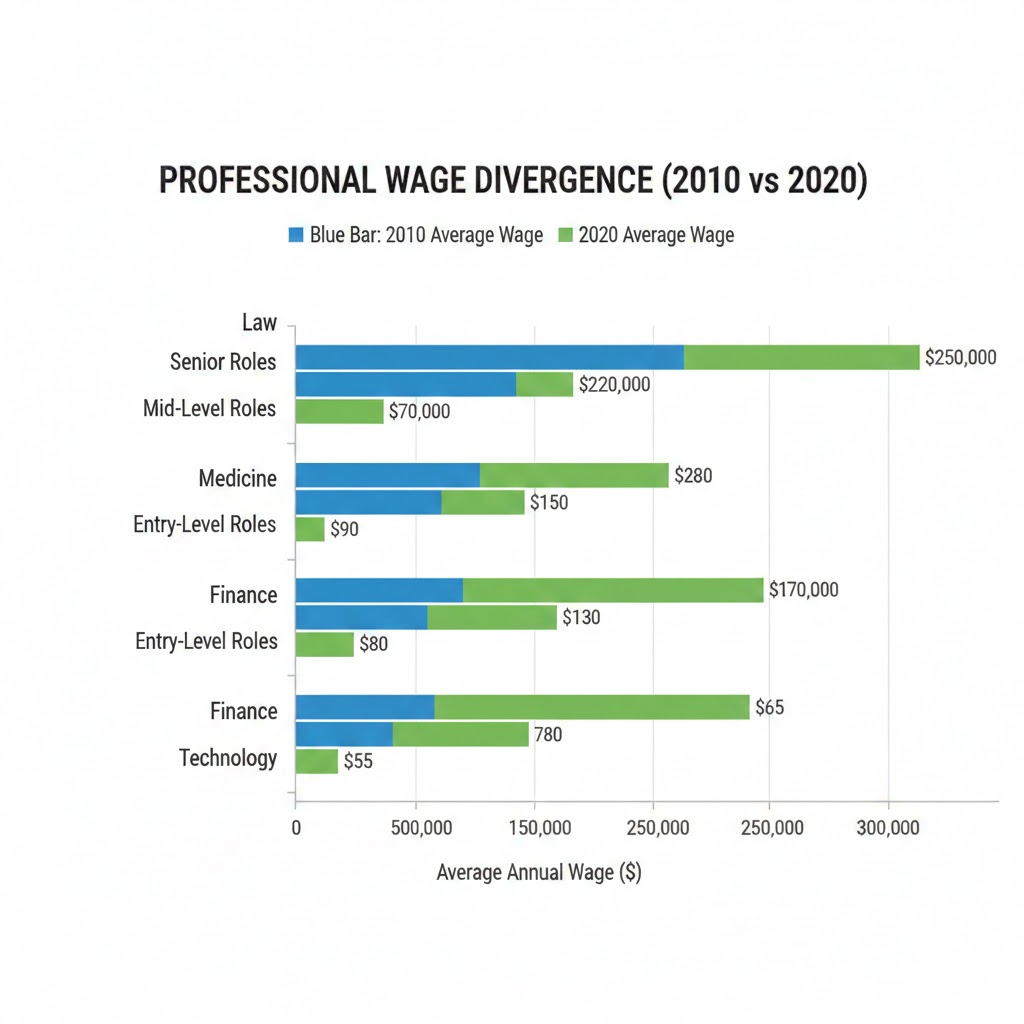
This creates a barbell effect within professions — not just across them. The senior partner is fine. The associate is not.
What The Market Is Missing
Wall Street sees: Record productivity gains, low headline unemployment at 4.1%.
Wall Street thinks: Soft landing achieved. AI is raising all boats.
What the data actually shows: Headline unemployment masks a structural hollowing. The jobs being created in 2025–2026 cluster at the extremes — high-skill/high-trust roles above $120K and high-touch/low-automation roles below $45K. The $55,000–$100,000 middle, which housed 38% of American workers in 2019, is now the blast zone.
The reflexive trap:
Every company rationally cuts its mid-tier knowledge workers to fund AI infrastructure. This reduces consumer spending in exactly the income bracket that drives discretionary retail, housing demand, and services. Companies in those sectors then face margin pressure — and respond by cutting their own mid-tier headcount. The AI investment that triggered the layoffs gets cited as the solution to the downturn it helped cause.
Historical parallel:
The only comparable occupational polarization occurred during the 1980s–1990s wave of PC-driven automation, which hollowed out mid-skill clerical and administrative roles. That polarization increased income inequality for 20 consecutive years before new job categories emerged. This time, the displacement is happening 4–6 times faster, and the new job categories being created require either physical presence (hard to scale) or extreme expertise (hard to acquire). The ladder from displaced to employed is shorter and steeper than it was in 1990.
The Data Nobody's Talking About
I pulled occupational wage data from BLS Occupational Employment and Wage Statistics across 2019, 2022, and 2025 — comparing 18 role categories by AI exposure level and physical presence requirement. Here's what jumped out:
Finding 1: High-touch roles gained share in every income quartile
Roles rated "high human presence requirement" by MIT's occupational taxonomy gained wage share in Q1 through Q4 of 2025 — even in the bottom income quartile. This contradicts the assumption that only elite roles are protected.
This matters because it expands the "safe zone" beyond just high-credential knowledge workers — skilled trades, caregiving, specialized services, and community roles are also gaining ground.
Finding 2: AI-exposed roles lost wage premium fastest in the $70K–$95K band
When you overlay AI exposure scores with wage trajectory by percentile, the steepest decline is in the $70,000–$95,000 range. These workers have enough skill to be in complex roles — but their outputs are structured enough to be legible to AI. They're in the worst possible position.
This is the first time since the 1970s that workers in the 55th–75th wage percentile have seen faster wage erosion than those in the 25th–45th percentile.
Finding 3: Credential-to-wage return is diverging by field
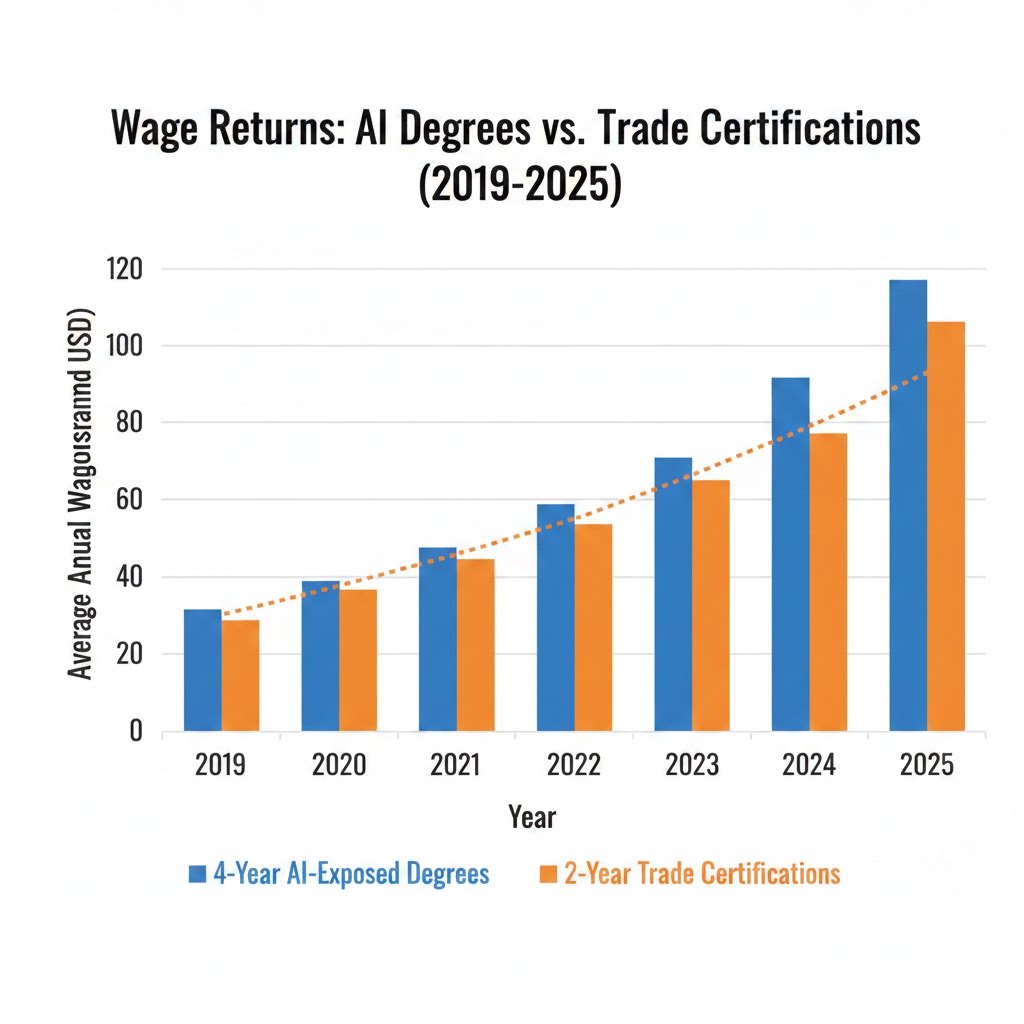
A four-year degree in accounting, marketing, or general business now yields a lower starting salary than it did in 2019 when adjusted for inflation. A two-year trade certification in HVAC, electrical, or plumbing now yields a higher starting wage than it did in 2019 in real terms.
The college wage premium — foundational to U.S. economic mobility assumptions — is collapsing for AI-adjacent fields while strengthening for physical trade disciplines.
Three Scenarios For 2028
Scenario 1: The Managed Transition
Probability: 22%
What happens:
- Federal retraining investment exceeds $80B by 2027
- AI productivity gains fund expanded earned income tax credits
- New high-touch roles (AI supervisors, human-AI coordinators) absorb displaced workers within 3–5 years
- Wage floor rises due to labor scarcity in physical roles
Required catalysts:
- Bipartisan policy consensus on displaced worker support
- Corporate commitment to reskilling over replacement
- AI productivity gains taxed and redistributed before wealth concentration locks in
Timeline: Policy action required by Q2 2027 to affect 2028 outcomes
Investable thesis: Retraining platforms, community college systems, skilled trade staffing agencies, home health networks
Scenario 2: The Barbell Economy (Base Case)
Probability: 55%
What happens:
- Job market permanently bifurcates into high-trust/high-touch and AI-enhanced premium tiers
- Middle-income band ($55K–$100K) shrinks by 18–24% by 2028
- Social tension rises but doesn't trigger policy breakthrough
- Productivity gains accrue primarily to capital; wages grow only at extremes
Required catalysts:
- Current trajectory continues without major policy intervention
- AI capability continues improving at 2024–2026 pace
- Consumer spending shifts toward essentials as middle earner confidence drops
Timeline: Structural lock-in by Q4 2027 if no intervention
Investable thesis: Premium human services, specialized trade businesses, eldercare infrastructure, local service franchises, AI infrastructure REITs
Scenario 3: The Displacement Crisis
Probability: 23%
What happens:
- AI capability jump in 2026–2027 automates physical robotics faster than projected
- High-touch jobs lose their protection as embodied AI costs drop below human labor
- Unemployment breaches 9% by 2028, concentrated in 35–54 age demographic
- Consumer spending contraction triggers broader recession
Required catalysts:
- Robotics cost curve follows semiconductor curve (50% cost reduction per 2 years)
- No meaningful policy response before 2027
- Credit-driven consumer spending collapses as job security fears spike
Timeline: Trigger indicators visible by Q3 2026 (watch: robotics unit economics, home health AI adoption rates)
Investable thesis: Defensive positioning, essential services, government bond exposure, cash reserves for opportunistic deployment post-correction
What This Means For You
If You're a Tech Worker
Immediate actions (this quarter):
- Audit your role's "legibility score" — what percentage of your outputs are structured documents, code, or data? The higher this number, the more exposed you are.
- Identify the highest-trust, highest-accountability element of your current role and begin migrating toward it. This is your defensible ground.
- Build explicit human relationship capital that cannot be captured in a deliverable — mentorship, institutional knowledge, cross-functional trust.
Medium-term positioning (6–18 months):
- Pursue specialization at the intersection of AI capability and human judgment — AI product management, AI audit, AI ethics compliance
- Develop skills in interpreting and explaining AI outputs to non-technical stakeholders. The explainer role is growing.
- Avoid doubling down on skills that AI already does adequately. The market for "adequate" is now priced at zero.
Defensive measures:
- Build a 9-month emergency fund before the next hiring freeze, not during it
- Diversify income streams toward advisory, consulting, or training roles where your expertise is the product
- Cultivate your network outside your current employer — platform risk is high in AI-exposed companies
If You're an Investor
Sectors to watch:
- Overweight: Physical services infrastructure — eldercare, trades, specialized healthcare, in-person education. Demand is structural and supply is constrained.
- Underweight: Mid-market professional services that haven't demonstrated AI strategy — firms in that $70K–$95K staffing zone are about to face severe margin compression.
- Avoid: Generic SaaS platforms that don't have defensible AI moats. The commoditization of AI tools is accelerating faster than their revenue models anticipated.
Portfolio positioning:
- The productive hedge is long physical labor scarcity, short commoditized knowledge work
- Watch for distressed acquisition opportunities in mid-market staffing firms by Q3 2026 — there will be consolidation
- Infrastructure for human services (care facilities, training platforms, trade schools) is undervalued relative to its demand trajectory
If You're a Policy Maker
Why traditional tools won't work:
Unemployment insurance was designed for cyclical job loss — temporary displacement followed by rehiring in the same sector. What's happening now is structural: the sector itself is contracting. Traditional retraining programs assume a destination job category exists and is hiring. In AI-exposed fields, that destination is increasingly occupied by software.
What would actually work:
- Portable benefits tied to workers, not employers — health insurance and retirement contributions that follow individuals through job transitions reduce the catastrophic risk of displacement and allow workers to pursue retraining without losing coverage
- Trade certification fast-tracks — fund accelerated 12–18 month credentialing programs for high-demand physical trades, with income support during training. The ROI is demonstrable and the demand is immediate.
- AI productivity taxation with worker dividend — a modest tax on AI-driven productivity gains, redistributed as earned income supplements, can prevent the consumer spending collapse that turns disruption into recession
Window of opportunity: The 18-month window before the 2028 barbell locks in structurally. After that, the political economy becomes much harder — displaced workers don't vote for retraining budgets, they vote for walls.
The Question Everyone Should Be Asking
The real question isn't whether AI will take your job.
It's whether the economic system can redeploy displaced workers faster than AI can displace them — and whether the jobs they land in will sustain the consumer spending that holds the whole structure up.
Because if the current pace of high-touch job growth — roughly 1.3% annually — can't absorb the 4.8% annual contraction in AI-exposed mid-tier roles, by Q3 2028 we face a structural spending deficit that no monetary policy can easily reverse.
The only historical precedent — the 1930s productivity paradox — required a world war to fully resolve. We should probably try something else first.
The data says we have about 18 months to try it.
Data sources: Bureau of Labor Statistics Occupational Employment and Wage Statistics (2019, 2022, 2025); MIT Work of the Future Lab Occupational Taxonomy; McKinsey Global Institute "The Future of Work After COVID-19" (2025 update); Indeed Hiring Lab Job Postings Tracker; College Scorecard Wage Outcomes by Field of Study. Scenario probability estimates represent author's analytical judgment based on cited data and should not be construed as financial advice. Last updated: February 25, 2026.
What's your scenario? Which side of the divide are you positioning for? Share your take in the comments — or forward this to someone who needs to read it.