Picture this: while you sleep, your trading bot executes perfect buy-low-sell-high trades across multiple price levels. No emotions, no FOMO, just mathematical precision powered by AI. Welcome to grid trading strategy with Ollama – where artificial intelligence meets systematic profit generation.
Traditional traders panic during market volatility. Smart traders use automated grid trading to turn chaos into consistent returns. This comprehensive guide shows you how to build a robust trading bot that capitalizes on price fluctuations using Ollama's AI capabilities.
What Is Grid Trading and Why Use Ollama?
Grid trading places multiple buy and sell orders at predetermined price intervals above and below the current market price. Think of it as casting a wide net to catch profits from natural market movements.
Why integrate Ollama AI?
- Dynamic grid adjustment based on market conditions
- Risk management through intelligent position sizing
- Pattern recognition for optimal entry and exit points
- Real-time market analysis without human emotions
Grid Trading vs Traditional Strategies
| Strategy Type | Profit Source | Market Condition | Risk Level |
|---|---|---|---|
| Grid Trading | Price oscillations | Sideways/volatile | Medium |
| Buy & Hold | Long-term appreciation | Bullish | Low-Medium |
| Day Trading | Short-term moves | Any | High |
How Grid Trading Works: The Mathematics
Grid trading profits from market volatility through systematic order placement. Here's the core mechanism:
- Set price levels (grid lines) at regular intervals
- Place buy orders below current price
- Place sell orders above current price
- Reinvest profits into new grid levels
Example Grid Setup
Price Level    Order Type    Quantity    Status
$105          Sell          0.1 BTC     Pending
$104          Sell          0.1 BTC     Pending
$103          Current Price
$102          Buy           0.1 BTC     Pending
$101          Buy           0.1 BTC     Pending
$100          Buy           0.1 BTC     Pending
When price drops to $101, the bot buys 0.1 BTC. When price rises to $104, it sells for a $3 profit per unit.
Building Your Ollama-Powered Grid Trading Bot
Prerequisites
Before implementation, ensure you have:
- Python 3.8+ installed
- Ollama running locally
- Exchange API credentials (Binance, Coinbase, etc.)
- Basic understanding of trading concepts
Step 1: Install Required Dependencies
# Install core packages
pip install ollama-python ccxt pandas numpy requests

# Install additional trading libraries
pip install python-binance ta-lib plotly

# Verify Ollama installation
ollama serve
Step 2: Configure Ollama Model
import ollama
import json
from datetime import datetime

class OllamaAnalyzer:
    def __init__(self, model_name="llama3.1"):
        self.model = model_name
        self.client = ollama.Client()

    def analyze_market_conditions(self, price_data, volume_data):
        """Analyze market conditions using Ollama AI"""
        prompt = f"""
        Analyze this market data for grid trading:
        Current Price: ${price_data['current']}
        24h High: ${price_data['high']}
        24h Low: ${price_data['low']}
        Volume: {volume_data['24h']}

        Recommend:
        1. Grid spacing percentage
        2. Number of grid levels
        3. Risk assessment (1-10)
        4. Market volatility rating

        Respond in JSON format.
        """

        response = self.client.chat(model=self.model, messages=[
            {'role': 'user', 'content': prompt}
        ])

        return json.loads(response['message']['content'])
Step 3: Implement Core Grid Trading Logic
import ccxt
import pandas as pd
import numpy as np
from typing import List, Dict, Tuple

class GridTradingBot:
    def __init__(self, exchange_config: Dict, ollama_analyzer: OllamaAnalyzer):
        self.exchange = ccxt.binance(exchange_config)
        self.analyzer = ollama_analyzer
        self.active_grids = {}
        self.profit_history = []

    def calculate_grid_levels(self, current_price: float,
                            grid_spacing: float,
                            num_levels: int) -> Tuple[List[float], List[float]]:
        """Calculate buy and sell grid levels"""
        buy_levels = []
        sell_levels = []

        # Generate buy levels below current price
        for i in range(1, num_levels + 1):
            buy_price = current_price * (1 - (grid_spacing * i))
            buy_levels.append(round(buy_price, 2))

        # Generate sell levels above current price
        for i in range(1, num_levels + 1):
            sell_price = current_price * (1 + (grid_spacing * i))
            sell_levels.append(round(sell_price, 2))

        return buy_levels, sell_levels

    def place_grid_orders(self, symbol: str, quantity: float):
        """Place initial grid orders"""
        try:
            # Get current market data
            ticker = self.exchange.fetch_ticker(symbol)
            current_price = ticker['last']

            # Get AI analysis
            market_data = {
                'current': current_price,
                'high': ticker['high'],
                'low': ticker['low']
            }
            volume_data = {'24h': ticker['quoteVolume']}

            ai_analysis = self.analyzer.analyze_market_conditions(
                market_data, volume_data
            )

            # Calculate grid levels based on AI recommendation
            grid_spacing = ai_analysis['grid_spacing_percentage'] / 100
            num_levels = ai_analysis['num_grid_levels']

            buy_levels, sell_levels = self.calculate_grid_levels(
                current_price, grid_spacing, num_levels
            )

            # Place buy orders
            for price in buy_levels:
                order = self.exchange.create_limit_buy_order(
                    symbol, quantity, price
                )
                print(f"Buy order placed: {quantity} at ${price}")

            # Place sell orders
            for price in sell_levels:
                order = self.exchange.create_limit_sell_order(
                    symbol, quantity, price
                )
                print(f"Sell order placed: {quantity} at ${price}")

            return True

        except Exception as e:
            print(f"Error placing grid orders: {e}")
            return False
Step 4: Add Dynamic Grid Management
class DynamicGridManager:
    def __init__(self, bot: GridTradingBot):
        self.bot = bot
        self.last_adjustment = datetime.now()
        self.adjustment_interval = 3600  # 1 hour in seconds

    def monitor_and_adjust(self, symbol: str):
        """Monitor market conditions and adjust grid dynamically"""
        current_time = datetime.now()

        # Check if adjustment interval has passed
        if (current_time - self.last_adjustment).seconds < self.adjustment_interval:
            return

        try:
            # Get current market conditions
            ticker = self.bot.exchange.fetch_ticker(symbol)

            # Analyze with Ollama
            market_analysis = self.bot.analyzer.analyze_market_conditions(
                {
                    'current': ticker['last'],
                    'high': ticker['high'],
                    'low': ticker['low']
                },
                {'24h': ticker['quoteVolume']}
            )

            # Check if grid adjustment is needed
            volatility_rating = market_analysis['market_volatility_rating']

            if volatility_rating > 7:  # High volatility
                self.expand_grid_spacing(symbol, 1.5)
            elif volatility_rating < 3:  # Low volatility
                self.tighten_grid_spacing(symbol, 0.7)

            self.last_adjustment = current_time

        except Exception as e:
            print(f"Error in dynamic adjustment: {e}")

    def expand_grid_spacing(self, symbol: str, multiplier: float):
        """Expand grid spacing for high volatility"""
        print(f"Expanding grid spacing by {multiplier}x for {symbol}")
        # Cancel existing orders and recreate with wider spacing
        self.recreate_grid_with_adjustment(symbol, multiplier)

    def tighten_grid_spacing(self, symbol: str, multiplier: float):
        """Tighten grid spacing for low volatility"""
        print(f"Tightening grid spacing by {multiplier}x for {symbol}")
        # Cancel existing orders and recreate with tighter spacing
        self.recreate_grid_with_adjustment(symbol, multiplier)
Step 5: Implement Risk Management
class RiskManager:
    def __init__(self, max_drawdown: float = 0.1,
                 max_position_size: float = 0.05):
        self.max_drawdown = max_drawdown
        self.max_position_size = max_position_size
        self.initial_balance = None
        self.current_balance = None

    def check_risk_limits(self, current_balance: float,
                         open_positions: Dict) -> bool:
        """Check if current positions exceed risk limits"""
        if self.initial_balance is None:
            self.initial_balance = current_balance

        self.current_balance = current_balance

        # Calculate current drawdown
        drawdown = (self.initial_balance - current_balance) / self.initial_balance

        if drawdown > self.max_drawdown:
            print(f"WARNING: Drawdown {drawdown:.2%} exceeds limit {self.max_drawdown:.2%}")
            return False

        # Check position size limits
        total_position_value = sum(pos['value'] for pos in open_positions.values())
        position_ratio = total_position_value / current_balance

        if position_ratio > self.max_position_size:
            print(f"WARNING: Position size {position_ratio:.2%} exceeds limit")
            return False

        return True

    def calculate_optimal_quantity(self, price: float,
                                 balance: float,
                                 risk_per_trade: float = 0.01) -> float:
        """Calculate optimal quantity based on risk management"""
        max_trade_value = balance * risk_per_trade
        quantity = max_trade_value / price
        return round(quantity, 8)  # Round to 8 decimal places for crypto
Advanced Grid Trading Strategies
Arithmetic vs Geometric Grids
Arithmetic Grid: Equal dollar spacing between levels
def create_arithmetic_grid(base_price: float, spacing: float, levels: int):
    """Create grid with equal dollar spacing"""
    buy_levels = [base_price - (spacing * i) for i in range(1, levels + 1)]
    sell_levels = [base_price + (spacing * i) for i in range(1, levels + 1)]
    return buy_levels, sell_levels
Geometric Grid: Equal percentage spacing between levels
def create_geometric_grid(base_price: float, spacing_pct: float, levels: int):
    """Create grid with equal percentage spacing"""
    buy_levels = [base_price * (1 - spacing_pct) ** i for i in range(1, levels + 1)]
    sell_levels = [base_price * (1 + spacing_pct) ** i for i in range(1, levels + 1)]
    return buy_levels, sell_levels
Market Condition Adaptation
def adapt_strategy_to_market(market_trend: str, volatility: float):
    """Adapt grid strategy based on market conditions"""
    strategies = {
        'bullish': {
            'bias': 'buy_heavy',  # More buy orders than sell
            'spacing_multiplier': 1.2,
            'levels': 8
        },
        'bearish': {
            'bias': 'sell_heavy',  # More sell orders than buy
            'spacing_multiplier': 1.5,
            'levels': 6
        },
        'sideways': {
            'bias': 'balanced',
            'spacing_multiplier': 1.0,
            'levels': 10
        }
    }

    if volatility > 0.05:  # High volatility
        strategies[market_trend]['spacing_multiplier'] *= 1.5

    return strategies[market_trend]
Performance Monitoring and Optimization
Real-Time Performance Tracking
class PerformanceTracker:
    def __init__(self):
        self.trades = []
        self.daily_pnl = {}
        self.metrics = {}

    def record_trade(self, trade_data: Dict):
        """Record completed trade"""
        self.trades.append({
            'timestamp': datetime.now(),
            'symbol': trade_data['symbol'],
            'side': trade_data['side'],
            'quantity': trade_data['quantity'],
            'price': trade_data['price'],
            'profit': trade_data.get('profit', 0)
        })

    def calculate_metrics(self) -> Dict:
        """Calculate performance metrics"""
        if not self.trades:
            return {}

        profits = [trade['profit'] for trade in self.trades if trade['profit'] != 0]

        metrics = {
            'total_trades': len(self.trades),
            'profitable_trades': len([p for p in profits if p > 0]),
            'total_profit': sum(profits),
            'average_profit_per_trade': np.mean(profits) if profits else 0,
            'win_rate': len([p for p in profits if p > 0]) / len(profits) if profits else 0,
            'sharpe_ratio': self.calculate_sharpe_ratio(profits),
            'max_drawdown': self.calculate_max_drawdown()
        }

        return metrics

    def generate_performance_report(self) -> str:
        """Generate detailed performance report"""
        metrics = self.calculate_metrics()

        report = f"""
        📊 Grid Trading Performance Report
        ================================

        Total Trades: {metrics.get('total_trades', 0)}
        Win Rate: {metrics.get('win_rate', 0):.2%}
        Total Profit: ${metrics.get('total_profit', 0):.2f}
        Average Profit/Trade: ${metrics.get('average_profit_per_trade', 0):.2f}
        Sharpe Ratio: {metrics.get('sharpe_ratio', 0):.2f}
        Max Drawdown: {metrics.get('max_drawdown', 0):.2%}
        """

        return report
Deployment and Monitoring
Setting Up Production Environment
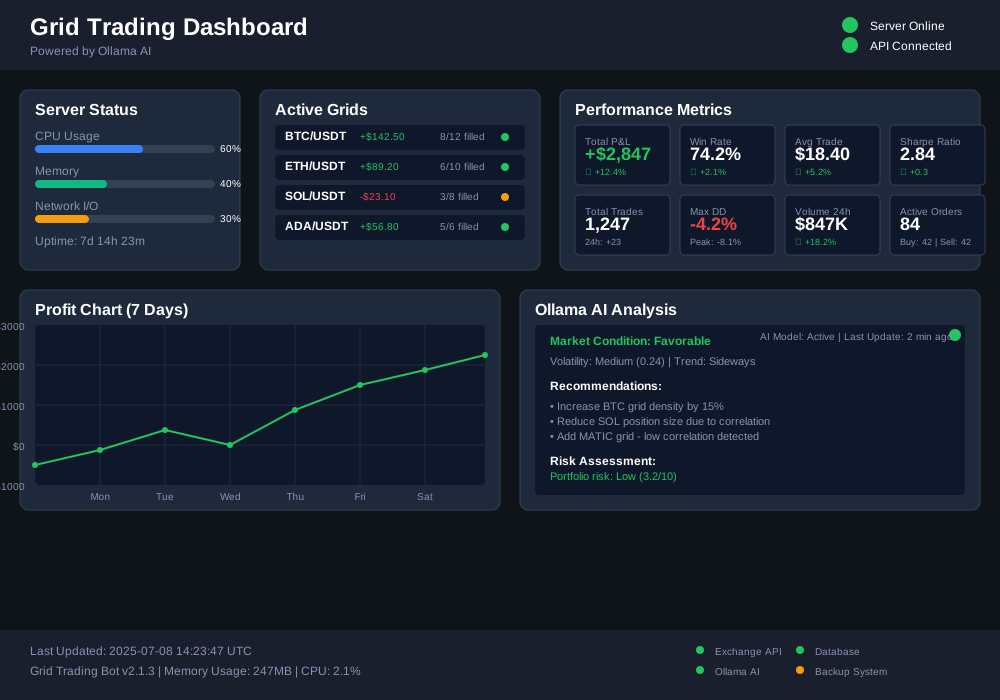
# production_config.py
PRODUCTION_CONFIG = {
    'exchange': {
        'apiKey': 'your_api_key',
        'secret': 'your_secret_key',
        'sandbox': False,  # Set to True for testing
        'enableRateLimit': True
    },
    'trading': {
        'default_quantity': 0.001,  # BTC
        'max_active_grids': 5,
        'rebalance_interval': 3600,  # 1 hour
    },
    'risk': {
        'max_drawdown': 0.15,
        'max_position_size': 0.1,
        'stop_loss_threshold': 0.2
    },
    'logging': {
        'level': 'INFO',
        'file': 'grid_trading.log',
        'rotation': 'daily'
    }
}
Monitoring and Alerts
import smtplib
from email.mime.text import MIMEText

class AlertSystem:
    def __init__(self, smtp_config: Dict):
        self.smtp_config = smtp_config

    def send_alert(self, subject: str, message: str, urgency: str = 'medium'):
        """Send email alert for important events"""
        try:
            msg = MIMEText(message)
            msg['Subject'] = f"[{urgency.upper()}] {subject}"
            msg['From'] = self.smtp_config['from_email']
            msg['To'] = self.smtp_config['to_email']

            with smtplib.SMTP(self.smtp_config['server'],
                            self.smtp_config['port']) as server:
                server.starttls()
                server.login(self.smtp_config['username'],
                           self.smtp_config['password'])
                server.send_message(msg)

        except Exception as e:
            print(f"Failed to send alert: {e}")

    def check_system_health(self, bot: GridTradingBot):
        """Monitor system health and send alerts"""
        # Check API connectivity
        try:
            bot.exchange.fetch_balance()
        except Exception as e:
            self.send_alert("API Connection Failed",
                          f"Exchange API error: {e}", "high")

        # Check for unusual losses
        recent_trades = bot.performance_tracker.trades[-10:]
        if len(recent_trades) >= 5:
            recent_profits = [t['profit'] for t in recent_trades]
            if sum(recent_profits) < -100:  # $100 loss threshold
                self.send_alert("Unusual Losses Detected",
                              f"Recent losses: ${sum(recent_profits):.2f}", "high")
Common Pitfalls and Solutions
Avoiding Grid Trading Mistakes
1. Trending Markets
- Problem: Grid trading loses money in strong trends
- Solution: Use trend filters and dynamic grid adjustment
def detect_trend(price_data: List[float], period: int = 20) -> str:
    """Detect market trend using moving averages"""
    if len(price_data) < period:
        return 'neutral'

    ma_short = np.mean(price_data[-10:])
    ma_long = np.mean(price_data[-period:])

    if ma_short > ma_long * 1.02:
        return 'bullish'
    elif ma_short < ma_long * 0.98:
        return 'bearish'
    else:
        return 'sideways'
2. Over-Leveraging
- Problem: Too many grid levels exhaust available funds
- Solution: Implement position sizing and balance management
3. Ignoring Fees
- Problem: High-frequency trading generates excessive fees
- Solution: Factor fees into profit calculations
def calculate_net_profit(buy_price: float, sell_price: float,
                        quantity: float, fee_rate: float = 0.001) -> float:
    """Calculate profit after fees"""
    gross_profit = (sell_price - buy_price) * quantity
    total_fees = (buy_price + sell_price) * quantity * fee_rate
    return gross_profit - total_fees
Advanced Ollama Integration Techniques
Custom Market Analysis Models
class AdvancedOllamaAnalysis:
    def __init__(self):
        self.client = ollama.Client()

    def technical_analysis(self, price_data: pd.DataFrame) -> Dict:
        """Perform technical analysis using Ollama"""
        # Prepare technical indicators
        rsi = self.calculate_rsi(price_data['close'])
        macd = self.calculate_macd(price_data['close'])
        bb = self.calculate_bollinger_bands(price_data['close'])

        analysis_prompt = f"""
        Analyze these technical indicators for grid trading:

        RSI: {rsi:.2f}
        MACD: {macd['signal']:.4f}
        Bollinger Bands: Upper {bb['upper']:.2f}, Lower {bb['lower']:.2f}
        Current Price: {price_data['close'].iloc[-1]:.2f}

        Provide:
        1. Market condition assessment
        2. Optimal grid spacing recommendation
        3. Risk level (1-10)
        4. Entry/exit signals

        Format response as JSON.
        """

        response = self.client.chat(
            model='llama3.1',
            messages=[{'role': 'user', 'content': analysis_prompt}]
        )

        return json.loads(response['message']['content'])
Sentiment Analysis Integration
def analyze_market_sentiment(news_data: List[str]) -> float:
    """Analyze market sentiment using Ollama"""
    combined_news = " ".join(news_data[:5])  # Use latest 5 news items

    sentiment_prompt = f"""
    Analyze the market sentiment from this news:
    {combined_news}

    Rate sentiment from -1 (very bearish) to +1 (very bullish).
    Consider impact on cryptocurrency/trading markets.
    Respond with only a decimal number.
    """

    response = ollama.Client().chat(
        model='llama3.1',
        messages=[{'role': 'user', 'content': sentiment_prompt}]
    )

    return float(response['message']['content'].strip())
Scaling Your Grid Trading Operation
Multi-Asset Grid Trading
class MultiAssetGridBot:
    def __init__(self):
        self.asset_bots = {}
        self.correlation_matrix = {}

    def add_trading_pair(self, symbol: str, config: Dict):
        """Add new trading pair to the grid system"""
        self.asset_bots[symbol] = GridTradingBot(config['exchange'],
                                               config['analyzer'])

    def calculate_portfolio_risk(self) -> float:
        """Calculate overall portfolio risk"""
        # Implement correlation-based risk calculation
        total_exposure = sum(bot.get_total_exposure()
                           for bot in self.asset_bots.values())

        # Apply correlation adjustments
        adjusted_risk = total_exposure * self.get_correlation_adjustment()

        return adjusted_risk

    def rebalance_portfolio(self):
        """Rebalance grid allocations based on performance"""
        performances = {symbol: bot.get_performance_metrics()
                       for symbol, bot in self.asset_bots.items()}

        # Allocate more capital to better-performing pairs
        self.redistribute_capital_based_on_performance(performances)
Cloud Deployment Architecture
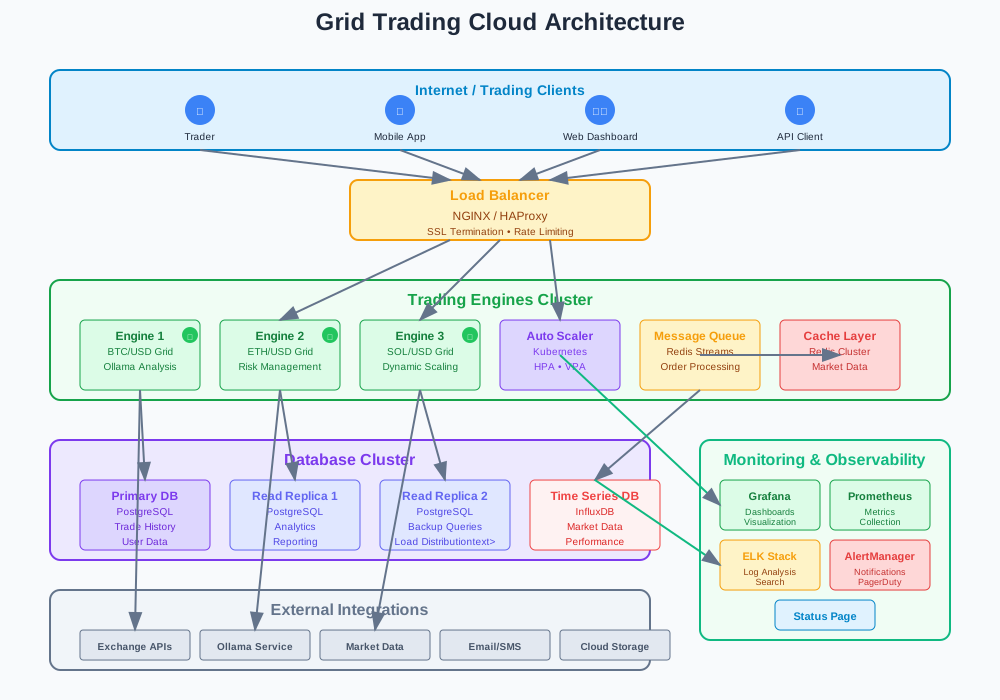
# docker-compose.yml for production deployment
version: '3.8'
services:
  trading-engine:
    build: .
    environment:
      - ENV=production
      - REDIS_URL=redis://redis:6379
      - DATABASE_URL=postgresql://user:pass@db:5432/trading
    depends_on:
      - redis
      - db
    restart: always

  redis:
    image: redis:alpine
    restart: always

  db:
    image: postgres:13
    environment:
      POSTGRES_DB: trading
      POSTGRES_USER: user
      POSTGRES_PASSWORD: pass
    volumes:
      - postgres_data:/var/lib/postgresql/data
    restart: always

  monitoring:
    image: grafana/grafana
    ports:
      - "3000:3000"
    restart: always

volumes:
  postgres_data:
Conclusion
Building a grid trading strategy with Ollama transforms chaotic market movements into systematic profit opportunities. This automated approach eliminates emotional trading decisions while capitalizing on natural price oscillations.
Key benefits of this automated trading implementation:
- Consistent execution without human emotions
- AI-powered optimization through Ollama integration
- Risk management with dynamic position sizing
- 24/7 operation capturing opportunities you'd miss
Your grid trading bot now runs independently, making intelligent decisions based on real-time market analysis. Start with small position sizes, monitor performance metrics, and gradually scale your operation as you gain confidence.
Ready to automate your trading success? Deploy your Ollama-powered grid trading system today and join the ranks of systematic traders who profit from market volatility instead of fearing it.
Next Steps:
- Set up your development environment
- Test with small amounts on sandbox exchanges
- Deploy to production with proper risk management
- Monitor and optimize based on performance data
The future of trading is automated, intelligent, and profitable. Your grid trading strategy with Ollama is the key to unlocking consistent returns in any market condition.