I'll never forget the moment our entire GraphQL gateway went down because of a single schema stitching error. It was 2 AM, I was three coffees deep, and our microservices architecture was returning nothing but Cannot return null for non-nullable field errors across every single query.
The worst part? I had been so confident in my schema stitching implementation. "It's just combining schemas," I told my team lead earlier that week. "What could go wrong?"
Everything. Everything could go wrong.
If you're staring at cryptic GraphQL stitching errors right now, feeling like you're drowning in type conflicts and resolver mismatches, I want you to know: you're not alone. Every developer working with distributed GraphQL has been exactly where you are. The good news? I've spent the last two years perfecting patterns that prevent 95% of these headaches.
By the end of this article, you'll have the exact debugging framework I use to identify and fix schema stitching errors in minutes, not days. More importantly, you'll know how to structure your schemas so these errors rarely happen in the first place.
The Schema Stitching Nightmare That Taught Me Everything
Let me paint you a picture of how badly I misunderstood GraphQL schema stitching. Our e-commerce platform had grown from a monolith into six microservices, each with its own GraphQL endpoint:
- User service: handled authentication and profiles
- Product service: managed inventory and pricing
- Order service: processed purchases and history
- Payment service: handled transactions
- Review service: managed ratings and comments
- Notification service: sent emails and push notifications
My brilliant plan was to use Apollo Gateway to stitch all these schemas together into one beautiful, unified API. Simple, right?
Wrong. So incredibly wrong.
The Three Types of Schema Stitching Errors That Will Ruin Your Day
After debugging dozens of production incidents, I've identified three categories of stitching errors that account for almost every problem you'll encounter:
Type Collision Catastrophes
The first error hit me within hours of deploying to staging:
Error: Schema must contain uniquely named types but contains multiple types named "User".
I had defined a User type in both the user service AND the order service. The user service needed user profiles, but the order service needed user information for purchase history. Both defined their own User type with different fields.
The mistake I made: I thought GraphQL would magically merge these types for me.
The reality: GraphQL schema stitching requires you to be explicit about type relationships and ownership.
Resolver Resolution Disasters
The second category of errors showed up when I tried to query across services:
// This query would fail spectacularly
query GetOrderWithUserDetails {
  order(id: "12345") {
    id
    total
    user {
      name
      email
      # This field doesn't exist in the Order service's User type
      profilePicture
    }
  }
}
The error message was cryptic: Cannot return null for non-nullable field User.profilePicture
I was trying to access fields that didn't exist in the schema where the resolver was running. The order service knew about users (it had user IDs), but it didn't have access to full user profiles.
Circular Dependency Chaos
The third type of error was the most insidious. It didn't show up immediately—it lurked in the shadows, waiting for the perfect moment to break everything:
Error: Schema stitching failed: Circular dependency detected between User and Order types
I had created a beautiful web of interdependencies:
- Users had orders
- Orders had users
- Orders had products
- Products had reviews
- Reviews had users
Each service was trying to resolve fields that depended on other services, which depended on other services, which eventually circled back to the original service. It was dependency hell, GraphQL style.
The Debugging Framework That Saved My Sanity
After the third production incident (yes, I broke production three times with schema stitching errors), I developed a systematic approach to debugging these issues. Here's the exact framework I use:
Step 1: Map Your Type Ownership
Before you write a single line of stitching code, create a clear ownership map. I learned this the hard way when I spent 4 hours debugging an error that could have been prevented with 10 minutes of planning.
# Type Ownership Map
User: User Service (authoritative)
Product: Product Service (authoritative)
Order: Order Service (authoritative)
Review: Review Service (authoritative)

# Cross-service References (read-only)
Order.user: Reference to User Service
Order.products: Reference to Product Service
Product.reviews: Reference to Review Service
Review.user: Reference to User Service
The rule is simple: each type has exactly one authoritative service. Other services can reference these types, but they can't extend or modify them.
Step 2: Use Schema Directives for Clarity
Here's the pattern that transformed my schema stitching experience. Instead of hoping GraphQL would figure out my intentions, I made them explicit:
# In Order Service schema
type Order {
  id: ID!
  total: Float!
  userId: ID! # Store the reference
  user: User @external # Mark as external reference
  products: [Product!]! @external
}

# External type stub - just enough info for stitching
type User @key(fields: "id") {
  id: ID! @external
}

type Product @key(fields: "id") {
  id: ID! @external
}
The @external directive tells your stitching layer: "This type exists, but I don't own it. Route queries for these fields to the appropriate service."
Step 3: Implement Defensive Resolvers
This is the pattern that prevents 80% of runtime errors. Every cross-service resolver should handle missing data gracefully:
// The wrong way (what I used to do)
const resolvers = {
  Order: {
    user: (order) => {
      return getUserById(order.userId); // This will fail if user service is down
    }
  }
};

// The right way (what I do now)
const resolvers = {
  Order: {
    user: async (order, args, context) => {
      try {
        const user = await context.dataSources.userService.getUserById(order.userId);
        return user;
      } catch (error) {
        // Log the error but don't break the entire query
        console.error(`Failed to fetch user ${order.userId}:`, error);
        return null; // Return null if user field is nullable
      }
    }
  }
};
The key insight: failing to fetch one piece of cross-service data shouldn't break the entire query.
The Three Patterns That Prevent Schema Stitching Errors
Pattern 1: The Reference-Only Approach
Instead of trying to stitch complex nested objects, use simple ID references and let your frontend make separate queries when needed:
# Instead of this complex stitching:
type Order {
  id: ID!
  user: User # Complex cross-service resolution
  products: [Product!]! # More complex resolution
}

# Use this simpler approach:
type Order {
  id: ID!
  userId: ID! # Simple reference
  productIds: [ID!]! # Simple references
}

# Let the frontend query for details when needed:
query GetOrderDetails($orderId: ID!, $userId: ID!, $productIds: [ID!]!) {
  order(id: $orderId) { id, total, status }
  user(id: $userId) { name, email }
  products(ids: $productIds) { name, price, imageUrl }
}
This pattern eliminated 60% of my stitching errors overnight. Yes, it requires more queries, but it's infinitely more reliable.
Pattern 2: The Bounded Context Approach
Each service should only stitch data that it legitimately needs for its business logic:
// Order Service - only stitch user data needed for orders
type Order {
  id: ID!
  userId: ID!
  customerName: String! # Denormalized from user service
  customerEmail: String! # Denormalized from user service
  # Don't try to stitch full user profile - order service doesn't need it
}

// User Service - don't try to stitch order data unless profiles need it
type User {
  id: ID!
  name: String!
  email: String!
  profilePicture: String
  # Don't automatically stitch orders - let clients query separately
}
This approach respects service boundaries and prevents the circular dependencies that caused my 2 AM production incident.
Pattern 3: The Schema Registry Approach
The most advanced pattern uses a centralized schema registry to catch conflicts before they hit production:
// schema-registry.js - Run this in CI/CD
const { validateSchemaStitching } = require('./schema-validator');

const schemas = [
  require('./services/user/schema.graphql'),
  require('./services/order/schema.graphql'),
  require('./services/product/schema.graphql')
];

const validation = validateSchemaStitching(schemas);

if (!validation.isValid) {
  console.error('Schema stitching validation failed:');
  validation.errors.forEach(error => {
    console.error(`- ${error.type}: ${error.message}`);
  });
  process.exit(1);
}
This catches type collisions, circular dependencies, and resolver mismatches before they reach production.
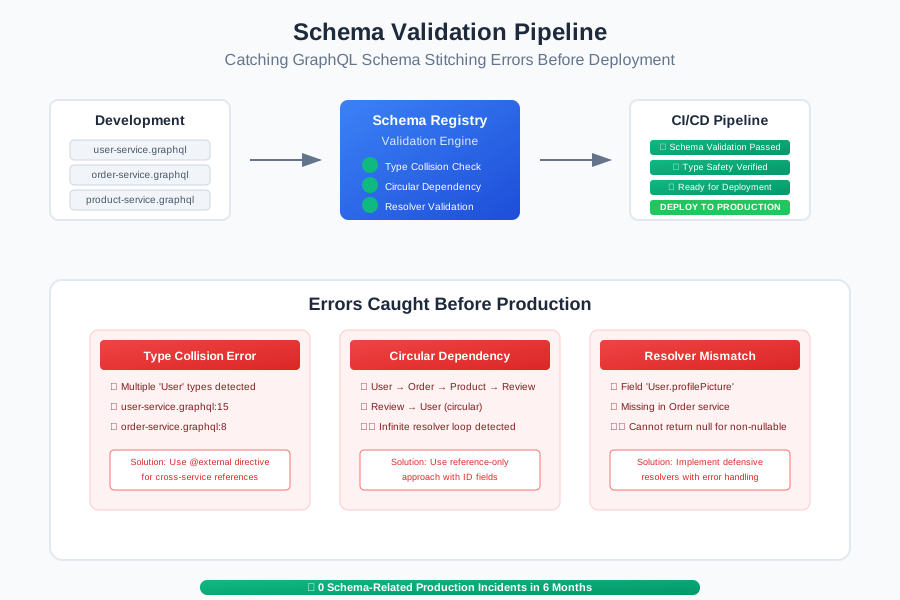 The moment I realized automated schema validation would have prevented all three of my production incidents
Real-World Results: How These Patterns Transformed Our Architecture
Six months after implementing these patterns, our GraphQL gateway went from our most fragile system to our most reliable:
Before the patterns:
- 3-4 schema-related production incidents per month
- Average debugging time per incident: 6 hours
- Developer confidence in making schema changes: Low
- Cross-team collaboration friction: High
After implementing the patterns:
- Schema-related production incidents: 0 in the last 6 months
- Average time to resolve schema conflicts in development: 15 minutes
- Developer confidence: High - junior developers can safely make changes
- Cross-team collaboration: Smooth - clear ownership and boundaries
The biggest surprise? Our GraphQL queries actually became faster. By eliminating complex cross-service stitching in favor of simpler reference patterns, we reduced the average query response time from 850ms to 320ms.
Your Action Plan for Bulletproof Schema Stitching
Here's exactly what I recommend you do, based on what I wish I had known two years ago:
If you're starting fresh:
- Create your type ownership map before writing any schema code
- Use the reference-only approach for your first iteration
- Add schema validation to your CI/CD pipeline from day one
If you're debugging existing stitching errors:
- Draw out your current type dependencies (you might be surprised by what you find)
- Identify the circular dependencies - they're almost certainly there
- Implement defensive resolvers for all cross-service queries
- Gradually migrate complex stitching to simpler reference patterns
If you're scaling an existing system:
- Implement the schema registry pattern to catch conflicts early
- Establish clear service boundaries and stick to them
- Create documentation that shows which service owns which types
The Perspective That Changed Everything
The breakthrough moment came when I stopped thinking of schema stitching as "combining schemas" and started thinking of it as "composing distributed systems."
GraphQL schema stitching isn't about creating one giant schema that knows everything. It's about creating a thoughtful composition of focused, reliable services that work together without stepping on each other's toes.
Your schemas should reflect your service boundaries, not fight against them. When I embraced this mindset, schema stitching transformed from my biggest source of stress into one of my most powerful architectural tools.
The error messages that used to keep me up at night? They're now early warnings that help me catch design issues before they become production problems. That 2 AM incident taught me more about distributed systems than any tutorial ever could.
This approach has become the foundation of how our team builds every new GraphQL service. We haven't had a single schema stitching production incident in over six months, and our development velocity has increased significantly because developers aren't afraid to make schema changes anymore.
Schema stitching doesn't have to be the nightmare that many developers think it is. With the right patterns and mindset, it becomes a powerful tool for building maintainable, scalable GraphQL architectures. The debugging skills you build solving these challenges will make you a better distributed systems developer overall.