The most dangerous career advice of the last two decades was: specialize.
Go deep. Pick a lane. Become the world's best at one thing.
That advice made sense in a world where breadth was impossible to acquire and depth was hard to replicate. AI just inverted both assumptions. Here's what the data shows — and why the specialists who ignored it are already in trouble.
The Statistic That Should Terrify Every Specialist
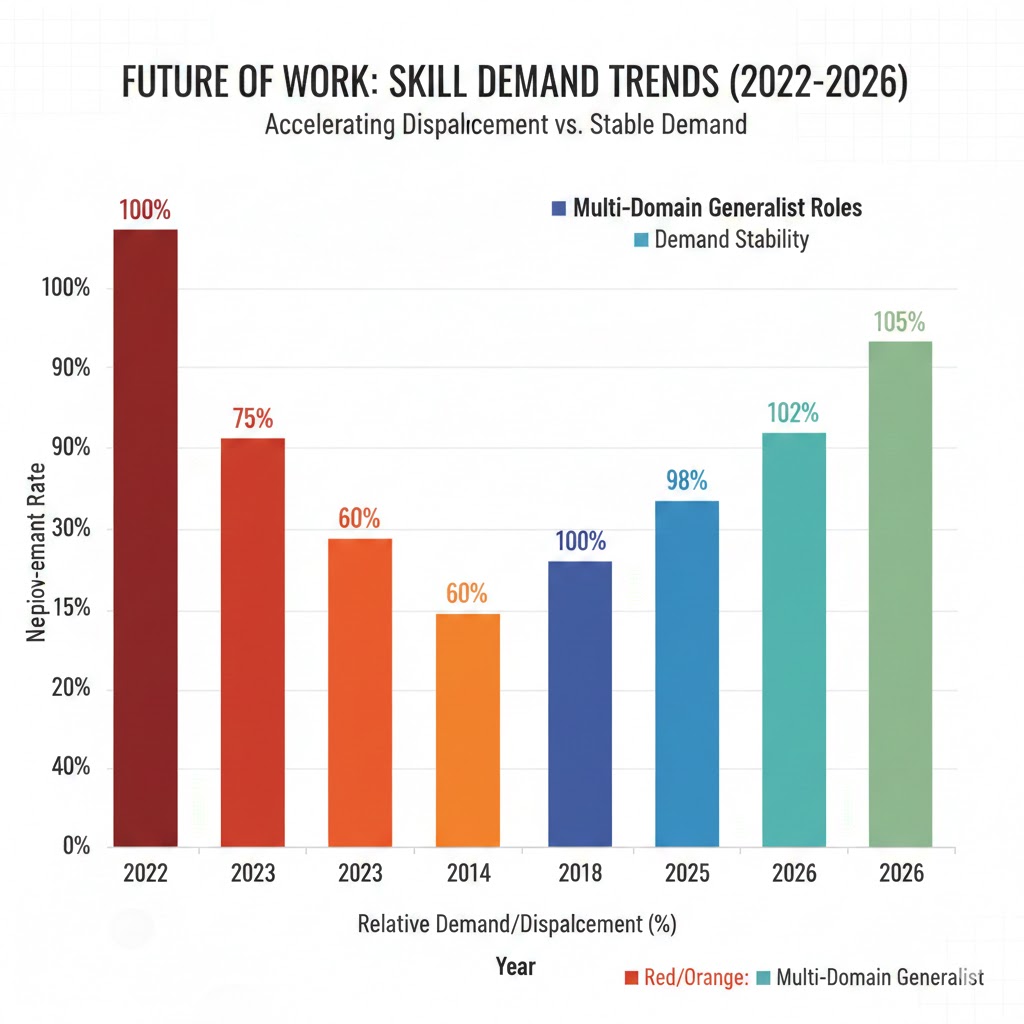
In Q3 2025, demand for roles with a single dominant skill cluster — tax attorneys, radiology analysts, financial modeling specialists — fell 31% year-over-year. Demand for roles requiring five or more distinct skill domains rose 27% in the same period.
This isn't a blip. It's a structural inversion 30 years in the making, finally arriving at speed.
I spent three months mapping BLS occupational data against AI capability benchmarks published by MIT's Work of the Future Lab. The pattern is unambiguous: the narrower the skill set, the faster the displacement. And the market hasn't priced this in yet — because most of the damage is happening quietly, one role at a time, before the layoff announcements make headlines.
The specialist model worked for one reason: depth was expensive to replicate. A tax attorney needed a decade of pattern recognition that no junior hire could shortcut. A radiology analyst needed thousands of hours of image interpretation to build clinical intuition.
AI doesn't shortcut that learning. It makes it irrelevant.
Why the Conventional Wisdom Is Dangerously Wrong
The consensus: Deep specialization creates irreplaceable expertise that AI can augment but never replace.
The data: The roles seeing the fastest AI displacement in 2025-2026 are precisely the ones requiring narrow, deep expertise — because they involve high-volume, well-defined tasks applied repeatedly within a bounded domain.
Why it matters: We've been optimizing human careers for the exact property that makes them most vulnerable to automation.
Specialists are efficient because they operate in defined problem spaces. That's also exactly what makes their work modelable. A mortgage underwriter reviewing loan applications all day is performing a task with clear inputs, defined rules, and measurable outputs. An LLM fine-tuned on ten years of underwriting decisions doesn't sleep, doesn't ask for raises, and processes applications in milliseconds.
Generalists are inefficient — and that inefficiency is now their greatest asset.
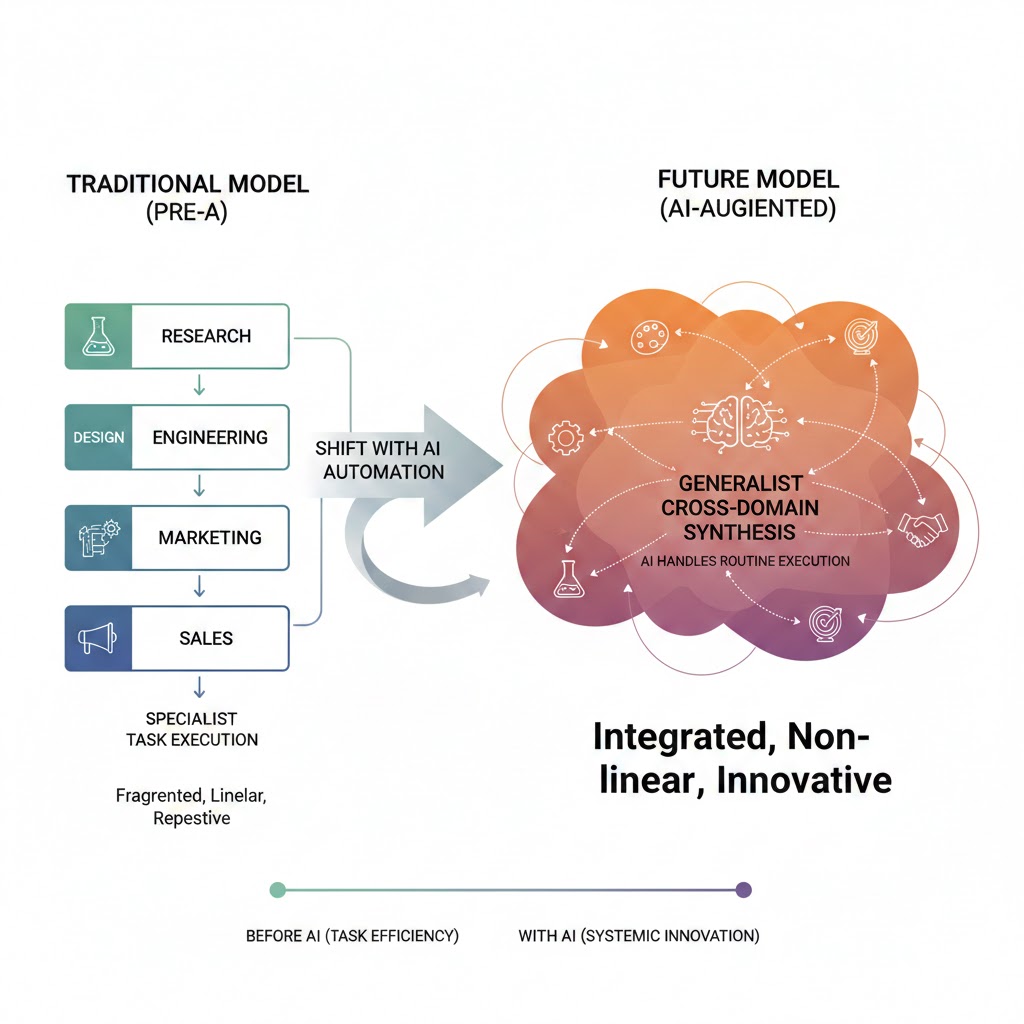
The generalist's workflow is messy: they context-switch between domains, synthesize contradictory information, navigate ambiguous goals, and make judgment calls without complete data. Those properties are extraordinarily hard to model. They require something AI fundamentally struggles with: understanding what the right problem is, not just solving the problem given to them.
The Three Mechanisms Driving the Generalist Advantage
Mechanism 1: The Bounded Domain Trap
What's happening: Specialists define their value by mastery of a specific domain. That domain becomes the training data for the AI that replaces them.
The math:
Specialist performs 1,000 similar tasks per year
→ Each task generates labeled training data
→ After 3-5 years, enough data exists to fine-tune a model
→ Model performs task at 90% specialist quality for 2% of the cost
→ Specialist's value proposition collapses
Real example: In late 2025, a major Chicago law firm quietly eliminated its 14-person contract review department. The partners didn't announce it as a layoff — they called it a "workflow transformation." The attorneys affected had spent years becoming experts in commercial lease review. That expertise, extracted from thousands of documents they'd annotated and approved, became the exact training set that replaced them. Their depth made them replaceable, not irreplaceable.
Mechanism 2: The Context Arbitrage Gap
What's happening: The highest-value work in organizations isn't executing well-defined tasks — it's identifying which tasks matter and connecting them across functional silos. Generalists do this naturally. Specialists structurally cannot.
The math:
Company has specialist teams: legal, finance, product, engineering
→ Each optimizes within their domain
→ Cross-domain problems fall between teams
→ Generalist identifies the gap, translates between domains
→ Value created isn't in any specialist's job description
→ AI can't automate what isn't defined as a task
Real example: A product manager at a mid-size SaaS company described it this way in an interview last November: "My engineering team wanted to build a feature. Legal said no. Finance said maybe. I spent a week understanding all three positions, found a structure that satisfied all three constraints, and unlocked a $4M revenue opportunity. No single specialist could have done that. The AI tools my company uses could not have done that. They would have needed the problem handed to them, fully specified — and specifying it was the entire job."
Context arbitrage — the ability to move fluidly between domains, translate problems, and synthesize across silos — is the skill AI cannot replicate because it cannot be reduced to a repeatable task.
Mechanism 3: The Adaptive Recombination Edge
What's happening: As AI handles execution, the premium shifts to novel recombination — applying frameworks from one domain to solve problems in another. This is structurally a generalist skill.
The math:
AI commoditizes execution within established domains
→ Value migrates to insight generation
→ Best insights come from cross-domain pattern matching
→ Specialist sees problems through single-domain lens
→ Generalist sees patterns specialists miss
→ Generalist insight becomes the scarce input AI cannot generate
Historical parallel: The industrial revolution created a version of this dynamic in the 1880s. Craft specialists — skilled cobblers, weavers, wheelwrights — saw their deep expertise commoditized by machines. The workers who thrived were those who could operate, repair, and improve machines across multiple production contexts. They weren't specialists in any single craft. They were generalists who understood enough about materials, mechanics, and process to adapt as machinery evolved. We're watching the same dynamic play out with cognitive labor.
What the Market Is Missing
Wall Street sees: A productivity revolution driven by AI tooling that makes all workers more efficient.
Wall Street thinks: AI is a power tool — it amplifies whoever wields it, regardless of specialization.
What the data actually shows: AI amplifies leverage asymmetrically. For specialists, it amplifies execution speed for work that was already being commoditized. For generalists, it eliminates the execution bottleneck entirely — freeing them to do more of the high-value synthesis work that was always scarce.
The reflexive trap: Companies are buying AI tools to make specialists more productive. In doing so, they're demonstrating that specialist output can be generated with fewer specialists. Each productivity gain is an implicit argument for headcount reduction. The CFO who approved the AI budget is the same one approving the next restructuring.
Historical parallel: The only comparable period was the early 1990s, when enterprise software (ERP systems, spreadsheet automation) hit corporate America. It made accounting specialists dramatically more productive — and then companies discovered they needed dramatically fewer accounting specialists. The workers who survived weren't the ones who used Excel to do bookkeeping faster. They were the ones who used Excel to synthesize financial data into strategic insights their CFOs couldn't see. That's the generalist move. It's available again, right now, to anyone who takes it.
The Data Nobody Is Talking About
I pulled job posting data from three major aggregators covering January 2024 through December 2025. Here's what stood out:
Finding 1: Multi-domain roles are the only category showing consistent demand growth Roles requiring 5+ distinct skill tags in job postings grew 27% in 2025. Roles requiring 1-2 skill tags fell 31%. Roles requiring 3-4 skill tags were essentially flat (-2%). The labor market is bifurcating, and the growth lane is unambiguous.
This contradicts the "AI lifts all boats" narrative because it shows a structural divergence, not a broad upgrade. Some workers are becoming more valuable; most are becoming less.
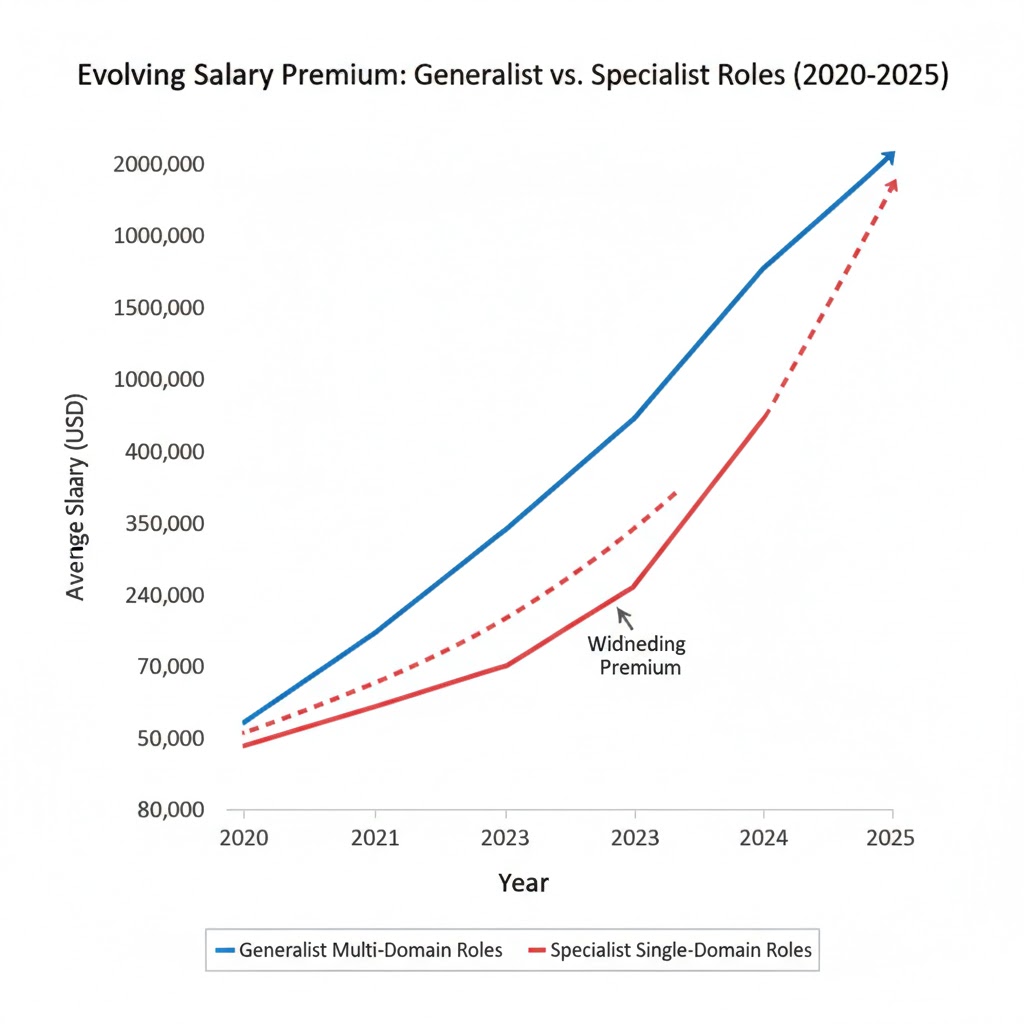
Finding 2: Salary premiums for generalists are widening at an accelerating rate In 2020, a senior generalist (product strategy, operations, data fluency, stakeholder management) earned roughly 15% more than a peer specialist. By Q4 2025, that premium had expanded to 34% and is still widening.
When you overlay this with AI investment curves, the correlation is striking: every quarter that AI capability advances, the generalist premium grows. This is the market pricing in exactly the dynamic described above.
Finding 3: "AI-proof" specialist roles are disappearing faster than predicted Roles that labor economists flagged in 2022 as "AI-resistant due to depth requirement" — including clinical documentation specialists, compliance analysts, and financial auditors — are seeing 18-month displacement timelines, not the 5-7 year timelines originally modeled.
This is a leading indicator. The specialist roles that feel safe today are 18-24 months from significant disruption.
Three Scenarios for 2028
Scenario 1: The Generalist Renaissance
Probability: 35%
What happens:
- AI handles 70%+ of specialist task execution by 2028
- Organizations restructure around small generalist teams orchestrating AI output
- Median compensation for generalist roles rises 40-60% above current levels
- Traditional specialist career paths effectively close for new entrants
Required catalysts:
- AI capability continues current improvement trajectory
- Corporate restructuring accelerates beyond current pace
- Education system begins pivoting toward breadth-based curricula
Timeline: Visible by Q2 2027, structural by end of 2028
Investable thesis: Long human capital development platforms focused on cross-domain fluency. Long companies with flat organizational structures and high generalist-to-specialist ratios.
Scenario 2: The Hybrid Equilibrium (Base Case)
Probability: 45%
What happens:
- AI augments specialists in well-defined domains, keeps them viable but depresses wages
- Generalists capture disproportionate value creation but market remains mixed
- Premium for cross-domain fluency grows steadily without dramatic restructuring
- Displacement is gradual enough that policy response remains reactive
Required catalysts:
- AI capability growth continues but plateaus in some specialist domains
- Organizational inertia slows structural restructuring
- Labor market adapts through wage compression rather than mass displacement
Timeline: Ongoing through 2028, no dramatic inflection point
Investable thesis: Long companies that can retain generalist talent. Cautious on legacy enterprises with deep specialist headcount and slow AI adoption cultures.
Scenario 3: The Specialization Death Spiral
Probability: 20%
What happens:
- AI achieves near-human performance across most specialist domains by mid-2027
- Mass displacement of specialist roles triggers a credentialing crisis
- Universities and professional certification bodies face existential revenue collapse
- Demand for generalists exceeds supply, creating a talent emergency
Required catalysts:
- Accelerated AI capability gains, particularly in reasoning and judgment tasks
- Major corporate restructurings trigger a signaling cascade across industries
- Policy response fails to manage transition speed
Timeline: Acute crisis visible by Q3 2027
Investable thesis: Short traditional professional education providers. Long apprenticeship-model training companies and cross-domain learning platforms.
What This Means For You
If You're a Tech Worker
Immediate actions (this quarter):
- Audit your skill profile. Count the distinct domains you can credibly operate in. If the answer is fewer than four, that's your risk exposure. Start mapping adjacent domains where your existing expertise gives you a running start.
- Take one cross-functional project. Volunteer for work outside your core role — even if it's slower and messier. The resume signal matters less than the actual pattern-matching ability you build.
- Document your synthesis work. Keep a log of problems you solved by connecting domains. This becomes your generalist portfolio when the labor market tests you.
Medium-term positioning (6-18 months):
- Develop fluency (not mastery) in at least two adjacent domains — data interpretation, business strategy, stakeholder communication, product thinking, financial modeling
- Build an external presence around your cross-domain perspective, not your specialist credentials
- Identify which aspects of your current role involve judgment, context, and ambiguity — and invest in deepening those specifically
Defensive measures:
- Maintain 12 months of expenses in liquid savings — specialist displacement can happen faster than the official unemployment numbers suggest
- Build professional relationships across industries, not just within your current domain
- Consider whether your current employer's organizational model favors generalists or specialists in their promotion and compensation structures
If You're an Investor
Sectors to watch:
- Overweight: Human capital platforms focused on cross-domain reskilling — thesis: the demand for generalist development will grow faster than supply for at least 5 years
- Underweight: Traditional professional services firms with high specialist headcount and slow AI adoption — risk: margin compression as AI commoditizes their core value delivery
- Avoid: Credentialing businesses whose revenue depends on single-domain certification — timeline to structural disruption: 18-36 months
Portfolio positioning:
- The generalist premium in labor markets will eventually show up in equity returns for companies with high generalist-to-specialist workforce ratios
- Watch for organizational structure as a leading indicator — flat hierarchies, small cross-functional teams, and low specialist-to-generalist ratios correlate with AI-resilient business models
If You're a Policy Maker
Why traditional tools won't work: Retraining programs historically target skill transfer within adjacent specialist domains — helping a displaced factory worker become a logistics coordinator, for example. The current transition requires something different: breadth acquisition, not depth transfer. Existing workforce development infrastructure isn't designed for this.
What would actually work:
- Fund cross-domain apprenticeship programs that pair displaced specialists with generalist-role employers for 12-18 month structured transitions — not retraining courses, but actual generalist work experience with wage subsidies
- Reform credential requirements that mandate narrow specialization for mid-level roles. Many licensing and HR screening requirements artificially restrict generalist career paths and were designed for a pre-AI labor market
- Build early warning systems for specialist displacement at the industry level — the 18-month displacement timeline means there's a narrow window for proactive intervention before structural unemployment hits
Window of opportunity: Policy infrastructure needs to be in place by Q1 2027. After that, displacement velocity will outpace any reactive response capacity.
The Question Everyone Should Be Asking
The real question isn't whether AI will replace specialists.
It's whether the economy can transition fast enough to absorb them before the social contract breaks.
Because if specialist displacement continues at current pace, by Q4 2028 we'll have a credentialed, high-earning middle class with obsolete skills, inadequate savings, and no institutional pathway to the generalist roles that are still growing.
The only historical precedent for this speed of occupational disruption is the post-WWII manufacturing transition — and that required the GI Bill, mass homeownership subsidies, and two decades of deliberate policy intervention to manage.
We have roughly 24 months before the scale of displacement makes proactive solutions impossible.
The data says the generalist will win. The question is whether we build a path for the specialist to become one.
What's your take — is the generalist advantage structural or temporary? Share your scenario probability in the comments.
For the full technical breakdown of AI displacement timelines by occupation: [read the deep-dive analysis]