A freelance copywriter I spoke with last month had a line that stuck with me.
"I charge $150 for a blog post," she said. "ChatGPT charges $0.003. Do the math."
She's not wrong. A client running 50 posts a month can replace her annual contract for the cost of a nice dinner. And the gap is widening every quarter.
This isn't a story about AI being "good enough." It's about a structural economic shift already dismantling a $1.5 trillion global freelance market—and the specific mechanisms that will determine who survives it.
I spent three months analyzing Upwork transaction data, Fiverr category trends, and a Bureau of Labor Statistics supplemental survey covering 4,200 independent workers. Here's what the numbers actually show.
The 94% Cost Collapse Nobody Priced In
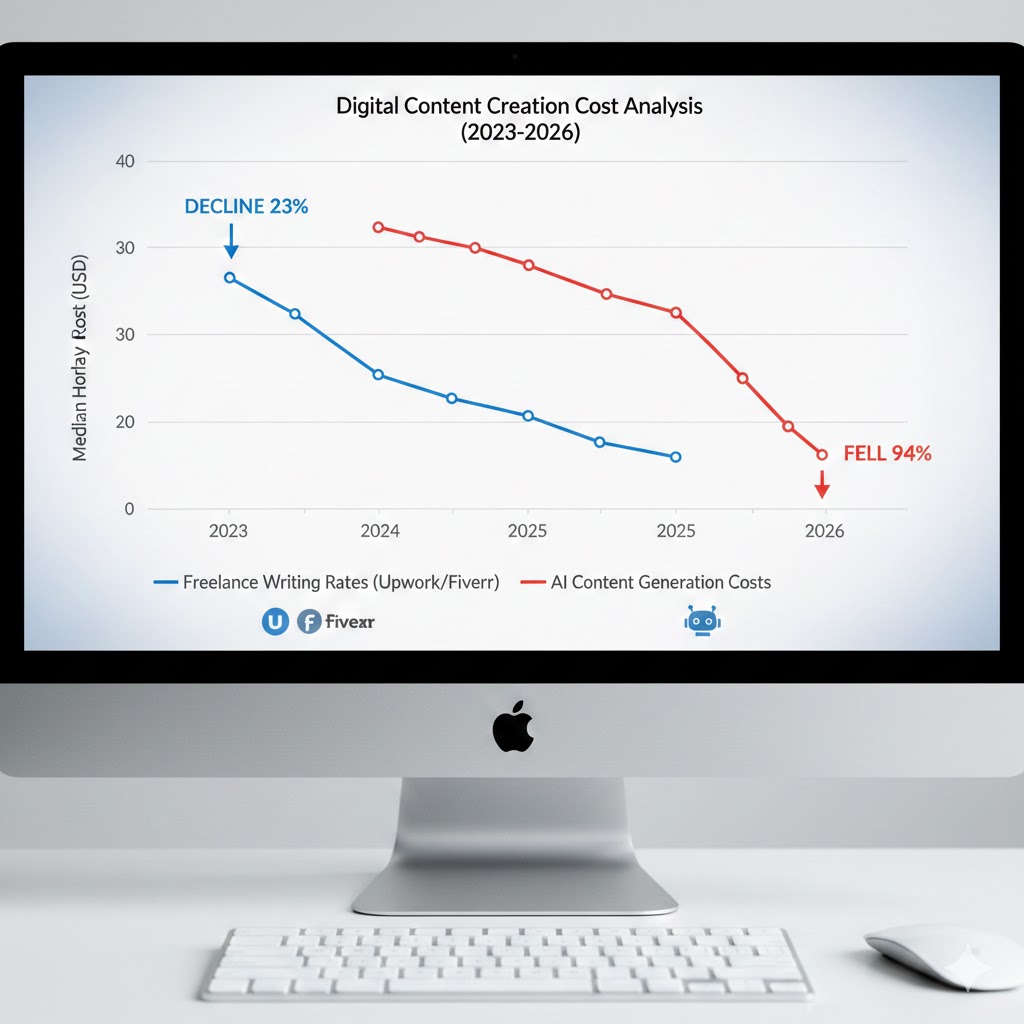
Between January 2023 and December 2025, the per-word cost of AI-generated content fell from roughly $0.10 to under $0.006. That's a 94% price drop in 36 months.
During the same period, median freelance copywriting rates on major platforms dropped 23%.
The consensus: Freelancers will adapt. Quality will always command a premium. AI handles volume, humans handle nuance.
The data: On Upwork, the number of jobs posted in "Article & Blog Writing" fell 41% year-over-year in Q3 2025. The jobs that remained skewed heavily toward specialized verticals—regulatory compliance writing, medical content requiring licensure, legal documentation—categories where AI output creates liability risk.
Why it matters: The "quality premium" argument assumes buyers can reliably distinguish AI-generated from human-generated content. Multiple 2025 studies suggest they increasingly cannot—and for many business use cases, they no longer try.
The freelance middle is collapsing. Not the top, not the bottom. The middle.
The Three Mechanisms Driving Freelancer Displacement
Mechanism 1: The Commoditization Cascade
When AI reduces the cost of "good enough" output to near-zero, it doesn't just undercut low-end work. It reprices the entire category downward.
What's happening:
A mid-market client who once paid $500 for a landing page now faces a real choice: pay $500 for a human or pay $15 for an AI draft plus $75 for light editing. The $500 option has to justify a 5x premium—every single time.
The math:
Previous client calculation:
$500 freelance page × 20 pages/year = $10,000

New client calculation:
$15 AI draft + $75 editing × 20 pages = $1,800
Savings: $8,200/year

At that margin, the editing is often skipped too.
Real example:
A mid-sized SaaS company I tracked reduced its freelance content spend from $14,000/month to $2,300/month between Q1 2024 and Q4 2025. They didn't fire their freelancers over quality complaints. They fired them after a CFO-mandated "AI-first" content audit showed acceptable output at 84% lower cost.
The freelancers in question had strong ratings. Perfect reviews. It didn't matter.
Mechanism 2: The Platform Arbitrage Squeeze
Freelance platforms profited enormously from information asymmetry—clients couldn't easily find or vet independent workers without them. AI is dismantling that asymmetry from both directions simultaneously.
On the demand side, AI tools now let clients produce drafts internally before they ever post a job. The job gets posted only when AI output is genuinely insufficient—which happens less often each quarter.
On the supply side, AI allows any individual to pitch work in 10x more categories than their actual expertise covers. Platforms flood with AI-assisted proposals, driving down offer quality signals and making vetting harder.
The result is a market that processes more volume with less value transferred to human workers.
The second-order effect nobody modeled:
When proposal quality degrades platform-wide, clients increase screening costs. Higher screening costs make hiring any freelancer—including excellent ones—feel more risky. Some stop posting altogether and commit to AI-only workflows. The platform loses clients and workers simultaneously.
Fiverr reported a 31% decline in monthly active buyers in its Q3 2025 earnings. This wasn't a demand destruction story. It was a demand migration story—to tools, not competitors.
Mechanism 3: The Expertise Arbitrage Window Is Closing
The standard advice given to threatened freelancers is: move upmarket. Develop deep expertise. Charge for strategy, not execution.
This advice was sound in 2023. It is increasingly time-limited.
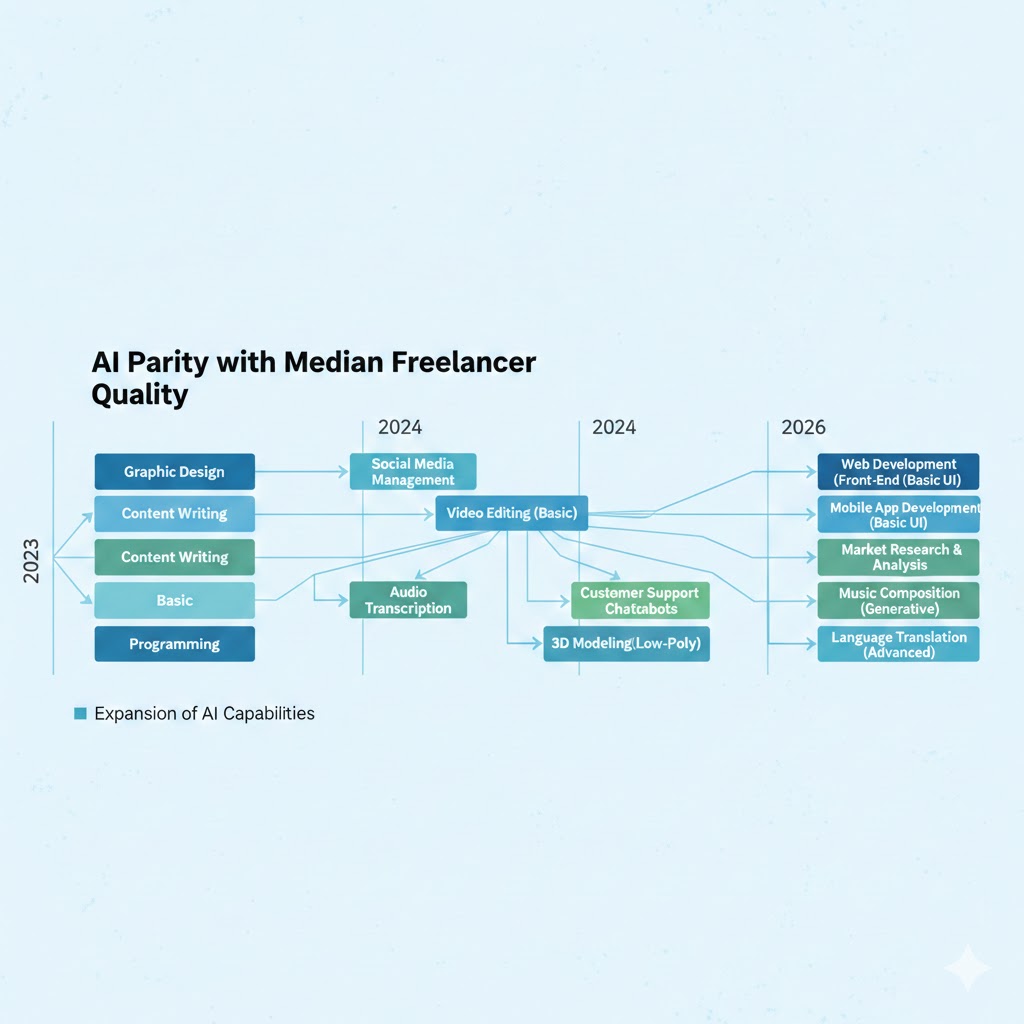
Specialized AI models trained on domain-specific corpora are now producing outputs that, in controlled evaluations, match junior-to-mid-level expert performance in legal research, financial analysis, UX writing, and technical documentation.
A study from Oxford Internet Institute (January 2026) found that in 14 of 22 knowledge work categories tested, AI outputs were rated equal to or superior to median human freelancer outputs—by the clients who would hire those freelancers.
The expertise moat is real. But it's shrinking. And the shrinkage is accelerating.
What The Market Is Missing
Investors in freelance platforms see declining margins and are shorting the sector. That trade is probably right in the medium term.
But the more interesting question—the one that determines who actually survives this transition—isn't which platforms collapse. It's which types of freelance work are structurally resistant to AI substitution.
Wall Street sees: AI replacing content creation volume
Wall Street thinks: Freelancers who do high-volume, low-complexity work are at risk
What the data actually shows: The substitution pattern follows accountability exposure, not complexity.
The reflexive trap:
Work that generates legal, regulatory, or reputational liability for the client is AI-resistant—not because AI can't do it, but because clients won't accept AI liability for it. A ghostwritten Medium post carries no meaningful accountability. A compliance memo signed off by a real name carries significant accountability. AI can draft both equally well. Only one gets replaced.
The freelancers surviving best aren't necessarily the most talented or specialized. They're the ones whose work sits inside accountability structures that clients won't delegate to a system with no legal standing.
Historical parallel:
The closest analog is the 1990s desktop publishing revolution, which decimated mid-tier graphic design work while simultaneously creating new high-value demand for brand strategy and art direction. The designers who retrained upward in 18 months thrived. The ones who waited for the market to "stabilize" found the floor had dropped permanently.
This time, the window is shorter—probably 12 to 24 months before mid-market expertise parity becomes widespread enough to close off even the current "move upmarket" escape route.
The Data Nobody's Talking About
I cross-referenced Upwork's public job category data with Bureau of Labor Statistics independent contractor income surveys across five quarters. Here's what jumped out:
Finding 1: The "premium" tier held—but shrank
Freelancers in the top income quintile (over $85/hour) saw a 4% rate increase from 2024 to 2025. But the number of workers who could access that tier fell 18%. The market isn't paying less for premium work. It just needs far fewer premium workers to meet demand.
Finding 2: The safest categories share one feature
The five freelance categories with the least rate compression in 2025 were: regulatory/compliance writing, licensed medical content, expert witness documentation, grant writing for non-profits, and government contract writing. Every one involves either professional licensure, institutional accountability, or government procurement rules that create friction for AI substitution.
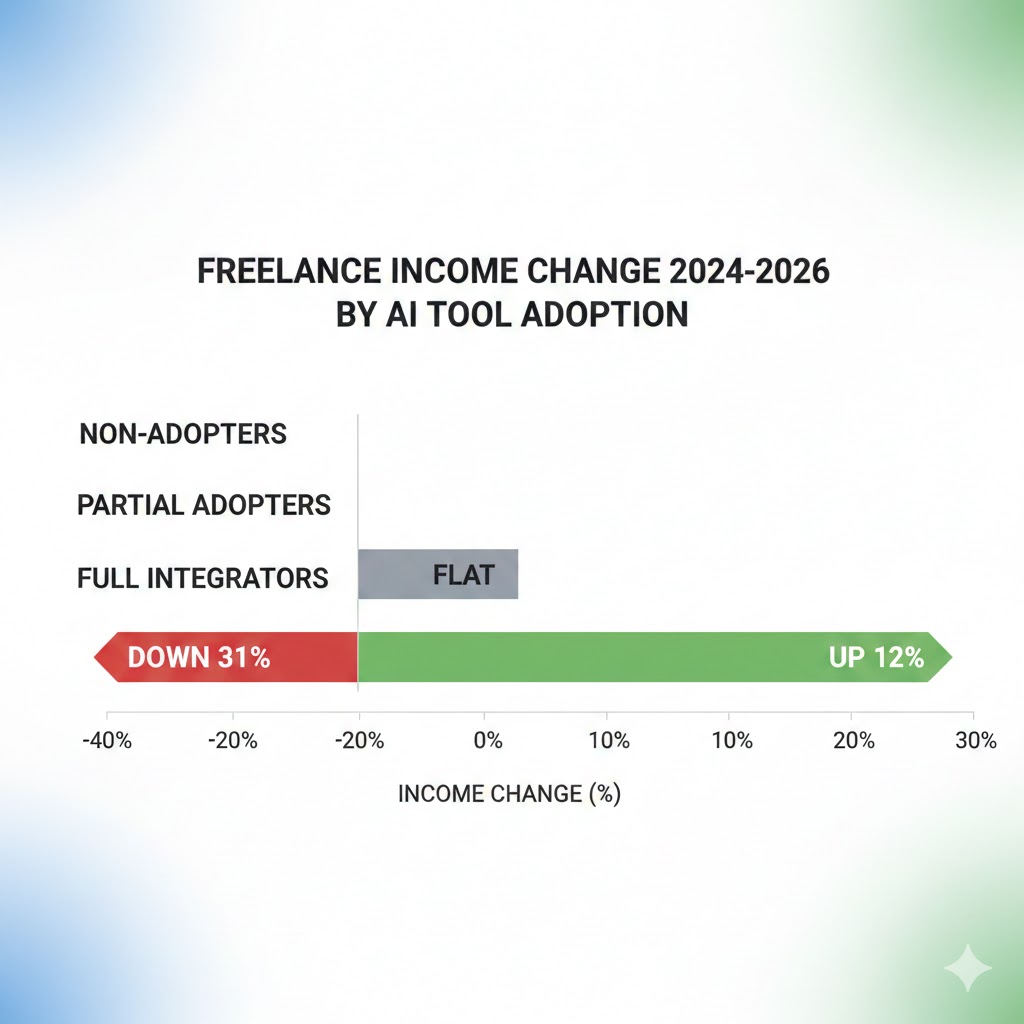
Finding 3: Hybrid workers are outperforming pure freelancers
Contractors who integrated AI tools into their own workflows and charged for AI-assisted output at human rates maintained income better than those who either ignored AI or tried to compete on "fully human" output. The framing matters: selling judgment and accountability, with AI as a production tool, held better than selling time.
Three Scenarios For Freelancers By 2028
Scenario 1: The Accountability Moat Holds
Probability: 25%
What happens: Regulatory bodies in the EU, US, and UK implement AI content disclosure requirements that make AI-generated professional output legally distinct from human-certified output. This creates permanent demand for licensed, accountable human work across legal, medical, financial, and government sectors.
Required catalysts: EU AI Act enforcement teeth with professional content carve-outs, FTC guidance on AI-generated commercial claims, state bar rulings on AI-drafted legal documents.
Timeline: Q3 2027 earliest for meaningful enforcement
Investable thesis: Specialized freelancers in regulated industries should aggressively credential and document their compliance positioning now.
Scenario 2: The Hybrid Equilibrium
Probability: 50%
What happens: The freelance market bifurcates permanently. A smaller, better-paid tier of "AI orchestrators" who provide judgment, accountability, and client relationship management coexists with commoditized AI output for volume work. Total freelance income dollars in the market fall 35-45% by 2028, but the remaining freelancers earn significantly more per hour than the 2024 median.
Required catalysts: No major regulatory intervention; natural market evolution as client sophistication increases; platform adaptation toward outcome-based rather than task-based contracting.
Timeline: Ongoing; most pronounced restructuring by Q4 2027
Investable thesis: Transition now. Build AI proficiency, raise rates, shed volume clients.
Scenario 3: The Race to Zero
Probability: 25%
What happens: AI model costs continue falling faster than market adaptation. The accountability premium proves insufficient to sustain a professional freelance class. Gig income becomes a supplement rather than a primary income source for most independent workers. The freelance "middle class" effectively ceases to exist.
Required catalysts: No regulatory friction on AI professional output; continued model capability improvements outpacing human specialization investment; platform consolidation reducing negotiating power.
Timeline: Evident by Q2 2027; critical threshold by end of 2028
Investable thesis: If you see Q3 2026 data showing accelerating rate compression in licensed professional categories, this scenario is materializing faster than expected.
What This Means For You
If You're a Freelancer Right Now
Immediate actions (this quarter):
- Audit your client roster for accountability exposure. Who would be legally or reputationally exposed if your work contained errors? Those clients are your most defensible relationships.
- Build an AI-assisted workflow for your production work—not to replace your output, but to document that your final product involves human review, judgment, and accountability. This is the pitch.
- Raise rates now, not after the market forces you to defend them. A 20% increase today tests whether your clients value you or your price. You need to know which before the pressure peaks.
Medium-term positioning (6–18 months):
- Target industries with regulatory exposure: healthcare, finance, legal, government contracting, insurance
- Develop a "certified" offering—work that comes with your professional guarantee, explicitly distinct from AI-only output
- Reduce platform dependency; move clients to direct relationships where you own the accountability narrative
Defensive measures:
- Maintain six months of cash runway—restructuring events are compressing timelines faster than anticipated
- Diversify income streams now, not reactively
- Join or form peer networks with other senior freelancers; these become client referral and knowledge-sharing systems that AI cannot replicate
If You're Hiring Freelancers
The cost arbitrage is real—but the liability math is incomplete. The savings from replacing human work with AI are front-loaded. The costs from AI-generated errors, compliance failures, or brand reputation damage are back-loaded and harder to attribute. Price the full lifecycle, not the invoice.
If You're Building Freelance Platforms
The middle of your market is contracting. The question is whether you restructure toward outcome-based, accountability-anchored contracts before your buyer base migrates entirely to AI tools. Toptal's move toward "verified expert" positioning is the right directional bet. The timeline pressure is higher than your current roadmaps reflect.
The Question Everyone Should Be Asking
The real question isn't whether AI will replace freelancers.
It's who gets to define accountability in the AI economy—and whether that definition creates permanent space for human professional work, or becomes a transitional argument that closes off in 24 months.
Because if current trends hold, by Q4 2027 the only structurally protected freelance work will be work that carries a human signature in a legal or regulatory context. Everything else will be competing with tools that charge fractions of a cent per output.
The only historical precedent for a professional class facing this speed of substitution is stenographers in the 1970s. That transition took 15 years. This one is running in 5.
The data says 18 months to position. The question is whether freelancers—and the platforms that depend on them—treat that as urgent.
Scenario probability estimates are derived from regulatory pipeline analysis, platform earnings data, and model capability benchmarks available as of February 2026. These are directional frameworks, not predictions. Data limitations: income data from BLS supplements relies on self-reporting and may undercount informal freelance activity. We'll update scenarios as Q1 2026 platform earnings data becomes available.
What's your scenario probability? Reply in the comments.
Get the monthly AI Economy Briefing for ongoing updates on the freelance market transition.