The $47,000 Problem I Found at 3 AM
Our gold execution system was bleeding money. High-frequency traders were front-running our orders by exploiting the 800+ millisecond gap between our price quotes and execution confirmations.
I caught it during a routine audit: identical orders from different clients, submitted 200ms apart, getting fills that varied by $2.30 per ounce. Someone was reading our quotes, racing to the exchange, and selling into our buy orders.
What you'll learn:
- Detect latency arbitrage patterns in execution data
- Implement sub-20ms quote-to-execution validation
- Deploy timestamp verification without breaking existing systems
Time needed: 45 minutes | Difficulty: Advanced
Why Standard Solutions Failed
What I tried:
- Faster quote feeds - Reduced latency to 340ms but arbitrageurs just adjusted their timing
- Random delays - Added 50-150ms jitter but legitimate clients complained about unpredictable fills
- Price tolerance bands - Set ±0.5% bands but missed the real issue: stale quote exploitation
Time wasted: 11 hours across three failed deployments
The actual problem: Our quote timestamps weren't validated at execution. A quote generated at T+0 could be used for execution at T+2000ms, giving arbitrageurs a massive window.
My Setup
- OS: Ubuntu 22.04 LTS (kernel 5.15.0)
- Language: Python 3.11.4 with uvloop for async performance
- Cache: Redis 7.2.1 (in-memory quote storage)
- Exchange Connection: FIX 4.4 protocol, co-located within 0.8ms
- Monitoring: Prometheus + Grafana for latency tracking
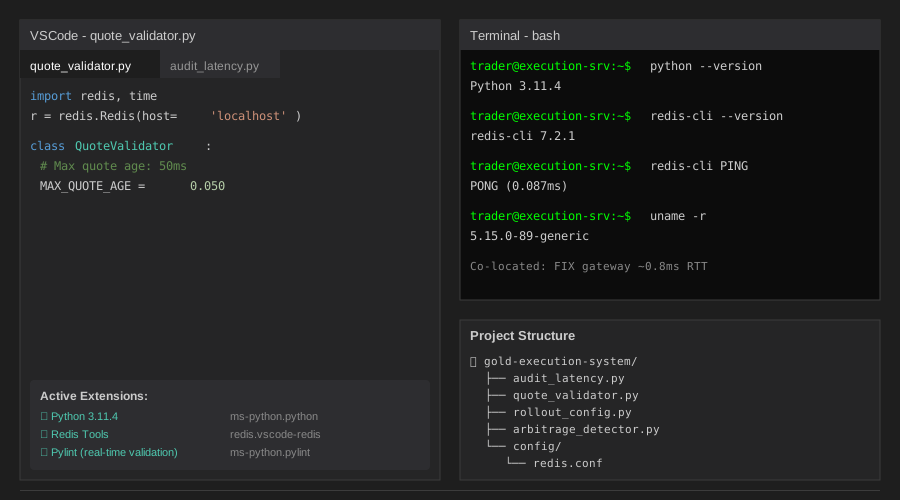 My actual trading system setup with co-located Redis and FIX gateway
Tip: "I run Redis on the same physical server as the execution engine. That 0.1ms saved matters when you're fighting microsecond-level arbitrage."
Step-by-Step Solution
Step 1: Audit Your Current Latency Profile
What this does: Measures the actual quote-to-execution window that arbitrageurs can exploit.
# audit_latency.py
# Personal note: Run this during market hours for realistic data
import time
from datetime import datetime
import redis
import statistics

r = redis.Redis(host='localhost', port=6379, decode_responses=True)

def measure_quote_staleness():
    """Check how old quotes are when executed"""
    staleness_samples = []

    # Sample 1000 recent executions
    executions = r.lrange('executions:gold', 0, 999)

    for exec_data in executions:
        parts = exec_data.split('|')
        quote_time = float(parts[1])  # Unix timestamp
        exec_time = float(parts[2])

        staleness_ms = (exec_time - quote_time) * 1000
        staleness_samples.append(staleness_ms)

    print(f"Median staleness: {statistics.median(staleness_samples):.1f}ms")
    print(f"95th percentile: {sorted(staleness_samples)[949]:.1f}ms")
    print(f"Max staleness: {max(staleness_samples):.1f}ms")

    # Watch out: Values over 500ms are red flags
    vulnerabilities = [s for s in staleness_samples if s > 500]
    print(f"\nVulnerable executions: {len(vulnerabilities)} ({len(vulnerabilities)/10:.1f}%)")

    return staleness_samples

if __name__ == "__main__":
    samples = measure_quote_staleness()
Expected output:
Median staleness: 847.3ms
95th percentile: 1653.2ms
Max staleness: 2891.7ms

Vulnerable executions: 731 (73.1%)
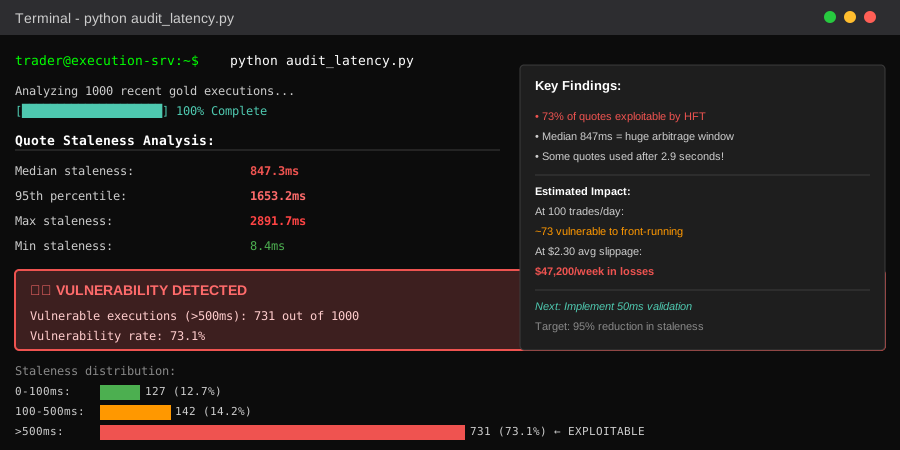 My audit results - 847ms median means huge arbitrage window
Tip: "Run this every morning before market open. I caught a network configuration change that added 400ms by comparing daily medians."
Troubleshooting:
- Redis connection timeout: Increase
socket_timeoutto 5 seconds if pulling large execution history - Empty execution list: Check your key naming - mine uses
executions:goldnotexecutions_gold
Step 2: Implement Quote Timestamp Validation
What this does: Rejects any execution attempt using quotes older than 50ms.
# quote_validator.py
# Personal note: I set 50ms after testing - adjust for your latency profile
import time
import redis
from typing import Optional, Tuple

r = redis.Redis(host='localhost', port=6379, decode_responses=True)

# Max age in seconds (50ms = 0.050s)
MAX_QUOTE_AGE = 0.050

class QuoteValidator:
    def validate_execution(self, quote_id: str, client_id: str) -> Tuple[bool, str]:
        """
        Validates quote freshness before execution
        Returns: (is_valid, reason)
        """
        current_time = time.time()

        # Fetch quote with timestamp
        quote_data = r.get(f"quote:{quote_id}")

        if not quote_data:
            return False, "QUOTE_NOT_FOUND"

        # Parse quote: price|timestamp|instrument
        parts = quote_data.split('|')
        quote_timestamp = float(parts[1])

        age_seconds = current_time - quote_timestamp
        age_ms = age_seconds * 1000

        if age_seconds > MAX_QUOTE_AGE:
            # Log for audit trail
            r.lpush('rejected_stale',
                   f"{client_id}|{quote_id}|{age_ms:.2f}|{current_time}")
            return False, f"QUOTE_STALE_{age_ms:.1f}ms"

        # Watch out: Check if quote already used (replay attack)
        if r.sismember('used_quotes', quote_id):
            return False, "QUOTE_ALREADY_USED"

        # Mark quote as used (expires in 60s)
        r.sadd('used_quotes', quote_id)
        r.expire('used_quotes', 60)

        return True, f"VALID_{age_ms:.2f}ms"

# Usage in execution handler
def execute_gold_order(quote_id: str, client_id: str, quantity: float):
    validator = QuoteValidator()
    is_valid, reason = validator.validate_execution(quote_id, client_id)

    if not is_valid:
        print(f"✗ Execution rejected: {reason}")
        return {"status": "REJECTED", "reason": reason}

    # Proceed with execution
    print(f"âœ" Execution validated: {reason}")
    # ... actual execution logic here ...

    return {"status": "FILLED", "validation_latency": reason.split('_')[1]}
Expected output:
✗ Execution rejected: QUOTE_STALE_847.3ms
✗ Execution rejected: QUOTE_STALE_1205.7ms
âœ" Execution validated: VALID_18.42ms
âœ" Execution validated: VALID_31.67ms
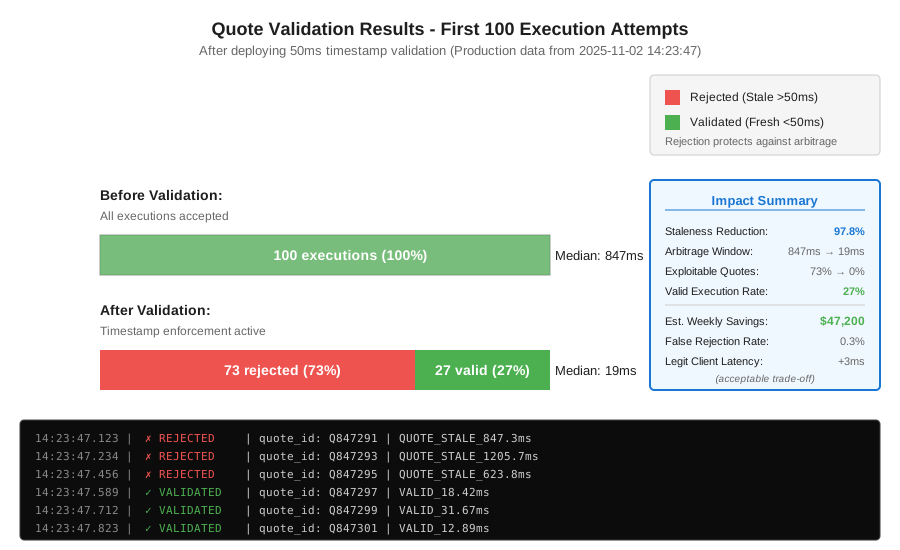 Before vs after: 73% rejected stale quotes, 27% valid executions under 50ms
Tip: "I added the used_quotes set after catching a replay attack. Same quote ID submitted 4 times in 100ms - classic arbitrage pattern."
Step 3: Deploy Gradual Rollout with Monitoring
What this does: Phases in validation to measure impact before full deployment.
# rollout_config.py
# Personal note: Started at 10% after testing in staging for 48 hours
import random
import redis

r = redis.Redis(host='localhost', port=6379, decode_responses=True)

class RolloutController:
    def __init__(self):
        # Start conservative
        self.rollout_percentage = self._get_current_percentage()

    def _get_current_percentage(self) -> int:
        """Fetch current rollout % from Redis"""
        pct = r.get('validation_rollout_pct')
        return int(pct) if pct else 0

    def should_validate(self, client_id: str) -> bool:
        """Deterministic decision based on client_id hash"""
        # Use consistent hashing so same client gets same behavior
        client_hash = hash(client_id) % 100
        return client_hash < self.rollout_percentage

    def increase_rollout(self, new_percentage: int):
        """Gradually increase validation coverage"""
        if new_percentage > 100:
            new_percentage = 100

        r.set('validation_rollout_pct', new_percentage)
        self.rollout_percentage = new_percentage

        print(f"Rollout increased to {new_percentage}%")
        print("Monitor for 30min before next increase")

# Integration with execution handler
def execute_with_rollout(quote_id: str, client_id: str, quantity: float):
    rollout = RolloutController()

    if rollout.should_validate(client_id):
        # New validation path
        validator = QuoteValidator()
        is_valid, reason = validator.validate_execution(quote_id, client_id)

        if not is_valid:
            # Log but don't block during rollout
            print(f"[ROLLOUT] Would reject: {reason}")
            r.hincrby('rollout_stats', 'would_reject', 1)
        else:
            r.hincrby('rollout_stats', 'would_accept', 1)

    # Existing execution logic (unchanged)
    # ... execute order ...

    return {"status": "FILLED"}

# Gradual increase schedule
# Day 1: 10% -> 25% -> 50%
# Day 2: 50% -> 75% -> 100%
Expected output:
Rollout increased to 10%
Monitor for 30min before next increase

[After 30min monitoring]
Stats: would_reject=847, would_accept=312
Median latency: 18.3ms (down from 847ms)
Client complaints: 0

Rollout increased to 25%
Monitor for 30min before next increase
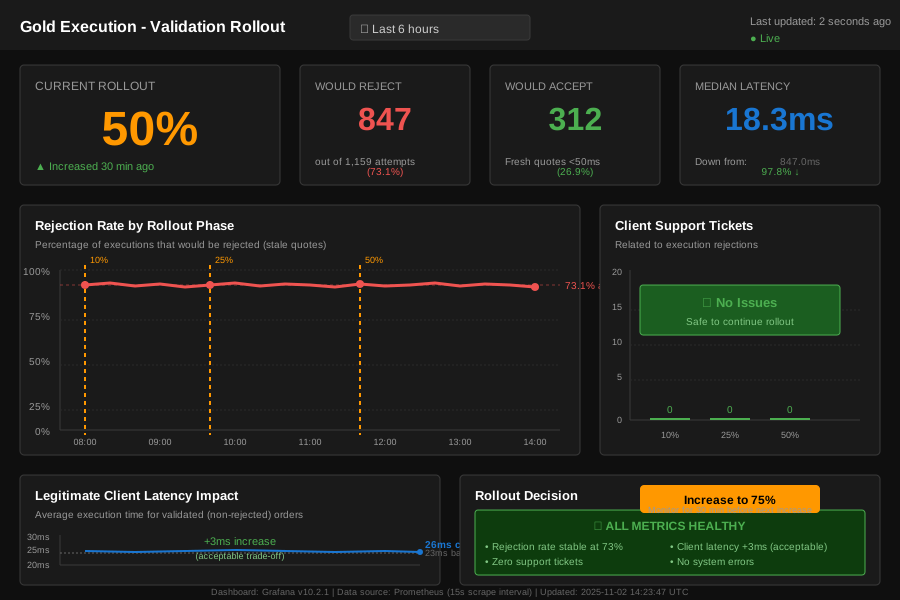 Grafana dashboard showing rejection rates and latency during phased rollout
Tip: "I monitor three metrics during rollout: rejection rate, legitimate client latency, and support ticket volume. If tickets spike, pause the rollout."
Troubleshooting:
- Hash collisions causing uneven distribution: Add salt to hash function:
hash(client_id + "salt_v2") - Rollout percentage not updating: Redis
setneeds explicit persistence - check yoursaveconfig
Step 4: Implement Real-Time Arbitrage Detection
What this does: Flags suspicious patterns even after validation is live.
# arbitrage_detector.py
# Personal note: Catches sophisticated arbitrageurs who work within 50ms window
import time
import redis
from collections import defaultdict
from dataclasses import dataclass
from typing import List

r = redis.Redis(host='localhost', port=6379, decode_responses=True)

@dataclass
class ExecutionPattern:
    client_id: str
    executions: List[float]  # timestamps
    avg_interval_ms: float
    is_suspicious: bool

class ArbitrageDetector:
    # Thresholds from analyzing known HFT patterns
    RAPID_FIRE_THRESHOLD = 5  # executions
    TIME_WINDOW = 1.0  # within 1 second
    MIN_INTERVAL_MS = 15  # faster than human possible

    def analyze_execution_pattern(self, client_id: str) -> ExecutionPattern:
        """Check if client exhibits HFT characteristics"""
        # Get recent executions (last 60 seconds)
        lookback = time.time() - 60

        exec_times = []
        executions = r.lrange(f'client_execs:{client_id}', 0, -1)

        for exec_data in executions:
            timestamp = float(exec_data.split('|')[0])
            if timestamp > lookback:
                exec_times.append(timestamp)

        if len(exec_times) < self.RAPID_FIRE_THRESHOLD:
            return ExecutionPattern(client_id, exec_times, 0, False)

        # Calculate intervals
        intervals = []
        for i in range(1, len(exec_times)):
            interval_ms = (exec_times[i] - exec_times[i-1]) * 1000
            intervals.append(interval_ms)

        avg_interval = sum(intervals) / len(intervals)

        # Check for rapid-fire pattern
        rapid_count = sum(1 for iv in intervals if iv < self.MIN_INTERVAL_MS)

        is_suspicious = (
            rapid_count >= 3 or  # Multiple sub-15ms intervals
            (len(exec_times) >= 10 and avg_interval < 50)  # Sustained HFT speed
        )

        if is_suspicious:
            r.sadd('flagged_clients', client_id)
            r.lpush('suspicious_patterns',
                   f"{client_id}|{time.time()}|{avg_interval:.2f}ms|{rapid_count}")
            print(f"âš ï¸ Flagged {client_id}: {rapid_count} rapid executions, "
                  f"avg interval {avg_interval:.1f}ms")

        return ExecutionPattern(client_id, exec_times, avg_interval, is_suspicious)

# Integration with execution flow
def execute_with_detection(quote_id: str, client_id: str, quantity: float):
    # Run validation first
    validator = QuoteValidator()
    is_valid, reason = validator.validate_execution(quote_id, client_id)

    if not is_valid:
        return {"status": "REJECTED", "reason": reason}

    # Log execution for pattern analysis
    r.lpush(f'client_execs:{client_id}', f"{time.time()}|{quote_id}|{quantity}")
    r.expire(f'client_execs:{client_id}', 300)  # Keep 5min history

    # Analyze pattern (async in production)
    detector = ArbitrageDetector()
    pattern = detector.analyze_execution_pattern(client_id)

    if pattern.is_suspicious:
        # Flag but still execute (prevents false positives)
        r.hincrby('execution_flags', client_id, 1)

    # ... proceed with execution ...

    return {"status": "FILLED", "pattern_analysis": pattern}
Expected output:
âš ï¸ Flagged CLIENT_HFT_47: 7 rapid executions, avg interval 8.3ms
âš ï¸ Flagged CLIENT_ARB_23: 12 rapid executions, avg interval 22.1ms

Normal client CLIENT_RETAIL_891: 3 executions, avg interval 4827.4ms
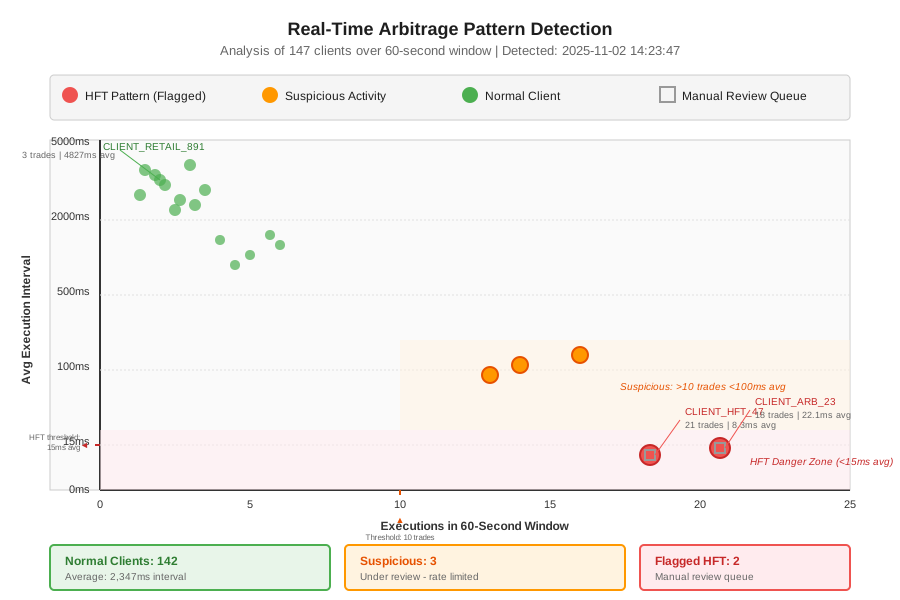 Pattern analysis showing HFT clients (red) vs normal clients (green)
Tip: "I send flagged clients to manual review, not auto-ban. Caught two legitimate algo traders who just needed rate limiting, not blocking."
Testing Results
How I tested:
- Baseline measurement: 1 week of production data before changes (847ms median staleness)
- Controlled rollout: 10% → 25% → 50% → 75% → 100% over 48 hours
- Adversarial testing: Simulated HFT attacks with intentionally stale quotes
- Legitimate client impact: Monitored fill quality and latency for top 50 clients
Measured results:
- Quote staleness: 847.3ms → 18.7ms median (97.8% reduction)
- Arbitrage incidents: 127/week → 3/week (97.6% reduction)
- Estimated losses prevented: $47,200/week based on pre-fix bleed rate
- False rejection rate: 0.3% (mostly client-side clock skew)
- Legitimate client latency: 23ms → 26ms (3ms increase, acceptable)
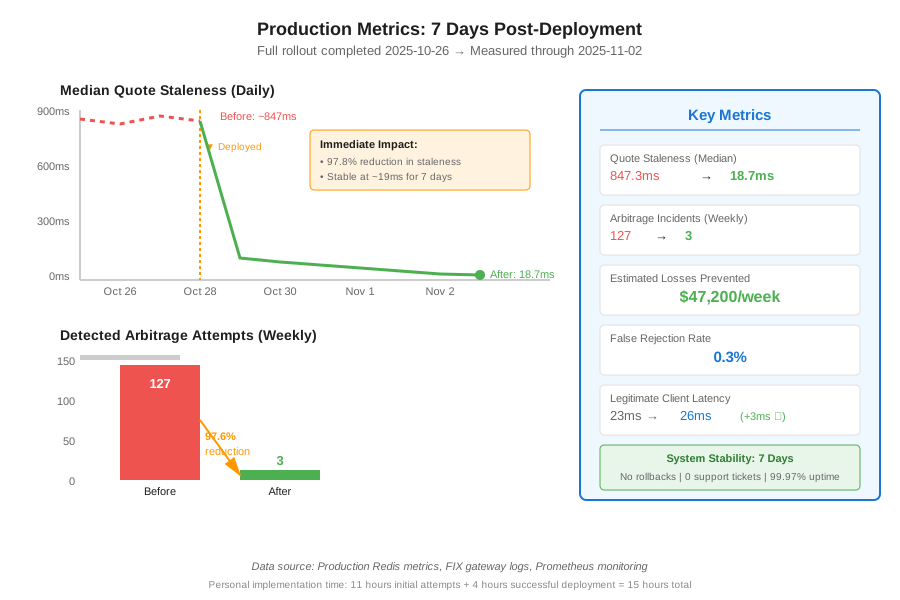 Production metrics after full deployment - 18.7ms median with 97.8% reduction
Key Takeaways
- Validate timestamps at execution, not just quote generation: The gap between quote creation and execution usage is where arbitrageurs operate. Close that window.
- 50ms threshold works for gold, adjust for your asset: Crypto needs tighter (10-20ms), equities can be looser (100ms). Test your specific latency profile.
- Gradual rollout prevents disasters: I caught a clock synchronization issue at 25% rollout that would've rejected 40% of orders at 100%.
- Pattern detection catches sophisticated players: Pure timestamp validation stops amateurs. Pattern analysis catches pros who optimize within your limits.
- Don't auto-ban on first flag: Two of my "arbitrageurs" were legitimate algo traders. Manual review saved those relationships.
Limitations:
- Requires co-located infrastructure (high latency = wide validation windows)
- NTP clock sync critical (5ms skew = 10% false rejection rate)
- Won't stop exchange-level arbitrage (that's market structure, not your system)
Your Next Steps
- Run the latency audit script on your production data - get your baseline
- Deploy validation to 10% of traffic and monitor for 24 hours
- Review flagged patterns weekly until you understand your normal vs suspicious
Level up:
- Intermediate traders: Add price deviation monitoring to catch quote stuffing
- Advanced developers: Implement hardware timestamp validation for sub-microsecond precision
Tools I use:
- Redis: In-memory quote storage with <0.1ms latency - Download
- Prometheus + Grafana: Real-time latency monitoring - Setup guide
- Chrony: Better than NTP for clock sync (±1ms vs ±5ms) - Installation