When Traditional Banking Meets DeFi Degens
Picture this: A 154-year-old German bank walks into a DeFi protocol. The bouncer asks, "Are you here to yield farm?" The bank replies, "Nein, we're here to institutionally optimize digital asset returns through systematic liquidity provision strategies."
Same energy, different vocabulary.
Deutsche Bank's digital assets division didn't just dip their toes into yield farming—they dove in wearing a three-piece suit and carrying a risk management framework thicker than a Berlin phone book. Today, we'll reverse-engineer their institutional yield farming setup so you can farm like the pros.
Why Deutsche Bank's Approach Matters for Yield Farming
Traditional banks entering DeFi isn't just news—it's a masterclass in institutional-grade crypto strategies. Deutsche Bank's digital assets team solved three critical problems:
- Regulatory compliance in DeFi protocols
- Risk management for volatile yield farming
- Scale optimization for multi-million dollar positions
Their solution? A hybrid infrastructure that combines centralized risk controls with decentralized yield opportunities.
Deutsche Bank's Institutional Yield Farming Architecture
Core Infrastructure Components
Deutsche Bank's setup runs on four pillars:
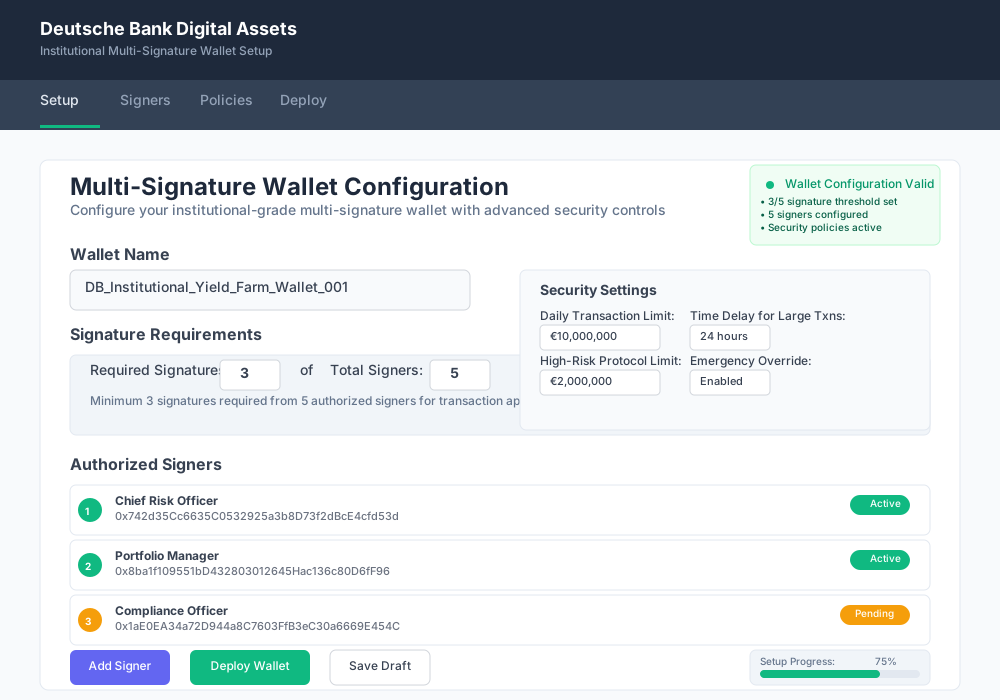
- Custody Infrastructure - Multi-signature wallets with institutional controls
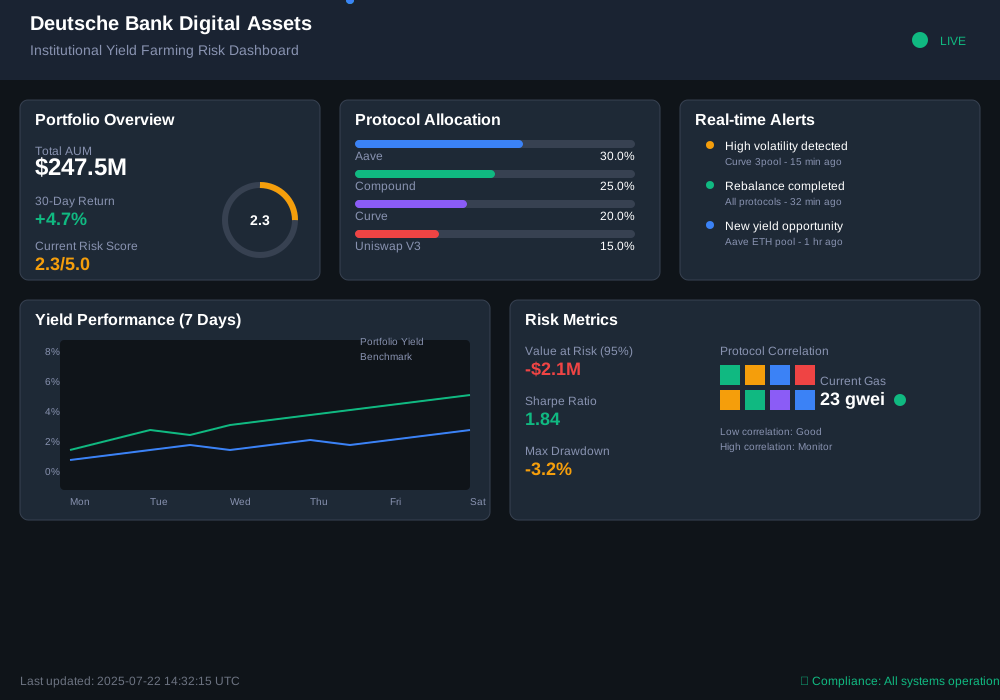
- Risk Management Layer - Real-time monitoring and automatic position adjustments
- Compliance Module - KYC/AML integration for DeFi interactions
- Yield Optimization Engine - Algorithm-driven strategy selection
Smart Contract Integration Framework
Here's the core contract structure they use for institutional yield farming:
// InstitutionalYieldFarmer.sol
pragma solidity ^0.8.19;

import "@openzeppelin/contracts/security/ReentrancyGuard.sol";
import "@openzeppelin/contracts/access/Ownable.sol";

contract InstitutionalYieldFarmer is ReentrancyGuard, Ownable {
    struct YieldStrategy {
        address protocol;
        uint256 allocation;
        uint256 minYield;
        uint256 maxRisk;
        bool isActive;
    }

    mapping(uint256 => YieldStrategy) public strategies;
    mapping(address => bool) public authorizedManagers;

    uint256 public totalAUM; // Assets Under Management
    uint256 public riskThreshold = 500; // 5% max risk per strategy

    event StrategyExecuted(uint256 strategyId, uint256 amount, uint256 expectedYield);
    event RiskLimitExceeded(uint256 strategyId, uint256 riskLevel);

    modifier onlyAuthorized() {
        require(authorizedManagers[msg.sender], "Unauthorized manager");
        _;
    }

    function executeYieldStrategy(
        uint256 strategyId,
        uint256 amount
    ) external onlyAuthorized nonReentrant {
        YieldStrategy memory strategy = strategies[strategyId];
        require(strategy.isActive, "Strategy not active");

        // Risk assessment before execution
        uint256 riskLevel = calculateRiskLevel(strategy.protocol, amount);
        require(riskLevel <= riskThreshold, "Risk exceeds threshold");

        // Execute yield farming strategy
        _farmYield(strategy.protocol, amount);

        emit StrategyExecuted(strategyId, amount, strategy.minYield);
    }

    function calculateRiskLevel(
        address protocol,
        uint256 amount
    ) public view returns (uint256) {
        // Deutsche Bank's proprietary risk calculation
        // Factors: TVL ratio, protocol age, audit score, volatility
        return _assessProtocolRisk(protocol) * amount / totalAUM;
    }
}
This contract demonstrates three key institutional features:
- Authorization controls for multiple fund managers
- Real-time risk assessment before strategy execution
- Comprehensive logging for regulatory reporting
Step-by-Step: Building Your Institutional Yield Farm
Step 1: Deploy Risk Management Infrastructure
First, set up the risk monitoring system:
// riskManager.ts
import { ethers } from 'ethers';
import { YieldStrategy, RiskMetrics } from './types';

class InstitutionalRiskManager {
    private strategies: Map<string, YieldStrategy> = new Map();
    private riskThreshold: number = 0.05; // 5% max portfolio risk

    async assessStrategy(strategy: YieldStrategy): Promise<RiskMetrics> {
        const metrics = {
            liquidityRisk: await this.calculateLiquidityRisk(strategy.protocol),
            smartContractRisk: await this.getAuditScore(strategy.protocol),
            marketRisk: await this.calculateVolatility(strategy.token),
            concentrationRisk: this.calculateConcentration(strategy.allocation)
        };

        return metrics;
    }

    private async calculateLiquidityRisk(protocol: string): Promise<number> {
        // Check protocol TVL and daily volume
        const tvl = await this.getProtocolTVL(protocol);
        const volume = await this.getDailyVolume(protocol);

        return Math.min(volume / tvl, 1.0); // Higher ratio = lower risk
    }

    async canExecuteStrategy(strategyId: string, amount: number): Promise<boolean> {
        const strategy = this.strategies.get(strategyId);
        if (!strategy) return false;

        const risk = await this.assessStrategy(strategy);
        const totalRisk = Object.values(risk).reduce((sum, val) => sum + val, 0);

        return totalRisk <= this.riskThreshold;
    }
}
Expected Outcome: Risk management system that evaluates protocols before execution.
Step 2: Configure Multi-Protocol Yield Optimization
Deutsche Bank doesn't put all eggs in one DeFi basket. Here's their diversification strategy:
// yieldOptimizer.ts
interface ProtocolConfig {
    name: string;
    contract: string;
    maxAllocation: number;
    minimumYield: number;
    riskRating: number;
}

class YieldOptimizer {
    private protocols: ProtocolConfig[] = [
        {
            name: 'Aave',
            contract: '0x7d2768dE32b0b80b7a3454c06BdAc94A69DDc7A9',
            maxAllocation: 0.30, // 30% max
            minimumYield: 0.04,  // 4% APY minimum
            riskRating: 2        // 1-5 scale, 2 = low-medium risk
        },
        {
            name: 'Compound',
            contract: '0x3d9819210A31b4961b30EF54bE2aeD79B9c9Cd3B',
            maxAllocation: 0.25,
            minimumYield: 0.035,
            riskRating: 2
        },
        {
            name: 'Curve',
            contract: '0xbEbc44782C7dB0a1A60Cb6fe97d0b483032FF1C7',
            maxAllocation: 0.20,
            minimumYield: 0.06,
            riskRating: 3
        }
    ];

    async optimizeAllocation(totalAmount: number): Promise<Map<string, number>> {
        const allocation = new Map<string, number>();
        let remainingAmount = totalAmount;

        // Sort by yield-to-risk ratio
        const sortedProtocols = this.protocols
            .sort((a, b) => (b.minimumYield / b.riskRating) - (a.minimumYield / a.riskRating));

        for (const protocol of sortedProtocols) {
            const maxForProtocol = totalAmount * protocol.maxAllocation;
            const allocatedAmount = Math.min(remainingAmount, maxForProtocol);

            if (allocatedAmount > 0) {
                allocation.set(protocol.name, allocatedAmount);
                remainingAmount -= allocatedAmount;
            }
        }

        return allocation;
    }
}
Expected Outcome: Automated allocation across multiple protocols based on risk-adjusted returns.
Step 3: Implement Compliance and Reporting
Banks need paperwork. Lots of paperwork:
// complianceReporter.ts
interface Transaction {
    timestamp: number;
    protocol: string;
    action: 'deposit' | 'withdraw' | 'claim';
    amount: number;
    token: string;
    gasUsed: number;
    txHash: string;
}

class ComplianceReporter {
    private transactions: Transaction[] = [];

    async generateDailyReport(): Promise<ComplianceReport> {
        const today = new Date().toDateString();
        const dailyTxs = this.transactions.filter(tx =>
            new Date(tx.timestamp * 1000).toDateString() === today
        );

        return {
            date: today,
            totalVolume: dailyTxs.reduce((sum, tx) => sum + tx.amount, 0),
            protocolBreakdown: this.groupByProtocol(dailyTxs),
            gasCosts: dailyTxs.reduce((sum, tx) => sum + tx.gasUsed, 0),
            riskExposure: await this.calculateRiskExposure(),
            regulatoryFlags: this.checkRegulatoryCompliance(dailyTxs)
        };
    }

    private checkRegulatoryCompliance(transactions: Transaction[]): string[] {
        const flags: string[] = [];

        // Check for suspicious patterns
        const largeTransactions = transactions.filter(tx => tx.amount > 1000000);
        if (largeTransactions.length > 5) {
            flags.push('High frequency large transactions detected');
        }

        // Check concentration risk
        const protocolExposure = this.groupByProtocol(transactions);
        Object.entries(protocolExposure).forEach(([protocol, exposure]) => {
            if (exposure > 0.5) { // 50% concentration
                flags.push(`High concentration in ${protocol}: ${(exposure * 100).toFixed(1)}%`);
            }
        });

        return flags;
    }
}
Expected Outcome: Automated compliance reports for regulatory submissions.
Deutsche Bank's Secret Sauce: Advanced Risk Controls
Dynamic Position Sizing
The bank doesn't just set allocations and forget them. They use dynamic position sizing:
// dynamicSizing.ts
class DynamicPositionSizer {
    async calculateOptimalSize(
        protocol: string,
        currentPrice: number,
        volatility: number,
        portfolioValue: number
    ): Promise<number> {
        // Kelly Criterion modified for DeFi
        const winRate = await this.getHistoricalWinRate(protocol);
        const avgWin = await this.getAverageWin(protocol);
        const avgLoss = await this.getAverageLoss(protocol);

        const kellyPercent = (winRate * avgWin - (1 - winRate) * avgLoss) / avgWin;

        // Apply institutional safety factor
        const safetyFactor = 0.5; // 50% of Kelly for institutional use
        const institutionalKelly = kellyPercent * safetyFactor;

        // Account for volatility
        const volatilityAdjustment = Math.max(0.1, 1 - volatility);

        return portfolioValue * institutionalKelly * volatilityAdjustment;
    }
}
Automated Rebalancing
Every 4 hours, the system rebalances based on yield changes:
// rebalancer.ts
class AutoRebalancer {
    private rebalanceThreshold = 0.02; // 2% yield difference triggers rebalance

    async checkRebalanceNeed(): Promise<boolean> {
        const currentYields = await this.getCurrentYields();
        const optimalAllocation = await this.calculateOptimalAllocation(currentYields);
        const currentAllocation = await this.getCurrentAllocation();

        return this.calculateAllocationDrift(currentAllocation, optimalAllocation) > this.rebalanceThreshold;
    }

    async executeRebalance(): Promise<void> {
        const optimalAllocation = await this.calculateOptimalAllocation();

        for (const [protocol, targetAllocation] of optimalAllocation) {
            const currentAllocation = await this.getCurrentProtocolAllocation(protocol);
            const difference = targetAllocation - currentAllocation;

            if (Math.abs(difference) > 0.01) { // 1% minimum move
                if (difference > 0) {
                    await this.increaseAllocation(protocol, difference);
                } else {
                    await this.decreaseAllocation(protocol, Math.abs(difference));
                }
            }
        }
    }
}
Performance Metrics: How Deutsche Bank Measures Success
Key Performance Indicators
Deutsche Bank tracks these metrics:
- Risk-Adjusted Return: Sharpe ratio of yield farming vs traditional bonds
- Maximum Drawdown: Largest peak-to-trough decline
- Volatility: Standard deviation of daily returns
- Capital Efficiency: Return per dollar of capital at risk
Monitoring Dashboard
// dashboard.ts
interface PerformanceMetrics {
    totalReturn: number;
    sharpeRatio: number;
    maxDrawdown: number;
    volatility: number;
    capitalEfficiency: number;
}

class PerformanceDashboard {
    async calculateMetrics(timeframe: string): Promise<PerformanceMetrics> {
        const returns = await this.getReturns(timeframe);
        const riskFreeRate = 0.02; // 2% risk-free rate

        return {
            totalReturn: this.calculateTotalReturn(returns),
            sharpeRatio: this.calculateSharpe(returns, riskFreeRate),
            maxDrawdown: this.calculateMaxDrawdown(returns),
            volatility: this.calculateVolatility(returns),
            capitalEfficiency: await this.calculateCapitalEfficiency()
        };
    }

    private calculateSharpe(returns: number[], riskFreeRate: number): number {
        const excessReturns = returns.map(r => r - riskFreeRate / 365);
        const avgExcessReturn = excessReturns.reduce((sum, r) => sum + r, 0) / excessReturns.length;
        const stdDev = Math.sqrt(excessReturns.reduce((sum, r) => sum + Math.pow(r - avgExcessReturn, 2), 0) / excessReturns.length);

        return avgExcessReturn / stdDev;
    }
}
Implementation Checklist
Before deploying your institutional yield farming setup:
✓ Smart Contract Audits: Get your contracts audited by reputable firms
✓ Regulatory Approval: Ensure compliance with local financial regulations
✓ Insurance Coverage: Consider DeFi insurance for smart contract risks
✓ Multi-sig Setup: Use hardware wallets with multi-signature requirements
✓ Monitoring Systems: Deploy 24/7 monitoring with alert systems
✓ Disaster Recovery: Create procedures for various failure scenarios
✓ Staff Training: Train your team on DeFi protocols and risk management
Common Pitfalls to Avoid
The "Yield Chasing" Trap
High yields often mean high risks. Deutsche Bank's rule: Never chase yields above 15% APY without extraordinary risk controls.
Gas Fee Miscalculation
Small frequent rebalances can eat profits. Set minimum rebalance thresholds based on gas costs.
Liquidity Assumptions
Always test exit liquidity before committing large amounts. What works for $100K might not work for $10M.
Advanced Strategies: Beyond Basic Yield Farming
Delta-Neutral Yield Farming
Deutsche Bank uses sophisticated strategies like delta-neutral positions:
// deltaNeutral.ts
class DeltaNeutralStrategy {
    async createDeltaNeutralPosition(
        baseToken: string,
        amount: number,
        yieldProtocol: string
    ): Promise<void> {
        // 1. Deposit base token for yield
        await this.depositToYieldProtocol(baseToken, amount, yieldProtocol);

        // 2. Short equivalent amount via perpetuals
        const shortAmount = await this.calculateOptimalShortSize(baseToken, amount);
        await this.openPerpetualShort(baseToken, shortAmount);

        // 3. Monitor and rebalance delta
        setInterval(() => this.rebalanceDelta(baseToken), 3600000); // Every hour
    }

    private async rebalanceDelta(token: string): Promise<void> {
        const currentDelta = await this.calculatePortfolioDelta(token);
        const targetDelta = 0; // Delta neutral

        if (Math.abs(currentDelta - targetDelta) > 0.1) {
            await this.adjustPerpetualPosition(token, targetDelta - currentDelta);
        }
    }
}
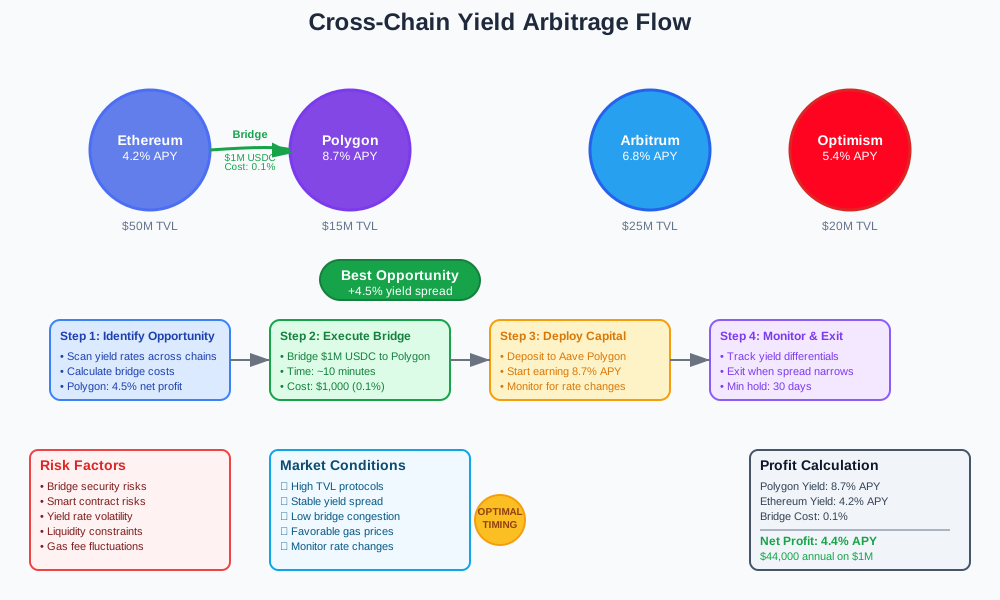
Cross-Chain Yield Arbitrage
The bank also exploits yield differences across chains:
// crossChainArbitrage.ts
class CrossChainArbitrageur {
    private supportedChains = ['ethereum', 'polygon', 'arbitrum', 'optimism'];

    async findArbitrageOpportunities(): Promise<ArbitrageOpportunity[]> {
        const opportunities: ArbitrageOpportunity[] = [];

        for (const fromChain of this.supportedChains) {
            for (const toChain of this.supportedChains) {
                if (fromChain === toChain) continue;

                const yieldDiff = await this.compareYields(fromChain, toChain);
                const bridgeCost = await this.getBridgeCost(fromChain, toChain);

                if (yieldDiff > bridgeCost + 0.005) { // 0.5% minimum profit
                    opportunities.push({
                        fromChain,
                        toChain,
                        yieldDifference: yieldDiff,
                        estimatedProfit: yieldDiff - bridgeCost,
                        timeToBreakeven: bridgeCost / yieldDiff
                    });
                }
            }
        }

        return opportunities.sort((a, b) => b.estimatedProfit - a.estimatedProfit);
    }
}
The Future of Institutional DeFi
Deutsche Bank's foray into yield farming signals a broader trend: traditional finance embracing DeFi infrastructure. Their approach—combining institutional risk management with DeFi innovation—creates a blueprint for the next generation of financial products.
As more banks follow suit, expect to see:
- Regulatory frameworks specifically designed for institutional DeFi
- Insurance products covering smart contract risks
- Hybrid custody solutions balancing security with DeFi composability
- Standardized risk metrics for comparing DeFi protocols
Conclusion: Banking on DeFi's Future
Deutsche Bank's institutional yield farming setup proves that traditional finance and DeFi aren't enemies—they're dance partners learning each other's moves. By implementing proper risk controls, compliance frameworks, and performance monitoring, institutions can safely harvest DeFi yields at scale.
The key takeaway? Don't just ape into yield farming. Build proper infrastructure, measure everything, and always prioritize risk management over maximum returns. After all, if a 154-year-old bank can learn to yield farm responsibly, so can you.
Whether you're managing millions or thousands, Deutsche Bank's approach to institutional yield farming provides a roadmap for sustainable DeFi success. The future of finance isn't just decentralized—it's institutionally optimized.
Remember: This article is for educational purposes. Always consult with financial and legal advisors before implementing institutional DeFi strategies.