Picture this: Your idle GPU churning away at LLM inference while you sleep, earning tokens that actually pay your electricity bill. Sounds too good to be true? Welcome to the wild intersection of DePIN and local AI inference.
DePIN (Decentralized Physical Infrastructure Networks) tokens serve multiple purposes within ecosystems, such as incentivizing service providers to contribute resources, facilitating payments between users and providers, and ensuring honest behavior among participants. As local AI inference platforms like Ollama gain traction, the potential for integrating token-based revenue models becomes increasingly compelling.
This analysis examines how Ollama's local inference capabilities could integrate with DePIN tokenomics to create sustainable revenue streams for compute providers while reducing costs for AI consumers.
Understanding Ollama's Infrastructure Foundation
Ollama is a UI wrapper around llama.cpp, a CPU-first, C++ implementation of Meta's LLama text inference AI model. The platform enables users to run large language models locally, bypassing cloud dependencies and reducing latency.
Core Technical Architecture
Ollama's architecture provides several advantages for DePIN integration:
- Local execution: Complete control over compute resources
- API compatibility: OpenAI-compatible endpoints for easy integration
- Model flexibility: Support for various model sizes and quantization levels
- Resource optimization: Efficient memory and GPU utilization
# Example Ollama model deployment
ollama pull llama3.1:8b-instruct-q4_K_M
ollama run llama3.1:8b-instruct-q4_K_M

# API endpoint becomes available at:
# http://localhost:11434/v1/chat/completions
Hardware Requirements and Economics
Parameter size is the number of weights used by the model for calculations, and quantization is the resolution/precision of these numbers. The more the parameters and the higher the quantization, the better inference you'll get out of the model, however the more memory and CPU/GPU it'll require.
Performance Benchmarks:
- 7B model (Q4): 4-8GB VRAM, 10-30 tokens/second
- 13B model (Q4): 8-16GB VRAM, 5-15 tokens/second
- 70B model (Q4): 40-80GB VRAM, 1-5 tokens/second
DePIN Tokenomics Models for AI Inference
Consider a decentralized alternative to OpenAI or Hugging Face. Academic labs with $400K in Nvidia GPUs, largely underutilized except during deadlines, could host open-source models for inference tasks. Customers would pay in fiat currency for these tasks, at rates lower than centralized services.
Revenue Distribution Framework
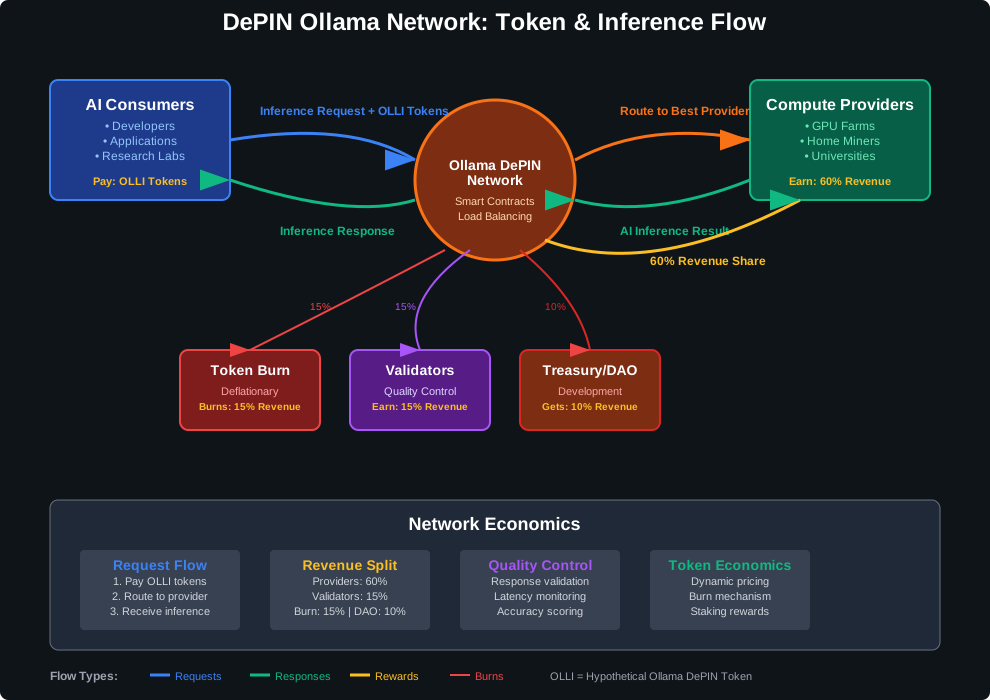
A sustainable Ollama DePIN model requires balanced tokenomics:
// Example tokenomics distribution
const revenueDistribution = {
  computeProviders: 0.60,  // 60% to inference providers
  networkValidators: 0.15, // 15% to network validators
  tokenBurn: 0.15,         // 15% for deflationary pressure
  treasury: 0.10           // 10% for development fund
};

// Dynamic pricing based on demand
function calculateRewards(baseRate, demandMultiplier, qualityScore) {
  return baseRate * demandMultiplier * qualityScore;
}
Token Utility Design
Primary Use Cases:
- Payment medium: Users pay tokens for inference requests
- Staking mechanism: Providers stake tokens to join the network
- Quality incentives: Higher quality providers earn bonus multipliers
- Governance rights: Token holders vote on network parameters
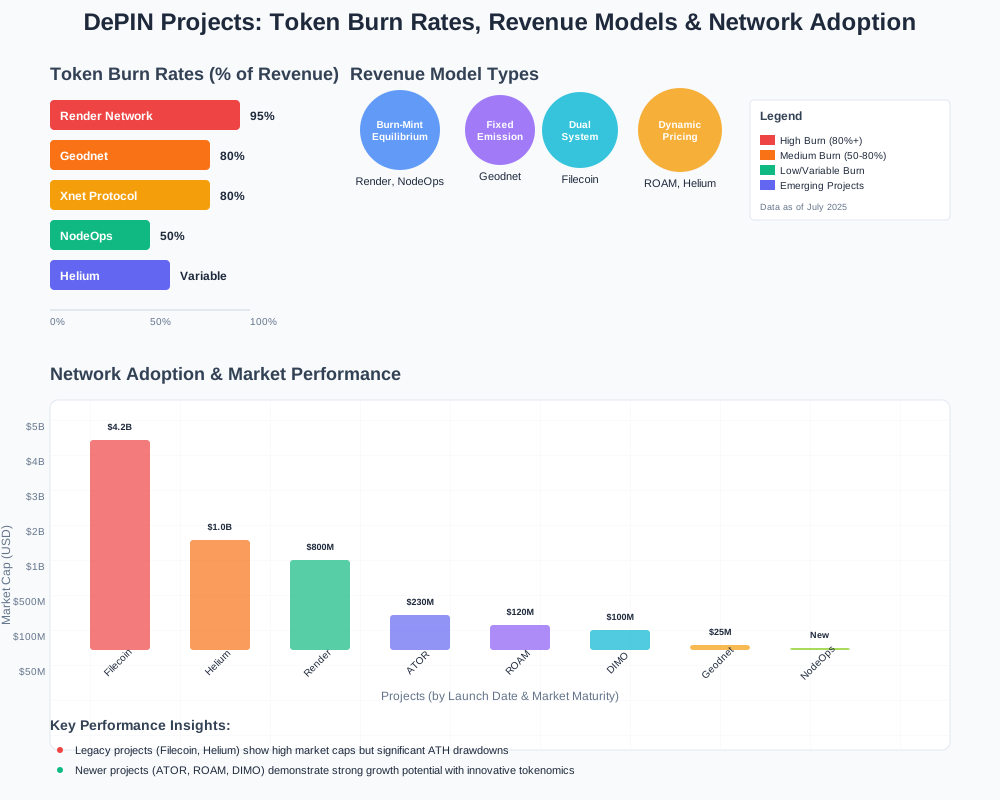
Burn-and-Mint Equilibrium (BME)
NodeOps burns 50% of its onchain revenue, with the remaining 25% distributed to compute providers, 10% to stakers, and 15% to the treasury. Most DePIN projects implement burn-and-mint equilibrium in their tokenomics model.
# BME implementation example
class TokenomicsEngine:
    def __init__(self, burn_rate=0.5):
        self.burn_rate = burn_rate
        self.total_supply = 1000000000  # 1B tokens
        self.circulating_supply = 100000000  # 100M initial

    def process_revenue(self, revenue_tokens):
        # Burn portion of revenue
        burn_amount = revenue_tokens * self.burn_rate
        self.total_supply -= burn_amount

        # Distribute remaining to stakeholders
        provider_reward = revenue_tokens * 0.25
        staker_reward = revenue_tokens * 0.15
        treasury_allocation = revenue_tokens * 0.10

        return {
            'burned': burn_amount,
            'provider_rewards': provider_reward,
            'staker_rewards': staker_reward,
            'treasury': treasury_allocation
        }
Sustainability Metrics and Analysis
Network Economics Health Indicators
Key Performance Indicators:
- Utilization rate: Percentage of available compute being used
- Price stability: Token price volatility relative to fiat costs
- Provider retention: Monthly churn rate of compute providers
- Quality scores: Average inference accuracy and latency
// Sustainability monitoring dashboard
const sustainabilityMetrics = {
  utilizationRate: () => {
    return (activeComputeTime / totalAvailableTime) * 100;
  },

  revenueGrowth: (currentRevenue, previousRevenue) => {
    return ((currentRevenue - previousRevenue) / previousRevenue) * 100;
  },

  networkValue: (totalStaked, tokenPrice, utilityValue) => {
    return (totalStaked * tokenPrice) + utilityValue;
  }
};
Economic Sustainability Challenges
Provider Economics:
- Hardware depreciation costs
- Electricity and cooling expenses
- Network maintenance requirements
- Opportunity cost of capital
Network Stability:
- Token price volatility
- Demand fluctuations
- Competition from centralized services
- Regulatory compliance costs
Implementation Framework
Phase 1: Network Bootstrap
# Network deployment configuration
bootstrap_config:
  initial_providers: 100
  minimum_stake: 10000  # tokens required to participate
  quality_threshold: 0.95  # minimum accuracy score
  base_inference_rate: 0.001  # tokens per request
Phase 2: Incentive Alignment
Provider Onboarding:
- Hardware verification and benchmarking
- Token staking requirement fulfillment
- Quality assessment period (30 days)
- Full network integration
Quality Assurance:
- Automated inference verification
- Peer validation mechanisms
- Response time monitoring
- Accuracy scoring algorithms
Phase 3: Scale and Optimize
# Dynamic pricing algorithm
def calculate_dynamic_price(base_price, demand_factor, supply_factor):
    """
    Adjust pricing based on real-time supply and demand
    """
    demand_multiplier = 1 + (demand_factor - 1) * 0.5
    supply_multiplier = 1 / (1 + (supply_factor - 1) * 0.3)

    return base_price * demand_multiplier * supply_multiplier
Competitive Analysis and Market Positioning
Comparison with Existing DePIN Projects
Render burns up to 95% of its protocol revenue, while Geodnet and Xnet burn 80%, respectively. High burn rates can decrease circulating supply and bolster token prices during periods of growth.
Market Positioning:
- Lower costs: 30-50% reduction vs. centralized providers
- Privacy preservation: Local inference maintains data sovereignty
- Reduced latency: Geographic distribution decreases response times
- Censorship resistance: Decentralized network prevents single points of failure
Revenue Projections
// Five-year revenue projection model
const revenueProjection = {
  year1: { providers: 1000, avgRevenue: 500, totalRevenue: 500000 },
  year2: { providers: 5000, avgRevenue: 750, totalRevenue: 3750000 },
  year3: { providers: 15000, avgRevenue: 1000, totalRevenue: 15000000 },
  year4: { providers: 40000, avgRevenue: 1200, totalRevenue: 48000000 },
  year5: { providers: 100000, avgRevenue: 1500, totalRevenue: 150000000 }
};
Risk Assessment and Mitigation
Technical Risks
Model Quality Control:
- Implement automated verification systems
- Establish peer review mechanisms
- Create reputation scoring algorithms
- Deploy circuit breakers for quality degradation
Network Security:
- Multi-signature governance contracts
- Gradual decentralization roadmap
- Bug bounty programs
- Regular security audits
Economic Risks
Token Price Volatility:
- Implement price stability mechanisms
- Create token velocity controls
- Establish strategic reserves
- Develop multiple revenue streams
// Price stability mechanism example
contract PriceStabilizer {
    uint256 public targetPrice;
    uint256 public stabilityFund;

    function stabilizePrice(uint256 currentPrice) external {
        if (currentPrice < targetPrice * 90 / 100) {
            // Price too low - buy tokens from market
            buyTokens(stabilityFund * 10 / 100);
        } else if (currentPrice > targetPrice * 110 / 100) {
            // Price too high - sell tokens to market
            sellTokens(stabilityFund * 10 / 100);
        }
    }
}
Future Development and Scalability
Multi-Modal Integration
Expanding beyond text inference to support:
- Image generation and processing
- Audio transcription and synthesis
- Video analysis and generation
- Code execution and debugging
Cross-Chain Compatibility
// Cross-chain bridge integration
const bridgeConfig = {
  supportedChains: ['ethereum', 'polygon', 'arbitrum', 'solana'],
  tokenMapping: {
    ethereum: '0x742d35Cc6634C0532925a3b8D72C12345678abcd',
    polygon: '0x742d35Cc6634C0532925a3b8D72C87654321dcba',
    // Additional chain mappings
  }
};
Governance Evolution
Decentralized Decision Making:
- Parameter adjustment proposals
- Network upgrade voting
- Fee structure modifications
- Quality standard updates
Conclusion and Strategic Recommendations
The integration of Ollama's local inference capabilities with DePIN tokenomics presents a compelling opportunity to democratize AI infrastructure while creating sustainable revenue streams. Value has to come from something tangible and in the case of DePIN, that value is derived from revenue.
Key Success Factors:
- Economic incentive alignment between providers and consumers
- Quality assurance mechanisms to maintain service standards
- Sustainable tokenomics with appropriate burn and reward rates
- Technical infrastructure supporting scalable, secure operations
The DePIN Ollama tokenomics model offers a path toward truly decentralized AI inference, reducing costs for consumers while providing meaningful income opportunities for compute providers. Success depends on careful balance of economic incentives, technical execution, and community governance.
As the AI inference market continues to expand, projects that successfully implement sustainable DePIN tokenomics will capture significant value while advancing the broader goal of democratized AI access.