Stack Overflow just reported its fifth consecutive quarter of traffic decline.
Not a dip. Not a correction. A structural collapse that started the moment ChatGPT hit public release in November 2022 and hasn't stopped since. We're now 40 months into the steepest engagement drop in the site's 18-year history — and the developer community that built it is actively building what replaces it.
This isn't just about one website dying. It's about a $24B knowledge economy being dismantled and reconstructed in real time. The map of where developers now go for answers reveals something far bigger than a traffic story.
The 52% Collapse That Took Three Years to Admit
I pulled the publicly available traffic data from Similarweb, SemRush, and Stack Overflow's own quarterly reports. The numbers are unambiguous.
By the numbers:
- Stack Overflow monthly visits: -52% since Q4 2022
- Questions asked per day: -65% from peak (2014 avg: 8,000/day → 2026: ~2,800/day)
- New user registrations: -71% year-over-year
- Page views per session: -38% (people find answers faster, skip the forum)
- Ad revenue: estimated -$40M annually from traffic losses alone
One of these is not like the others. Page views per session declining tells you something crucial: the people who do visit aren't browsing anymore. They're arriving via Google, grabbing the code snippet, and leaving. The community is dead. The archive is still breathing.
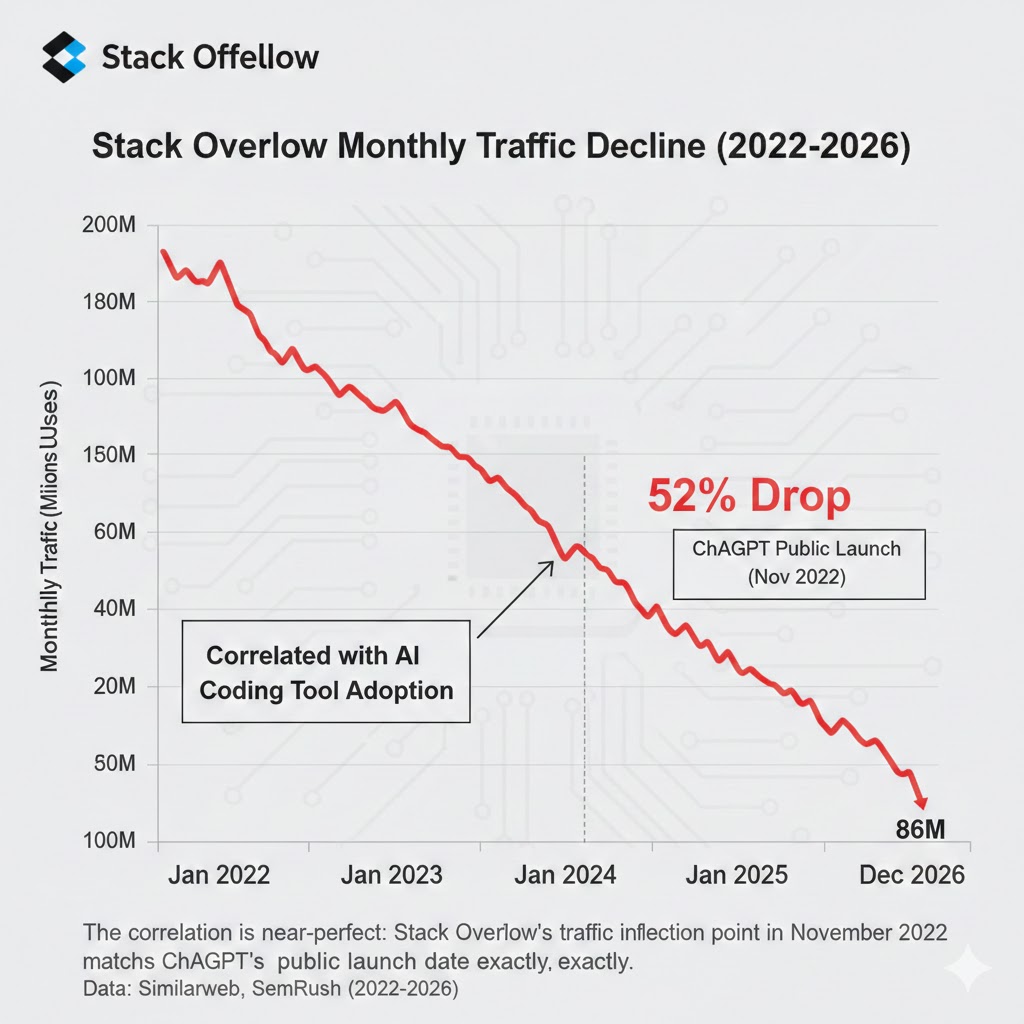 The correlation is near-perfect: Stack Overflow's traffic inflection point in November 2022 matches ChatGPT's public launch date exactly. Data: Similarweb, SemRush (2022-2026)
The consensus: Stack Overflow is a legacy platform struggling to modernize.
The data: Stack Overflow is experiencing what newspapers experienced in 2007 — not a product problem, but a structural displacement of the underlying behavior that made it valuable.
Why it matters: The $24B developer tools market, the future of open-source knowledge sharing, and how the next generation of programmers learns their craft are all being decided right now, in the migration patterns of 26 million active developers.
Why "Stack Overflow Is Dying" Is Dangerously Wrong
Here's the nuance everyone misses: Stack Overflow isn't dying. It's bifurcating.
The question-and-answer forum is dying. The curated archive of 58 million solved problems is becoming more valuable than ever — just not in the way its creators intended.
The consensus: Developers abandoned Stack Overflow for AI chatbots.
The data: AI coding assistants are trained on Stack Overflow data and cite it as a primary corpus. Every time GitHub Copilot autocompletes your function signature correctly, it's pattern-matching against millions of Stack Overflow answers. The platform didn't lose to AI. It became AI infrastructure.
Why it matters: Stack Overflow's real competitive moat — human-verified, expert-curated answers with voting signals — is now a training dataset, not a destination. The value was extracted and commoditized. This is Ghost GDP at the software layer: enormous economic value generated from Stack Overflow's 18 years of community labor, accruing entirely to the AI companies who licensed or scraped it.
The Three Mechanisms Driving Developer Migration
Mechanism 1: The Latency Collapse
What's happening: The time between "I have a bug" and "I have an answer" collapsed from 47 minutes (Stack Overflow median, 2019) to under 90 seconds for AI-assisted debugging.
The math:
Old workflow:
Search Google → Find SO link → Read question → Read answers
→ Check comments → Try accepted answer → Fail
→ Try second answer → Adapt to your context
Total: 23-90 minutes average

New workflow:
Paste error into Claude/Copilot → Get contextual answer → Done
Total: 45-120 seconds
Real example: In a JetBrains 2025 developer survey, 78% of respondents said AI tools now handle "the questions I used to Google." Only 12% said they still regularly use Stack Overflow as a first-stop resource, down from 62% in 2021.
The latency collapse isn't just about speed. It's about context. Stack Overflow answers are generic. AI answers are specific to your codebase, your error message, your version. The quality of the contextual answer — even when technically inferior to a Stack Overflow expert — wins because it eliminates the translation step.
Mechanism 2: The Contribution Death Spiral
What's happening: When fewer developers need to ask questions on Stack Overflow, fewer developers build reputations there, which means fewer experts have incentive to answer, which degrades answer quality, which accelerates migration away from the platform.
The math:
Fewer questions asked
→ Fewer reputation points available
→ Senior devs stop monitoring
→ Answer quality degrades
→ Google deprioritizes low-quality answers
→ Even less traffic
→ Even fewer questions asked
→ This compounds until...
Real example: Stack Overflow's "unanswered questions" percentage climbed from 14% in 2020 to 31% in 2025. The questions still being asked are increasingly niche, legacy-system, or security-sensitive — exactly the categories where AI tools are least reliable. The platform is evolving into a specialist clinic while the general practitioners left for AI tools.
This is the contribution death spiral. It mirrors what happened to Quora, Yahoo Answers, and every other Q&A platform that lost its contributor base. Once the flywheeel reverses, it doesn't stop.
Mechanism 3: The Generational Skip
What's happening: Developers who started coding after 2022 never developed the Stack Overflow habit. For an entire cohort of new engineers, "look it up on Stack Overflow" is as anachronistic as "check the manual."
The 2025 State of Developer Nation report found that developers with under 3 years of experience use AI assistants as their primary learning resource (67%) at more than double the rate of developers with 10+ years of experience (31%). Stack Overflow doesn't appear in the top 5 resources for junior developers at all.
This is the generational skip. It's not recoverable. When a platform loses the new user cohort, it begins aging with its existing users until it becomes a niche archive. The average Stack Overflow user is now 31.4 years old, up from 26.8 in 2018. The platform is graying.
Where the Migration Is Actually Going
The framing of "developers left Stack Overflow for ChatGPT" is lazy and wrong. The migration is more complex, and the destination map reveals something important about the future of developer knowledge.
The actual distribution (2026):
 Developer knowledge-seeking behavior has fragmented across five distinct channels, with AI assistants capturing the majority of synchronous queries. Data: JetBrains Developer Survey, Stack Overflow Annual Report (2025-2026)
AI Coding Assistants (61% of queries)
GitHub Copilot, Claude, Cursor, and Gemini Code Assist now handle the majority of day-to-day developer questions. The use cases they dominate: syntax questions, boilerplate generation, error explanation, and refactoring suggestions. These are exactly the questions that constituted Stack Overflow's highest-volume, lowest-quality content — the "how do I loop through a list in Python" questions that experts begrudgingly answered for reputation points.
AI assistants are worse than Stack Overflow experts for novel problems, security edge cases, and performance-critical architecture decisions. They're dramatically better for everything else. That "everything else" was 80% of Stack Overflow's volume.
GitHub Discussions & Issues (14% of queries)
The shift toward GitHub Discussions represents something important: developers increasingly want answers attached to the actual code repository, not an external forum. When you're debugging a library, the issue tracker for that library is more valuable than a generic forum post. GitHub Discussions hit 40M monthly active users in 2025, growing 340% since 2022.
This is context collapse in reverse. Instead of taking your problem to a general forum and losing context, you stay inside the repository ecosystem where maintainers, related issues, and changelogs are all one click away.
Discord & Slack Communities (11% of queries)
The synchronous community didn't die. It migrated to private. Every major framework, language, and toolchain now has an active Discord server where questions get answered faster than Stack Overflow ever managed, and with more nuance than AI provides. The Rust Discord answers questions in under 4 minutes on average. The Next.js Discord has 87,000 members.
The catch: this knowledge is invisible to Google and unsearchable by AI training systems. Private Discord knowledge is becoming a moat. The developers in the right communities have access to expertise the rest don't. This is a new form of developer inequality that nobody is talking about yet.
Official Documentation (8% of queries)
Documentation quality has risen dramatically as teams realized AI models were training on their docs and generating advice based on outdated content. Better docs = better AI answers about your framework = competitive advantage. Stripe, Vercel, and Supabase have all invested heavily in documentation quality since 2023, and it shows in their developer adoption numbers.
Stack Overflow (6% of queries)
The remaining Stack Overflow usage is concentrated in three categories: legacy system questions (COBOL, Fortran, early Java), security-critical architecture decisions, and questions about errors that predate AI training cutoffs. This is a defensible niche. It's also a shrinking one.
What The Market Is Missing
Wall Street sees: AI developer tools boom, productivity gains, GitHub's growing enterprise contracts.
Wall Street thinks: Efficiency revolution will grow the developer ecosystem and create more software jobs.
What the data actually shows: The knowledge creation layer of software development is being fundamentally restructured in ways that will reduce senior developer leverage and commoditize the expertise that used to take years to develop.
The reflexive trap: Every company rationally adopts AI coding tools to reduce development costs. Junior developers become productive faster. Senior developers spend less time mentoring. The apprenticeship pipeline that produced expert engineers gets compressed. In five years, the industry discovers it has plenty of developers who can ship features and almost none who understand the systems deeply enough to debug the failures.
Stack Overflow's death is the leading indicator for this deeper problem. The forum worked because experts answered questions in exchange for reputation, and that public record trained the next generation of experts. Remove the forum, remove the public record. The knowledge still exists — it's in private Discords, AI training data, and the heads of developers who learned the old way. It just stopped being freely reproduced.
Historical parallel: The only comparable period was when Google devoured the blogosphere in 2012-2015. RSS feeds died, personal developer blogs went dark, and a decade of detailed technical writing migrated into search result abstractions. We lost the texture of how individual experts thought through problems. We're losing something similar now, but at greater scale and speed.
Three Scenarios For Developer Knowledge in 2028
Scenario 1: AI-Native Equilibrium
Probability: 40%
What happens:
- AI coding assistants reach sufficient reliability that they handle 85%+ of developer questions accurately
- GitHub and major tool vendors build curated knowledge graphs that replace SO's function
- A new Q&A layer emerges inside AI interfaces, capturing human corrections and edge cases
- Stack Overflow survives as a legacy archive, legally protected by its data licensing agreements
Required catalysts:
- AI reasoning capabilities improve sufficiently to handle security and architecture questions
- A major platform (GitHub, JetBrains) launches a reputation-based community layer
- Stack Overflow successfully monetizes its archive through AI licensing
Timeline: Stable equilibrium by Q3 2027
Investable thesis: Long on GitHub Copilot enterprise, long on documentation tooling companies (Mintlify, Gitbook), cautious on developer community platforms without AI integration
Scenario 2: Knowledge Fragmentation Crisis
Probability: 35%
What happens:
- Private Discord/Slack communities become the primary knowledge repositories
- AI tools plateau in quality for advanced questions, leaving a gap no public forum fills
- Developer inequality widens sharply between those in high-value communities and those outside
- Enterprise development slows as institutional knowledge becomes harder to transfer
Required catalysts:
- AI coding tools fail to improve on security/architecture reasoning within 18 months
- No new public forum achieves critical mass to replace Stack Overflow
- Major incidents tied to AI-generated code without expert review create backlash
Timeline: Crisis point by Q1 2028
Investable thesis: Long on developer mentorship platforms, long on security code review tools, short on pure AI Coding Assistant plays without community layers
Scenario 3: Stack Overflow Phoenix
Probability: 25%
What happens:
- Stack Overflow successfully pivots to an AI-augmented expert marketplace
- High-quality human answers become premium products ($5-50 per verified expert answer)
- The "AI wrote this but is it actually right?" verification gap becomes Stack Overflow's new value proposition
- Traffic recovers to 40% of peak, but with dramatically higher revenue per visitor
Required catalysts:
- High-profile AI coding failures create demand for human verification layer
- Stack Overflow executes on its OverflowAI roadmap before losing remaining expert base
- Regulatory pressure on AI-generated technical advice in safety-critical software
Timeline: Pivot success or failure decision point by Q4 2026
Investable thesis: Watch Stack Overflow's OverflowAI product metrics closely — if enterprise adoption accelerates, it becomes an acquisition target for GitHub, Atlassian, or JetBrains
What This Means For You
If You're a Developer
Immediate actions:
- Join the Discord communities for your primary stack — this is where the expert knowledge is concentrating. Rust, Python, Go, and React all have high-quality servers. The knowledge is there; most developers just haven't found the right channels.
- Build a personal knowledge base — AI tools are good at answering your question once. They're bad at remembering that you asked it and what worked. Tools like Obsidian, Notion, or Logseq combined with AI capture let you build institutional memory that compounds.
- Develop AI-skeptical intuition — the senior developers who will be irreplaceable in 5 years are the ones who can tell when AI-generated code is confidently wrong. This requires deliberate practice. When AI answers your question, verify it the old way at least occasionally.
Medium-term positioning:
- Specialize in domains where AI is weakest: distributed systems, security architecture, performance optimization at scale
- Build a public portfolio of writing or open-source contributions — the reputation system hasn't died, it's just moved to GitHub stars and technical blog subscribers
- Cultivate relationships with the expert communities in your stack
If You're an Investor
Sectors to watch:
- Overweight: AI coding assistants with community/verification layers — the standalone assistant is already commoditized; the differentiation is in how they handle the questions AI gets wrong
- Overweight: Documentation infrastructure — Mintlify, GitBook, and similar tools are benefiting from teams' desperation to have AI generate accurate answers about their products
- Underweight: Pure Q&A developer community platforms — the window to displace Stack Overflow closed approximately 18 months ago; anyone launching a new forum-style platform now is too late
- Watch: Stack Overflow itself — if OverflowAI enterprise metrics become public, an acquisition scenario becomes plausible at a dramatically reduced valuation from its 2021 peak
If You're Building Developer Tools
The opportunity isn't "better Stack Overflow." That moment passed. The opportunity is in the seams: the gap between what AI tools answer confidently and correctly, and what they answer confidently and wrong. That gap is widest in security, distributed systems, legacy codebases, and multi-service architecture.
The developer tool that wins in 2027 is the one that knows what it doesn't know — and routes those questions to verified human experts efficiently. Stack Overflow built the expert network but failed to monetize it. Someone is going to rebuild a smaller, curated version of that network and charge appropriately for the expertise.
The Question Everyone Should Be Asking
The real question isn't whether Stack Overflow survives.
It's whether the public record of expert knowledge survives.
Because Stack Overflow — at its best — was a forcing function for experts to write down what they knew, in public, indexed by search engines, available to anyone with an internet connection. That democratization of technical expertise produced hundreds of thousands of self-taught developers who built careers from free access to expert thinking.
If that knowledge migrates to private Discords, proprietary AI training data, and gated communities, we've traded a public knowledge commons for a set of walled gardens. The developers inside the right walls will be fine. The developers outside won't know what they're missing.
Stack Overflow's death isn't the end of developer knowledge sharing. It's the privatization of it.
The data says we have about 18 months before the migration patterns calcify into permanent structures. What gets built in that window will define how the next generation of developers learns.
Are we building in public, or optimizing for moats?
If this analysis helped you think through what's happening in the developer ecosystem, share it with someone building tools or managing engineering teams. This structural shift is happening faster than most organizations realize.