Picture this: You wake up at 3 AM to manually claim your farming rewards, only to spend gas fees that eat half your profits. Meanwhile, your neighbor sleeps peacefully while smart contracts automatically reinvest their rewards every few hours. Who's winning the yield farming game?
Compound yield farming transforms your DeFi strategy from manual labor into automated wealth building. This guide shows you how to set up automatic reward reinvestment that works 24/7, maximizing your returns while you focus on what matters most.
You'll learn to configure auto-compounding protocols, choose the best platforms, and implement strategies that professional DeFi traders use to multiply their yields exponentially.
What Is Compound Yield Farming?
Compound yield farming automatically reinvests your earned rewards back into the same liquidity pool or farming contract. Instead of manually claiming tokens and restaking them, smart contracts handle the entire process.
Traditional yield farming requires these manual steps:
- Claim earned rewards
- Pay gas fees for the transaction
- Swap rewards for the required tokens
- Add liquidity back to the pool
- Stake the new LP tokens
Auto-compounding protocols eliminate this tedious process. Smart contracts automatically:
- Harvest your rewards at optimal intervals
- Swap tokens for the best rates
- Reinvest everything back into your position
- Compound your returns exponentially
Why Automated Reinvestment Beats Manual Farming
Gas Fee Efficiency
Manual claiming costs $5-50 per transaction on Ethereum. Auto-compounding protocols batch transactions and split gas costs among all users. You pay a fraction of individual transaction fees.
Optimal Timing
Smart contracts monitor gas prices and market conditions. They execute reinvestments when gas is cheapest and slippage is minimal. Human traders can't match this precision.
Exponential Growth
Compound interest works best with frequent reinvestment. Manual farmers might compound weekly or monthly. Automated systems compound multiple times daily.
Example: $10,000 at 100% APY
- Manual monthly compounding: $25,992 after 1 year
- Automated daily compounding: $27,148 after 1 year
- Difference: $1,156 extra profit (11.5% boost)
Time Savings
Professional DeFi traders manage dozens of positions. Automation lets them scale without spending hours on routine tasks.
How Compound Yield Farming Works
Smart Contract Architecture
Auto-compounding protocols use specialized smart contracts called vaults or strategies. These contracts:
- Deposit Interface: Accept user funds and issue receipt tokens
- Harvest Function: Automatically claim rewards from underlying protocols
- Swap Engine: Exchange rewards for optimal token ratios
- Reinvestment Logic: Add liquidity back to the original pool
- Fee Distribution: Take protocol fees and distribute to token holders
Token Flow Process
// Simplified auto-compounding vault logic
contract AutoCompoundVault {
    function harvest() external {
        // 1. Claim pending rewards
        farmingContract.claim();

        // 2. Swap rewards for pool tokens
        swapRewardsToPoolTokens();

        // 3. Add liquidity to pool
        addLiquidityToPool();

        // 4. Stake new LP tokens
        stakeLPTokens();

        // 5. Update user balances
        updateUserBalances();
    }
}
Frequency and Triggers
Most protocols use these harvest triggers:
- Time-based: Every 4-24 hours
- Profit-based: When rewards exceed gas costs by 2-5x
- Event-based: Before major market movements
- User-initiated: Anyone can trigger harvest for gas refunds
Step-by-Step Setup Guide
Step 1: Choose Your Protocol
Research these top auto-compounding platforms:
Ethereum:
- Yearn Finance (yearn.finance)
- Convex Finance (convexfinance.com)
- Harvest Finance (harvest.finance)
Binance Smart Chain:
- PancakeBunny (pancakebunny.finance)
- Beefy Finance (beefy.finance)
- Auto Farm (autofarm.network)
Polygon:
- Beefy Finance
- Autofarm
- Polycat Finance
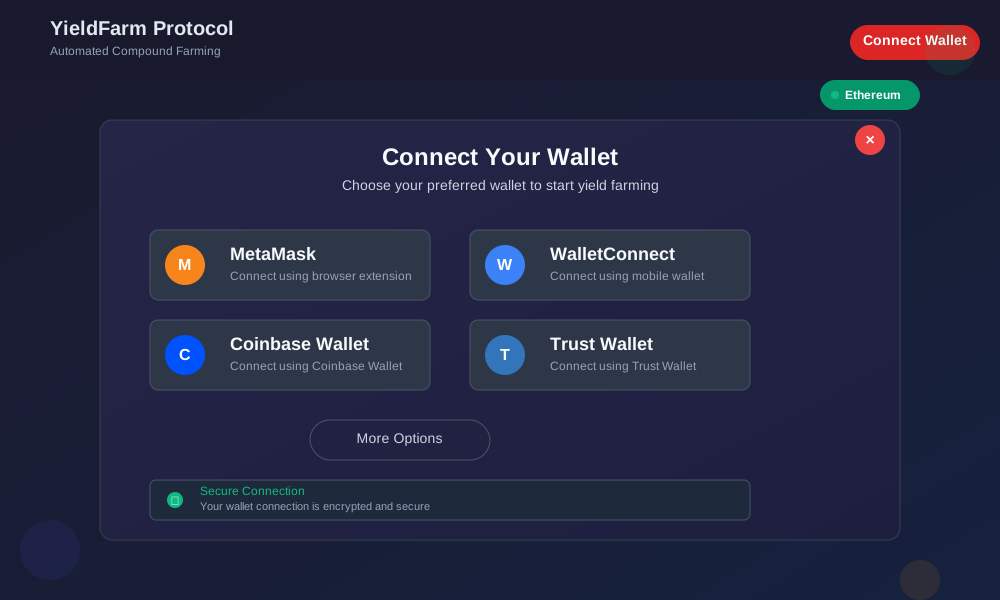
Step 2: Connect Your Wallet
- Install MetaMask or your preferred wallet
- Navigate to your chosen protocol
- Click "Connect Wallet"
- Approve the connection request
- Verify you're on the correct network
Step 3: Select a Vault
Filter vaults by:
- APY: Target 50-200% for sustainable yields
- TVL: Choose pools with $1M+ for stability
- Age: Avoid pools younger than 30 days
- Audit Status: Only use audited protocols
Vault Analysis Example:
USDC-USDT Vault
- APY: 85%
- TVL: $15.2M
- Strategy: Curve + Convex farming
- Fees: 2% management + 10% performance
- Risk: Low (stablecoin pair)
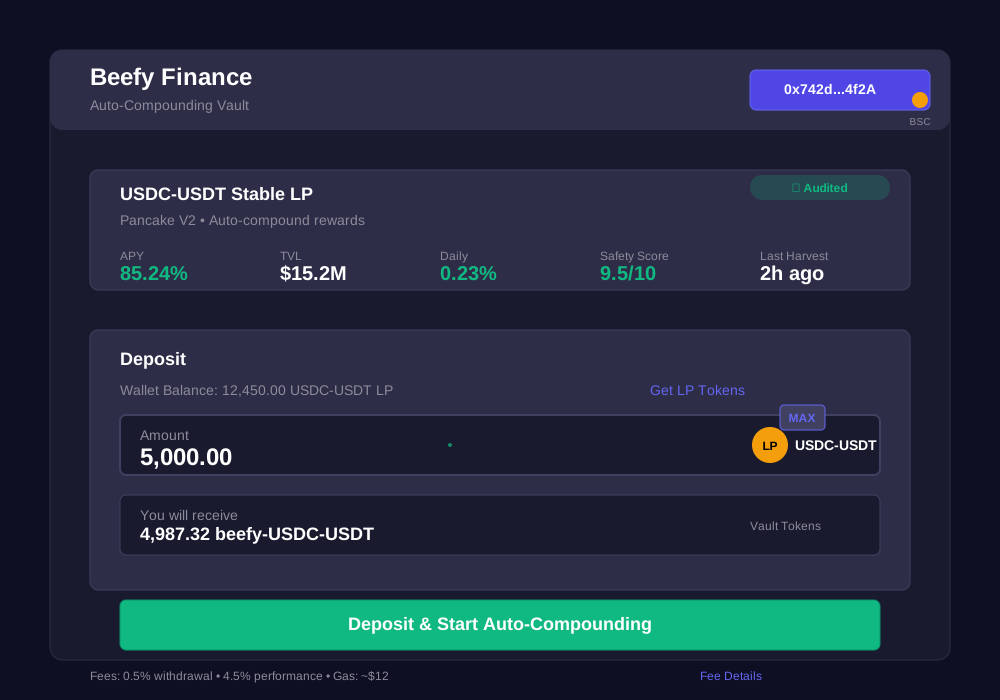
Step 4: Deposit Funds
- Click on your selected vault
- Enter deposit amount
- Approve token spending (first-time only)
- Confirm deposit transaction
- Receive vault tokens representing your share
Step 5: Monitor Performance
Track these metrics:
- Vault Token Price: Shows compounding effect
- APY Changes: Monitor for strategy adjustments
- Harvest Frequency: Ensures regular compounding
- Fee Deductions: Verify reasonable fee structure
Best Platforms for Auto-Compounding
Yearn Finance (Ethereum)
- Strengths: Pioneer in auto-compounding, extensive strategy library
- Fees: 2% management + 20% performance
- Best For: Large deposits ($10K+), stable strategies
Beefy Finance (Multi-chain)
- Strengths: Supports 20+ chains, low fees, active community
- Fees: 0.5% withdrawal + 4.5% performance
- Best For: Smaller deposits, exploring new chains
Convex Finance (Ethereum)
- Strengths: Specialized for Curve pools, boosted rewards
- Fees: 17% performance fee
- Best For: Curve LPs, stablecoin farming
Platform Comparison
| Platform | Chains | Min Deposit | Avg APY | Audit Status |
|---|---|---|---|---|
| Yearn | 3 | $100 | 15-30% | Extensive |
| Beefy | 20+ | $10 | 25-100% | Regular |
| Convex | 1 | $50 | 20-40% | Comprehensive |
Risk Management Strategies
Smart Contract Risk
- Use only audited protocols
- Check audit reports for critical findings
- Avoid pools with unlimited token approvals
- Monitor protocol governance changes
Impermanent Loss Protection
Choose stable asset pairs:
- Stablecoin pairs: USDC-USDT, DAI-USDC
- Correlated assets: ETH-stETH, BTC-WBTC
- Same-protocol tokens: UNI-ETH on Uniswap
Diversification Rules
- Maximum 20% in any single protocol
- Split between different chains
- Mix stable and volatile asset pairs
- Keep 10% in traditional DeFi for emergencies
Exit Strategy Planning
Set clear criteria for withdrawing:
- APY drops below 20%
- Protocol TVL decreases 50%
- Multiple security incidents
- Major team changes
Advanced Compounding Strategies
Yield Farming Ladders
Stagger deposits across multiple vaults:
Month 1: 25% in Vault A
Month 2: 25% in Vault B
Month 3: 25% in Vault C
Month 4: 25% in Vault D
This reduces timing risk and captures different yield cycles.
Cross-Chain Arbitrage
Monitor yield differences between chains:
- Ethereum: Higher security, lower yields
- BSC: Medium security, higher yields
- Polygon: Lower security, highest yields
Move funds when yield differences exceed bridge costs.
Protocol Token Staking
Many platforms offer additional rewards for staking their native tokens:
- Yearn: veYFI for boosted rewards
- Convex: vlCVX for increased APY
- Beefy: BIFI staking for fee sharing
Liquidity Mining Integration
Some vaults provide bonus tokens on top of compounding:
- Harvest Finance: FARM token rewards
- Autofarm: AUTO token emissions
- PancakeBunny: BUNNY token bonuses
Technical Implementation
Smart Contract Integration
For developers building on top of auto-compounding protocols:
// Interface for Yearn-style vaults
interface IVault {
    function deposit(uint256 amount) external;
    function withdraw(uint256 shares) external;
    function pricePerShare() external view returns (uint256);
    function totalSupply() external view returns (uint256);
}

// Integration example
contract YieldAggregator {
    IVault public vault;

    function autoCompound() external {
        uint256 balance = vault.pricePerShare();
        // Implement compounding logic
    }
}
API Integration
Most protocols provide APIs for tracking performance:
// Yearn API example
const response = await fetch('https://api.yearn.finance/v1/vaults/all');
const vaults = await response.json();

// Find best performing vault
const bestVault = vaults.reduce((best, current) =>
    current.apy > best.apy ? current : best
);
Monitoring Tools
Set up automated alerts:
- Zapier: Connect protocol webhooks to notifications
- The Graph: Query on-chain data for custom alerts
- Tenderly: Monitor transaction failures and gas usage
Common Mistakes to Avoid
Chasing High APYs
Extremely high yields (500%+) usually indicate:
- Unsustainable token emissions
- High-risk experimental strategies
- Potential rug pull schemes
Stick to yields that make economic sense.
Ignoring Fee Structures
Calculate real returns after fees:
Real APY = (Gross APY - Management Fee) × (1 - Performance Fee)
Example: (100% - 2%) × (1 - 0.20) = 78.4% real APY
Poor Timing
Avoid these timing mistakes:
- Depositing during high gas periods
- Withdrawing during temporary APY dips
- Panic selling during market downturns
Insufficient Due Diligence
Research before depositing:
- Team background and experience
- Code audit results and findings
- Community sentiment and reviews
- Historical performance and stability
Measuring Success
Key Performance Indicators
Track these metrics monthly:
- Real APY: Returns after all fees
- Risk-Adjusted Returns: Performance vs. benchmark
- Compounding Frequency: Harvest efficiency
- Fee Drag: Impact of protocol fees
Benchmarking Performance
Compare against these standards:
- Conservative: 10-25% APY (stablecoin farming)
- Moderate: 25-50% APY (mixed strategies)
- Aggressive: 50%+ APY (high-risk protocols)
Performance Tracking Template
Protocol: Yearn USDC Vault
Deposit Date: Jan 1, 2025
Initial: $10,000
Current: $12,156
Duration: 90 days
APY: 95.2%
Fees Paid: $243
Net Profit: $2,156
Future of Auto-Compounding
Technology Trends
Layer 2 Integration: Cheaper transactions enable more frequent compounding
Cross-Chain Bridges: Seamless yield optimization across networks
AI-Powered Strategies: Machine learning for optimal harvest timing
Institutional Tools: Professional-grade risk management features
Regulatory Considerations
Monitor these developments:
- DeFi Regulations: Impact on protocol operations
- Tax Implications: Compounding event taxation
- Compliance Requirements: KYC/AML for institutional users
Market Evolution
Expect these changes:
- Consolidation: Fewer, larger protocols
- Specialization: Niche strategies for specific assets
- Integration: Traditional finance adopting DeFi tools
- Standardization: Common interfaces and practices
Conclusion
Compound yield farming transforms your DeFi strategy from manual work into automated wealth building. By reinvesting rewards automatically, you capture exponential returns while saving time and gas fees.
The key to success lies in choosing audited protocols, diversifying across strategies, and maintaining disciplined risk management. Start with smaller amounts on established platforms like Yearn or Beefy, then scale as you gain experience.
Auto-compounding protocols offer the closest thing to passive income in DeFi. Set up your positions correctly, monitor performance regularly, and let compound interest work its magic while you sleep.
Ready to automate your yield farming? Start with a stablecoin vault on your preferred platform and experience the power of compound yield farming firsthand.
This article is for educational purposes only. Always research protocols thoroughly and never invest more than you can afford to lose. DeFi carries significant risks including smart contract bugs, impermanent loss, and regulatory changes.