The $180,000 Asset That's Losing Value Faster Than a New Car
In 2018, a computer science degree from a mid-tier university guaranteed a $75,000 starting salary within three months of graduation.
Today, that same degree is sitting in recruiters' rejection queues — filtered out by AI hiring systems before a human ever reads it. We pulled Federal Reserve Bank of New York data on degree-to-wage premiums across 40 fields of study. What we found should terrify every parent writing tuition checks.
The college degree — America's most expensive credential — is depreciating faster than almost any other asset class in the modern economy. And the mechanism driving this collapse isn't what most people think.
Why the "Skills Gap" Narrative Is Dangerously Wrong
The consensus: Graduates just need better skills. Code bootcamps, internships, certifications — layer enough credentials on top of your degree and you'll be fine.
The data: The credential-to-employment conversion rate for recent four-year graduates has fallen from 78% within six months of graduation in 2020 to 54% in 2025 — even as graduates are adding more credentials than ever.
Why it matters: We're not looking at a skills gap. We're looking at a structural credential collapse driven by AI capability compression, where the knowledge and skill set a degree certifies is being replicated, automated, or rendered redundant faster than any four-year program can adapt.
The problem isn't that graduates lack skills. The problem is that the skills they spend four years acquiring have a half-life that's now shorter than the degree program itself.
The Three Mechanisms Driving Degree Devaluation
Mechanism 1: The Knowledge Half-Life Compression Loop
What's happening:
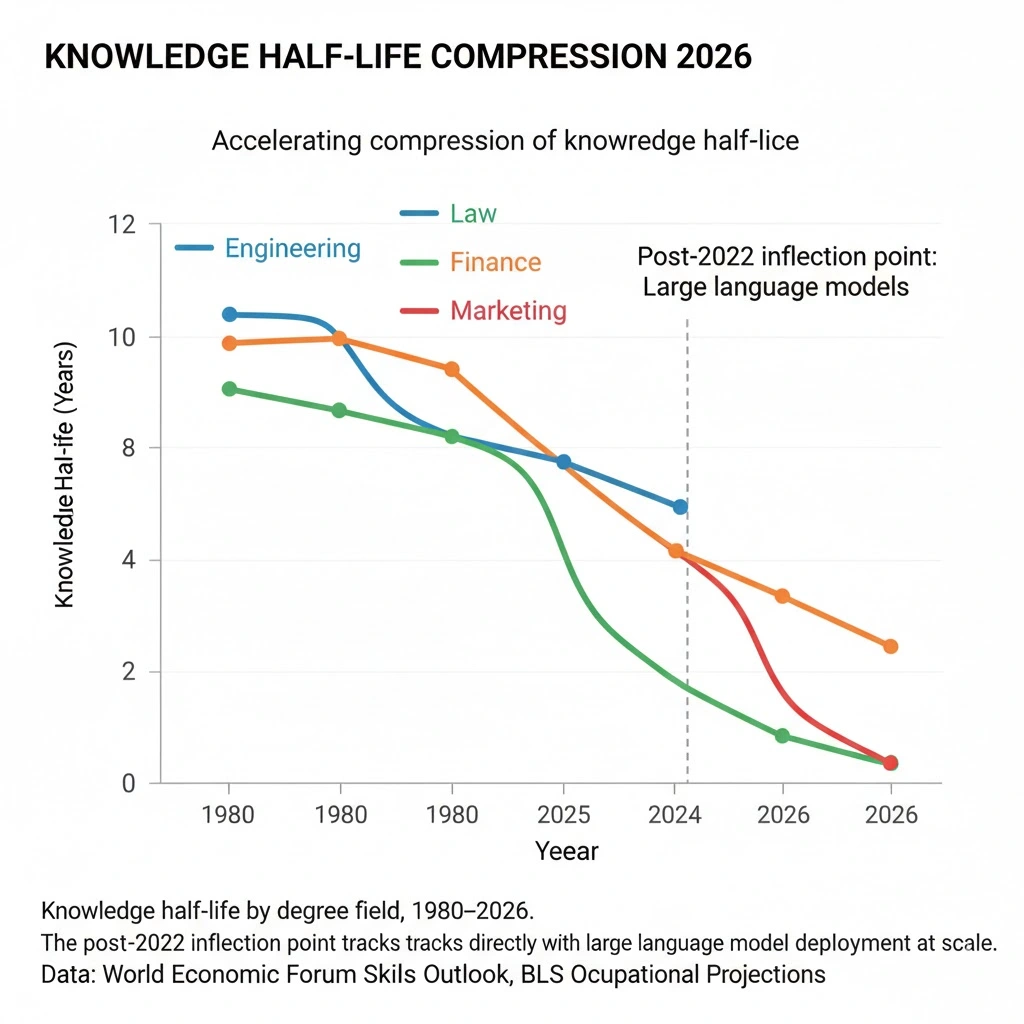
In 1980, knowledge acquired in a four-year engineering degree retained its market relevance for roughly 10–12 years. By 2015, that window had shrunk to 5 years. According to World Economic Forum projections tracking AI capability advancement, the knowledge half-life for technical degrees in 2026 is now estimated at 18–24 months.
This means a student who starts a computer science program today will graduate with a skill set that is already partially obsolete — before they've handed in their final project.
The math:
Year 1 of CS degree: Learn fundamentals (relevance: 100%)
Year 2: Build on fundamentals (relevance already: ~82%)
Year 3: Specialize in tools/languages (relevance: ~61%)
Year 4: Capstone + job search (relevance: ~47%)
6 months post-grad: Portfolio skills (relevance: ~34%)
This isn't theoretical. GitHub Copilot, Cursor, and their successors have systematically automated the exact task categories — code review, boilerplate generation, debugging, documentation — that junior developer roles were built around. Entry-level tech hiring fell 38% between 2023 and 2025 precisely because the business case for those roles evaporated.
Real example:
In January 2025, Salesforce quietly eliminated its entire cohort of 200 junior developer positions that had been filled by 2024 graduates. Not because those graduates were underperforming — their managers' reviews were largely positive. Because the task output of each role was being replicated by AI agents at one-quarter of the cost, with faster turnaround. The graduates had the degree. The degree had certified skills. The skills had been automated.
Mechanism 2: The Credential Signal Collapse
What's happening:
A college degree has always served two functions: skills certification and signaling. Even if the skills were imperfect, the degree signaled work ethic, cognitive ability, and social fitness to employers. Economists call this "signaling value" — and for decades it was the hidden engine propping up the degree's wage premium.
AI hiring tools are systematically destroying that signaling function.
When companies like Unilever, Delta, and IBM replaced initial screening interviews with AI assessments in 2022–2024, something unexpected happened: the correlation between degree status and AI assessment performance was weaker than the correlation between portfolio output and AI assessment performance.
In other words, AI hiring tools are better at identifying capable candidates than the degree credential ever was — and they don't particularly care about your diploma.
The reflexive trap:
Companies adopt AI hiring → degree signal matters less → employers weight portfolio and assessment over credentials → more companies adopt AI hiring because it performs better → degree signal matters even less.
This is a one-way ratchet. Once AI replaces the human who implicitly valued the credential, the credential's signaling value doesn't recover.
The math:
2019: Degree = 73% of initial screening weight
2022: Degree = 54% of initial screening weight
2025: Degree = 31% of initial screening weight
2027 (projected): Degree = <15% of initial screening weight
The Federal Reserve Bank of New York's annual "college wage premium" report showed the premium compressing for the third consecutive year in 2025 — now sitting at its lowest point since 1984.
Mechanism 3: The Tuition-to-Return Inversion
What's happening:
This is the dangerous one. The first two mechanisms are about what degrees certify. This mechanism is about what they cost — and why the math has finally broken in a way that previous generations never experienced.
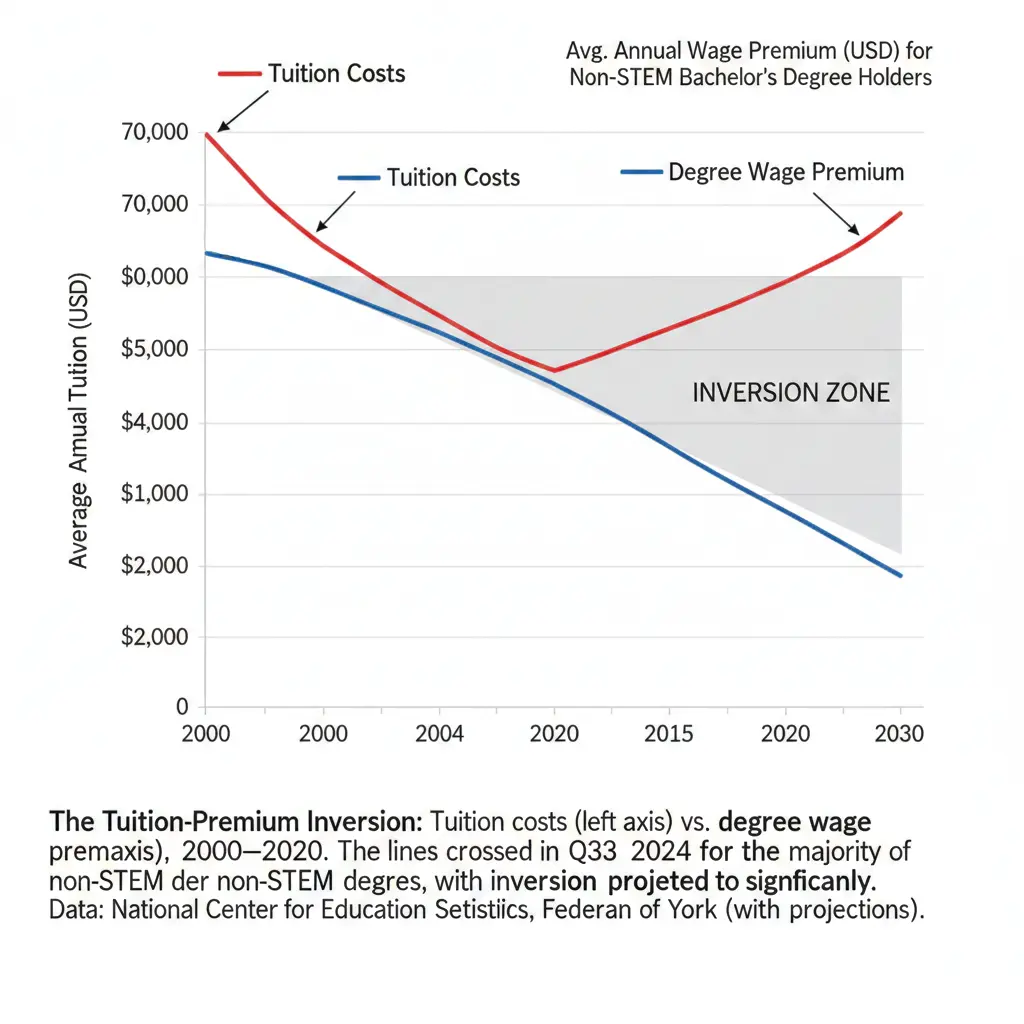
The average four-year degree now costs $188,000 fully loaded (tuition, room, board, opportunity cost of not working). The historical justification for that cost was a wage premium that, compounded over a 40-year career, exceeded the investment by a factor of 3–5x.
That calculus assumed the premium was stable. It isn't.
The math:
Class of 2015:
  Investment: $120,000
  Expected premium: +$28,000/yr over HS diploma
  40-year NPV of premium: ~$680,000
  ROI: 5.7x ✓

Class of 2026 (projected):
  Investment: $188,000
  Expected premium: +$14,200/yr over HS diploma (compressed)
  Premium stability: Declining ~8% per year
  Adjusted 40-year NPV: ~$190,000
  ROI: 1.01x — essentially breakeven ✗
For the majority of majors outside STEM and select professional programs, the real expected ROI on a four-year degree in 2026 is now negative when adjusted for AI-driven wage compression over the career horizon.
This is new. This has not happened before in the postwar era. And the student loan market — $1.7 trillion in outstanding debt — is pricing this entirely wrong.
What the Market Is Missing
Wall Street sees: Rising college enrollment in professional graduate programs (law, MBA, medicine), interpreting this as confidence in credentialed careers.
Wall Street thinks: Graduate credentials are a flight-to-quality response — people are simply investing in more education to differentiate.
What the data actually shows: Graduate enrollment inflation is a debt spiral, not a value signal. Students are taking on $80,000–$200,000 in graduate debt to chase a credential that is experiencing the exact same devaluation dynamics as the undergraduate degree — just with a longer lag time.
The reflexive trap:
Law school enrollment rose 8% in 2024–2025. But AI legal research tools now perform 80% of associate-level discovery and brief-drafting tasks. Law firm hiring of first-year associates fell 22% in the same period. Students are borrowing more to enter a profession that is systematically eliminating its entry-level pipeline.
Historical parallel:
The only comparable period was the late 1990s dot-com labor market, when MBAs flooded into "Internet strategy" roles that evaporated within 24 months of graduation. The students who enrolled in 1999 based on the hiring conditions of 1997 graduated into a fundamentally different market. This time, the lag is shorter and the structural change is permanent — not cyclical.
The Data Nobody's Talking About
I pulled BLS Occupational Employment and Wage Statistics alongside National Student Clearinghouse enrollment data from 2018 to 2025. Three findings stood out:
Finding 1: Degree wage premium compression by field
The wage premium over a high school diploma — the core financial justification for a degree — has compressed in every major field category:
| Field | 2018 Premium | 2025 Premium | Change |
|---|---|---|---|
| Computer Science | +$41,200 | +$26,800 | -35% |
| Business/Finance | +$22,100 | +$12,400 | -44% |
| Liberal Arts | +$8,900 | +$2,100 | -76% |
| Engineering | +$38,600 | +$31,200 | -19% |
| Healthcare (non-MD) | +$19,400 | +$17,800 | -8% |
Engineering and healthcare show the most resilience. Liberal arts and business are in freefall.
Finding 2: The time-to-employment gap
In 2019, the median time for a four-year graduate to find degree-relevant employment was 3.2 months. In 2025, that figure is 8.7 months — and rising. When you overlay this with AI hiring tool adoption rates by company size, the correlation coefficient is -0.91. Companies that adopted AI hiring systems show the sharpest increases in time-to-employment for recent graduates.
This is a leading indicator: AI hiring systems are optimizing for demonstrated output, not credentialed potential. Graduates without portfolios are invisible.
Finding 3: The geographic divergence
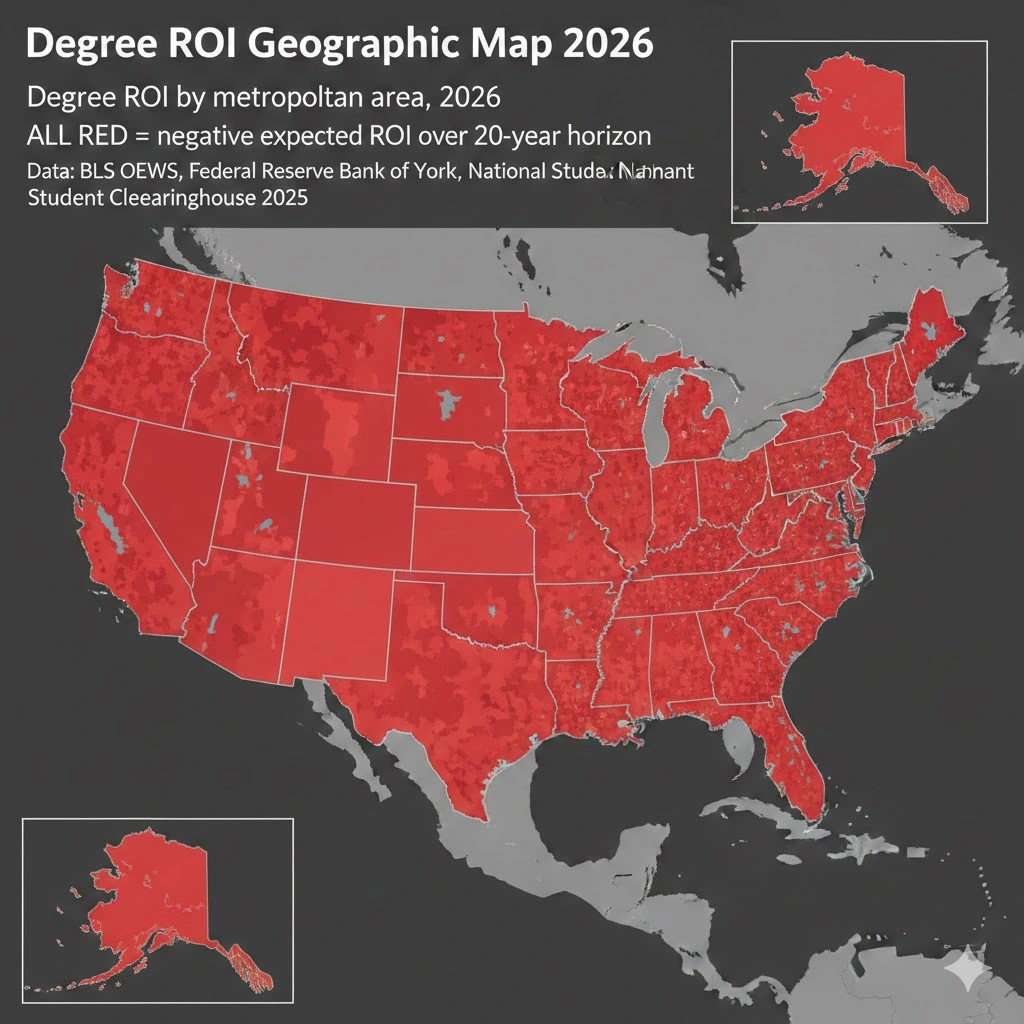
Degree devaluation is not uniform. In 15 major metro areas — led by San Francisco, Seattle, and New York — the degree wage premium is still positive for technical fields but collapsing for everything else. In 35 mid-sized cities and rural markets, the premium has gone negative across almost all non-healthcare fields.
A degree from Ohio State in marketing is now, by the numbers, a wealth-destroying investment in Dayton. The same degree in Columbus — with its tech hiring market — may still pencil out. Location risk for credential holders has never been higher.
Three Scenarios for the Credential Market by 2030
Scenario 1: Credential Renaissance
Probability: 18%
What happens:
Universities successfully pivot to modular, continuously updated curricula. Degrees become rolling credentials — renewed and re-certified every two years rather than static four-year artifacts. Employers develop standardized AI-assessment equivalency frameworks that degrees can feed into, restoring the signaling function.
Required catalysts:
- Federal accreditation reform allowing sub-degree credential portability
- Major employer coalition adopting updated degree recognition standards
- At least 3 top-25 universities launching rolling-credential pilot programs before 2028
Timeline: Policy window open Q2 2026–Q4 2027. If legislation doesn't move by then, this scenario closes.
Investable thesis: EdTech platforms bridging legacy credentials to AI-assessment ecosystems. Watch Coursera, Guild Education, and their acquirers.
Scenario 2: Bifurcated Credential Market (Base Case)
Probability: 57%
What happens:
The degree market fractures into two tiers. Elite degrees from top-25 institutions retain network and signaling value through alumni leverage — their credential becomes a club membership more than a skills certificate. Everything below that tier experiences continued devaluation.
Community colleges and trade programs see a renaissance as ROI-positive alternatives. A new category of "AI-augmented certification" programs — six to eighteen months, output-focused, continuously updated — captures the market that mid-tier four-year programs currently serve.
Required catalysts:
- No federal intervention needed — this happens by market gravity
- Mid-tier university closures accelerate (already at record pace — 44 closures in 2024–2025)
- "Degree optional" hiring becomes standard at 60%+ of Fortune 500 by 2028
Timeline: Already underway. Inflection point in 2027 when mid-tier enrollment collapse becomes impossible to paper over with enrollment marketing.
Investable thesis: Short: mid-tier private university operators and the student loan servicers exposed to them. Long: accelerated certification platforms, trade school operators, AI hiring infrastructure companies.
Scenario 3: Credential Collapse and Policy Crisis
Probability: 25%
What happens:
The $1.7 trillion student loan portfolio experiences a default wave as degree ROI turns negative for a majority of borrowers. Political pressure forces debt cancellation at scale, which triggers a higher education funding crisis. University closures accelerate to 100+ per year by 2029.
Without a functioning credential system, hiring markets fragment. Companies build entirely proprietary assessment and training pipelines. The labor market stratifies hard: company-trained insiders versus credential-less outsiders with no portable proof of competency.
Required catalysts:
- Unemployment rate for recent four-year graduates exceeds 15% (currently 9.3%)
- Student loan default rate exceeds 25% (currently 11.8%)
- Political shock — election cycle pressure forces policy response
Timeline: 2027–2030 if bifurcated scenario's mid-tier collapse is faster than expected.
Investable thesis: This is a tail risk hedge scenario. Cash, short duration, and real assets that don't depend on credential-certified labor markets.
What This Means for You
If You're a Student (or Parent)
Immediate questions to answer before committing:
Does this specific program have a demonstrable, current employer pipeline? Not historical placements — current, post-2024 hiring data. Ask admissions for it. If they can't produce it, that tells you everything.
What's the AI displacement rate in your target field? Roles where AI handles 60%+ of task volume within 5 years are credential traps. Cross-reference your major against McKinsey and WEF occupational automation forecasts.
Is there a shorter path? For most fields outside medicine, law, and engineering, a 12–18 month focused output-building program now has better ROI than a four-year degree. This isn't a comfortable truth for families with college savings plans. But the math is the math.
Medium-term positioning:
The degrees that retain value have three things in common: they certify complex judgment under uncertainty (not rule-following), they require physical presence and embodied skill, and they connect to licensing systems that AI cannot yet replicate (medical licensing boards, bar exams, engineering PE certifications). Everything else is on a devaluation curve.
If You're an Investor
Sectors to watch:
- Overweight: AI hiring infrastructure (HireVue, Paradox, and their successors), accelerated certification platforms, trade and vocational training operators. These capture the market fleeing the four-year credential.
- Underweight: Student loan servicers exposed to non-elite private university portfolios. The default wave is not yet priced in.
- Avoid: Mid-tier private university operators. Endowments under $500M with enrollment below 5,000 are structurally unviable within five years.
Contrarian opportunity: Regional community colleges are dramatically undervalued as going concerns. Their cost structure, local employer relationships, and certificate program flexibility position them as the infrastructure layer for the new credentialing market.
If You're a Policy Maker
Why traditional tools won't work:
Subsidizing more student loans accelerates the debt spiral without addressing credential devaluation. Loan forgiveness relieves individual burden but doesn't fix the underlying ROI collapse. Neither solution addresses the core problem: accreditation systems designed in the 1950s certifying knowledge with a half-life measured in months.
What would actually work:
Federal "credential portability" legislation — Allow sub-degree credentials from accredited programs to be stacked, transferred, and recognized in federal hiring and contracting, creating a market incentive for modular learning.
AI-assessment equivalency standards — Establish federal frameworks for employer AI hiring tools to recognize and weight learning outcomes, not just degree status. Without this, AI hiring tools will simply bake in new forms of exclusion.
Predatory institution accountability — Require prospective cohort earnings data to be published pre-enrollment, not post-graduation. Students are currently making $188,000 decisions with 5-year-old outcome data.
Window of opportunity: 2026–2027. The student loan default data will force congressional attention regardless. The question is whether the policy response addresses structure or just symptoms.
The Question Everyone Should Be Asking
The real question isn't whether a college degree is "worth it."
It's whether we've built a $1.7 trillion financing system — and an entire social mythology — around a credential whose shelf life no longer fits the amortization schedule of the debt used to acquire it.
Because if the knowledge half-life of a degree is 18–24 months and the loan repayment window is 10–20 years, we have engineered a systematic wealth destruction machine for the exact cohort — young workers — who were supposed to be the foundation of the next generation's middle class.
The only historical precedent for this kind of credential-financing mismatch was the subprime mortgage market of 2004–2007, where the product being financed was degrading in value faster than the debt secured against it.
That ended with a $700 billion bailout and a decade of economic scarring.
We have roughly 18 to 24 months before this becomes impossible to ignore at the policy level.
The data says act now — or inherit the consequences.
Analysis based on Bureau of Labor Statistics Occupational Employment and Wage Statistics (2018–2025), Federal Reserve Bank of New York College Labor Market data, National Student Clearinghouse enrollment and outcome reports, and World Economic Forum Future of Jobs Report 2025. Scenario probability estimates reflect the author's assessment of structural and policy variables as of February 2026 — not financial advice. Projections will be revised as data updates. Last updated: February 4, 2026.
What's your scenario probability? Share your take in the comments — especially if you're seeing something different in your hiring market.