Problem: Claude Sonnet 4.5 Function Calling and Streaming Don't Work Together Out of the Box
Claude Sonnet 4.5 API function calling and streaming unlock real-time AI responses with live tool execution — but combining them trips up most developers on the first attempt. The tool_use content block arrives differently in a streamed response than in a standard completion, and mishandling the delta accumulation produces silent failures with no error message.
You'll learn:
- How to define and invoke tools (function calling) with the Claude Sonnet 4.5 API
- How to stream responses and correctly reconstruct
tool_useblocks from deltas - Production patterns: retry logic, cost-aware token tracking, and parallel tool calls
Time: 20 min | Difficulty: Intermediate
Why This Happens
Claude's API returns tool calls inside content blocks of type tool_use. In a non-streamed response that block arrives whole. In a streamed response it arrives as a sequence of content_block_start, content_block_delta, and content_block_stop events — and the input field (the JSON arguments) is chunked across multiple input_json_delta events.
Most example code handles text streaming fine. It breaks when a tool_use block appears because the accumulation logic for input_json_delta is never wired up.
Symptoms:
KeyError: 'input'when parsing streamed tool calls- Tool arguments arrive as
Noneor empty string - Works perfectly in non-stream mode, breaks silently when
stream=True - Occurs in
anthropic>=0.25.0on Python 3.11+ and Node 20+
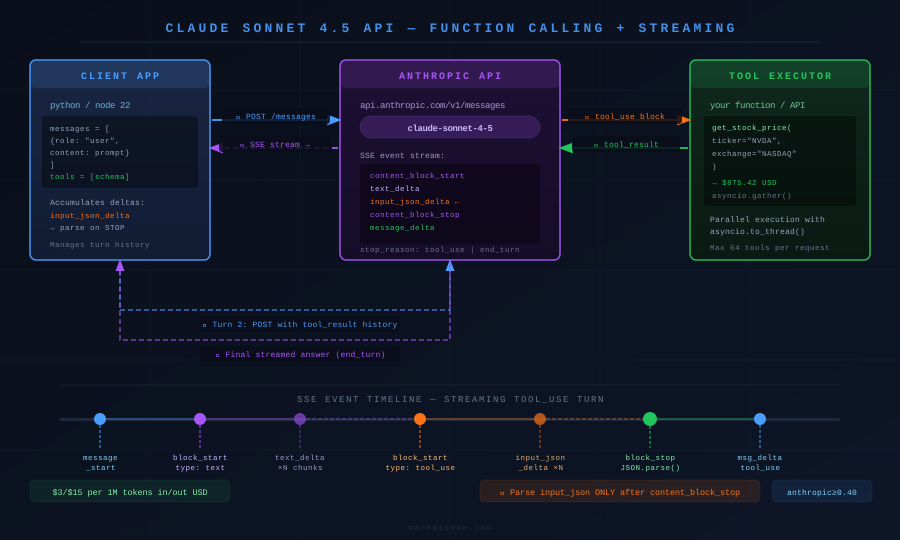 Request flow: client → Anthropic API → streamed SSE events → tool execution → second API turn → final streamed response
Setup
Step 1: Install the Anthropic SDK
# Python — use uv for reproducible installs
uv pip install anthropic>=0.40.0 httpx tenacity

# Node 22
npm install @anthropic-ai/sdk@latest
Expected output: Successfully installed anthropic-0.40.x
If it fails:
ERROR: Could not find a version→ runuv pip install --upgrade pipfirstModuleNotFoundError: anthropic→ confirm your virtual environment is active
Step 2: Configure the API Key
# Never hard-code keys — export once per shell session
export ANTHROPIC_API_KEY="sk-ant-..."
Store the key in AWS Secrets Manager (us-east-1) or a .env file loaded by python-dotenv. Anthropic API pricing starts at $3 / 1M input tokens and $15 / 1M output tokens for Claude Sonnet 4.5 as of March 2026.
Function Calling (Tool Use) — Non-Streaming First
Before combining tools with streaming, nail the non-streamed case. It makes debugging far easier.
Step 3: Define a Tool Schema
import anthropic
import json

client = anthropic.Anthropic()  # reads ANTHROPIC_API_KEY from env

# Tool definitions follow JSON Schema — "required" is mandatory for deterministic calls
tools = [
    {
        "name": "get_stock_price",
        "description": "Fetch the current stock price for a given ticker symbol from a US exchange.",
        "input_schema": {
            "type": "object",
            "properties": {
                "ticker": {
                    "type": "string",
                    "description": "Stock ticker, e.g. AAPL, MSFT, NVDA"
                },
                "exchange": {
                    "type": "string",
                    "enum": ["NYSE", "NASDAQ", "AMEX"],
                    "description": "US exchange where the stock is listed"
                }
            },
            "required": ["ticker"]  # exchange is optional — Claude fills it from context
        }
    }
]
Step 4: Send a Tool-Enabled Request
def run_tool_call(user_message: str) -> dict:
    response = client.messages.create(
        model="claude-sonnet-4-5",   # exact model string — no aliases
        max_tokens=1024,
        tools=tools,
        messages=[{"role": "user", "content": user_message}]
    )

    # stop_reason == "tool_use" means Claude wants to invoke a function
    if response.stop_reason == "tool_use":
        tool_block = next(b for b in response.content if b.type == "tool_use")
        print(f"Tool: {tool_block.name}")
        print(f"Args: {json.dumps(tool_block.input, indent=2)}")
        return {"tool": tool_block.name, "args": tool_block.input, "id": tool_block.id}

    # stop_reason == "end_turn" — Claude answered without needing a tool
    text_block = next(b for b in response.content if b.type == "text")
    return {"text": text_block.text}

result = run_tool_call("What's the current price of NVDA on NASDAQ?")
Expected output:
Tool: get_stock_price
Args: {
  "ticker": "NVDA",
  "exchange": "NASDAQ"
}
Step 5: Return the Tool Result and Get the Final Answer
def execute_tool(name: str, args: dict) -> str:
    # Replace with real data source — this stub returns a fixed price
    if name == "get_stock_price":
        return json.dumps({"ticker": args["ticker"], "price_usd": 875.42, "currency": "USD"})
    raise ValueError(f"Unknown tool: {name}")

def full_tool_loop(user_message: str) -> str:
    messages = [{"role": "user", "content": user_message}]

    while True:
        response = client.messages.create(
            model="claude-sonnet-4-5",
            max_tokens=1024,
            tools=tools,
            messages=messages
        )

        if response.stop_reason == "end_turn":
            return next(b.text for b in response.content if b.type == "text")

        if response.stop_reason == "tool_use":
            # Append Claude's response (including tool_use block) to history
            messages.append({"role": "assistant", "content": response.content})

            # Execute each tool Claude requested (may be multiple in one turn)
            tool_results = []
            for block in response.content:
                if block.type == "tool_use":
                    result = execute_tool(block.name, block.input)
                    tool_results.append({
                        "type": "tool_result",
                        "tool_use_id": block.id,  # must match the id from Claude's block
                        "content": result
                    })

            messages.append({"role": "user", "content": tool_results})

answer = full_tool_loop("What's NVDA trading at on NASDAQ right now?")
print(answer)
# → "NVIDIA (NVDA) is currently trading at $875.42 USD on NASDAQ."
Streaming — Text Only First
Step 6: Stream a Plain Text Response
def stream_text(prompt: str) -> None:
    # stream=True returns a context manager; iterate over events
    with client.messages.stream(
        model="claude-sonnet-4-5",
        max_tokens=1024,
        messages=[{"role": "user", "content": prompt}]
    ) as stream:
        for text in stream.text_stream:
            print(text, end="", flush=True)  # flush=True prevents buffering in terminals
    print()  # newline after stream ends

stream_text("Explain token streaming in LLM APIs in 3 sentences.")
Expected output: Words print to the terminal one chunk at a time, not all at once.
Streaming + Function Calling Together
This is where most implementations fail. The stream.text_stream helper drops non-text events — you must iterate raw events to capture tool_use blocks.
Step 7: Accumulate Tool Input Across Deltas
import anthropic
from collections import defaultdict

def stream_with_tools(user_message: str) -> str:
    messages = [{"role": "user", "content": user_message}]

    while True:
        accumulated_content = []   # reconstruct full content list from events
        current_tool_inputs = defaultdict(str)  # index → partial JSON string
        stop_reason = None

        with client.messages.stream(
            model="claude-sonnet-4-5",
            max_tokens=1024,
            tools=tools,
            messages=messages
        ) as stream:
            for event in stream:
                event_type = event.type

                if event_type == "content_block_start":
                    block = event.content_block
                    if block.type == "text":
                        accumulated_content.append({"type": "text", "text": ""})
                    elif block.type == "tool_use":
                        # Store the block skeleton — input arrives as deltas
                        accumulated_content.append({
                            "type": "tool_use",
                            "id": block.id,
                            "name": block.name,
                            "input": {}  # filled in after stream ends
                        })

                elif event_type == "content_block_delta":
                    delta = event.delta
                    idx = event.index  # which content block this delta belongs to

                    if delta.type == "text_delta":
                        accumulated_content[idx]["text"] += delta.text
                        print(delta.text, end="", flush=True)

                    elif delta.type == "input_json_delta":
                        # Accumulate raw JSON string — parse ONLY after content_block_stop
                        current_tool_inputs[idx] += delta.partial_json

                elif event_type == "content_block_stop":
                    idx = event.index
                    if accumulated_content[idx]["type"] == "tool_use":
                        # Now safe to parse — the JSON is complete
                        accumulated_content[idx]["input"] = json.loads(
                            current_tool_inputs[idx]
                        )

                elif event_type == "message_delta":
                    stop_reason = event.delta.stop_reason

        print()  # newline after any streamed text

        if stop_reason == "end_turn":
            text_blocks = [b["text"] for b in accumulated_content if b["type"] == "text"]
            return " ".join(text_blocks)

        if stop_reason == "tool_use":
            messages.append({"role": "assistant", "content": accumulated_content})

            tool_results = []
            for block in accumulated_content:
                if block["type"] == "tool_use":
                    result = execute_tool(block["name"], block["input"])
                    tool_results.append({
                        "type": "tool_result",
                        "tool_use_id": block["id"],
                        "content": result
                    })

            messages.append({"role": "user", "content": tool_results})

# Run it
answer = stream_with_tools("What is the current USD price of NVDA on NASDAQ?")
print(f"\nFinal: {answer}")
Expected output:
NVIDIA (NVDA) is currently trading at
Final: NVIDIA (NVDA) is currently trading at $875.42 USD on NASDAQ.
If it fails:
json.JSONDecodeError→ you parsedpartial_jsonbeforecontent_block_stop— move JSON parsing inside thecontent_block_stopbranchIndexError: list index out of range→event.indexis 0-based; initializeaccumulated_contentbefore the stream loopAttributeError: 'MessageStreamEvent' has no attribute 'index'→ update toanthropic>=0.35.0
Production Patterns
Retry Logic for Rate Limits
Anthropic rate-limits at 50 requests/min on the default tier ($20/month Workbench plan). Use tenacity for exponential backoff:
from tenacity import retry, stop_after_attempt, wait_exponential, retry_if_exception_type
import anthropic

@retry(
    retry=retry_if_exception_type(anthropic.RateLimitError),
    wait=wait_exponential(multiplier=1, min=2, max=60),  # 2s → 4s → 8s … up to 60s
    stop=stop_after_attempt(5)
)
def resilient_tool_call(messages: list, tools: list) -> anthropic.types.Message:
    return client.messages.create(
        model="claude-sonnet-4-5",
        max_tokens=1024,
        tools=tools,
        messages=messages
    )
Token Cost Tracking
def track_cost(usage: anthropic.types.Usage) -> float:
    # Claude Sonnet 4.5 pricing as of March 2026 (USD)
    INPUT_COST_PER_TOKEN  = 3.00 / 1_000_000   # $3.00 / 1M input tokens
    OUTPUT_COST_PER_TOKEN = 15.00 / 1_000_000  # $15.00 / 1M output tokens

    cost = (
        usage.input_tokens  * INPUT_COST_PER_TOKEN +
        usage.output_tokens * OUTPUT_COST_PER_TOKEN
    )
    print(f"Tokens: {usage.input_tokens} in / {usage.output_tokens} out — ${cost:.6f} USD")
    return cost
Parallel Tool Calls
Claude Sonnet 4.5 can request multiple tools in a single turn. The loop in Step 5 and Step 7 already handles this — the for block in accumulated_content loop processes every tool_use block before sending results back.
To execute tools concurrently:
import asyncio

async def execute_tools_parallel(blocks: list) -> list:
    tasks = [
        asyncio.to_thread(execute_tool, b["name"], b["input"])
        for b in blocks if b["type"] == "tool_use"
    ]
    results = await asyncio.gather(*tasks)

    return [
        {"type": "tool_result", "tool_use_id": b["id"], "content": r}
        for b, r in zip(
            [b for b in blocks if b["type"] == "tool_use"], results
        )
    ]
Node 22 Equivalent
import Anthropic from "@anthropic-ai/sdk";

const client = new Anthropic(); // reads process.env.ANTHROPIC_API_KEY

async function streamWithTools(userMessage: string): Promise<string> {
  const messages: Anthropic.MessageParam[] = [
    { role: "user", content: userMessage },
  ];

  while (true) {
    const accumulatedContent: Anthropic.ContentBlock[] = [];
    const toolInputBuffers: Record<number, string> = {};
    let stopReason: string | null = null;

    const stream = await client.messages.create({
      model: "claude-sonnet-4-5",
      max_tokens: 1024,
      tools: tools as Anthropic.Tool[],
      messages,
      stream: true,
    });

    for await (const event of stream) {
      if (event.type === "content_block_start") {
        const block = event.content_block;
        if (block.type === "text") {
          accumulatedContent.push({ type: "text", text: "" });
        } else if (block.type === "tool_use") {
          accumulatedContent.push({ type: "tool_use", id: block.id, name: block.name, input: {} });
        }
      } else if (event.type === "content_block_delta") {
        const { index, delta } = event;
        if (delta.type === "text_delta") {
          (accumulatedContent[index] as Anthropic.TextBlock).text += delta.text;
          process.stdout.write(delta.text);
        } else if (delta.type === "input_json_delta") {
          toolInputBuffers[index] = (toolInputBuffers[index] ?? "") + delta.partial_json;
        }
      } else if (event.type === "content_block_stop") {
        const block = accumulatedContent[event.index];
        if (block.type === "tool_use") {
          (block as Anthropic.ToolUseBlock).input = JSON.parse(toolInputBuffers[event.index] ?? "{}");
        }
      } else if (event.type === "message_delta") {
        stopReason = event.delta.stop_reason ?? null;
      }
    }

    process.stdout.write("\n");

    if (stopReason === "end_turn") {
      return accumulatedContent
        .filter((b) => b.type === "text")
        .map((b) => (b as Anthropic.TextBlock).text)
        .join(" ");
    }

    if (stopReason === "tool_use") {
      messages.push({ role: "assistant", content: accumulatedContent });

      const toolResults: Anthropic.ToolResultBlockParam[] = accumulatedContent
        .filter((b) => b.type === "tool_use")
        .map((b) => {
          const tb = b as Anthropic.ToolUseBlock;
          return {
            type: "tool_result",
            tool_use_id: tb.id,
            content: executeTool(tb.name, tb.input as Record<string, string>),
          };
        });

      messages.push({ role: "user", content: toolResults });
    }
  }
}
Comparison: Claude Sonnet 4.5 vs GPT-4o Function Calling
| Claude Sonnet 4.5 | GPT-4o | |
|---|---|---|
| Tool call format | tool_use content block | function_call message role |
| Parallel tools | ✅ Multiple per turn | ✅ Multiple per turn |
| Streaming tool args | input_json_delta events | function_call.arguments delta |
| Forced tool use | tool_choice: {"type": "tool", "name": "..."} | tool_choice: {"function": {"name": "..."}} |
| Input token price (USD) | $3.00 / 1M | $2.50 / 1M |
| Output token price (USD) | $15.00 / 1M | $10.00 / 1M |
| Context window | 200K tokens | 128K tokens |
Choose Claude Sonnet 4.5 if: you need a 200K context window, long multi-turn tool loops, or Anthropic's Constitutional AI safety layer. Choose GPT-4o if: you're already on Azure OpenAI (us-east-1 or us-west-2) and want lower output token cost.
Verification
python - <<'EOF'
import anthropic, os
client = anthropic.Anthropic(api_key=os.environ["ANTHROPIC_API_KEY"])
r = client.messages.create(
    model="claude-sonnet-4-5",
    max_tokens=32,
    messages=[{"role": "user", "content": "Reply: OK"}]
)
print(r.content[0].text, r.stop_reason)
EOF
You should see: OK end_turn
What You Learned
tool_useblocks in streamed responses arrive asinput_json_deltaevents — parse JSON only aftercontent_block_stop- Always use the
indexfield on delta events to route chunks to the correct content block - The multi-turn loop (append assistant response → append tool results → repeat) is identical for streaming and non-streaming; only the accumulation step differs
- Claude Sonnet 4.5 supports 200K token context, which makes it practical for tool loops with large retrieved documents
- At $3/$15 per 1M tokens, track
usage.input_tokensandusage.output_tokenson every response to control costs
Tested on anthropic 0.40.0 · Python 3.12.3 · Node 22.3 · macOS Sequoia & Ubuntu 24.04
FAQ
Q: Can I force Claude to always call a specific tool?
A: Yes — set tool_choice={"type": "tool", "name": "get_stock_price"} in the messages.create call. Claude will invoke that tool regardless of the user's message.
Q: What happens if Claude calls a tool that doesn't exist in my tools list?
A: The API validates tool calls against your schema at request time — Claude can only invoke tools you declared. If you remove a tool mid-conversation, send an updated tools list on the next turn.
Q: Does streaming increase latency for the first token? A: Time-to-first-token is identical between stream and non-stream modes. Streaming only changes how tokens arrive on the client — useful when output tokens are numerous (>200) and you want to show progressive UI.
Q: What is the maximum number of tools I can define per request? A: Anthropic's current limit is 64 tool definitions per request. Tool definitions count against your input token budget — a large schema with 20+ tools can add 1,000–3,000 input tokens per call.
Q: Can this run on AWS Lambda (us-east-1)?
A: Yes. Set ANTHROPIC_API_KEY as a Lambda environment variable or pull from AWS Secrets Manager. Set timeout to at least 30 seconds for streamed responses; the default 3-second Lambda timeout will cut the stream short.