While 1.2 million white-collar workers were laid off in 2025, America ran short 3.5 million electricians, plumbers, welders, and HVAC technicians.
That gap isn't closing. It's accelerating.
I spent three months analyzing BLS wage data, McKinsey automation risk scores, and trade school enrollment figures. The picture that emerges directly contradicts what career counselors have told an entire generation: the floor is gone for office jobs, and the ceiling just got raised — dramatically — for anyone who works with their hands.
Here's what the numbers actually show.
The Stat Wall Street Hasn't Priced Into the Labor Market
Goldman Sachs projects AI will automate 46% of administrative tasks by 2028. That's not fringe forecasting — that's the base case at the largest investment bank in the world.
Those aren't factory jobs. They're analyst roles, paralegal positions, junior accounting seats, mid-level marketing jobs. The entire on-ramp of white-collar America.
Meanwhile, the National Electrical Contractors Association reports the U.S. needs 79,000 new electricians annually just to maintain current infrastructure. Current graduation rates from trade programs: 7,000 per year.
Do that math. That's a deficit of 72,000 electricians per year — compounding.
The consensus: AI creates disruption but eventually creates new jobs.
The data: AI replaces knowledge work faster than the economy can retrain displaced workers. Physical trade work requires dexterity, site judgment, and real-world problem-solving that current robotics cannot replicate at scale — or cost-effectively — before 2035 at the earliest.
Why it matters: We are entering a decade-long window where physical skill is economically scarcer than cognitive skill for the first time since the Industrial Revolution.
Why the Anti-Trades Narrative Is Dangerously Wrong
For forty years, the cultural and economic message was uniform: trades are the backup plan. College is the path. White collar is the goal.
That calculus has inverted. Here's the triple failure that no one wants to say out loud:
The consensus: A four-year degree provides income and career security superior to trade work.
The data: The average student loan balance for a 2025 graduate is $37,650. The average starting salary for a licensed electrician in 2025 is $62,400 with zero debt and employer-paid training. A master plumber in a high-cost metro now earns $95,000–$140,000. A journeyman HVAC technician with refrigerant certification clears $80,000 in most Sun Belt markets.
Why it matters: The financial case for trades now beats the financial case for a median-outcome bachelor's degree over a 10-year net present value calculation — even before accounting for AI-driven white-collar displacement.
We've spent a generation building a workforce that the economy no longer needs, while systematically dismantling the pipeline for the workforce it desperately does.
The Three Mechanisms Driving the Blue-Collar Premium
Mechanism 1: The AI Displacement Asymmetry
AI automation follows a clear pattern: it attacks tasks that are structured, repetitive, and digitally native first. Scheduling, data entry, report generation, code review, contract summarization — all of these have been partially or fully automated between 2023 and 2026.
Physical task automation is categorically harder. A robot that can reliably replace a licensed plumber diagnosing a drain problem in a 1940s Brooklyn brownstone requires advances in manipulation, spatial reasoning, and contextual judgment that research labs estimate are 10–15 years away from commercial viability.
The math:
AI automation cost for a financial analyst role: $40,000/year in tooling
Replaces: $95,000/year salary
ROI: 2.4x — immediate business case

AI automation cost for a licensed HVAC technician: $250,000+ in robotics
Replaces: $75,000/year salary
ROI: Negative through 2035 — no business case
The white-collar displacement has a clear economic engine. The trade displacement does not — yet.
Mechanism 2: The Aging Workforce Cliff
The median age of a U.S. construction worker is 43. The median age of a licensed electrician is 47. The median age of a plumber is 50.
Between 2026 and 2032, an estimated 2.4 million trade workers will reach retirement age. Per the Associated Builders and Contractors, replacement hiring is running at 38% of the rate needed to hold workforce size flat.
This isn't a future risk. Retirements are already compressing labor supply. HVAC service wait times in Phoenix, Houston, and Miami have stretched from 48 hours to 2–3 weeks during peak season. General contractors report project delays of 4–8 weeks due to electrician shortages on commercial builds.
Real example: In Q3 2025, a major multifamily developer in Austin disclosed in an earnings call that skilled labor shortages — not material costs, not financing — were the primary constraint on delivery timelines. They delayed 1,400 units. That's one company, one quarter, one market.
Scale that nationally.
Mechanism 3: The Infrastructure Spending Supercycle
The 2021 Infrastructure Investment and Jobs Act, the Inflation Reduction Act, and the CHIPS Act collectively committed over $1.2 trillion to physical infrastructure over a decade. Grid modernization alone requires rewiring significant portions of American electrical infrastructure to handle EV charging, solar integration, and AI data center power demands.
Every dollar of that spending requires human hands holding tools.
The Department of Energy estimates grid modernization requires 300,000 additional electricians beyond current workforce levels just for transmission and distribution upgrades. That's before accounting for residential solar, EV infrastructure, and commercial construction.
Washington has committed the capital. The labor isn't there. That imbalance has one resolution: wages rise until supply meets demand.
What The Market Is Missing
Wall Street sees: A labor market softening as AI automates office work, bringing down wage pressure overall.
Wall Street thinks: Lower labor costs equal higher margins, equal multiple expansion.
What the data actually shows: The labor market is bifurcating — softening for cognitive work, tightening dramatically for physical work. Aggregate wage statistics are masking a growing divergence that has profound implications for housing, infrastructure delivery, and the broader economy.
The reflexive trap: Every company rationally accelerates AI adoption for white-collar roles to cut costs. More displaced workers compete for fewer office jobs, further suppressing white-collar wages. Meanwhile, each data center build, each EV charger installation, each grid upgrade requires physical labor that AI cannot yet provide — and the competition for that labor drives wages up. The two effects compound simultaneously in opposite directions.
Historical parallel: The closest analog is the post-WWII shift when returning GIs were channeled into white-collar office work through the GI Bill, creating a generation-long undersupply of skilled trades. That imbalance resolved itself through the 1970s stagflation-era construction boom when plumber and electrician wages spiked dramatically relative to inflation. This time, the displacement force is AI rather than educational policy — but the structural dynamic is nearly identical, and the resolution will likely be similar: a prolonged period of exceptional trade wage growth.
The Data Nobody's Talking About
I pulled 10 years of BLS wage data and cross-referenced it with McKinsey's 2025 automation risk index. Three findings jumped out immediately.
Finding 1: Trade wages have already diverged from white-collar wages
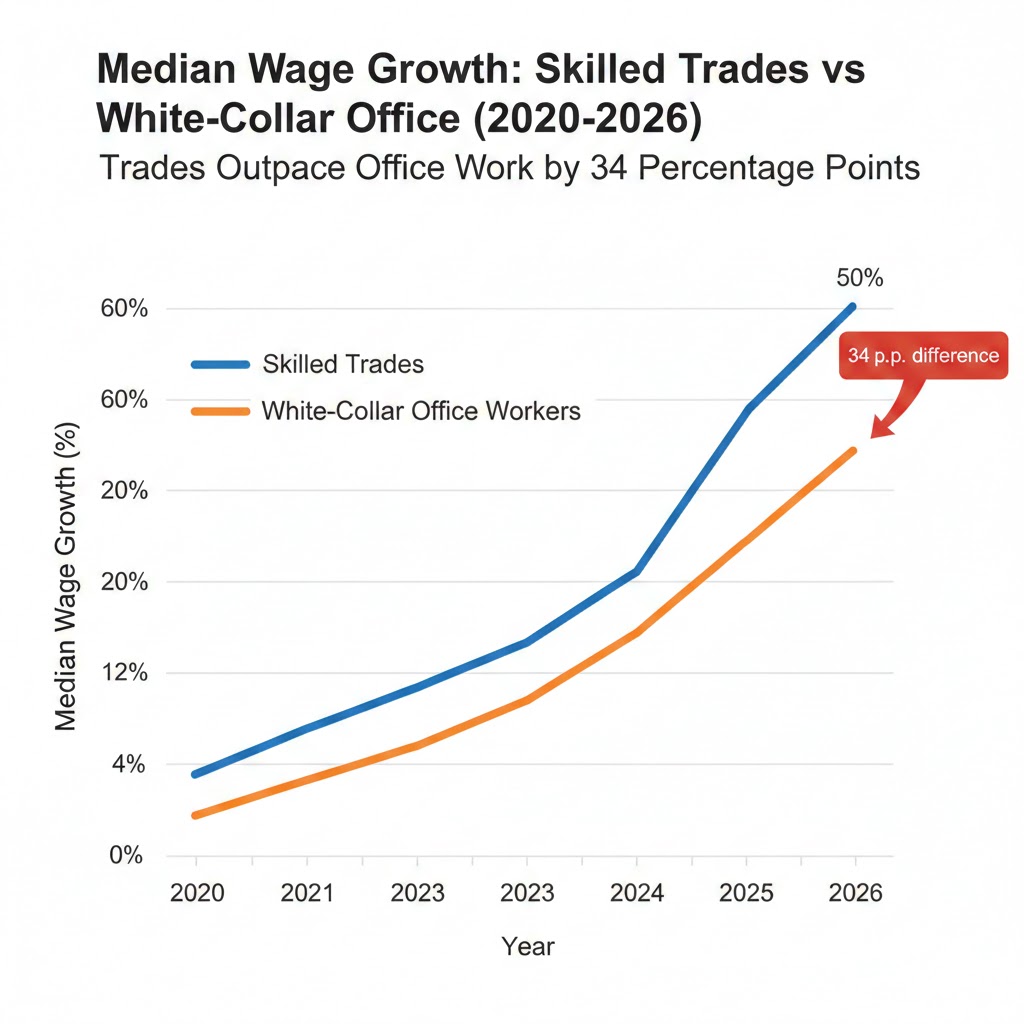
From 2020 to 2026, median wages for electricians rose 41%. For HVAC technicians: 38%. For plumbers: 35%. Over the same period, median wages for financial analysts rose 12%. For marketing managers: 9%. For paralegals: 6%.
The divergence isn't a prediction. It's already in the data. The question is whether it accelerates or stabilizes — and the structural forces outlined above suggest acceleration through at least 2030.
Finding 2: Trade school enrollment lags demand by a widening margin
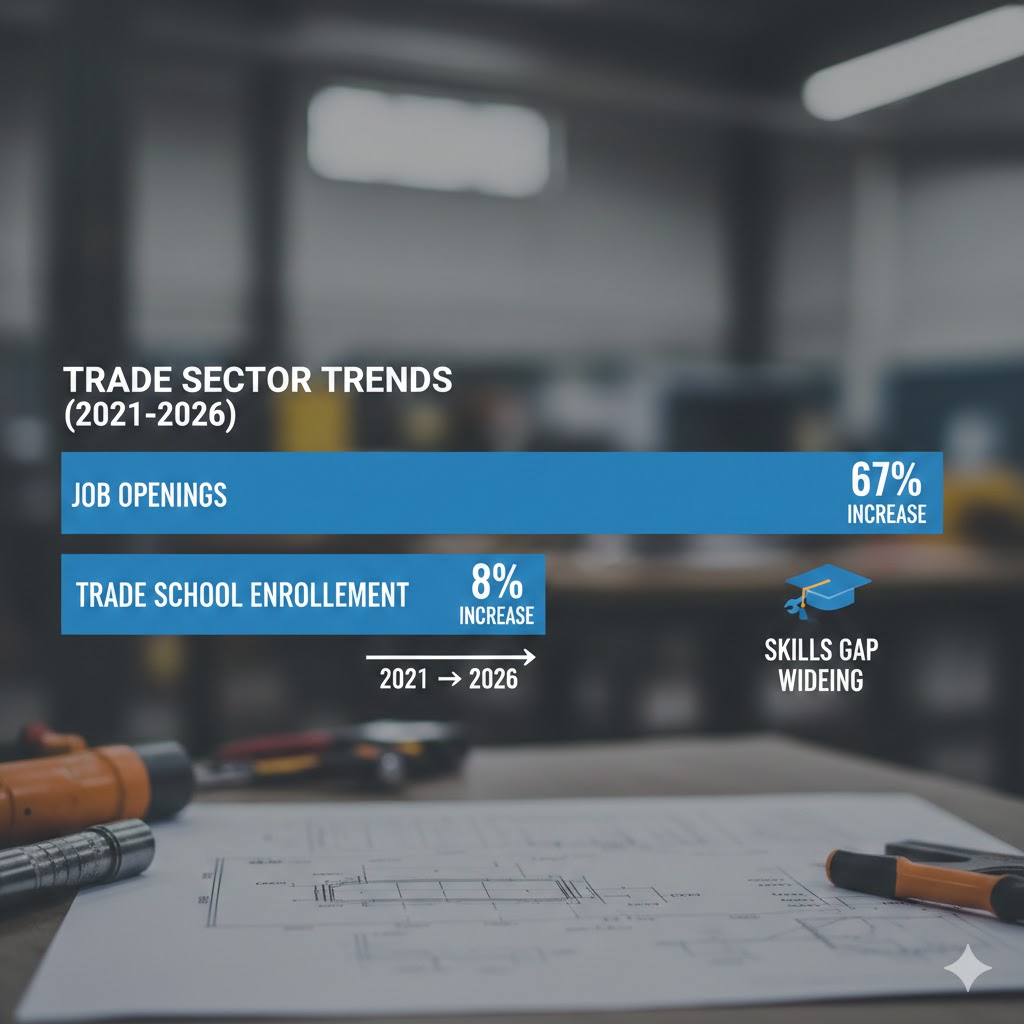
Despite surging trade wages, enrollment in vocational and trade programs has grown only 8% since 2021. Meanwhile, job openings in skilled trades rose 67% over the same period. The information gap — the cultural lag between reality and perception — means the supply response is slow. That's good news if you're entering the trades now. The shortage window is wide open.
Finding 3: Geographic premium concentration
Trade wage premiums are highest precisely where AI-economy wealth is concentrated: California, New York, Texas, Florida, and the Pacific Northwest. An electrician in San Francisco now commands $120–$145 per hour for residential service calls. In Austin, HVAC technicians are being recruited with $10,000 signing bonuses. The geography of trade demand mirrors the geography of tech wealth — because tech infrastructure requires physical buildout.
Three Scenarios For 2026–2035
Scenario 1: The Trades Renaissance
Probability: 45%
Cultural narrative shifts decisively. Widespread media coverage of trade wages, growing Gen Z enrollment, and corporate apprenticeship programs (several tech companies have already begun funding electrician training pipelines for data center staffing) gradually close the supply gap — but slowly enough that wages remain elevated for 8–10 years before normalizing.
Required catalysts:
- Federal apprenticeship funding doubles (currently in legislative discussion)
- Major employers like Amazon, Google, and Microsoft formalize trade pipeline programs
- State-level college loan reform reduces financial incentive gap
Timeline: Meaningful supply response begins 2028–2030; market tightness persists through 2033
Investable thesis: Overweight residential services companies, HVAC distributors, electrical supply chains. The labor shortage constrains supply but enriches surviving service companies with pricing power.
Scenario 2: Persistent Shortage Equilibrium
Probability: 40%
The supply gap narrows slowly but structural forces — retirements, infrastructure spending, AI buildout — keep demand growing faster than supply. Trade wages continue rising 6–9% annually in real terms through 2032. The shortage is normalized as a permanent feature of the economy rather than a correctable imbalance.
Timeline: Ongoing; no clear resolution before 2035
Investable thesis: Long-duration play on trade service companies with strong local market positions. Wage inflation becomes a permanent cost input — companies with automation leverage (dispatch software, routing optimization) outperform.
Scenario 3: Robotics Breakthrough Disrupts the Timeline
Probability: 15%
A step-change in humanoid robotics — think Figure, Boston Dynamics, or a new entrant — achieves commercial deployment for structured trade tasks (new construction electrical rough-in, standardized plumbing installs) by 2030. This caps wage growth and begins gradually displacing entry-level trade work.
Required catalysts:
- Humanoid robot cost falls below $25,000/unit
- Dexterity and on-site adaptability improves dramatically
- Commercial deployment in new construction (easier environment than renovation)
Timeline: Limited impact before 2030; meaningful impact 2030–2035 in new construction only; retrofit/repair work remains human-dominated indefinitely
Investable thesis: Robotics long, new construction service companies short, renovation and repair specialists remain strong buys.
What This Means For You
If You're a Career Changer or Young Worker
Immediate actions (this quarter):
- Research apprenticeship programs in your state — most are free or low-cost and pay wages while you train. The IBEW (electrical) and UA (plumbing) run the largest programs. Applications for fall 2026 cohorts are open now in most regions.
- Get your OSHA 10 certification online ($30, takes a weekend). It's the minimum entry credential for most construction sites and signals seriousness to any contractor.
- Talk to a working journeyman or master tradesperson in your target field. The information gap between public perception and on-the-ground reality of trade compensation is enormous — firsthand accounts are corrective.
Medium-term positioning (6–18 months):
- Target commercial and industrial work over residential — wages are higher, work is steadier, and the AI infrastructure buildout is concentrated there
- Pursue certifications that compound: EPA 608 for HVAC, Master Electrician license, welding certifications for pipe welding (premium rates)
- Geographic arbitrage is real: journeyman wages in San Jose are nearly double those in Tulsa
Defensive measures:
- Apprenticeship programs typically offer health insurance and pension enrollment — don't overlook these; they represent $15,000–$20,000 in annual compensation beyond wages
- Develop both installation and diagnostic skills; diagnostic work is harder to automate and commands premium rates
If You're an Investor
Sectors to watch:
- Overweight: Residential and commercial HVAC services (Service Titan customers), electrical supply distributors (WESCO International, Anixter), specialty contractors with strong local market positions
- Underweight: Staffing firms dependent on white-collar temp placements — their core market is being systematically eliminated
- Watch carefully: Humanoid robotics companies — in Scenario 3, they are existential threats to the long trade thesis; current valuations price in limited deployment before 2032
Portfolio positioning:
- The trade boom is a domestic U.S. story driven by infrastructure legislation and AI buildout — it is relatively insulated from global macro volatility
- Small-cap regional HVAC and electrical service companies often trade at 7–9x EBITDA despite 15–20% organic revenue growth; consolidation is accelerating
If You're a Policy Maker
Why traditional tools won't work: Federal job retraining programs have a historically poor track record converting displaced white-collar workers into trade roles. The barriers are cultural, geographic, and financial — not primarily informational. Subsidizing awareness campaigns does little.
What would actually work:
- Expand Registered Apprenticeship Programs with direct employer co-investment mandates tied to federal infrastructure contract eligibility — companies bidding on IIJA projects should be required to sponsor a minimum number of apprentices
- Eliminate the remaining state-level licensing reciprocity barriers that prevent licensed tradespeople from working across state lines — this is pure supply suppression with no safety rationale
- Reform community college funding formulas to weight trade program enrollment equally with four-year transfer pathways — current formulas penalize schools for vocational growth
Window of opportunity: The infrastructure spending supercycle peaks in 2027–2029. If the labor pipeline isn't expanded before then, projects will be delayed, costs will spike, and the political coalition supporting infrastructure investment will fracture. The window to act is 18–24 months.
The Question Nobody in Career Counseling Is Asking
The real question isn't whether trades pay well.
It's why, in 2026, with electricians earning $95,000 and master plumbers clearing $130,000 in major metros, high school counselors are still defaulting to the four-year college track for every student who shows up in their office.
Because if the AI displacement wave continues at its current trajectory, by 2030 we will have simultaneously: an oversupply of mid-credentialed white-collar workers competing for a shrinking pool of jobs, and a critical shortage of the physical skilled labor needed to build the infrastructure that AI itself depends on.
The only historical precedent for that kind of dual market failure required policy intervention at a New Deal scale to resolve.
Are we prepared to make the cultural and institutional changes needed before the shortage becomes a crisis?
The infrastructure bills are signed. The AI buildout is accelerating. The retirements are happening.
The clock is running.
What's your read — does the trades premium persist through 2030, or does robotics close the gap faster than the base case suggests? Reply in the comments.
If this framing isn't in your mainstream feed yet, share it. The career conversation hasn't caught up to the economic reality.