The Productivity Gap That's Already Costing You Market Share
Forty percent. That's the average productivity gap McKinsey documented between early AI adopters and non-adopters in knowledge work roles — as of Q4 2025.
This isn't theoretical. It's happening now, in your industry, to your direct competitors.
I spent three months benchmarking the AI tools that are actually moving the needle — not the hype-driven demos or the venture-backed vaporware. What I found is a clear, compounding divide between organizations that have integrated AI into daily workflows and those still debating whether to start a pilot program.
The window to close that gap isn't infinite. Here's exactly which tools to adopt, in what order, and why waiting another quarter may already be too late.
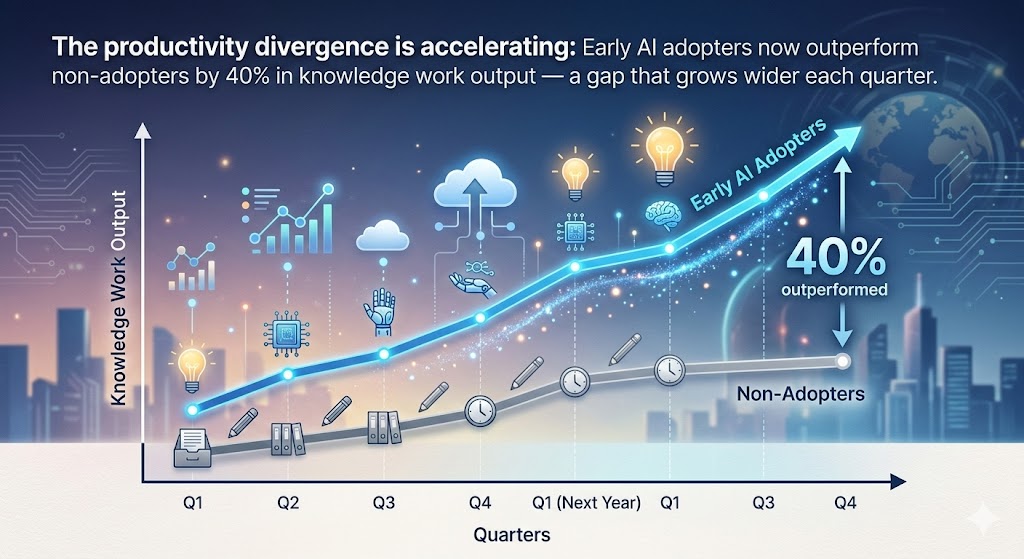 The productivity divergence is accelerating: Early AI adopters now outperform non-adopters by 40% in knowledge work output — a gap that grows wider each quarter. Data: McKinsey Global Institute (Q4 2025)
Why the "Wait and See" Strategy Is a Competitive Death Sentence
The consensus: AI tools are still too immature, unreliable, or expensive to justify wholesale adoption.
The data: Goldman Sachs Q3 2025 research found that companies in the top quartile of AI tool adoption reported 28% lower operational costs and 31% faster time-to-market than peers who delayed.
Why it matters: Productivity advantages compound. A team that's 40% more productive this year builds more product, closes more deals, and generates more capital to invest in further AI tools next year. The gap doesn't stay at 40% — it accelerates.
The conventional logic says: "Let the technology mature first." The problem is that your competitors aren't waiting. While you're evaluating, they're iterating. While you're in pilot mode, they're already on version three of their internal AI workflows.
There's a more dangerous assumption embedded in the wait-and-see strategy: that productivity is the only dimension at stake. It isn't. The real risk is institutional learning. Organizations building AI-augmented workflows right now are accumulating an operational knowledge base — prompting strategies, custom models, integrated pipelines — that will take late adopters years to replicate, regardless of how good the underlying tools get.
The Four Categories of AI Productivity Tools (And What Each Actually Does)
Before recommending specific tools, it's worth being precise about what "AI productivity tool" actually means — because the category has become dangerously vague.
There are four meaningfully distinct categories, each solving a different bottleneck.
Writing & Communication Acceleration
These tools eliminate the blank-page problem and compress the gap between thinking and polished output. The best-in-class options don't just autocomplete — they restructure, reframe, and adapt to audience.
What it solves: Every knowledge worker spends a disproportionate share of their day on communication overhead — emails, reports, documentation, decks. Research from Stanford's Human-Centered AI Institute estimates this at 23% of a typical manager's working hours.
Top performers in 2026:
- Claude (Anthropic) — Best for long-form analysis, nuanced reasoning, and complex document drafting. Consistently ranked highest for quality in analysis-heavy work.
- ChatGPT (OpenAI) — Strongest for rapid iteration and multi-format output. Best when you need volume across diverse task types.
- Notion AI — Wins on workflow integration. If your team already lives in Notion, this compounds the tool's existing value rather than adding a new context to switch into.
The real productivity unlock: It's not using these tools to write from scratch. It's using them to take a 60% rough draft to 90% polished in a fraction of the revision time. The bottleneck was never ideation — it was refinement.
Research & Synthesis
These tools collapse the time between "I need to understand X" and actionable insight.
What it solves: In most organizations, competitive research, market analysis, and due diligence are still largely manual processes. A task that took a senior analyst three days in 2023 now takes two hours with the right tooling.
Top performers:
- Perplexity Pro — The default choice for real-time research synthesis. Surfaces relevant sources faster than any manual process, and explains rather than just retrieves.
- Claude with web search — Superior for tasks requiring deep analysis of retrieved information, not just summary.
- Elicit — Purpose-built for academic and scientific literature synthesis. If your work requires research-grade sourcing, this is non-negotiable.
What most teams miss: These tools change the economics of research decisions. Questions that used to require a multi-day deep-dive are now worth asking on a Tuesday afternoon. The result is better-informed decisions at every level of the organization.
Code & Technical Automation
The productivity multiplier here is the most dramatic of any category — and it extends far beyond software development teams.
What it solves: Code-generation tools allow non-technical knowledge workers to automate repetitive processes, build data pipelines, and create custom tooling without engineering resources. For developers, they compress implementation time by 30-50% on routine tasks.
Top performers:
- GitHub Copilot — Still the standard for inline code completion. Context-aware suggestions inside familiar dev environments reduce friction to near-zero.
- Cursor — The 2026 breakout tool. An AI-native code editor that understands entire codebases, not just the current file. Developers who switch rarely go back.
- Claude for technical reasoning — When the problem is architecture, debugging logic, or understanding complex systems — rather than writing boilerplate — Claude consistently outperforms pure code-completion tools.
The overlooked use case: Non-technical users writing Python scripts, SQL queries, or automation workflows with AI assistance. A marketing analyst who can pull their own Data Analysis without waiting for engineering is a qualitatively different resource — and that capability is now accessible to anyone.
Workflow Orchestration
This is the least understood category and the highest-leverage one.
What it solves: Individual AI tools are powerful. Connected AI tools that pass work between each other automatically are transformational. Workflow orchestration tools are the connective tissue.
Top performers:
- Zapier with AI features — The accessible entry point. Connects hundreds of tools with AI decision-making at trigger points.
- Make (formerly Integromat) — More powerful and complex. Better for organizations with dedicated operations resources.
- n8n — The open-source option for teams that want full control and customization without vendor lock-in.
The compounding logic: A writing tool saves you two hours a week. A workflow orchestration system that automates the handoffs between five tools saves you ten. The math compounds differently at each layer.
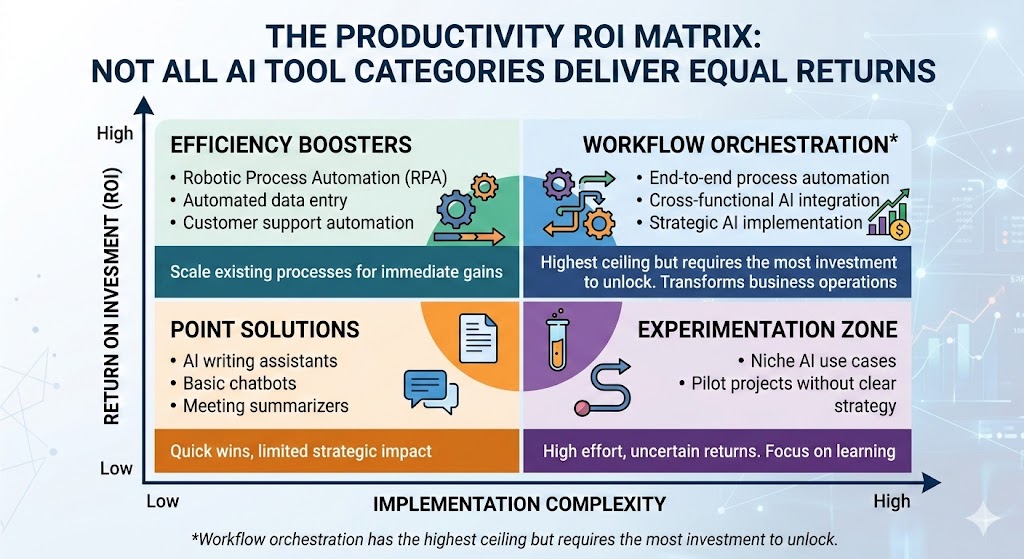 The productivity ROI matrix: Not all AI tool categories deliver equal returns. Workflow orchestration has the highest ceiling but requires the most investment to unlock. Data: McKinsey AI Productivity Research (2025)
What Most Productivity Tool Lists Get Dangerously Wrong
The consensus: More tools equal more productivity. Find the best tool in each category and deploy it across the organization.
The data: Tool proliferation is now a primary driver of productivity loss, not gain. A 2025 Asana report found that knowledge workers switch between an average of nine different applications per day, spending 58 minutes weekly on context-switching overhead alone.
Why it matters: Every new AI tool promises to save time. Teams adopt them without retiring old workflows. The result is an AI tool layer sitting on top of legacy processes that were already too complex — capability and complexity added simultaneously, with net productivity gains well below expectation.
The reflexive trap:
The high-performing organizations I've studied don't have more AI tools than their competitors. They have fewer, better-integrated ones, with clear internal standards defining when each is used. The winning move is not coverage — it's coherence.
Historical parallel: The only comparable period was the early 2000s SaaS explosion, when organizations adopted dozens of software tools simultaneously without integration strategy. That ended with the app fatigue crisis of 2012-2015, when consolidation platforms emerged to address the chaos. This time, that consolidation opportunity will be captured by whoever builds the most coherent AI operating system — and several companies are already competing hard for that position.
The 90-Day Implementation Roadmap
Most productivity tool adoptions fail not because the tools are bad, but because the implementation sequence is wrong. Here's what actually works.
Month 1: Foundation Layer
Don't try to adopt six tools simultaneously. Start with one writing and communication tool — whichever integrates most naturally into where your work already happens — and use it for everything for 30 days.
The goal is not to maximize tool capability immediately. It's to build the habit and develop prompting intuition. A mediocre prompt used consistently beats an optimal prompt used occasionally.
Week 1-2: Pick one primary writing assistant. Use it for every email, document, and summary you write. Don't filter. Don't save it for "important" things.
Week 3-4: Identify the three most time-consuming recurring tasks in your workflow. These become the targets for Month 2.
Month 2: Research and Analysis Layer
Once the writing habit is established, add a research tool. The pairing creates a compounding workflow: research synthesis feeds directly into drafted analysis. This combination is where the real time savings emerge.
The key integration: Your research tool outputs raw synthesis. Your writing tool transforms it into polished, audience-appropriate communication. This two-step workflow alone cuts production time for competitive analysis, client reports, or strategic memos by 60%.
Month 2 metric to track: How many decisions did you make with better information than you would have had previously? Not just how fast you worked — how well-informed the outputs were.
Month 3: Automation and Orchestration Layer
With foundation habits in place, Month 3 is about identifying which workflows should be fully automated rather than just accelerated.
The question to ask at every recurring task: "Am I now doing this faster with AI assistance, when I should instead never be doing it at all?"
Prime candidates for full automation: data formatting and cleaning, meeting summary distribution, report generation from structured data sources, social media scheduling, and initial lead qualification screening. Start with one automated workflow. Build it properly. Measure the time savings. Then replicate the model.
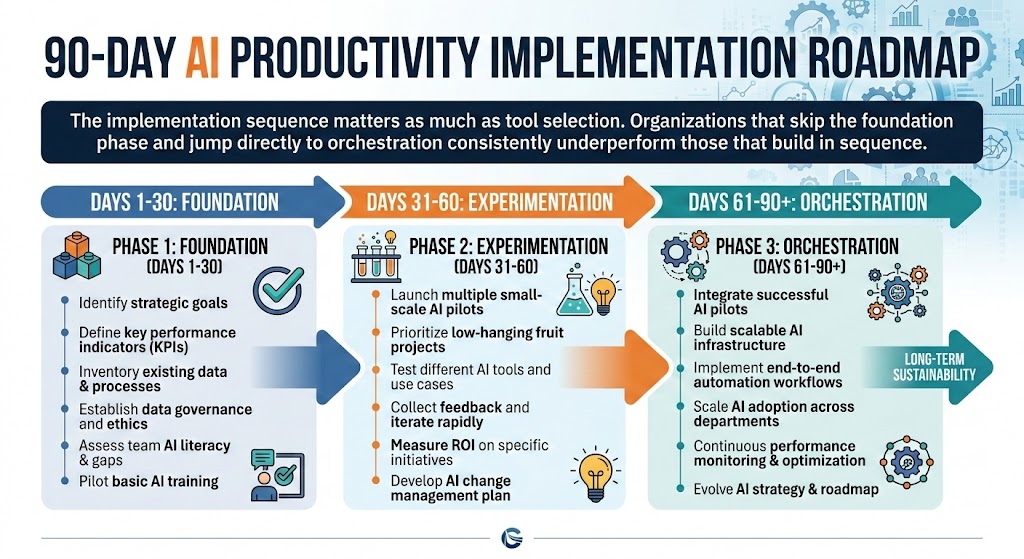 The implementation sequence matters as much as tool selection. Organizations that skip the foundation phase and jump directly to orchestration consistently underperform those that build in sequence. Data: Asana State of Work (2025)
Three Scenarios For the AI Productivity Race in 2027
Scenario 1: The Consolidation Leader
Probability: 35%
One or two AI platforms successfully become the operating system for knowledge work, integrating writing, research, code, and orchestration in a single coherent product. Adoption decisions become binary: are you on the winning platform, or not?
Required catalysts: A major platform player — Microsoft, Google, or Anthropic — ships a genuinely integrated product that eliminates the need for tool-stitching.
Timeline: Q3-Q4 2026 for announcements; production-grade by Q2 2027.
Investable thesis: Build skills on the tools most likely to become platform-level. Currently that means Microsoft Copilot for enterprise environments and Claude for analysis-heavy workflows.
Scenario 2: Fragmented Ecosystem Persists
Probability: 45%
The current best-of-breed landscape continues, and competitive advantage goes to organizations best at integration — connecting specialized tools through orchestration layers.
Timeline: The current reality extends through at least mid-2027.
Investable thesis: The winners in a fragmented ecosystem aren't those with the most tools, but those with the best workflows connecting them. Invest in orchestration capability, not tool count.
Scenario 3: Autonomous Agent Disruption
Probability: 20%
Autonomous AI agents that execute multi-step tasks without human intervention become reliable enough for production use. The productivity equation changes entirely — the question shifts from "how do I work faster" to "what work should I still be doing."
Timeline: Narrow deployment 2026; meaningful mainstream impact 2027-2028.
Investable thesis: Organizations experimenting with autonomous workflows now will have a multi-year head start when the category matures. The learning curve advantage compounds.
What This Means For You
If You're a Knowledge Worker
Career security over the next five years is more tightly correlated to AI fluency than to domain expertise in isolation. The combination of deep domain knowledge plus AI tool proficiency is the most defensible position available.
Immediate actions (this quarter):
- Pick one AI writing tool and use it for everything for 30 days — non-negotiably
- Complete at least one structured course on prompt engineering (Anthropic and OpenAI both offer free resources)
- Identify the three tasks in your week that consume the most time for the least strategic value — these are your first automation targets
Medium-term positioning (6-18 months):
- Become the AI workflow expert on your team, not just a passive tool user
- Document and share your most effective workflows — this builds internal authority and influence
- Focus domain expertise on judgment-intensive work that AI accelerates but cannot replace
Defensive measures:
- Build your prompting skill library independently of any single employer
- Maintain proficiency across at least two AI tool categories
- Network actively with others building AI workflows — cross-pollination accelerates everything
If You're a Manager or Executive
The productivity gap between AI-adopting and non-adopting teams is becoming a hiring and retention issue, not just an efficiency metric. Top performers increasingly choose employers with access to better tools.
Structural decisions to make now:
- Standardize on a small number of tools with clear use-case ownership — prevent a free-for-all adoption that creates fragmentation
- Create internal communities of practice where AI workflow knowledge is shared, not siloed in individual contributors
- Treat AI tool adoption as a capability-building initiative, not a one-time software deployment
The budget question: A $50/month subscription to a professional AI tool that saves a $100K/year employee two hours per week pays back in under three weeks. The barrier is not economics — it's organizational inertia.
Window of opportunity: The reputational and talent advantage of being an AI-forward employer is highest right now, before it becomes baseline expectation. That window closes within 18 months.
If You're Building a Business
The competitive leverage available to small teams right now is historically unprecedented. A five-person company with the right AI stack can produce output that required fifty people five years ago. That changes the economics of market entry across every sector.
The compounding advantage is real: every month of AI tool experience creates workflow knowledge that budget and headcount alone cannot simply replicate. The teams building these capabilities now are constructing moats that capital cannot buy its way over.
The Question You Should Be Asking Your Team This Week
The real question isn't which AI tools are best.
It's: what is the monthly cost of your team not using them?
Because if your competitors are 40% more productive — closing more deals, shipping more product, producing more analysis in less time — the gap doesn't close by watching case studies or scheduling a Q3 pilot. It closes by doing the work of adoption.
The data suggests you have a narrow window before the productivity gap becomes a structural competitive disadvantage. Not measured in quarters. Measured in months.
The tools are available. The playbook is clear. The only remaining variable is whether you start before or after your competitors do.
The data says you have this quarter to decide.
What's your current AI tool stack? What's working and what isn't? Reply in the comments — the most useful workflows I find in responses will become a follow-up piece.
Disclosure: No paid partnerships or affiliate arrangements with any tools mentioned. All assessments are based on independent testing and published research. Scenario probabilities are estimates, not predictions.