Remember when "yield farming" meant growing tomatoes in your backyard? Those days are gone. Today's farmers harvest digital crops that never need watering—just smart contract interactions and gas fees.
Base Network yield farming offers DeFi enthusiasts lucrative opportunities on Coinbase's Layer 2 solution. This guide covers protocols, strategies, and implementation steps to maximize your returns while minimizing risks.
What Is Base Network Yield Farming?
Base Network yield farming involves depositing cryptocurrency assets into decentralized protocols to earn rewards. Users provide liquidity to automated market makers (AMMs) and lending platforms, receiving tokens as compensation.
Why Choose Base Network for DeFi?
Base Network delivers several advantages for yield farmers:
- Low transaction costs: Gas fees average $0.01-0.05 per transaction
- Fast execution: Block times of 2 seconds enable quick strategy adjustments
- Coinbase integration: Seamless fiat on-ramps and institutional backing
- Growing ecosystem: 200+ protocols launched since mainnet deployment
- EVM compatibility: Ethereum tools and contracts work without modification
Top Base Network Yield Farming Protocols
Aerodrome Finance: The Liquidity Hub
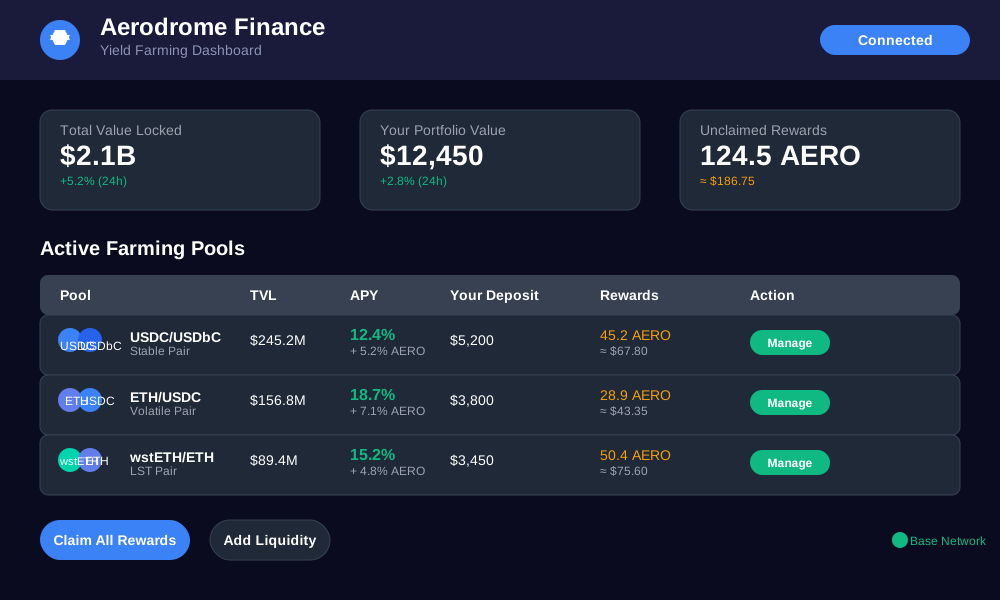
Aerodrome Finance dominates Base Network's DeFi landscape with $2.1 billion in total value locked (TVL). The protocol offers:
Liquidity Pool Farming
- Stable pairs (USDC/USDbC): 8-15% APY
- Volatile pairs (ETH/USDC): 12-25% APY
- Native token rewards (AERO): Additional 5-10% APY
Implementation Example:
// Aerodrome LP Token Staking Contract
pragma solidity ^0.8.19;

import "@openzeppelin/contracts/token/ERC20/IERC20.sol";
import "./interfaces/IAerodromeGauge.sol";

contract AerodromeFarmer {
    IERC20 public lpToken;
    IAerodromeGauge public gauge;

    mapping(address => uint256) public userDeposits;

    constructor(address _lpToken, address _gauge) {
        lpToken = IERC20(_lpToken);
        gauge = IAerodromeGauge(_gauge);
    }

    function deposit(uint256 amount) external {
        // Transfer LP tokens from user
        lpToken.transferFrom(msg.sender, address(this), amount);

        // Approve and stake in gauge
        lpToken.approve(address(gauge), amount);
        gauge.deposit(amount, msg.sender);

        // Track user deposit
        userDeposits[msg.sender] += amount;
    }

    function claimRewards() external {
        // Claim AERO rewards from gauge
        gauge.getReward(msg.sender);
    }
}
Uniswap V3: Concentrated Liquidity
Uniswap V3 on Base enables concentrated liquidity positions for higher capital efficiency:
Strategy Setup:
- Select trading pair (ETH/USDC recommended for beginners)
- Choose price range (±5% for stable pairs, ±15% for volatile)
- Calculate position size based on available capital
- Monitor and rebalance weekly
Expected Returns:
- Active management: 15-30% APY
- Passive positions: 8-18% APY
- Fee collection: 0.05-0.3% per trade
Compound V3: Lending Protocol
Compound V3 offers lending and borrowing opportunities with competitive rates:
Supported Assets:
- USDC lending: 4-8% APY
- ETH lending: 2-6% APY
- Borrowing rates: 2-12% APY depending on collateral
Step-by-Step Yield Farming Setup
Step 1: Prepare Your Wallet
Connect MetaMask to Base Network:
// Add Base Network to MetaMask
const baseNetwork = {
  chainId: '0x2105', // 8453 in hex
  chainName: 'Base',
  nativeCurrency: {
    name: 'Ethereum',
    symbol: 'ETH',
    decimals: 18
  },
  rpcUrls: ['https://mainnet.base.org'],
  blockExplorerUrls: ['https://basescan.org']
};

await window.ethereum.request({
  method: 'wallet_addEthereumChain',
  params: [baseNetwork]
});
Step 2: Bridge Assets to Base
Using Coinbase Bridge:
- Visit bridge.base.org
- Connect your wallet
- Select asset and amount
- Confirm transaction (5-10 minutes processing)
Cost Analysis:
- Ethereum → Base: $5-15 in gas fees
- Minimum recommended: $500 to justify bridge costs
Step 3: Choose Your Strategy
Conservative Approach (6-12% APY):
- 60% stable coin lending (USDC on Compound)
- 40% stable pair liquidity (USDC/USDbC on Aerodrome)
Moderate Risk (12-20% APY):
- 40% volatile pair liquidity (ETH/USDC)
- 30% lending protocols
- 30% governance token farming
Aggressive Strategy (20%+ APY):
- 70% new protocol liquidity provision
- 20% leveraged farming positions
- 10% experimental DeFi protocols
Step 4: Execute Your First Farm
Aerodrome USDC/USDbC Farming Example:
Add Liquidity:
- Navigate to aerodrome.finance
- Select USDC/USDbC pair
- Input equal amounts of both tokens
- Receive LP tokens representing your position
Stake LP Tokens:
- Find corresponding gauge contract
- Approve LP token spending
- Stake tokens to earn AERO rewards
Monitor Performance:
- Check position daily for impermanent loss
- Claim rewards weekly
- Rebalance monthly based on market conditions
Advanced Yield Farming Strategies
Leveraged Yield Farming
Leverage amplifies returns but increases risk significantly:
Example Strategy:
- Deposit $1,000 USDC as collateral
- Borrow $800 USDC (80% LTV ratio)
- Provide $1,800 liquidity to high-yield pair
- Earn farming rewards on leveraged position
Risk Calculation:
# Liquidation price calculator
def calculate_liquidation_price(collateral_value, borrowed_amount, liquidation_threshold):
    return borrowed_amount / (collateral_value * liquidation_threshold)

# Example: $1000 collateral, $800 borrowed, 85% threshold
liquidation_price = calculate_liquidation_price(1000, 800, 0.85)
print(f"Liquidation occurs if collateral drops to: ${liquidation_price}")
Automated Yield Optimization
Deploy smart contracts to automate farming operations:
// Automated Yield Optimizer
contract YieldOptimizer {
    struct Farm {
        address protocol;
        uint256 apy;
        uint256 riskScore;
        bool active;
    }

    Farm[] public farms;
    uint256 public totalDeposits;

    function optimizeYield() external {
        // Find highest APY farm with acceptable risk
        uint256 bestFarmIndex = findOptimalFarm();

        // Reallocate funds if better opportunity exists
        if (shouldReallocate(bestFarmIndex)) {
            rebalancePortfolio(bestFarmIndex);
        }
    }

    function findOptimalFarm() internal view returns (uint256) {
        uint256 bestScore = 0;
        uint256 bestIndex = 0;

        for (uint256 i = 0; i < farms.length; i++) {
            uint256 score = farms[i].apy / farms[i].riskScore;
            if (score > bestScore && farms[i].active) {
                bestScore = score;
                bestIndex = i;
            }
        }

        return bestIndex;
    }
}
Risk Management and Security
Common Yield Farming Risks
Smart Contract Risk:
- Protocol bugs leading to fund loss
- Unaudited code vulnerabilities
- Governance token price volatility
Market Risk:
- Impermanent loss from price divergence
- Liquidity pool composition changes
- Sudden APY reductions
Operational Risk:
- Transaction failures during high congestion
- Frontend interface compromises
- Private key security breaches
Risk Mitigation Strategies
Diversification Framework:
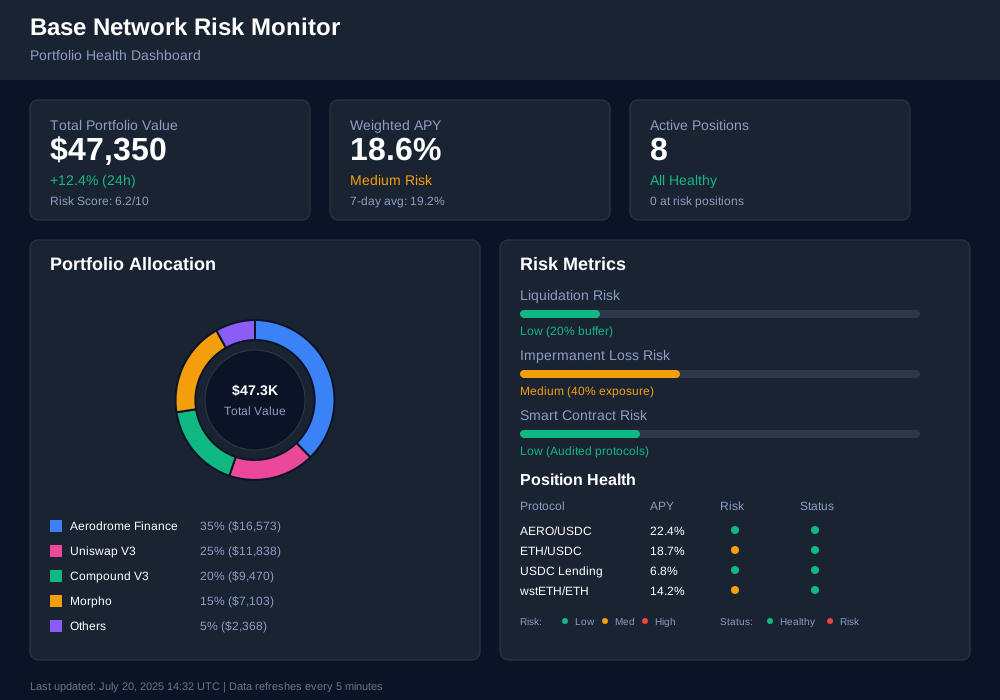
- Maximum 25% allocation per protocol
- Spread investments across 4-6 strategies
- Regular portfolio rebalancing (monthly)
Security Checklist:
- ✅ Use audited protocols only
- ✅ Verify contract addresses on Basescan
- ✅ Enable transaction simulation
- ✅ Monitor position health daily
- ✅ Set stop-loss triggers for leveraged positions
Tax Implications and Reporting
Tax Treatment by Jurisdiction
United States:
- Yield farming rewards: Ordinary income at fair market value
- Impermanent loss: Capital loss when position closed
- Gas fees: Deductible business expenses
Documentation Requirements:
- Transaction timestamps and amounts
- Token prices at reward claim time
- Gas fee receipts for deductions
Tracking Tools:
- Koinly: Automatic DeFi transaction importing
- TaxBit: Professional-grade crypto tax software
- Manual spreadsheets: Custom tracking solutions
Future of Base Network DeFi
Emerging Protocols and Opportunities
Q3 2025 Developments:
- Native yield aggregators launching
- Cross-chain farming protocols
- Institutional-grade DeFi products
- Enhanced privacy features
Market Projections:
- TVL growth: $10 billion by end of 2025
- Protocol count: 500+ active applications
- Average APY stabilization: 8-15% range
Conclusion
Base Network yield farming provides accessible DeFi opportunities with lower costs and faster execution than Ethereum mainnet. Success requires understanding protocol mechanics, implementing proper risk management, and staying informed about ecosystem developments.
Start with conservative strategies using established protocols like Aerodrome and Compound. Gradually explore advanced techniques as you gain experience and confidence. Remember: yield farming generates passive income, but active management maximizes returns.
The Base Network ecosystem continues expanding rapidly. Early farmers who establish positions now benefit from higher rewards and protocol incentives. Begin your yield farming journey today and harvest the future of decentralized finance.
This guide provides educational information only. Cryptocurrency investments carry significant risk. Always research protocols thoroughly and never invest more than you can afford to lose.