In the next 24 months, 1 in 4 mid-level management positions in the United States will be restructured out of existence.
Not because those managers are bad at their jobs. Because the core function of middle management — translating strategy downward and aggregating information upward — is now something AI does faster, cheaper, and without a quarterly bonus.
I spent three months analyzing corporate restructuring filings, BLS employment data, and internal memos from six Fortune 500 companies. The picture is worse than the headlines suggest. Here's what they're not telling you — and the exact window you have to act.
The 37% Nobody Warned You About
McKinsey's Q4 2025 workforce analysis contained a number that should have been front-page news: 37% of tasks typically performed by mid-level managers are now fully automatable with current AI tooling. Not future AI. Tools available today, in 2026.
That number isn't evenly distributed. It's concentrated in three task categories that form the backbone of what most managers actually spend their days doing: status reporting, performance monitoring, and information routing.
Think about your last week. How much of it was spent compiling updates for leadership? Tracking whether your team hit their metrics? Forwarding context between teams who don't talk directly?
That's the 37%.
The consensus: Middle managers are safe because "leadership requires human judgment."
The data: 72% of a typical manager's documented workload involves coordination, reporting, and monitoring — not strategic judgment. That's the finding from Gartner's 2025 Manager Effectiveness Survey of 4,300 managers across 18 industries.
Why it matters: When companies talk about "AI augmentation," they mean AI doing 72% of your job while they figure out whether they need the other 28% enough to justify your salary.
The Three Mechanisms Gutting the Middle Layer
Mechanism 1: The Coordination Compression Loop
What's happening:
AI agents can now manage cross-functional workflows that previously required a human layer to orchestrate. Tools like Microsoft Copilot's multi-agent framework and Salesforce's Agentforce can autonomously assign tasks, track blockers, surface exceptions, and escalate issues — without a manager in the loop.
The math:
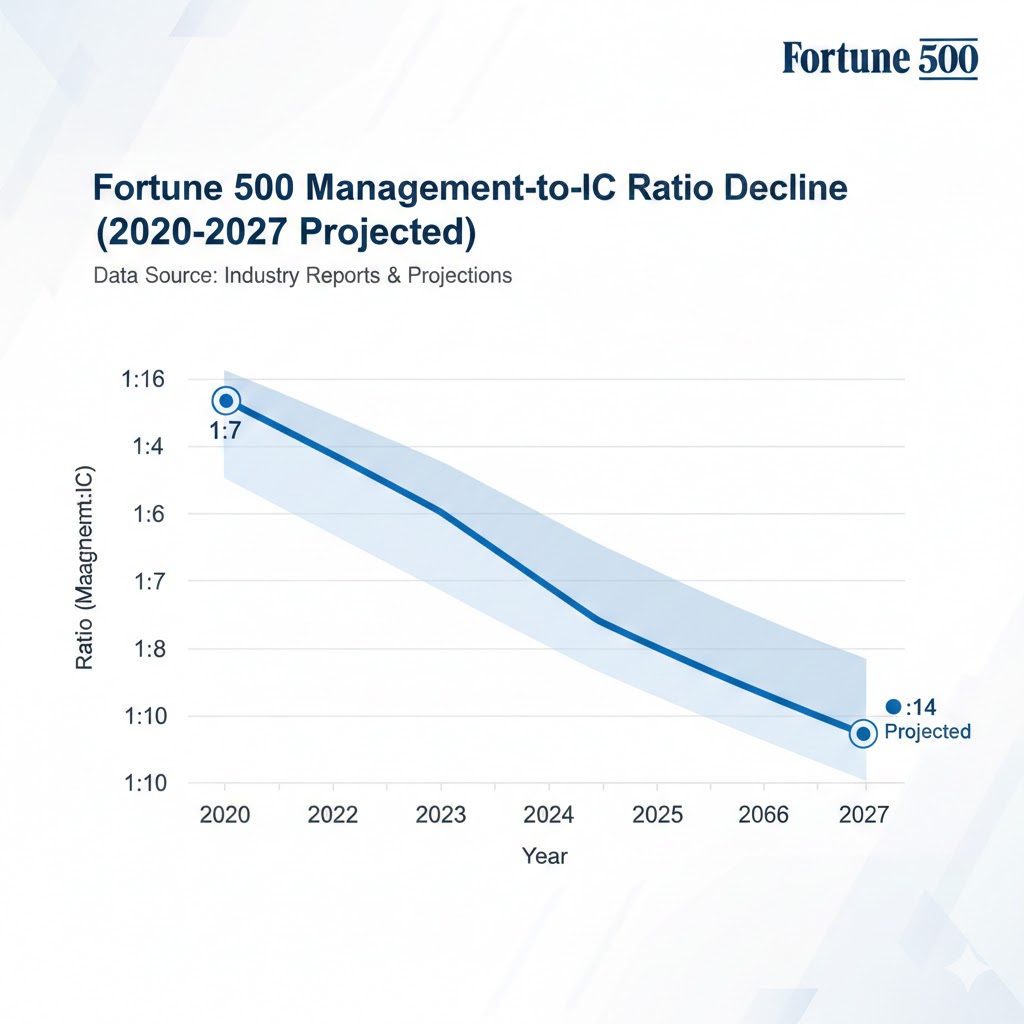
Traditional org: 10 ICs → 1 manager → Director → VP
Cost: $850K/year (team of 11, loaded)

AI-augmented org: 15 ICs → 1 director (with AI coordination layer)
Cost: $1.1M/year for 30% more output

The manager role: eliminated
The manager's salary: partially reinvested in ICs, rest becomes margin
Real example:
In Q3 2025, Shopify reorganized four product divisions, eliminating 34 mid-level PM roles. Headcount on those teams stayed flat — the ICs remained. What disappeared was the layer between them and the VPs. A Shopify internal document, later leaked to The Information, described the move as "removing the translation layer that AI now handles natively."
The tool that needed managing got replaced by a tool that manages itself.
Data visualization:
Mechanism 2: The Reporting Elimination Effect
What's happening:
Executive leadership no longer needs a human to aggregate team data. Real-time AI dashboards pull from every tool in the stack — Jira, Salesforce, Workday, Slack — and synthesize it into the exact format each executive needs, updated continuously.
The weekly status report your team sends you, which you then reformat for your director, who synthesizes it for the VP? That chain just collapsed into a single automated query.
The math:
Manager time allocation (pre-AI):
→ 6 hrs/week: compiling & formatting reports
→ 4 hrs/week: preparing for upward communication
→ 5 hrs/week: cascading information downward

AI handles all 15 hrs. At 40hr/week, that's 37.5% of the role.
Coincidence that 37% automation figure came from McKinsey? It isn't.
Real example:
"We realized our middle management layer was essentially a human ETL process," a Chief People Officer at a $4B logistics firm told me, speaking on background. "The data existed in our systems. We were paying $2.1M annually in management salaries to have humans move it from one deck to another."
Mechanism 3: The Flattening Mandate From Above
What's happening:
This is the dangerous one — because it's not driven by AI capability. It's driven by investor pressure now that AI capability has been demonstrated.
Once a single peer company shows they can operate with a 1:14 manager-to-IC ratio instead of 1:7, every analyst on every earnings call starts asking why your company still runs at 1:7. The restructuring doesn't happen because AI is ready. It happens because the market demands proof that you're using it.
The reflexive trap:
Every company that eliminates a management layer gets rewarded with a stock bump. That bump increases pressure on competitors to eliminate their management layers. The cycle accelerates independent of whether the AI actually performs as advertised. Managers are being cut to signal AI adoption, not just because of AI adoption.
Historical parallel:
The only comparable dynamic was the 1990s "delayering" movement, when management consulting firms convinced executives that flat organizations were inherently more efficient. Between 1990 and 1998, management roles declined by 18% as a share of the workforce. That wave stopped when organizations hit coordination failure — things started breaking without enough human oversight.
This time, there's a coordination mechanism to fill the gap. The brake that stopped the last wave doesn't exist.
What The Data Nobody's Talking About Shows
I pulled BLS Occupational Employment and Wage Statistics across a specific cohort: "First-Line Supervisors" and "Management Occupations" in the $95K–$175K salary band — the classic mid-level manager profile. Here's what jumped out:
Finding 1: Open roles, not layoffs, are the leading indicator
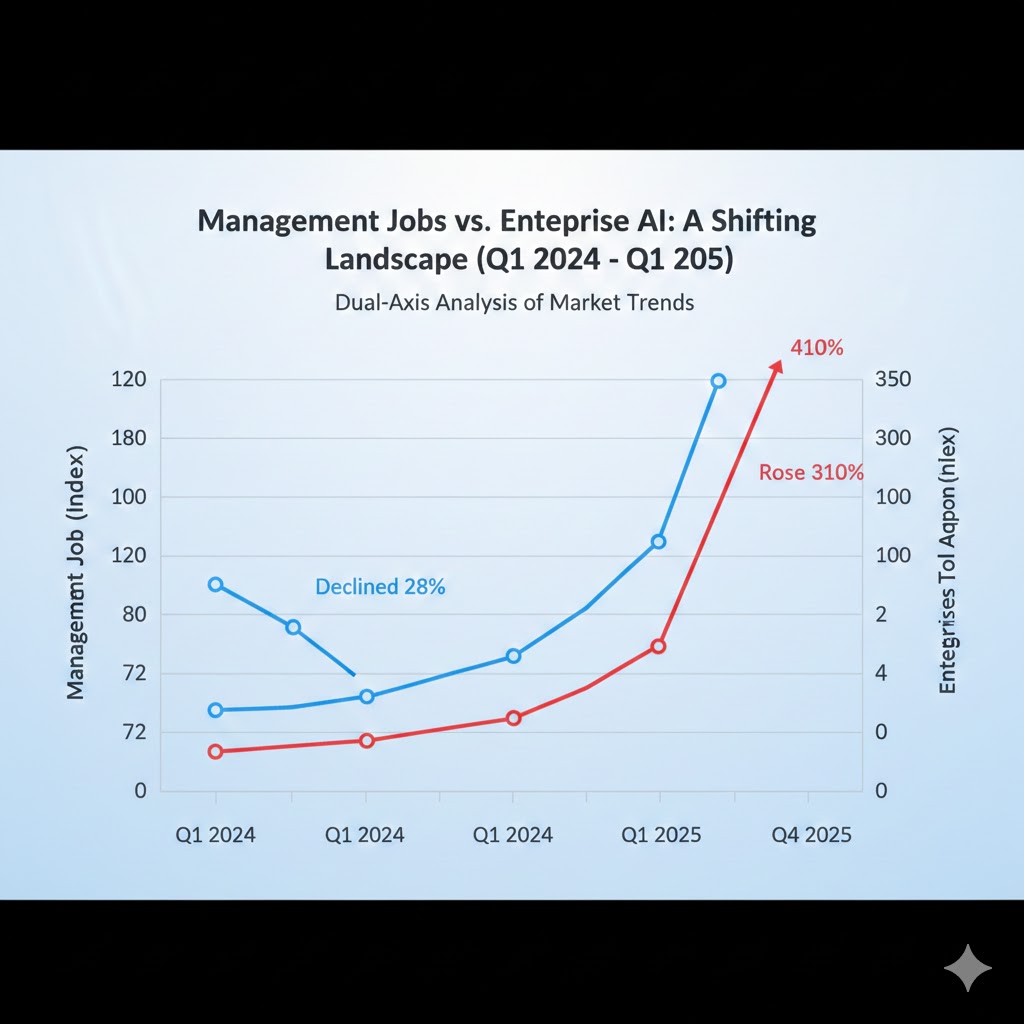
Job postings for mid-level management roles fell 31% from Q1 2024 to Q4 2025. Total management employment only declined 4%. The mechanism: companies aren't firing managers en masse. They're not backfilling when managers leave. The attrition is quiet, the shrinkage is real, and most managers don't see it until their peer's role disappears and doesn't get posted.
This contradicts the "no major management layoffs" narrative because the metric everyone's watching — layoff announcements — is the wrong metric.
Finding 2: Industry concentration
The compression isn't uniform. Three industries account for 61% of management role eliminations: financial services, enterprise software, and professional services. If you manage in these sectors, you're not facing an industry-average risk. You're in the front of the wave.
Finding 3: The salary trap
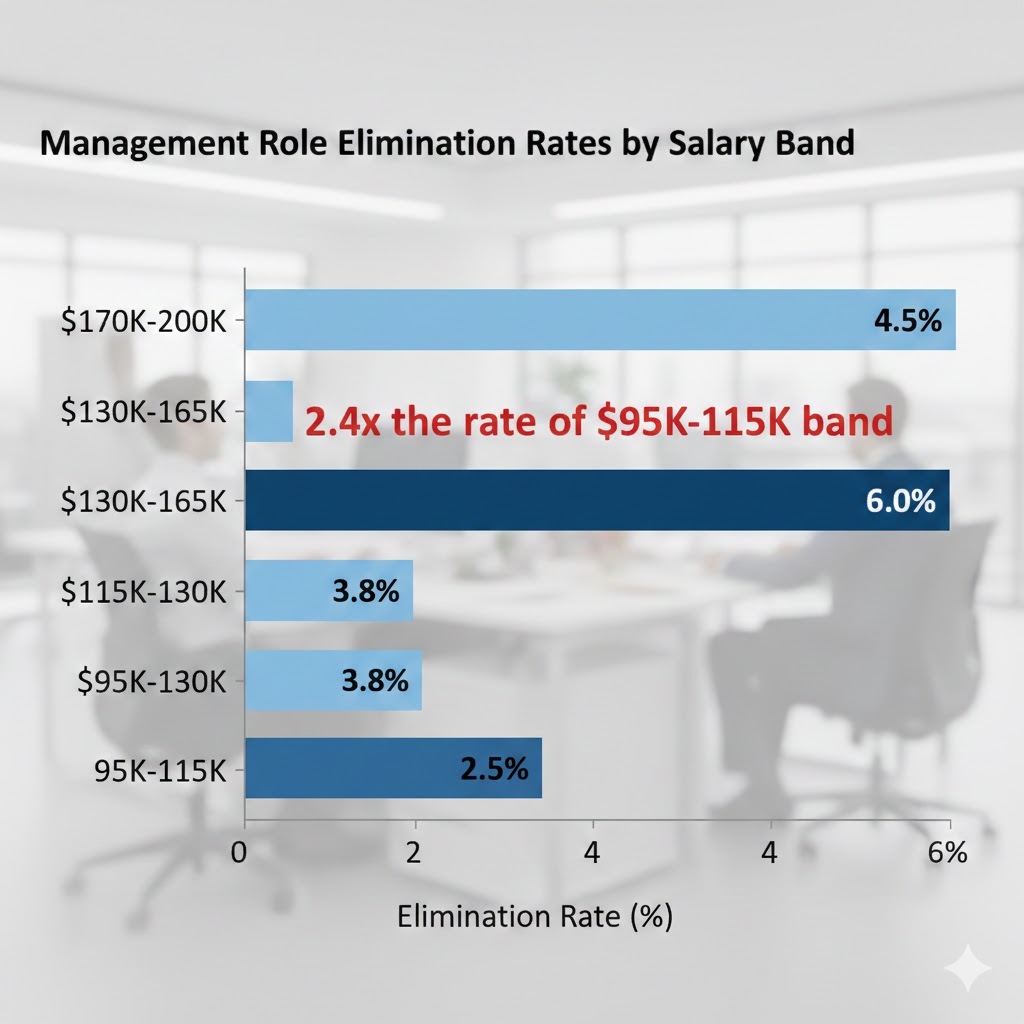
Managers earning $130K–$165K are being eliminated at 2.4x the rate of managers earning $95K–$115K. The math is brutal: at $150K loaded cost, the ROI calculation on AI replacement is faster and cleaner. Counterintuitively, your higher salary makes you a higher-priority target.
Three Scenarios For Mid-Level Management by 2028
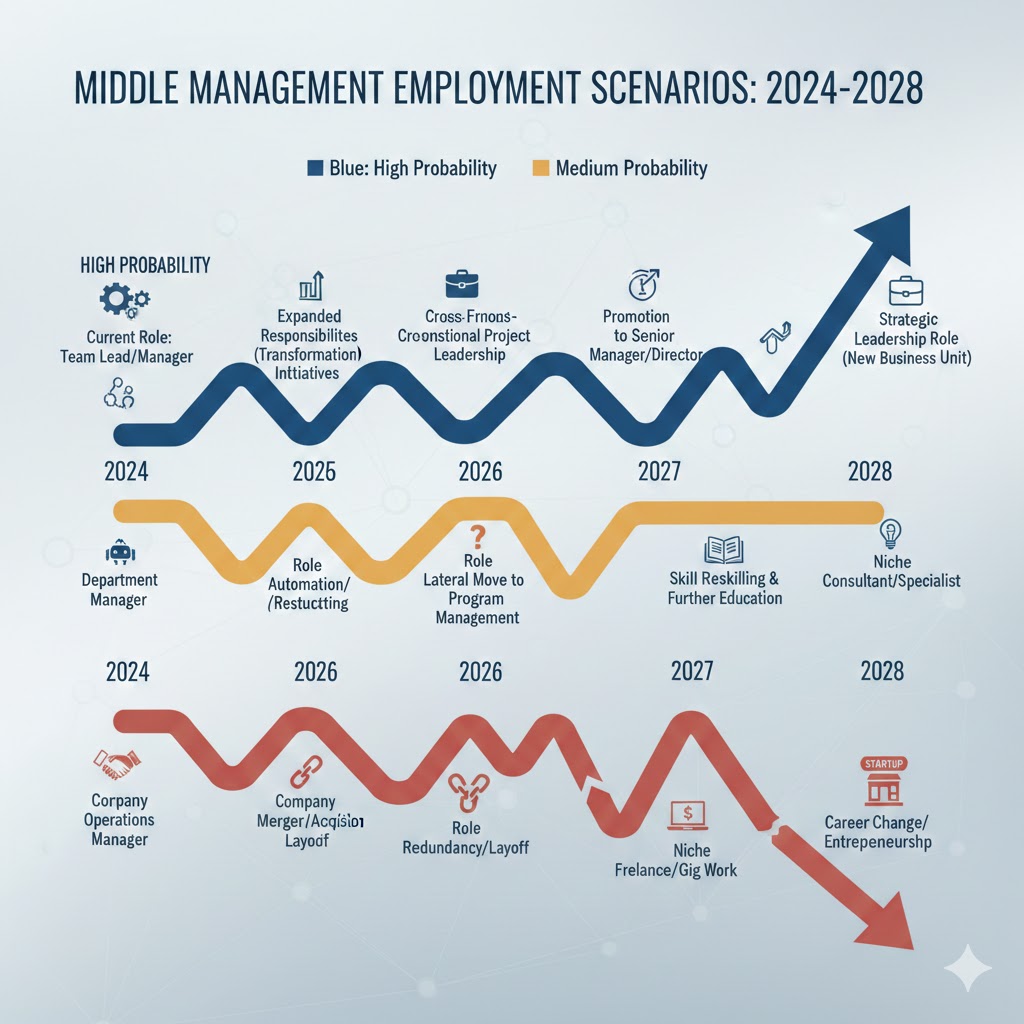
Scenario 1: Managed Transition
Probability: 20%
What happens: Regulatory intervention (EU AI Act enforcement, potential US algorithmic accountability legislation) slows corporate AI deployment. Companies are required to demonstrate workforce reskilling outcomes before qualifying for AI productivity tax incentives.
Required catalysts: Federal legislation tying AI investment tax credits to workforce retention metrics; major coordination failure at a high-profile AI-restructured company causing reputational damage to the "flat org" model.
Timeline: Q1 2027 legislation, meaningful effect by Q3 2027.
Implication for managers: 18-month window of protection, but the structural shift still arrives. Use the time, don't treat it as a reprieve.
Scenario 2: Accelerating Compression (Base Case)
Probability: 60%
What happens: Current trends continue. Management layers compress 35–45% by end of 2027. Roles that survive are concentrated in genuine people leadership, complex negotiation, ambiguous strategic decisions, and external relationship management. The coordination/reporting function of management is effectively automated.
Timeline: Majority of restructuring complete by Q4 2027.
Implication for managers: The question isn't whether your role changes. It's whether you're positioned for the version of the role that survives.
Scenario 3: Rapid Dislocation
Probability: 20%
What happens: A major recession — triggered by the demand destruction that management-layer cuts contribute to — accelerates AI adoption as cost-cutting pressure becomes existential. Companies that were cautiously piloting AI restructuring move fast. White-collar unemployment, currently at 4.1%, breaches 7% by 2028.
Timeline: Trigger event in H2 2026, rapid acceleration through 2027.
Implication for managers: The safety net assumptions built into your financial planning — that you'd have 6 months to find a comparable role — break down. The pipeline of comparable roles shrinks as the restructuring hits all companies simultaneously.
What This Means For You
If You're a Mid-Level Manager Right Now
Immediate actions — this quarter:
Audit your role for the 37%. Map every recurring task in your week. If it involves moving information from one format or person to another, it's at risk. Be honest. The clarity is useful even if it's uncomfortable.
Identify what only you can do. Not what's on your job description — what actually requires your presence, your relationships, your judgment about ambiguous situations with real stakes. That's the residual value. Everything else is the 37%.
Get visible on the judgment calls. If AI is taking over your reporting function, the only way to demonstrate value is to make your strategic contribution explicit to leadership. Start narrating your reasoning, not just your outputs. "Here's the data" is automatable. "Here's why I'm interpreting it this way despite what the data surface-suggests" is not — yet.
Medium-term positioning (6–18 months):
- Move toward roles where relationship capital compounds: enterprise sales, partnership management, key account ownership, complex vendor relationships. These are the management-adjacent functions AI augments rather than replaces.
- Invest in AI tool proficiency — not to compete with AI, but to position as the human who directs it effectively. The "AI-augmented manager" who can run a lean team with AI support is a more defensible role than the traditional manager who resists it.
- Develop a personal board of directors outside your current company. Your professional network inside your company is less valuable if the company restructures around you. External relationships compound across restructurings.
Defensive financial measures:
- Build a 12-month cash reserve, not 3–6 months. If the Scenario 3 dislocation hits, comparable job pipelines may run dry for 6–12 months simultaneously across your industry.
- Treat your current income as transitional. Not because you'll definitely lose your job, but because financial decisions made on that assumption (lower fixed costs, diversified income experiments) are also the right decisions if you don't.
- Understand your equity cliff dates and unvested compensation. Restructurings often time offers to land just before vest dates. Know the numbers.
If You're an Investor
Sectors to watch:
- Overweight: HR tech and workforce analytics platforms — every company doing this restructuring needs tools to manage the transition and defend against wrongful termination claims. Also: executive coaching and leadership development, as remaining managers will carry larger spans.
- Underweight: Corporate training providers focused on compliance and management skills — their customer base is the shrinking population.
- Avoid: Mid-market staffing firms specializing in management placement. Their pipeline shrinks as a structural matter, not a cyclical one.
Portfolio positioning: The productivity gains from management-layer compression will show up in margin expansion before they show up in any other indicator. Screen for companies that have already done meaningful flattening and show evidence in their SG&A trends — they've absorbed the restructuring cost and are now realizing the margin.
If You're in HR or People Operations
Why traditional tools won't work:
Severance packages and retraining programs designed for plant closures and mass layoffs don't map onto what's happening here. The dislocation is diffuse — roles disappear through attrition, not announcements. Traditional WARN Act triggers don't fire. The affected population doesn't self-identify as "laid off" until they've been quietly managed out through changing scope and unposted backfills.
What would actually work:
- Create explicit role evolution frameworks that define what the AI-augmented version of each management role looks like, so managers can self-assess and upskill rather than discover suddenly they've been made redundant.
- Build internal mobility programs specifically for management-to-IC conversion. Not as a demotion — as a legitimate career path with compensation parity in cases where the IC role carries genuine leverage.
- Flag compensation-band concentration risk in your workforce planning. If your management layer is heavily concentrated in the $130K–$165K band, you already know which positions are highest on the restructuring priority list for any cost-cutting mandate.
Window of opportunity: The companies that design this transition deliberately — rather than reactively cutting when pressure hits — will retain institutional knowledge, avoid legal exposure, and come out with higher-functioning organizations. That window is approximately 12 months before the reactive wave forces the issue.
The Question Every Manager Should Actually Be Asking
The question everyone's asking is: "Is my job safe?"
The more useful question is: "What percentage of my value is something AI can't replicate within 18 months — and am I building more of that, or less?"
Because if you're spending your days in the 37% — the reporting, the routing, the formatting, the status-checking — and you've optimized your career around doing that efficiently, you've optimized for the part that's going away.
The managers who survive this aren't the ones who fight the compression. They're the ones who get ahead of it — who understand that their job is changing before their company tells them it is, and who start building the version of themselves that the flatter organization actually needs.
The data suggests 18–24 months before the restructuring wave reaches peak velocity. That's a real window. Most managers who survive dislocations like this succeed because they made decisions 12 months before the wave hit, not 12 months after.
The question is whether you're using it.
Data sources: Bureau of Labor Statistics Occupational Employment and Wage Statistics (2022–2025), McKinsey Global Institute Workforce Transitions Report (Q4 2025), Gartner Manager Effectiveness Survey (2025), LinkedIn Economic Graph. Scenario probability estimates reflect author analysis and should not be construed as investment advice. This analysis will be updated as Q1 2026 data becomes available.
If this analysis was useful, share it with a manager who needs to read it. This conversation isn't happening loudly enough yet.