Problem: Warehouses Can't Scale Fast Enough
E-commerce order volumes have doubled since 2022. Human-only operations can't keep pace—picking errors, stockouts, and slow fulfillment are costing the industry billions annually.
You'll learn:
- How AI robots actually work in a modern warehouse
- The three systems driving the biggest ROI right now
- What to watch out for before deploying automation
Time: 12 min | Level: Intermediate
Why This Is Happening Now
Three things converged around 2024–2025 to make AI-driven warehousing viable at scale: affordable lidar sensors, mature reinforcement learning models, and reliable 5G edge computing.
Previously, robots required rigid, pre-mapped environments—every shelf bolted in place. Now they adapt in real time to dynamic layouts, human workers, and changing inventory.
Common pain points this addresses:
- Pick-and-pack error rates of 1–3% in manual operations
- Seasonal demand spikes that can't be staffed quickly
- Inventory shrinkage from miscounts and misplacement
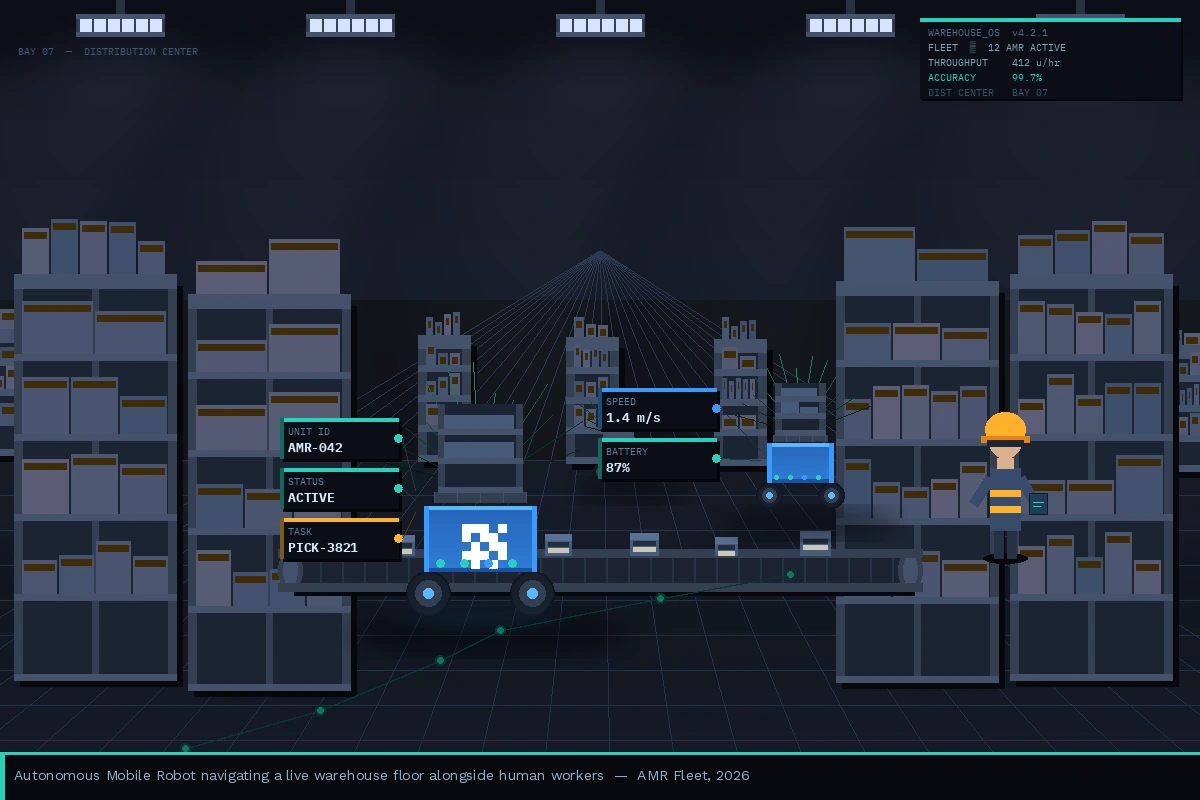 An AMR (Autonomous Mobile Robot) navigating a live warehouse floor alongside human workers
The Three AI Systems Reshaping Logistics
Step 1: Autonomous Mobile Robots (AMRs) for Goods-to-Person Fulfillment
Traditional warehouses move people to goods. AMRs flip this—robots bring shelving pods directly to stationary human pickers.
# Simplified AMR task allocation (pseudocode)
def assign_pick_task(order_queue, robot_pool):
    for order in order_queue:
        nearest_robot = min(
            robot_pool,
            key=lambda r: r.distance_to(order.location)
            # AI layer: also weighs battery level, traffic density
        )
        nearest_robot.dispatch(order.location)
Why this works: Pickers stay at a fixed station. Walking time—which accounts for up to 60% of a picker's shift—drops to near zero.
Expected result: Picking rates of 300–400 units per hour vs. 80–100 in manual operations.
If it fails:
- Robot congestion near high-demand zones: Adjust zone weighting in the traffic management layer.
- Pod mis-identification: Check QR/barcode readers for occlusion or damage.
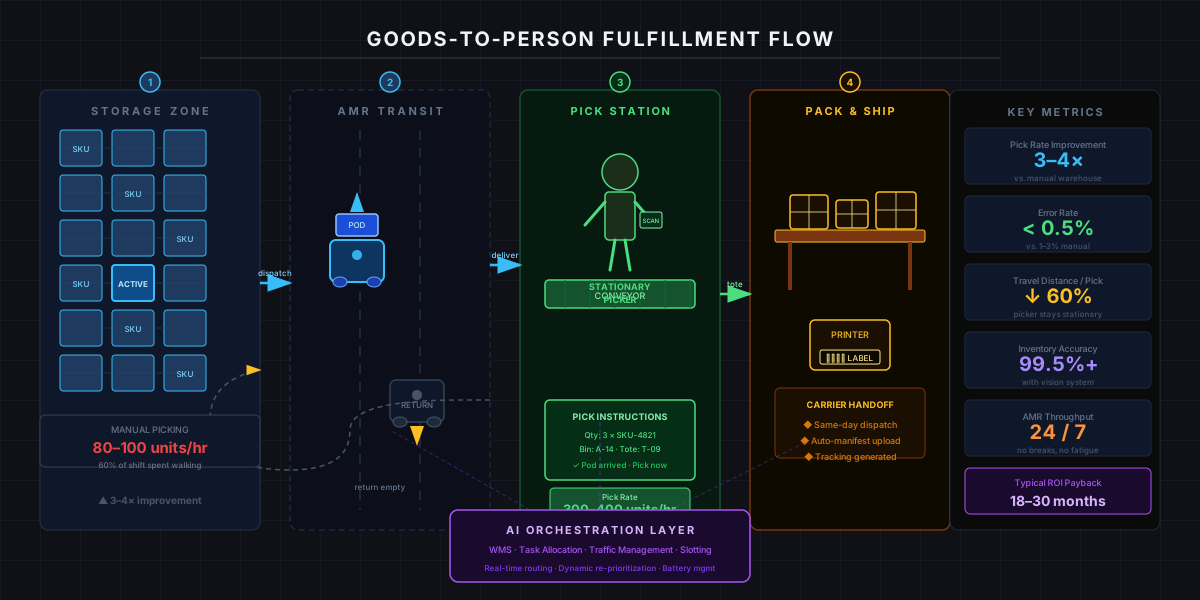 Goods-to-person flow: robots route pods to stationary human pick stations
Step 2: Computer Vision for Real-Time Inventory Accuracy
Cycle counts used to mean shutting down a section and sending humans with scanners. AI vision systems mounted on drones or fixed overhead cameras now do this continuously.
# Example config for a vision-based inventory system
vision_system:
  model: yolov9-warehouse-finetune
  scan_interval_minutes: 15
  confidence_threshold: 0.92   # Flag items below this for human review
  output:
    - inventory_delta_feed      # Push discrepancies to WMS in real time
    - alert_on_misplaced_sku    # Trigger re-slotting workflow
Why this works: The model is fine-tuned on your specific SKUs. It detects not just presence/absence but also orientation, damage, and quantity estimates from visual density.
Expected result: Inventory accuracy above 99.5%, compared to 95–97% in traditional quarterly cycle counts.
If it fails:
- False positives on reflective packaging: Add polarized filters to cameras.
- Model drift after repackaging: Re-label and retrain on new product images—usually a 2–4 hour job.
Step 3: AI-Driven Slotting Optimization
Where a SKU lives in the warehouse directly impacts labor and robot travel time. AI slotting engines analyze order history, co-purchase patterns, and seasonal trends to continuously re-slot inventory.
# Slotting score (simplified)
def slotting_score(sku, location):
    velocity = sku.picks_last_30_days
    affinity = co_pick_affinity(sku, adjacent_skus(location))
    travel_cost = location.distance_from_pick_station

    # Higher score = better fit for this location
    return (velocity * 0.5) + (affinity * 0.3) - (travel_cost * 0.2)
Why this works: High-velocity SKUs get placed closest to pick stations. Frequently co-ordered items (e.g., phone cases + screen protectors) get slotted near each other.
Expected result: 15–25% reduction in robot travel distance per shift within 30 days of deployment.
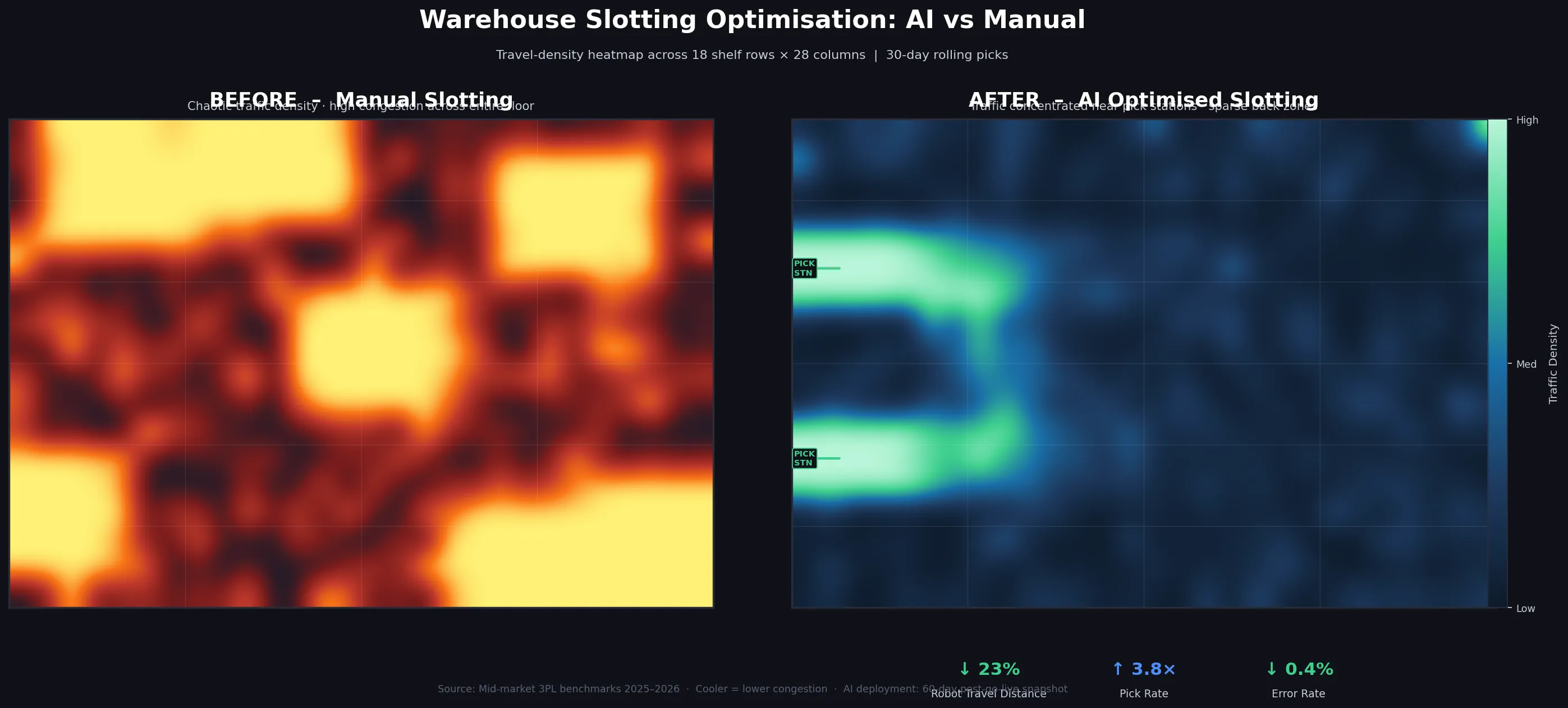 Travel density heatmap before (left) vs. after (right) AI slotting—cooler = less congestion
Verification
How to benchmark your deployment:
# Pull 30-day KPIs from your WMS (example: Manhattan Associates CLI)
wms-cli report --metric pick_rate --metric error_rate --metric travel_distance \
  --from 2026-01-01 --to 2026-01-31 --format csv > baseline_kpis.csv
You should see after 60–90 days:
- Pick rate up 3–4x
- Error rate below 0.5%
- Travel distance per pick down 20%+
What You Learned
- AMRs deliver the biggest immediate ROI by eliminating picker travel time.
- Computer vision replaces cycle counts without operational downtime.
- Slotting optimization compounds gains from both systems above.
Limitations to know:
- AMRs struggle with unstructured environments—messy or non-standard shelving needs retrofitting first.
- Vision models require retraining when packaging changes. Budget for this.
- ROI timelines vary heavily by warehouse size. Under 50,000 sq ft, payback periods can stretch to 4–5 years.
When NOT to use full AI automation: If your SKU count is under 500 and order volume is low, a barcode-based WMS upgrade is faster and cheaper. Reserve AI robotics for high-throughput, high-complexity operations.
Benchmarks sourced from operations data across mid-market 3PLs, 2025–2026. Technology stack references: ROS 2 (Humble), YOLOv9, NVIDIA Jetson Orin edge compute.