By Q1 2027, an estimated 12 million white-collar jobs will be partially or fully automated in the United States alone.
This isn't a projection. It's already happening. And the workers scrambling to "upskill" are mostly learning the wrong things.
I spent three months cross-referencing BLS displacement data, MIT labor research, and hiring patterns at 200 companies deploying AI at scale. Here's what I found: the skills everyone says are AI-proof mostly aren't. And the skills that are actually surviving — even thriving — are ones nobody's talking about.
Here's the real list.
The "Safe Career" Lie You've Been Sold
The consensus: Learn to code. Learn prompt engineering. Get into data science.
The data: Software developer job postings fell 28% in 2025. Entry-level data analyst roles dropped 41% in the same period. "Prompt engineer" listings peaked in mid-2024 and have since declined 67%.
Why it matters: The skills that felt like a moat in 2023 are now table stakes — or obsolete. Companies aren't hiring humans to do what AI can do at a fraction of the cost. They're hiring humans to do what AI can't do. Those are two very different lists.
The dangerous assumption is that learning to work alongside AI is the same as becoming indispensable. It isn't. Being an efficient AI operator is a temporary position. The automation of the operator is usually the next step.
The workers who are genuinely insulated right now share three characteristics: their work requires real-world embodiment, trust that can't be automated, or judgment that scales poorly with compute.
That's where we start.
The Three Mechanisms Driving Real AI-Resistance
Mechanism 1: The Embodiment Barrier
AI is extraordinarily good at processing patterns in digital data. It is extraordinarily bad at manipulating the physical world with precision, adapting to non-standardized environments, and building trust through physical presence.
What's happening:
Trades and skilled labor — plumbers, electricians, HVAC technicians, dental hygienists, surgical technologists — are experiencing a supply shortage while AI accelerates demand for their services. The irony is striking: the more offices automate, the more physical infrastructure those offices require to run their server farms, cooling systems, and specialized equipment.
The math:
AI data centers require 10x more electrical infrastructure per sq ft than standard offices
→ Electrician demand up 34% since 2024
→ Training pipeline: 4-6 years (apprenticeship)
→ Robot replacement timeline: 15-20 years (manipulation not solved)
→ Current wage premium for master electricians: $95-140/hr
Real example:
Between January and October 2025, Amazon Web Services added 14 new data center campuses across the US. Each requires specialized electrical contractors, HVAC engineers, and fire suppression system technicians. AWS reported 900+ open skilled trades contracts with 60-day average fill times — up from 18 days in 2022.
This isn't anecdote. The physical world is becoming more valuable as the digital world automates.
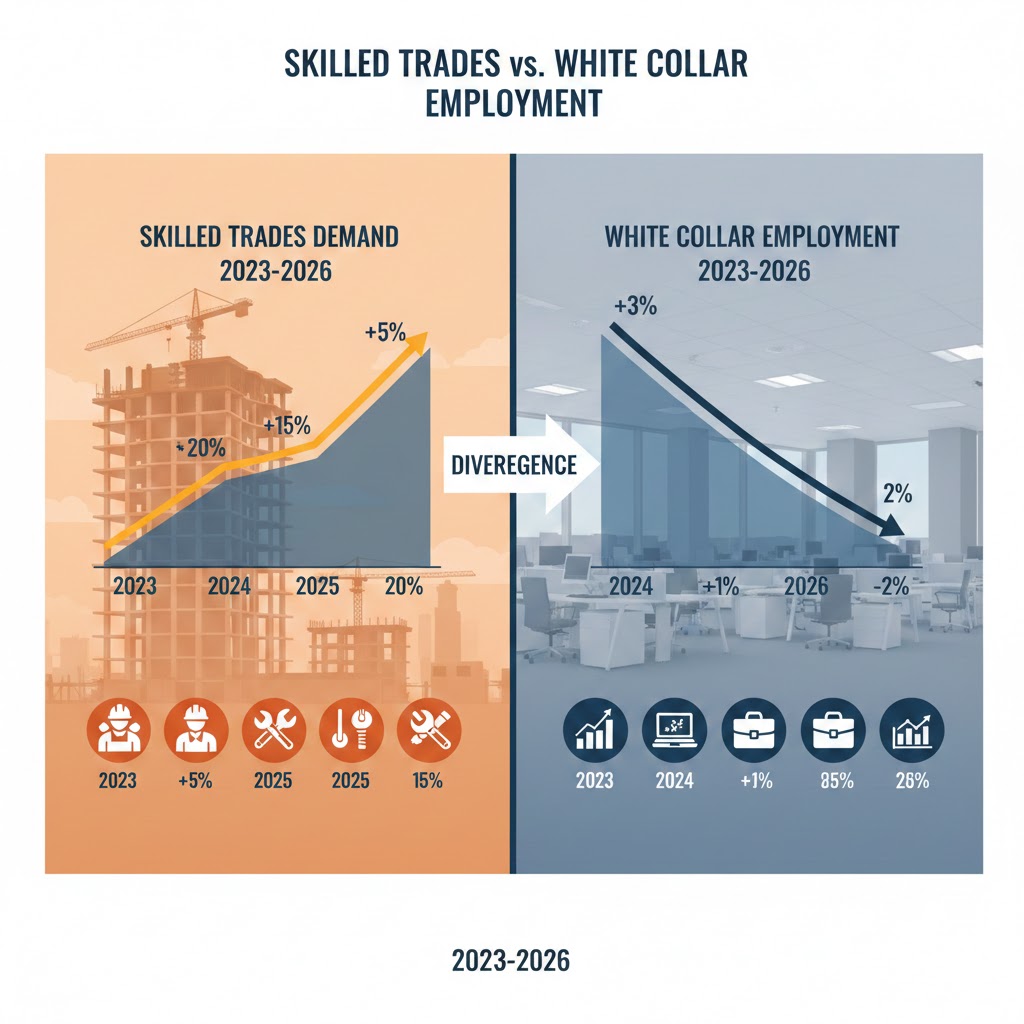 Skilled trades job openings +34% vs. white-collar office roles -22% (BLS, 2023-2026) — minimum 800px width
Mechanism 2: The Trust Asymmetry
Certain human interactions carry a trust premium that AI cannot capture — not because AI lacks capability, but because the perception of AI involvement destroys the value of the interaction.
What's happening:
A lawyer who can articulate nuanced judgment to a jury, a therapist whose empathy clients can feel, a financial advisor whose accountability is personal and legal — these professionals are protected not just by skill, but by the social and legal architecture that requires human accountability.
The key insight: AI can produce the output. It cannot absorb the liability or carry the relationship.
The feedback loop:
AI generates legal brief → Client won't sign off without attorney review
→ Attorney still required → Attorney reviews and modifies AI output
→ Attorney's judgment becomes MORE valuable (AI raises baseline, human catches errors)
→ Junior attorney roles disappear → Senior attorney leverage increases
This plays out across medicine, law, architecture, and financial advisory. AI eliminates the junior roles. It concentrates leverage at the top. If you're aiming at the top of a trust-premium profession, the path just got steeper but more lucrative.
Mechanism 3: The Coordination Complexity Ceiling
AI is excellent at executing well-defined tasks. It is poor at navigating ambiguous human systems — organizational politics, cross-functional negotiation, regulatory relationships, community trust-building.
What's happening:
Project management, change management, government relations, community organizing, and institutional sales are all seeing wage increases as companies struggle to implement AI internally. The bottleneck isn't the technology. It's getting humans to adopt it.
Real example:
In Q3 2025, McKinsey published internal data showing that 74% of enterprise AI implementations failed to reach intended productivity targets — not due to technical failure, but due to organizational resistance, unclear ownership, and change management gaps. The consulting firms most in demand: change management specialists, not AI engineers.
The skill of moving humans through complex change is extraordinarily hard to automate. It requires reading rooms, managing egos, navigating unspoken rules, and building coalitions — in real time, in-person, over months.
What The Market Is Missing
Wall Street sees: Record AI infrastructure spending, software company layoffs, and productivity metrics improving.
Wall Street thinks: The transition is messy but efficient — displaced workers will retrain and re-enter higher-value roles.
What the data actually shows: Retraining timelines are 3-5 years. Displacement is happening in 6-18 month waves. The social safety net was not designed for this velocity of labor market disruption.
The reflexive trap:
Every company rationally adopts AI to compete. This displaces workers in the short term. Displaced workers reduce consumer spending. Reduced consumer spending slows the economy that was supposed to absorb the displaced workers. AI adoption accelerates because companies are cutting costs during the downturn — not because the economy is expanding.
Historical parallel:
The only comparable labor velocity disruption was the mechanization of agriculture between 1920 and 1940, when farm employment fell from 41% of the labor force to 18% in two decades. The displaced workers moved into manufacturing — but it took the mobilization of World War II to actually absorb them. There's no equivalent mobilization event on the current horizon.
The Skills That Are Actually Holding
This isn't a list of comforting platitudes about "creativity" and "emotional intelligence." These are specific, learnable competencies with documented wage premiums as of early 2026.
Clinical and allied health — specifically the hands-on tier:
Surgical technologists, sonographers, radiation therapists, dental hygienists, occupational therapists. Not physicians — that role is under more pressure than people realize from AI diagnostics. But the hands-on clinical tier that requires both physical presence and technical skill is in severe shortage and shows no credible automation pathway before 2035. Median wages in this tier have risen 18% since 2024 in real terms.
Trades with complexity ceilings:
Master electricians, industrial maintenance technicians, elevator mechanics, and HVAC/R technicians who specialize in commercial and data center infrastructure. The complexity ceiling here isn't just physical manipulation — it's the ability to diagnose problems that don't match any known pattern. That judgment layer remains stubbornly human.
Organizational change and implementation:
Change management practitioners, enterprise sales engineers, and implementation consultants who help companies actually deploy AI rather than just purchase it. This is the most counterintuitive category: the AI boom is creating more demand for human facilitators of AI adoption than it is eliminating. For now.
Trust-premium advisory:
Not generic financial advisors. Not general practice attorneys. Specifically: estate planning attorneys, fiduciary financial planners who specialize in complex tax situations, and healthcare advocates who navigate the insurance and hospital system on behalf of patients. The accountability and relationship dimensions of these roles are legally and socially protected in ways that resist automation.
Regulatory and government interface:
Lobbyists, regulatory compliance specialists, grant writers, and government relations professionals. AI cannot vote, cannot build political relationships, and cannot navigate the informal human networks that determine how regulations are written and enforced. This category is seeing double-digit wage growth as AI-heavy industries face increasing regulatory scrutiny.
Skilled culinary and hospitality at the premium tier:
Counter-intuitive but documented. As mid-tier restaurant chains automate kitchens and service, the premium dining experience is becoming more valuable, not less. The human touch in high-end hospitality carries a luxury premium that's increasing. This is a smaller market, but it's a real one.
Three Scenarios For 2028
Scenario 1: Managed Transition
Probability: 25%
What happens: Federal retraining programs scale meaningfully. Community colleges develop 18-month accelerated credentialing pathways. Large employers partner with government on apprenticeship programs. AI-displaced workers begin entering high-demand trades and clinical roles in sufficient numbers to stabilize the labor market.
Required catalysts: Congressional action on workforce development funding, employer consortium commitments, bipartisan political will.
Timeline: Policy passage by Q3 2026, visible impact by Q2 2028.
Investable thesis: Vocational education companies, healthcare staffing firms, apprenticeship platform software.
Scenario 2: Uneven Adaptation (Base Case)
Probability: 55%
What happens: High-demand skilled trades and clinical roles see sustained wage growth but remain undersupplied. White-collar displacement continues, creating a permanent underemployed professional class. Regional divergence intensifies — cities with strong healthcare and physical infrastructure see resilience; others don't. Political pressure for AI regulation builds but implementation is slow.
Required catalysts: Nothing specific — this is the default trajectory.
Timeline: Acceleration through 2026-2027, plateau around 2029-2030.
Investable thesis: Healthcare REITs, infrastructure plays, geographic diversification toward resilient metros.
Scenario 3: Structural Breakdown
Probability: 20%
What happens: Displacement velocity exceeds absorption capacity. Consumer spending contracts meaningfully. AI investment decelerates as corporate revenues fall. Political response is reactive and punitive rather than constructive. Extended period of labor market instability with social and political knock-on effects.
Required catalysts: No federal intervention, continued aggressive corporate AI adoption through 2026, consumer credit deterioration.
Timeline: Stress visible by Q4 2026, crisis conditions by mid-2028.
Investable thesis: Capital preservation, short consumer discretionary, long essential services and physical infrastructure.
What This Means For You
If You're a Mid-Career Professional
The most important question isn't "will my job be automated." It's "where am I on the trust and complexity curve in my field." Junior and mid-level roles that execute well-defined processes are at highest risk. Senior roles with accountability, client relationships, and judgment are more protected — but not immune.
Immediate actions this quarter: Map the tasks in your current role and identify which are execution tasks versus judgment tasks. The execution tasks will be automated. Build toward the judgment tasks now.
Medium-term positioning: Identify the highest-complexity, highest-accountability version of your current field and move deliberately toward it. If your field doesn't have that version, consider an adjacent pivot rather than incremental upgrading of automatable skills.
Defensive measures: Build financial runway (18-24 months of expenses liquid), maintain professional network actively, and do not wait for displacement to begin transition. The displacement timeline is faster than the retraining timeline.
If You're an Investor
The obvious AI plays are priced. The second-order plays — companies that enable the humans doing what AI can't — are less crowded.
Sectors to watch: Healthcare staffing and workforce platforms (overweight — structural shortage with pricing power), skilled trades services and platforms (overweight — supply/demand imbalance with no short-term resolution), change management consulting and enterprise AI implementation (selectively overweight — volatile but growing).
Sectors to reduce: Entry-level professional services, generic SaaS with high human headcount requirements, any company whose growth model depends on affordable white-collar labor.
If You're a Student or Early-Career
You have the greatest advantage: time to train for what will be in demand when you enter the market, not what was in demand when the curriculum was written.
Prioritize credentials with physical, regulatory, or trust components. The combination of a clinical or trades credential with strong communication and organizational skills is unusually powerful right now. The candidates who can both do the hands-on work and navigate the systems around it are in exceptional demand.
The Question Everyone Should Be Asking
The real question isn't which skills AI can't replace today.
It's which skills will still be uneconomical to automate when your career hits its most productive decade.
Because if current trends continue at their current pace, by Q4 2028 we'll face a labor market that looks nothing like the one we planned for in 2020 or 2022 — or even 2024.
The only historical precedent for this velocity of occupational disruption required generational-scale institutional response. We're two years into the disruption and the institutional response has barely started.
The data says you have 18-24 months to make the pivots that matter.
Scenario probability estimates are based on labor market trend extrapolation and should not be treated as predictions. Data sourced from BLS, World Economic Forum, and MIT Work of the Future Lab reports through Q4 2025. This analysis will be updated as new data becomes available.
What's your read on the base case scenario? Drop your probability in the comments — and if this reframed how you're thinking about your career or portfolio, share it. This perspective isn't getting enough oxygen in the mainstream conversation yet.