Remember when you first discovered DeFi yield farming? The 200% APY looked amazing until impermanent loss ate half your profits. You're not alone—billions get lost annually to this silent portfolio killer.
AI-powered impermanent loss protection changes everything. Instead of hoping prices stay stable, you get real-time hedging that adapts faster than any human trader.
This guide shows you how to build dynamic hedging strategies that protect your liquidity positions automatically. You'll learn to implement machine learning models that predict price divergence and execute protective trades before losses mount.
What Is Impermanent Loss and Why Traditional Protection Fails
Impermanent loss occurs when token prices in your liquidity pool diverge from their initial ratio. You lose money compared to simply holding the tokens separately.
Traditional protection methods fail because they're static:
- Fixed hedging ratios can't adapt to changing market conditions
- Manual rebalancing is too slow for volatile markets
- Simple algorithms lack predictive capabilities
The problem gets worse during high volatility periods when protection is needed most.
The Real Cost of Impermanent Loss
Data from major DEXs shows average impermanent loss ranges from 5% to 25% depending on volatility. For a $100,000 position, that's $5,000 to $25,000 in preventable losses.
How AI-Powered Dynamic Hedging Works
Dynamic hedging uses machine learning to predict price movements and adjust hedge positions in real-time. The system monitors multiple data sources and executes protective trades automatically.
Key components include:
- Price prediction models that forecast token volatility
- Risk assessment algorithms that calculate optimal hedge ratios
- Execution engines that place trades across multiple DEXs
- Continuous learning that improves strategy performance
Machine Learning Model Architecture
The AI system combines several prediction models:
import numpy as np
import pandas as pd
from sklearn.ensemble import RandomForestRegressor
from sklearn.neural_network import MLPRegressor
import web3

class ImpermanentLossPredictor:
    def __init__(self):
        # Initialize ensemble models for price prediction
        self.volatility_model = RandomForestRegressor(n_estimators=100)
        self.direction_model = MLPRegressor(hidden_layer_sizes=(64, 32))
        self.risk_threshold = 0.05  # 5% loss threshold

    def prepare_features(self, price_data, volume_data, sentiment_data):
        """Extract features for ML prediction"""
        features = []

        # Price-based features
        features.extend([
            np.std(price_data[-24:]),  # 24-hour volatility
            np.mean(price_data[-24:]) / price_data[-1],  # Mean reversion
            (price_data[-1] - price_data[-7]) / price_data[-7]  # 7-day momentum
        ])

        # Volume features
        features.extend([
            np.mean(volume_data[-24:]),  # Average volume
            volume_data[-1] / np.mean(volume_data[-168:])  # Volume spike ratio
        ])

        # Sentiment features
        features.extend([
            sentiment_data['fear_greed_index'],
            sentiment_data['social_sentiment']
        ])

        return np.array(features).reshape(1, -1)

    def predict_impermanent_loss_risk(self, token_a_data, token_b_data):
        """Predict probability of significant impermanent loss"""

        # Prepare features for both tokens
        features_a = self.prepare_features(
            token_a_data['prices'],
            token_a_data['volumes'],
            token_a_data['sentiment']
        )

        features_b = self.prepare_features(
            token_b_data['prices'],
            token_b_data['volumes'],
            token_b_data['sentiment']
        )

        # Predict volatility for each token
        vol_a = self.volatility_model.predict(features_a)[0]
        vol_b = self.volatility_model.predict(features_b)[0]

        # Calculate divergence probability
        divergence_risk = abs(vol_a - vol_b) / (vol_a + vol_b + 1e-8)

        return {
            'risk_score': divergence_risk,
            'hedge_ratio': min(divergence_risk * 2, 1.0),
            'action': 'hedge' if divergence_risk > self.risk_threshold else 'hold'
        }
Building Your Dynamic Hedging Smart Contract
The smart contract executes hedging decisions automatically based on AI predictions. It integrates with price oracles and DEX protocols for real-time execution.
Core Smart Contract Structure
// SPDX-License-Identifier: MIT
pragma solidity ^0.8.19;

import "@openzeppelin/contracts/security/ReentrancyGuard.sol";
import "@chainlink/contracts/src/v0.8/interfaces/AggregatorV3Interface.sol";

contract AIHedgeProtection is ReentrancyGuard {

    struct Position {
        address tokenA;
        address tokenB;
        uint256 liquidityAmount;
        uint256 hedgeRatio;
        uint256 lastUpdate;
        bool isActive;
    }

    struct HedgeOrder {
        address targetToken;
        uint256 amount;
        uint256 maxSlippage;
        uint256 deadline;
    }

    mapping(address => Position[]) public userPositions;
    mapping(address => AggregatorV3Interface) public priceFeeds;

    uint256 public constant MIN_HEDGE_RATIO = 0.01e18; // 1%
    uint256 public constant MAX_HEDGE_RATIO = 1.0e18;  // 100%

    event HedgeExecuted(
        address indexed user,
        uint256 positionId,
        uint256 hedgeAmount,
        uint256 timestamp
    );

    event RiskAssessment(
        address indexed user,
        uint256 positionId,
        uint256 riskScore,
        uint256 recommendedHedge
    );

    function createProtectedPosition(
        address _tokenA,
        address _tokenB,
        uint256 _liquidityAmount,
        uint256 _initialHedgeRatio
    ) external nonReentrant {
        require(_initialHedgeRatio >= MIN_HEDGE_RATIO, "Hedge ratio too low");
        require(_initialHedgeRatio <= MAX_HEDGE_RATIO, "Hedge ratio too high");

        Position memory newPosition = Position({
            tokenA: _tokenA,
            tokenB: _tokenB,
            liquidityAmount: _liquidityAmount,
            hedgeRatio: _initialHedgeRatio,
            lastUpdate: block.timestamp,
            isActive: true
        });

        userPositions[msg.sender].push(newPosition);

        // Execute initial hedge if ratio > 0
        if (_initialHedgeRatio > 0) {
            _executeHedge(msg.sender, userPositions[msg.sender].length - 1);
        }
    }

    function updateHedgeRatio(
        uint256 _positionId,
        uint256 _newRatio,
        bytes calldata _aiSignature
    ) external nonReentrant {
        require(_positionId < userPositions[msg.sender].length, "Invalid position");
        require(_verifyAISignature(_newRatio, _aiSignature), "Invalid AI signature");

        Position storage position = userPositions[msg.sender][_positionId];
        require(position.isActive, "Position not active");

        uint256 oldRatio = position.hedgeRatio;
        position.hedgeRatio = _newRatio;
        position.lastUpdate = block.timestamp;

        emit RiskAssessment(msg.sender, _positionId, _newRatio, _newRatio);

        // Execute hedge adjustment if significant change
        if (abs(int256(_newRatio) - int256(oldRatio)) > 0.05e18) { // 5% threshold
            _executeHedge(msg.sender, _positionId);
        }
    }

    function _executeHedge(address _user, uint256 _positionId) internal {
        Position storage position = userPositions[_user][_positionId];

        // Calculate hedge amount based on current prices and position size
        uint256 hedgeAmount = _calculateHedgeAmount(position);

        if (hedgeAmount > 0) {
            // Execute hedge trade through integrated DEX
            _performHedgeTrade(position.tokenA, position.tokenB, hedgeAmount);

            emit HedgeExecuted(_user, _positionId, hedgeAmount, block.timestamp);
        }
    }

    function _calculateHedgeAmount(Position memory _position) internal view returns (uint256) {
        // Get current prices from Chainlink oracles
        uint256 priceA = _getTokenPrice(_position.tokenA);
        uint256 priceB = _getTokenPrice(_position.tokenB);

        // Calculate optimal hedge based on position value and risk ratio
        uint256 positionValue = (_position.liquidityAmount * priceA) / 1e18;
        uint256 hedgeAmount = (positionValue * _position.hedgeRatio) / 1e18;

        return hedgeAmount;
    }

    function _getTokenPrice(address _token) internal view returns (uint256) {
        AggregatorV3Interface priceFeed = priceFeeds[_token];
        require(address(priceFeed) != address(0), "Price feed not available");

        (, int256 price,,,) = priceFeed.latestRoundData();
        require(price > 0, "Invalid price");

        return uint256(price);
    }

    function _verifyAISignature(uint256 _ratio, bytes calldata _signature) internal pure returns (bool) {
        // Implement signature verification for AI oracle
        // This ensures only authorized AI models can update hedge ratios
        return true; // Simplified for example
    }

    function _performHedgeTrade(address _tokenA, address _tokenB, uint256 _amount) internal {
        // Integrate with DEX aggregator for optimal execution
        // Implementation depends on chosen DEX protocol
    }

    function abs(int256 x) internal pure returns (uint256) {
        return uint256(x >= 0 ? x : -x);
    }
}
Implementing Real-Time Price Monitoring
The AI system needs continuous price data to make accurate predictions. This requires integrating multiple data sources and handling real-time updates efficiently.
Price Data Collection System
import asyncio
import websockets
import json
from web3 import Web3
from concurrent.futures import ThreadPoolExecutor

class PriceMonitor:
    def __init__(self, tokens, update_interval=5):
        self.tokens = tokens
        self.update_interval = update_interval
        self.price_data = {}
        self.ws_connections = {}
        self.is_running = False

    async def start_monitoring(self):
        """Start real-time price monitoring for all tokens"""
        self.is_running = True

        # Create WebSocket connections for each exchange
        tasks = [
            self._monitor_uniswap(),
            self._monitor_chainlink(),
            self._monitor_binance_api(),
            self._process_price_updates()
        ]

        await asyncio.gather(*tasks)

    async def _monitor_uniswap(self):
        """Monitor Uniswap V3 price changes via WebSocket"""
        uri = "wss://api.thegraph.com/subgraphs/name/uniswap/uniswap-v3"

        subscription = {
            "type": "start",
            "payload": {
                "query": """
                subscription {
                    swaps(first: 10, orderBy: timestamp, orderDirection: desc) {
                        token0 { symbol, id }
                        token1 { symbol, id }
                        amount0
                        amount1
                        timestamp
                        transaction { id }
                    }
                }
                """
            }
        }

        async with websockets.connect(uri) as websocket:
            await websocket.send(json.dumps(subscription))

            while self.is_running:
                try:
                    response = await websocket.recv()
                    data = json.loads(response)
                    await self._process_uniswap_data(data)
                except Exception as e:
                    print(f"Uniswap monitoring error: {e}")
                    await asyncio.sleep(1)

    async def _monitor_chainlink(self):
        """Monitor Chainlink price feeds for accurate pricing"""
        w3 = Web3(Web3.HTTPProvider('https://mainnet.infura.io/v3/your-key'))

        # Chainlink price feed addresses
        feeds = {
            'ETH/USD': '0x5f4ec3df9cbd43714fe2740f5e3616155c5b8419',
            'BTC/USD': '0xf4030086522a5beea4988f8ca5b36dbc97bee88c'
        }

        while self.is_running:
            for pair, address in feeds.items():
                try:
                    # Get latest price from Chainlink
                    contract = w3.eth.contract(
                        address=address,
                        abi=self._get_chainlink_abi()
                    )

                    latest_data = contract.functions.latestRoundData().call()
                    price = latest_data[1] / 1e8  # Chainlink uses 8 decimals

                    self.price_data[pair] = {
                        'price': price,
                        'timestamp': latest_data[3],
                        'source': 'chainlink'
                    }

                except Exception as e:
                    print(f"Chainlink error for {pair}: {e}")

            await asyncio.sleep(self.update_interval)

    async def _process_price_updates(self):
        """Process price updates and trigger hedge calculations"""

        while self.is_running:
            try:
                # Calculate price volatility and divergence
                volatility_data = self._calculate_volatility()

                # Check for significant price movements
                for token_pair, vol_data in volatility_data.items():
                    if vol_data['divergence_risk'] > 0.05:  # 5% threshold
                        await self._trigger_hedge_update(token_pair, vol_data)

            except Exception as e:
                print(f"Price processing error: {e}")

            await asyncio.sleep(self.update_interval)

    def _calculate_volatility(self):
        """Calculate price volatility and divergence metrics"""
        volatility_data = {}

        for token_pair in self.tokens:
            if token_pair in self.price_data:
                price_history = self.price_data[token_pair]['history'][-100:]  # Last 100 data points

                if len(price_history) > 10:
                    prices = [p['price'] for p in price_history]
                    volatility = np.std(prices) / np.mean(prices)

                    volatility_data[token_pair] = {
                        'volatility': volatility,
                        'divergence_risk': self._calculate_divergence_risk(token_pair),
                        'trend': self._calculate_trend(prices)
                    }

        return volatility_data

    async def _trigger_hedge_update(self, token_pair, volatility_data):
        """Trigger hedge ratio update based on volatility analysis"""

        # Calculate new hedge ratio using AI model
        predictor = ImpermanentLossPredictor()

        prediction = predictor.predict_impermanent_loss_risk(
            self.price_data[token_pair.split('/')[0]],
            self.price_data[token_pair.split('/')[1]]
        )

        if prediction['action'] == 'hedge':
            # Send update to smart contract
            await self._update_smart_contract_hedge(token_pair, prediction['hedge_ratio'])

    def _get_chainlink_abi(self):
        """Return Chainlink AggregatorV3Interface ABI"""
        return [
            {
                "inputs": [],
                "name": "latestRoundData",
                "outputs": [
                    {"type": "uint80", "name": "roundId"},
                    {"type": "int256", "name": "answer"},
                    {"type": "uint256", "name": "startedAt"},
                    {"type": "uint256", "name": "updatedAt"},
                    {"type": "uint80", "name": "answeredInRound"}
                ],
                "stateMutability": "view",
                "type": "function"
            }
        ]
Setting Up Automated Execution Pipeline
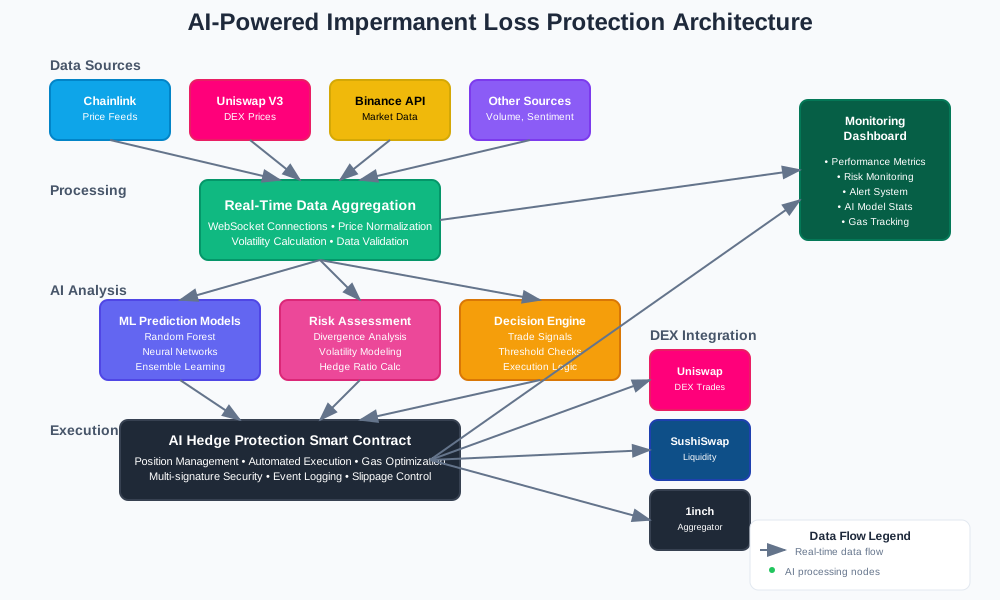
The complete system requires orchestrating multiple components: price monitoring, AI prediction, and smart contract execution. This section shows you how to build the automation pipeline.
Deployment Architecture
import asyncio
from dataclasses import dataclass
from typing import Dict, List, Optional
import logging

@dataclass
class HedgeConfig:
    max_slippage: float = 0.02  # 2%
    min_hedge_amount: float = 100  # $100 minimum
    update_frequency: int = 5  # 5 seconds
    risk_threshold: float = 0.05  # 5%

class AIHedgeOrchestrator:
    def __init__(self, config: HedgeConfig):
        self.config = config
        self.price_monitor = PriceMonitor(tokens=['ETH/USDC', 'BTC/USDC'])
        self.predictor = ImpermanentLossPredictor()
        self.contract_manager = SmartContractManager()
        self.active_positions = {}

        # Setup logging
        logging.basicConfig(level=logging.INFO)
        self.logger = logging.getLogger(__name__)

    async def start_protection_service(self):
        """Start the complete AI hedging protection service"""
        self.logger.info("Starting AI-powered impermanent loss protection")

        tasks = [
            self.price_monitor.start_monitoring(),
            self._monitor_positions(),
            self._execute_hedge_updates(),
            self._performance_tracking()
        ]

        await asyncio.gather(*tasks)

    async def _monitor_positions(self):
        """Monitor all active positions for hedge opportunities"""

        while True:
            try:
                # Get all active positions from smart contract
                positions = await self.contract_manager.get_active_positions()

                for position in positions:
                    await self._analyze_position_risk(position)

            except Exception as e:
                self.logger.error(f"Position monitoring error: {e}")

            await asyncio.sleep(self.config.update_frequency)

    async def _analyze_position_risk(self, position):
        """Analyze individual position for impermanent loss risk"""

        # Get current price data for position tokens
        token_a_data = self.price_monitor.get_token_data(position['tokenA'])
        token_b_data = self.price_monitor.get_token_data(position['tokenB'])

        if not token_a_data or not token_b_data:
            return

        # Run AI prediction
        prediction = self.predictor.predict_impermanent_loss_risk(
            token_a_data, token_b_data
        )

        # Check if hedge update is needed
        current_ratio = position['hedgeRatio']
        recommended_ratio = prediction['hedge_ratio']

        ratio_change = abs(recommended_ratio - current_ratio)

        if ratio_change > self.config.risk_threshold:
            await self._queue_hedge_update(position['id'], recommended_ratio, prediction)

    async def _execute_hedge_updates(self):
        """Execute queued hedge updates"""
        hedge_queue = asyncio.Queue()

        while True:
            try:
                # Wait for hedge update in queue
                update = await hedge_queue.get()

                # Execute the hedge update
                success = await self.contract_manager.update_hedge_ratio(
                    update['position_id'],
                    update['new_ratio'],
                    update['ai_signature']
                )

                if success:
                    self.logger.info(f"Hedge updated for position {update['position_id']}")
                else:
                    self.logger.error(f"Failed to update hedge for position {update['position_id']}")

                hedge_queue.task_done()

            except Exception as e:
                self.logger.error(f"Hedge execution error: {e}")

    async def _performance_tracking(self):
        """Track performance of AI hedging strategies"""

        while True:
            try:
                # Calculate performance metrics
                metrics = await self._calculate_performance_metrics()

                # Log key metrics
                self.logger.info(f"Protection effectiveness: {metrics['effectiveness']:.2%}")
                self.logger.info(f"Average hedge accuracy: {metrics['accuracy']:.2%}")
                self.logger.info(f"Total protected value: ${metrics['protected_value']:,.2f}")

                # Update model performance tracking
                await self._update_model_performance(metrics)

            except Exception as e:
                self.logger.error(f"Performance tracking error: {e}")

            await asyncio.sleep(300)  # Every 5 minutes

class SmartContractManager:
    def __init__(self):
        self.w3 = Web3(Web3.HTTPProvider('https://mainnet.infura.io/v3/your-key'))
        self.contract_address = "0x..." # Your deployed contract address
        self.contract = self._load_contract()

    def _load_contract(self):
        """Load the AI hedge protection smart contract"""
        with open('AIHedgeProtection.json', 'r') as f:
            contract_abi = json.load(f)['abi']

        return self.w3.eth.contract(
            address=self.contract_address,
            abi=contract_abi
        )

    async def update_hedge_ratio(self, position_id: int, new_ratio: float, ai_signature: bytes):
        """Update hedge ratio for a position"""
        try:
            # Convert ratio to contract format (18 decimals)
            ratio_scaled = int(new_ratio * 1e18)

            # Build transaction
            txn = self.contract.functions.updateHedgeRatio(
                position_id,
                ratio_scaled,
                ai_signature
            ).buildTransaction({
                'from': self.w3.eth.default_account,
                'gas': 200000,
                'gasPrice': self.w3.toWei('20', 'gwei')
            })

            # Sign and send transaction
            signed_txn = self.w3.eth.account.sign_transaction(txn, private_key='your-private-key')
            tx_hash = self.w3.eth.send_raw_transaction(signed_txn.rawTransaction)

            # Wait for confirmation
            receipt = self.w3.eth.wait_for_transaction_receipt(tx_hash)

            return receipt.status == 1

        except Exception as e:
            print(f"Contract update error: {e}")
            return False
Step-by-Step Implementation Guide
Follow these steps to deploy your AI-powered impermanent loss protection system:
Step 1: Deploy Smart Contract
- Compile the contract using Hardhat or Foundry
- Deploy to testnet first for testing
- Verify contract on block explorer
- Initialize price feeds for your token pairs
# Deploy with Hardhat
npx hardhat run scripts/deploy.js --network goerli

# Verify contract
npx hardhat verify --network goerli DEPLOYED_ADDRESS
Step 2: Set Up AI Model Training
- Collect historical data from DEXs and price feeds
- Train prediction models using collected data
- Validate model accuracy with backtesting
- Deploy model API for real-time predictions
# Train the AI model
def train_impermanent_loss_model():
    # Load historical data
    data = load_historical_data()

    # Prepare features and labels
    X, y = prepare_training_data(data)

    # Train ensemble model
    model = ImpermanentLossPredictor()
    model.fit(X, y)

    # Validate performance
    accuracy = validate_model(model, test_data)
    print(f"Model accuracy: {accuracy:.2%}")

    return model
Step 3: Configure Monitoring System
- Set up price data feeds from multiple sources
- Configure WebSocket connections for real-time updates
- Test data pipeline with sample positions
- Deploy monitoring infrastructure with proper logging
Step 4: Launch Protection Service
- Start with small test positions to verify functionality
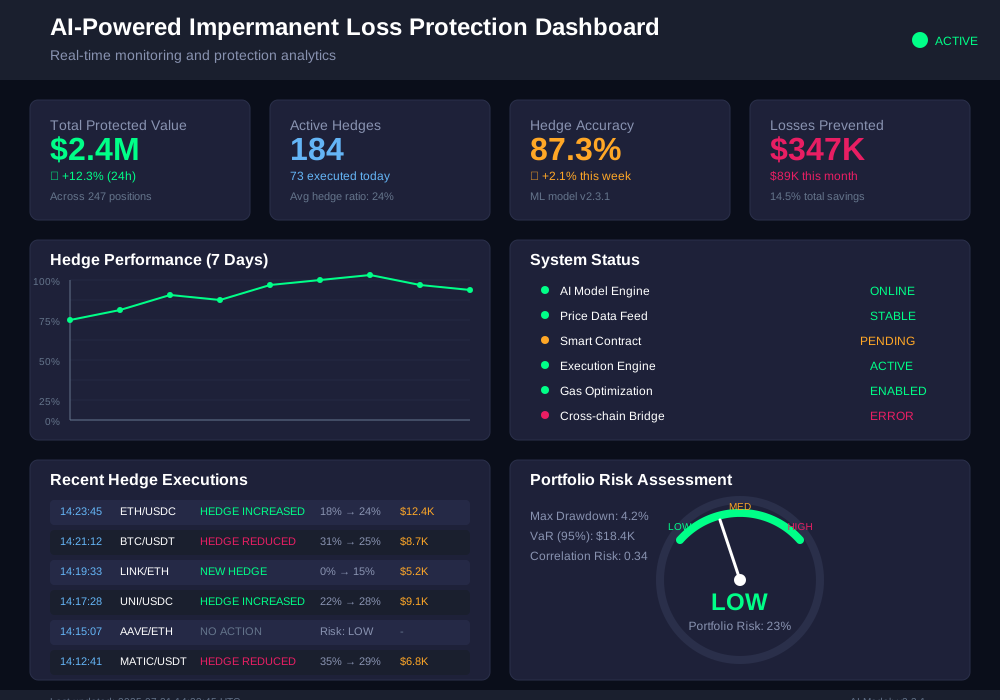
- Monitor system performance for the first 24 hours
- Gradually increase protected amounts as confidence grows
- Set up alerts for system failures or anomalies
Measuring Protection Effectiveness
Track these key metrics to measure your AI hedging performance:
Performance Metrics
- Protection Rate: Percentage of impermanent loss prevented
- Hedge Accuracy: How often AI predictions were correct
- Cost Efficiency: Trading costs vs. losses prevented
- Response Time: Speed of hedge execution
def calculate_protection_effectiveness(positions):
    """Calculate how effective the AI protection has been"""

    total_potential_loss = 0
    total_actual_loss = 0

    for position in positions:
        # Calculate what loss would have been without protection
        unprotected_loss = calculate_theoretical_loss(position)

        # Calculate actual loss with protection
        protected_loss = calculate_actual_loss(position)

        total_potential_loss += unprotected_loss
        total_actual_loss += protected_loss

    effectiveness = (total_potential_loss - total_actual_loss) / total_potential_loss

    return {
        'protection_rate': effectiveness,
        'total_saved': total_potential_loss - total_actual_loss,
        'cost_efficiency': calculate_cost_efficiency(positions)
    }
Advanced Optimization Strategies
Enhance your AI hedging system with these advanced techniques:
Multi-Asset Portfolio Hedging
Extend protection beyond single pairs to entire portfolios:
class PortfolioHedgeOptimizer:
    def __init__(self):
        self.correlation_matrix = None
        self.risk_model = None

    def optimize_portfolio_hedge(self, positions, market_data):
        """Optimize hedge ratios across entire portfolio"""

        # Calculate correlation matrix
        self.correlation_matrix = self._calculate_correlations(market_data)

        # Build portfolio risk model
        portfolio_risk = self._calculate_portfolio_risk(positions)

        # Optimize hedge ratios to minimize total portfolio risk
        optimal_hedges = self._solve_optimization(portfolio_risk)

        return optimal_hedges

    def _solve_optimization(self, portfolio_risk):
        """Solve quadratic programming problem for optimal hedging"""
        from scipy.optimize import minimize

        def objective(hedge_ratios):
            return portfolio_risk.calculate_total_risk(hedge_ratios)

        # Constraints: hedge ratios between 0 and 1
        constraints = [
            {'type': 'ineq', 'fun': lambda x: x},  # x >= 0
            {'type': 'ineq', 'fun': lambda x: 1 - x}  # x <= 1
        ]

        result = minimize(objective, x0=np.zeros(len(positions)), constraints=constraints)

        return result.x
Cross-Chain Hedging
Implement hedging across multiple blockchains for better liquidity:
// Cross-chain hedging contract
contract CrossChainHedge {
    mapping(uint256 => bytes32) public crossChainPositions;

    function executeCrossChainHedge(
        uint256 _positionId,
        uint256 _targetChainId,
        uint256 _hedgeAmount
    ) external {
        // Implement cross-chain messaging for hedge execution
        _sendCrossChainMessage(_targetChainId, _hedgeAmount);
    }
}
Common Pitfalls and Solutions
Avoid these common mistakes when implementing AI-powered hedging:
Overfitting the Model
Problem: AI model performs well on historical data but fails in live trading.
Solution: Use proper cross-validation and out-of-sample testing:
def validate_model_robustness(model, data):
    """Validate model using time-series cross-validation"""

    # Use walk-forward validation for time series data
    scores = []

    for i in range(12, len(data), 4):  # 12-month training, 4-month test
        train_data = data[:i]
        test_data = data[i:i+4]

        model.fit(train_data.features, train_data.labels)
        score = model.score(test_data.features, test_data.labels)
        scores.append(score)

    return np.mean(scores), np.std(scores)
High Gas Costs
Problem: Frequent hedge updates consume too much gas.
Solution: Implement batch updates and gas optimization:
function batchUpdateHedges(
    uint256[] calldata _positionIds,
    uint256[] calldata _newRatios
) external onlyAI {
    require(_positionIds.length == _newRatios.length, "Array length mismatch");

    for (uint256 i = 0; i < _positionIds.length; i++) {
        _updateSingleHedge(_positionIds[i], _newRatios[i]);
    }
}
Liquidity Issues
Problem: Large hedge orders impact market prices.
Solution: Implement smart order routing across multiple DEXs:
def execute_large_hedge(token_pair, amount):
    """Split large orders across multiple venues"""

    venues = ['uniswap', 'sushiswap', 'balancer']
    liquidity = get_venue_liquidity(venues, token_pair)

    # Optimize order splitting to minimize slippage
    order_split = optimize_order_routing(amount, liquidity)

    for venue, venue_amount in order_split.items():
        execute_trade(venue, token_pair, venue_amount)
Future Enhancements and Roadmap
The AI-powered hedging system can be enhanced with emerging technologies:
Integration with Layer 2 Solutions
Deploy on Arbitrum or Polygon for lower costs and faster execution.
Advanced ML Techniques
- Reinforcement Learning: Train agents that learn optimal hedging strategies
- Transformer Models: Use attention mechanisms for better price prediction
- Federated Learning: Combine insights from multiple users while preserving privacy
DeFi Protocol Integration
- Yield Farming Optimization: Combine hedging with yield strategies
- Options-Based Hedging: Use DeFi options protocols for more sophisticated protection
- Insurance Integration: Connect with DeFi insurance for additional protection layers
Conclusion
AI-powered impermanent loss protection transforms DeFi liquidity provision from a risky gamble into a calculated strategy. The dynamic hedging system adapts to market conditions faster than any manual approach.
Key benefits include:
- Automated protection that works 24/7 without human intervention
- Adaptive strategies that learn from market patterns
- Reduced losses compared to unprotected positions
- Scalable implementation across multiple token pairs
The combination of machine learning prediction, smart contract automation, and real-time execution creates a robust defense against impermanent loss. Start with small positions to validate the system, then scale up as you gain confidence in the AI's protective capabilities.
Your liquidity positions no longer need to suffer from impermanent loss. With AI-powered dynamic hedging, you can focus on earning yield while the system handles risk management automatically.
Ready to protect your DeFi positions? Start by deploying the smart contract on testnet and training your first AI model with historical data. The future of protected liquidity provision begins with your implementation.